---
tytul: "Schema.org Structured Data and AI Content Visibility"
opis: "Schema.org structured data is the language you use to explain your content to AI models. See how Article, FAQPage and Organization boost your citation chances."
adres: https://justidea.agency/en/blog/schema-org-structured-data-ai-visibility/
serwis: "JustIdea Agency"
jezyk: pl
zrodlo: automatyczny odpowiednik strony HTML, generowany przy każdym buildzie
---
Article
# Schema.org Structured Data and AI Content Visibility
Schema.org structured data is the language you use to explain your content to AI models. See how Article, FAQPage and Organization boost your citation chances.
[ Wojciech Wabno SEO Specialist](https://justidea.agency/en/author/wojciech-wabno/) 29 October 2025 25 min read 15 sections
 SEO
Trusted by
**In this article**
1. 01What exactly is structured data, and how does it work?
2. 02The difference between classic SEO and optimising a page's visibility in AI
3. 03From rich snippets to generative answers: how AI "reads" structured data
4. 04Entities and context: the key concepts that decide citation relevance in AI
5. 05Is schema.org a ranking factor, or more of a "language" of visibility?
6. 06Key types of structured data that increase content visibility in AI
7. 07Implementing structured data: practical tips and best practices
8. 08How to check schema correctness in Google Rich Results Test and Search Console?
9. 09What are the most common mistakes when implementing schema.org, and how do you avoid them?
10. 10How does structured data support local SEO and e-commerce?
11. 11How do you avoid inconsistent entities and semantic errors?
12. 12Frequently asked questions about structured data and AI visibility (FAQ)
13. 13What's worth remembering: structured data as a bridge between SEO and AI
14. 14Take care of your visibility in the age of AI
15. 15Check out these too
Share
In a world where artificial intelligence increasingly decides which content users see in search results, **structured data** is becoming an ever more important part of SEO strategy. Just a few years ago, its main role was to help Google understand a page's context; today, though, it's exactly what lets language models such as ChatGPT, Gemini or Copilot properly interpret content, give it meaning, and cite it in generative answers.
Below is a guide to structured data. Understanding how schema.org works, skilfully implementing structured data, and keeping it consistent are now an increasingly important part of effective brand visibility in the age of artificial intelligence. In this article, we'll look at how structured data in SEO can affect how AI models interpret content, which Schema types matter most, and how they can affect traffic in individual LLMs.
## What exactly is structured data, and how does it work?
What is schema? Structured data is a special way of recording information on your website that helps search engines and AI models better understand **exactly what's in the content**: whether it's an article, a product, a review, an event, a job posting, or a company profile. Unlike classic text, which a human can interpret intuitively, algorithms need **clear, unambiguous semantic cues**. Structured data therefore acts as a kind of "translator" between humans and machines, letting systems such as Google, Bing, ChatGPT, Copilot or Gemini correctly assign a page's context, meaning and purpose.
Technically, this data takes the form of code placed within a page's structure, most often in **JSON-LD** format (recommended by Google), although some projects also use **Microdata** or **RDF**. For example, if you run a local service business, structured data lets you specify its name, address, opening hours and contact details. For an online store, it will define the product name, price, availability and user reviews. For an expert blog, it will let you link an article to its author, publication date and source.
In practice, this means that **correctly implemented structured data helps AI algorithms recognise your page as a trustworthy source of information**. This, in turn, increases the chance of appearing in results such as Google's **AI Overview**, or of information about a given company showing up in various LLM agents (such as ChatGPT). In this new search ecosystem, where the traditional list of results is giving way to synthetic answers generated by language models, **the clarity of your structured data is becoming an increasingly important condition for brand visibility.**
## The difference between classic SEO and optimising a page's visibility in AI
Just a few years ago, [SEO](https://justidea.agency/en/services/marketing-agency/positioning-seo/) focused mainly on keywords, links, and site structure. Today, though, **semantics** plays the dominant role in interpreting content: meaning, rather than just the presence of specific phrases. AI models don't "read" content the way people do; they analyse it in the context of relationships between concepts, entities, and data from various sources. That's exactly why structured data has become the **new language of SEO**.
In the classic SEO approach, structured data mainly helped display **rich snippets**: ratings, stars, FAQ sections, or product images. In the new search ecosystem, where content is processed by generative models, its role becomes much bigger. **Above all, Schema.org can help AI better understand a page's context**, which means your company has a greater chance of being cited in a model's answer, not just in Google's results.
## From rich snippets to generative answers: how AI "reads" structured data
Language models learn from contextual data, and structured data provides them with that context in the most precise way. Thanks to schema.org, artificial intelligence can tell the difference between, say, a review and a product description, or between an SEO expert and a food blogger.
As a result, content correctly marked up with schema data can be **cited more often by generative models**, because systems may treat it as more trustworthy and easier to interpret.
## Entities and context: the key concepts that decide citation relevance in AI
To understand how AI models "see" a page's content, you need to forget about classic SEO and keywords for a moment. For AI, what matters isn't how often you use a phrase, but **whether the system can unambiguously identify what and who you're talking about**. This is where **entities** come into play: recognisable concepts, people, places, organisations, products or events that can be unambiguously linked to a specific context.
Imagine you write about JustIdea on your page. For a human, it's obvious that this refers to a marketing agency from Kraków. For AI, that's not necessarily the case. The language model has to decide whether "JustIdea" is the name of a brand, a product, an event, or maybe just a descriptive phrase. That's why it's worth clearly defining this entity in **schema.org** as an Organization or LocalBusiness, and adding data within it such as address, logo, website, or social media profiles; this makes it easier for AI to recognise the brand's place **in the right category within the knowledge graph**.
From a technical point of view, this means entities act as **knowledge nodes** connected by relationships. Structured data (e.g. Article, Organization, LocalBusiness, Person, Product) lets AI build a network of meaning out of these nodes.
Importantly, Google and other search engines no longer rely on content alone; Google's crawlers and AI also analyse **relationships between entities across many sources at once**. This means that consistency of data between your page, your social media profiles, Google Maps, and external citations (e.g. business directories) now has a direct effect on **whether AI considers your content trustworthy**.
## Is schema.org a ranking factor, or more of a "language" of visibility?
This is the question most SEO specialists and website owners ask themselves today: **does implementing structured data actually improve search results rankings?**
Correctly implemented structured data acts like a "semantic layer": it helps Google and AI models interpret exactly what you're presenting, whether that's a product description, a review, an expert article, a business profile, or an FAQ. The clearer and more precise this information is, the greater the chance that your data will be used in **rich results, AI Overview, featured snippets, or voice answers**.
It's worth stressing, though, that **having schema present isn't everything**. Google and other systems also analyse how consistent the structured data is with the page's actual content. If the schema describes a product but the page is missing the price or an image, the algorithm may consider the data unreliable and ignore it. The same applies in the context of AI: a language model won't use data that isn't confirmed by the real context of the content.
In practice, the lack of structured data won't cause a page's visibility to drop, but having it can mean your page's content **gets understood and noticed where others remain invisible.**
## Key types of structured data that increase content visibility in AI
Structured data can be implemented in many ways, but not all schema.org types have the same impact on content visibility in AI-based systems. Below, I'll present what I consider the 5 most popular Schema elements: **Article, FAQPage, Product, LocalBusiness and Organization**. Each of them is responsible for a different aspect of visibility.
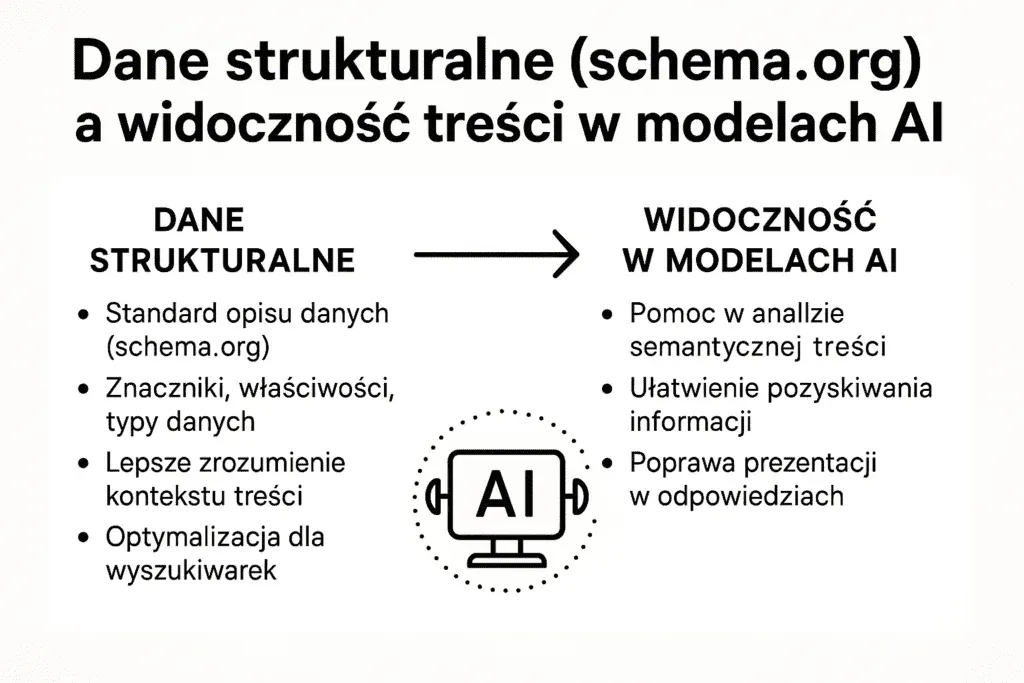
Key types of structured data that increase content visibility in AI
### Schema Article
Schema Article is the basic type of structured data for any blog, educational, industry, or expert content. Its job is to unambiguously state that a given page contains an article, meaning an informational piece written by a specific author, published by a specific brand, at a specific time and in a specific context.
**Thanks to Article, AI models can recognise the nature of the publication and link the author to the organisation**. This is crucial in the context of AI Overviews, which increasingly cite industry and how-to articles from well-described pages.
**In practice, Article-type structured data should include:**
- a title (headline),
- an author (author → Person or Organization),
- a publication date (datePublished),
- and a reference to the article's URL (mainEntityOfPage).
**JSON-LD example:**
```
```
### Schema FAQPage
Schema FAQPage (FAQ Schema) describes pages containing question-and-answer sections. Just a few years ago, it was mainly used to get **rich results in search**, but today it helps AI models **identify content that answers specific questions more quickly.**
FAQPage works great in how-to articles or on offer pages, where the content answers specific user questions. A well-implemented FAQPage **increases the chances that content excerpts will be cited in AI Overviews**, or referenced in the "People Also Ask" box. Only use FAQPage where a question-and-answer section actually exists. Google increasingly checks the consistency between the schema and the visible content; if the schema isn't confirmed in the HTML, it may be ignored.
**JSON-LD example:**
```
```
### Schema Product
Schema Product is a pillar of structured data for e-commerce. Thanks to it, search engines and AI models can recognise: **price, product type, availability, manufacturer, and user reviews.** Language models (e.g. in Copilot or Perplexity) can generate product recommendations based on marked-up data.
AI models analyse this data to match products to user queries ("best coffee set under €70"); a well-described Schema Product increases the chances that your offer will appear in AI results.
**JSON-LD example:**
```
```
### Schema LocalBusiness: the foundation for local businesses in the age of artificial intelligence
For businesses operating locally (clinics, restaurants, salons, law firms, agencies, brick-and-mortar shops), schema LocalBusiness is an absolute basic requirement. Thanks to it, Google, Bing, ChatGPT or Gemini can better link **the company name, address, opening hours and contact details** to a specific real-world location.
It's precisely schema LocalBusiness that helps your brand appear on **Google Maps**, in local results ("near me", "nearby"), and in generative results, which increasingly use geolocation data. A well-described Schema LocalBusiness increases the chance that AI will pick your company as the **answer to contextual queries**, e.g. "marketing agency in Kraków specialising in SEO" or "best hairdressing salon in Kraków open on Saturdays".
**For schema LocalBusiness to work correctly, it must contain several mandatory elements:**
- the company name (name),
- the address (address → PostalAddress),
- the phone number (telephone),
- opening hours (openingHours),
- and, optionally, links to social media profiles (sameAs).
**JSON-LD example:**
```
```
The data in this schema should be **identical** to that in your Google Business Profile (formerly Google My Business). AI can verify the consistency of information across sources.
It's also worth adding geo (geographic coordinates), which makes it easier to link the location to user queries. For businesses with multiple locations, it's possible to implement several LocalBusiness schemas: one for each branch or outlet.
### Schema Organization: how it builds brand trustworthiness and source authority
Schema Organization is one of the most important, yet also most frequently overlooked, elements of structured data. It's precisely what helps Google and AI models **understand who is behind the published content**, who owns the domain, and which organisation is responsible for its trustworthiness.
In the age of artificial intelligence, where generative models learn not just from content but also from a source's reputation, Schema Organization acts as a **digital identity certificate for your brand**. Thanks to it, systems can connect a company name to its logo, headquarters, website, LinkedIn profile, or YouTube channel. As a result, your brand is recognised as a real entity in the Knowledge Graph, which significantly increases the chances of being cited and appearing in so-called entity panels or AI Overviews.
It's also important for the Organization schema to be **linked with other schemas** on the page, e.g. with Article (via publisher) or LocalBusiness (if the company has a local presence). This network of relationships builds the semantic consistency that AI treats as a signal of authority.
**JSON-LD example:**
```
```
When AI models process content, they often analyse "trust sources". Pages with complete Organization data can be treated as **trustworthy authorial sources**, which can directly affect visibility in generative answers. In practice, it's precisely thanks to Schema Organization that brands appear in AI Overviews alongside the names of experts and industry publications.
## Implementing structured data: practical tips and best practices
### JSON-LD, Microdata or RDFa: which format should you choose, and why?
Before you start implementing structured data, it's worth understanding that schema.org isn't a single standard, but **a collection of definitions that can be implemented in different technical formats**. The most popular of these are **JSON-LD, Microdata** and **RDFa**. All of them let search engines understand a page's structure, but they differ in how they're implemented, their flexibility, and their resistance to errors.
### JSON-LD: recommended by Google and the easiest to maintain
JSON-LD (JavaScript Object Notation for Linked Data) is now the **industry standard**, officially recommended by Google and the biggest search engines. Its biggest advantage is that the data is **separate from the HTML content**: you add it as a single code snippet (usually in or at the end of ), which makes it easy to update, test, and roll out at scale.
JSON-LD works great in dynamic environments (WordPress, Shopify, Webflow, React, Next.js), where the front end is often modified. Thanks to its independence from HTML structure, even major changes to a page's appearance don't affect how the markup works.
### Microdata: good to start with, but hard to maintain
Microdata was popular back when pages were static and structured data was marked up **directly within the HTML content**. In this format, information is added through the itemprop, itemscope and itemtype attributes, meaning you literally "wrap" text fragments in semantic tags.
Although this can be a convenient solution for small sites, on larger projects (especially with a modern front end or components) Microdata becomes hard to maintain. Any change to the HTML structure can break the data, and debugging errors is more time-consuming than with JSON-LD.
### RDFa: for advanced semantic projects
RDFa (Resource Description Framework in Attributes) is the most flexible and precise way of recording structured data, used mainly in large research, educational, or encyclopaedic projects. It lets you create very complex relationships between entities and refer to multiple contexts at once. In business practice, though, such as SEO for companies or e-commerce, it's relatively rare, because implementing it requires a high level of precision and knowledge of RDF semantics.
## How to check schema correctness in Google Rich Results Test and Search Console?
Implementing structured data is only the first step. The next one, equally important, is **validating that the Schema is correct**. Errors in the JSON-LD structure, typos in field names, missing required attributes, or inconsistency with the actual content can cause structured data to be **completely ignored** by Google and AI models. That's why every piece of Schema you implement should be tested.
### 1. Google Rich Results Test: a basic verification tool
The simplest and most intuitive way to check whether your schema is correct is the [**Google Rich Results Test**](https://search.google.com/test/rich-results?hl=pl) tool. It lets you check both a single URL and a snippet of JSON-LD, Microdata, or RDFa code.
**How it works:**
- You paste in a link to the page, or the markup code.
- Google analyses the data and indicates which schema types were recognised (e.g. Article, FAQPage, Product).
- You get a report containing **errors** and **warnings**.
**Errors** are elements that prevent the data from being correctly understood (e.g. a missing name field in Product). **Warnings** don't block the schema from working, but tell you that optional, recommended fields are missing (e.g. a missing aggregateRating).
This tool has a huge advantage: you can paste in your code **before you even implement it on the page**, so you immediately know whether the schema is correct and ready to publish. The validation results also show whether the data qualifies for **Rich Results**, which indirectly confirms that the markup was correctly recognised by Google's systems.

Google Search Console: analysing implemented data in practice
### 2. Google Search Console: analysing implemented data in practice
After implementing your schema, it's worth going to **Google Search Console (GSC)**, which monitors the structured data implemented across your whole domain. In the **"Enhancements"** section, you'll find separate reports for different data types, e.g. FAQ, Product, Article, Breadcrumb, LocalBusiness, and so on.
**The GSC report shows:**
- the number of pages with valid data,
- the number of pages with errors,
- the number of pages with warnings,
- and the trend of changes over time (whether errors are increasing or decreasing).
This lets you track whether your implemented schema works correctly, and whether front-end updates have introduced any new errors. It's worth remembering that errors don't always appear in GSC immediately; sometimes Google needs a few days to re-index the page and update the report.
If you see warnings in GSC but no errors, don't panic. These are just optimisation suggestions, not a reason to reject the schema. Errors, on the other hand, need to be fixed, because they can cause the data not to be analysed by Google's systems or by AI models.
### 3. Alternative tests and manual inspection of the page code
**Besides Google's official tools, it's also worth using:**
- [**Schema Markup Validator**](https://validator.schema.org/): checks compliance with the schema.org standard,
- **Ahrefs / Semrush / Screaming Frog**: for automatically detecting and auditing schema on large sites,
- **Manual inspection of the page source** (Ctrl+U / Ctrl+F → "ld+json")
## What are the most common mistakes when implementing schema.org, and how do you avoid them?
Many marketers and developers assume that if their structured data passes validation in Google's tools, everything's fine. Unfortunately, that's **only half the truth**. Google's Rich Results Test only confirms technical correctness, not **whether the data makes sense, is consistent with the content, and is useful for AI models**. As a result, many pages with schema.org implemented still don't gain visibility in results or appear in generative answers. So let's look at the most common mistakes and how to avoid them.
### 1. Lack of consistency between the schema and the page's actual content
This is the most common, and also the most serious, mistake. Structured data has to fully reflect the content visible to the user. If the Product schema shows a different price from the one on the page, if the LocalBusiness schema has a different address than the footer, or if the FAQ contains questions that physically aren't in the content, Google treats this as semantic manipulation.
To avoid this mistake, it's worth generating structured data from the same sources as your content, e.g. directly from your CMS, database, or API. After implementation, always compare the markup with the HTML code (e.g. in the page's source view) and make sure the schemas complement the content rather than trying to replace it.
### 2. Duplication or overlap of schema types
This problem is especially common among users of automated SEO plugins such as Yoast, RankMath, or SEOPress. These tools often automatically generate Article, WebPage, or BlogPosting data, which leads to conflict and duplication. In such a situation, Google picks one of the types at random, ignoring the rest, causing the page to lose semantic context. To avoid this, remember that a single page shouldn't have two Article schemas or two Organization schemas.
### 3. Using outdated or incorrect properties
Schema.org is constantly being updated, so using old fields or the wrong types can lead to search engines and AI models misinterpreting your data. Many companies still use properties that have been retired or replaced with new ones. To avoid this, it's worth regularly checking the current schema.org documentation, especially the Pending Schemas and Deprecations sections, and using Google's official examples. Every schema you implement should be tested in the Rich Results Test tool before it goes live on the page.
### 4. Placing too many schemas on a single page
Some people try to increase visibility by adding as many schema types as possible to a single page, which leads to semantic chaos. Google prefers a clear, single-track context; for example, an article page should have one main Article schema, not a mix of Article, Product, FAQPage, and Event. Best practice is to choose schemas according to the page's purpose: Article for a blog, Product or Service for an offer, and LocalBusiness for a location page. If you need to combine different contexts, do it through links between pages, not within a single schema.
### 5. No updates after content changes
Schema isn't a "set it and forget it" element. Changing an article title, a product name, a company address, or opening hours requires updating your structured data. Outdated schemas are a signal of low quality, and in extreme cases can be treated as an attempt at manipulation. Every content change should automatically involve updating the relevant schema.
## How does structured data support local SEO and e-commerce?
Implementing structured data (schema.org) is a way to help increase visibility, trustworthiness, and conversion in AI-based search. A well-prepared Schema can not only help your page's content be better understood, but also make it stand out in results, both classic and generative (AI Overviews, voice search, Copilot, Perplexity).
### Benefits for local SEO
- **Greater visibility in local results and on Google Maps**: schema LocalBusiness helps link the company name, address, opening hours, and location to a real-world place.
- **Brand trustworthiness in AI's eyes**: consistent data (on the page, in your Google Business Profile, on social media) confirms the company's identity and increases AI models' trust.
- **Presence in voice results and AI Overviews**: well-described data makes it easier for AI to recommend your company in response to queries like "nearest beauty salon open now".
- **Better matching to user queries**: schema helps AI understand what you do and who you offer your services to, which improves result relevance.
### Benefits for e-commerce
- **Higher CTR thanks to rich snippets**: stars, prices, product availability, and reviews make Google results more attractive, which can translate into a higher click-through rate.
- **Higher conversion thanks to user trust**: data on ratings, brand, and product availability builds trustworthiness and influences purchase decisions.
- **Better visibility in AI recommendations**: generative models may be more willing to cite and recommend products with complete Product, Offer, and Review schema.
- **Ranking niche brands**: even smaller shops can compete with big platforms if they provide AI with complete, correct structured data.
## How do you avoid inconsistent entities and semantic errors?
Entities are the basic "units of meaning" that AI models work with. Every company, product, person, or place is a separate entity, and each of them should be unambiguously described. The problem arises when data about a brand is **scattered, inconsistent, or contradictory**.
**Example:**
- On the page, the LocalBusiness schema gives the address "ul. Piękna 12" (ul. is Polish for street),
- the page footer shows "ul. Piękna 11",
- and the Google Business Profile shows "ul. Piękna 10".
For a human, this is a trivial detail. For AI, it means **three different entities**, and therefore three potentially different companies. As a result, the system doesn't know which piece of information to treat as true.
**To avoid these mistakes, remember to:**
- unify the company name, address, NIP (the Polish tax ID number), phone number, and URLs across all platforms, such as your website, Google Maps, LinkedIn, industry directories, or social media,
- use the same information across all your company's data to maintain full consistency between sources,
- prepare a separate set of structured data for each location, instead of duplicating the same information for different branches,
- regularly update your data after every change of address, rebrand, or relocation of your headquarters, to avoid inconsistencies in how search engines and AI models interpret your brand.
AI works logically, not intuitively. If something isn't unambiguous, **it treats it as an unreliable source.**
### Building source authority through structured data and semantic linking
Authority in the context of AI isn't just about the number of links, but about **the semantic linking of entities**. This means that if your page, author profile, company, and product are logically connected in schema.org, AI sees this as a **coherent knowledge network**, not a collection of random information.
Language models build what's known as a knowledge graph: a network of connections between concepts, brands, and people. The more consistently your ecosystem is described, the greater the chance that AI **will understand your brand as a trustworthy source of knowledge** and will cite your content in generative answers.
## Frequently asked questions about structured data and AI visibility (FAQ)
### Does schema.org affect rankings in AI Overviews?
Content with well-implemented schema.org can be **cited more often in AI Overviews**, because models can interpret it more easily, assign it to the right entities, and rate it as a trustworthy source.
### Should every page have a FAQPage section?
Not every page, but every page that answers user questions should. Schema FAQPage works best in educational, offer, or how-to content where **questions and answers** actually exist. If you add FAQPage where there's no actual content in question form, Google may consider the data **schema abuse** and ignore it.
### Can incorrect schema harm content visibility?
Errors in schema (e.g. missing required fields, inconsistency with the content, outdated data) can cause **the entire markup to be rejected by Google**. What's worse, recurring technical errors can lower a site's trustworthiness in the context of AI, which interprets such data as an "unreliable source".
Example: if the Product schema gives a price of €59, but the page shows €49, the AI model will consider the data inconsistent and skip the page when generating recommendations. That's why, after every implementation or content update, you should validate the schema using the **Google Rich Results Test** tool and verify it in **Search Console**.
### Is an llms.txt file mandatory?
The **llms.txt** file is an experimental standard being worked on by, among others, OpenAI and Google, to let website owners decide **whether their content can be used to train language models**.
It's worth following its development, because over the next few years llms.txt may work alongside structured data, specifying **which pieces of knowledge can be indexed and cited by generative models.**
### Does structured data affect CTR?
Rich Snippets (stars, prices, FAQ, product availability) can improve the CTR (click-through rate) of a given search result.
## What's worth remembering: structured data as a bridge between SEO and AI
Structured data has become a pillar of visibility in the modern search ecosystem. Today, schema.org is **not an option, but a requirement** for any brand that wants to be understood by search engines and AI models. Correctly implemented schemas, such as Organization, Article, Product, LocalBusiness, or FAQPage, create a semantic knowledge network, thanks to which your brand stops being an anonymous page on the internet and becomes a **recognisable unit of knowledge**.
The key to success is **data consistency**. AI doesn't trust sources that give contradictory information. If your schema, social media profiles, and content speak with one voice, you build digital trust. One address, one name, one logo, one brand identity. In the world of generative artificial intelligence, it's precisely **entity consistency that is the new currency of trust**.
Over the next few years, schema.org will become an integral part of how AI understands the world. Language models don't read content the way people do; they **learn from relationships**. If your page is logically described, consistent, and semantically linked, you become part of the global knowledge ecosystem. This is no longer just a fight for a position on Google; it's **a fight to be understood by artificial intelligence**.
## Take care of your visibility in the age of AI
If you want your brand to be visible, understood, and cited by artificial intelligence, start with the fundamentals. At JustIdea, we help companies implement structured data, build semantic consistency, and increase visibility in AI results.
## Check out these too
- [How often should you analyse SEO content?](https://justidea.agency/en/blog/how-often-update-seo-content/)
- [What is PrestaShop? A complete guide](https://justidea.agency/en/blog/what-is-prestashop-complete-guide/)
- [Topical relevance: the secret to an effective content marketing strategy](https://justidea.agency/en/blog/topical-relevance-content-marketing-strategy/)
- [How to rank your Google Business Profile?](https://justidea.agency/en/blog/how-to-rank-google-business-profile/)

Written by
[Wojciech Wabno](https://justidea.agency/en/author/wojciech-wabno/)
SEO Specialist
Have a question about this article? Write to us.
Want this in your business
## Let's turn this knowledge into results in your store
30 minutes about your numbers. The call starts with someone from sales, and we bring in the channel specialist once we get into the details. The call is free of charge.
Book a call about your numbers [See how we do SEO](https://justidea.agency/en/services/marketing-agency/positioning-seo/)
Client reviews
## Ratings of the agency that runs this blog
Clients gave them after working with us, and you can read each one on the site where it was posted. They cover the work of the whole agency, not this one article.
4.96 / 5
weighted average of 224 reviews across three platforms
[Read the reviews](https://justidea.agency/en/justidea-reviews/)
[
4.97 / 5
156 reviews on our Google Business Profile](https://www.google.com/search?q=JustIdea+Agency+Krak%C3%B3w+opinie)[
5.0 / 5
33 reviews on our Facebook page](https://www.facebook.com/justidea.agency/reviews)[
4.9 / 5
35 B2B reviews, each verified in a call with the client](https://clutch.co/profile/justidea-agency)
Statuses awarded by the platforms: PrestaShop Expert ★★★, Google Premier Partner 2025, Meta Business Partner, Microsoft Advertising Elite Partner 2025. [All certificates and awards](https://justidea.agency/en/our-awards/)
Read on
## See also
[SEO 20 May 2025 What is on-page SEO? Wojciech Wabno](https://justidea.agency/en/blog/what-is-on-page-seo/)[SEO 5 May 2025 Does Internal Linking Matter for SEO? Wojciech Wabno](https://justidea.agency/en/blog/internal-linking-seo-guide/)[SEO 28 April 2025 SEO for AI Overview Łukasz Zontek](https://justidea.agency/en/blog/ai-overview-seo-how-to-rank/)
Contact
## A conversation about your numbers: 30 minutes
The call is led by a new business specialist. When we get into the details of an account, the specialist for that channel joins in. We reply within one business day.
A quick review of your tracking and campaignsThree priorities for the next quarterA written summary that stays with you
Before the meeting we review your website, your visibility and what your campaigns show from the outside. We will not open with “so, what does your company do?”.
[4.96 224 reviews](https://justidea.agency/en/justidea-reviews/)
What happens after you send it
01
within 1 business day
### We reply to your email
The reply comes from the same new business specialist who will run the call. No qualification form and no call from an unknown number.
02
this week
### A 30-minute conversation
We go through your numbers and your questions. If it turns out we are not the right fit, we will tell you straight away.