














The value of the whole process depends on how you turn the information you've gathered into insights, decisions and actions.
That's why it's best to treat Perplexity as an AI-based tool that supports the analytical stage. It helps you reach sources faster, compare competitors' messaging, spot changes in the market, collect the voice of the customer and check whether an idea that looks good in a presentation is really backed by data.
In this article we'll show you how to work through this process step by step: from defining the business problem, through analysing the market, competitors and audiences, to positioning, choosing channels and turning the information you've gathered into specific marketing decisions.
In short
- Use Perplexity mainly for research: gathering, comparing and synthesising information from many sources. You still build the strategy on business goals, your own data and what the company can do.
- Don't start by asking “create a marketing strategy for me”. First define the decision you want to make, and only then build a series of precise queries about the market, competitors and customers.
- Verify every important conclusion from Perplexity in the source. A cited document doesn't automatically mean the data is current, methodologically sound and relevant to your situation.
How does Perplexity work and what role does it play in marketing?
Perplexity AI is an innovative search engine that uses artificial intelligence and combines finding information with analysing and synthesising it. Instead of only listing search results, the tool prepares an answer to your question based on the materials it finds and cites the sources it uses. For more complex tasks you can work in modes such as Pro Search and Research. According to the Perplexity documentation, Pro Search runs a multi-step search, draws on different types of sources and lets you continue the work with follow-up questions. Pro users can also choose which AI model Pro Search runs on. The options include advanced language models, among them GPT, Claude and Gemini models, and Perplexity's own model, Sonar. Research mode (formerly Deep Research) is used for deeper analysis of complex topics and for preparing extensive reports. It usually takes a few minutes.
In digital marketing, what matters more than the mechanism itself is how it changes everyday analytical work. When you want to check how competitors position their offer, you don't have to open dozens of pages and copy every message into a spreadsheet by hand. You can ask the tool to find specific information, ask it to point to the sources, and then check for yourself the materials the answer is based on.
If you're only just starting with Perplexity, we've already described the basic features in a separate article, What is Perplexity AI? Features and uses. Here we focus only on using Perplexity AI in strategic work.
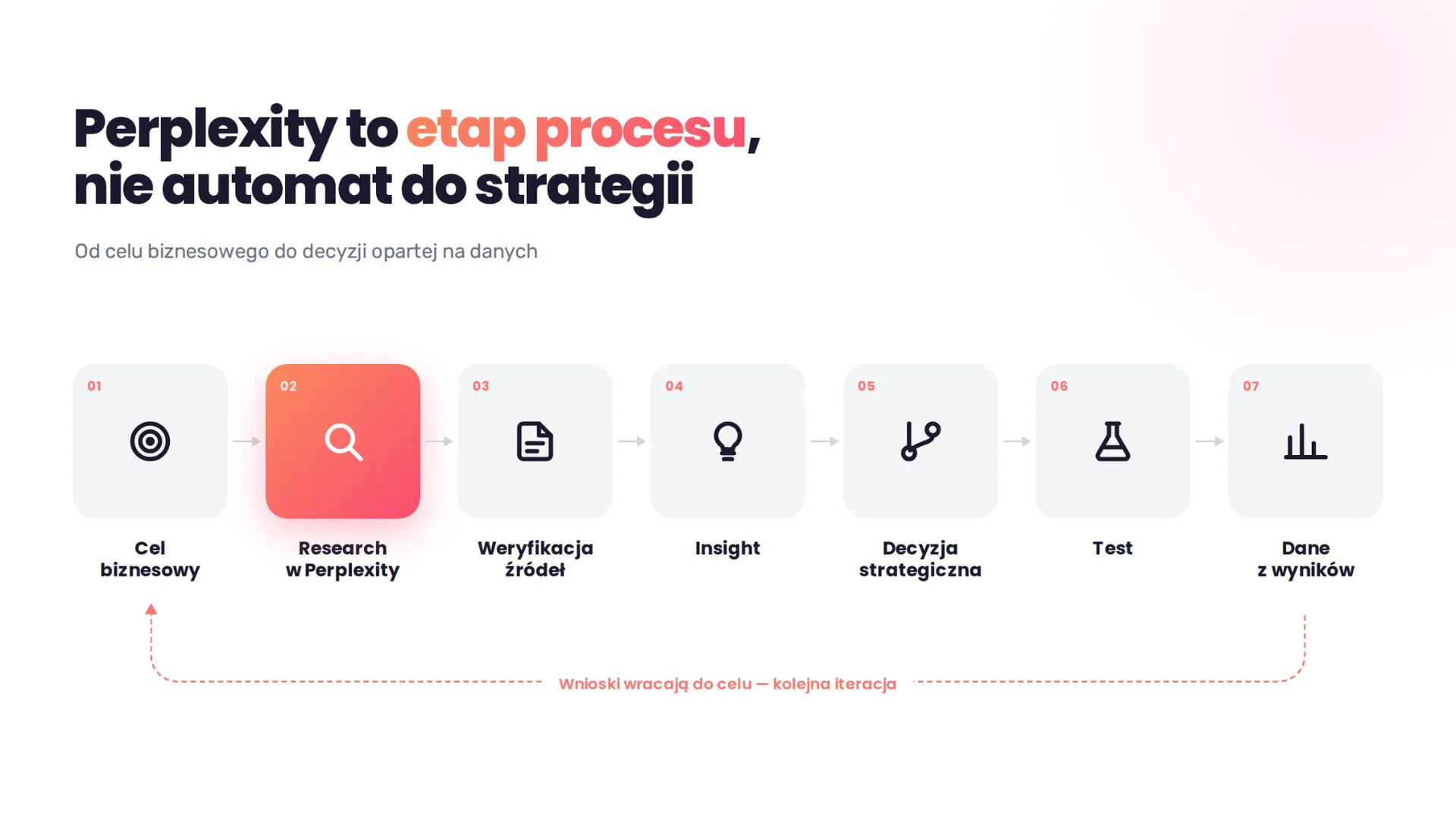
Before you start using Perplexity, define the decision you want to make
The most common mistake happens before the first search. You open Perplexity and type: “Analyse the cosmetics market in Poland” or “Create a marketing strategy for a SaaS company”. The answer will probably be long, neatly formatted and not very useful.
The problem is in the question. “Market analysis” doesn't say what decision you need. Is the company considering entering a new category? Does it want to change its positioning? Is it looking for a customer segment that competitors don't serve? Is it planning a campaign? Does it need to decide whether to invest in SEO, LinkedIn, Google Ads or industry events?
The more precisely you define the decision, the easier it is to plan the information gathering.
Instead of asking:
“Analyse the CRM software market in Poland.”
write:
“I'm preparing a strategy for entering the Polish market with a CRM tool for service companies employing 10 to 50 people. I want to establish whether there is room to position the product around ease of implementation. Identify the most important competitors, their main promises, customer groups, how they communicate the implementation process and the problems users mention most often. Focus on materials from the last 12 months and give sources for every important conclusion.”
The second query has a clear purpose: it tests a specific positioning hypothesis. Keep this approach throughout the process.
How do you use Perplexity to analyse the market?
Market analysis should give you the context in which the company operates. You don't need an encyclopaedia of the industry, though. You need information that changes decisions.
Check how the category is developing, which segments are growing, what changes are happening in customer behaviour, what barriers limit purchasing and what external factors could change the company's situation. In one industry it will be a legal regulation, in another a technological change, rising advertising costs, a new distribution model or the emergence of a new product category.
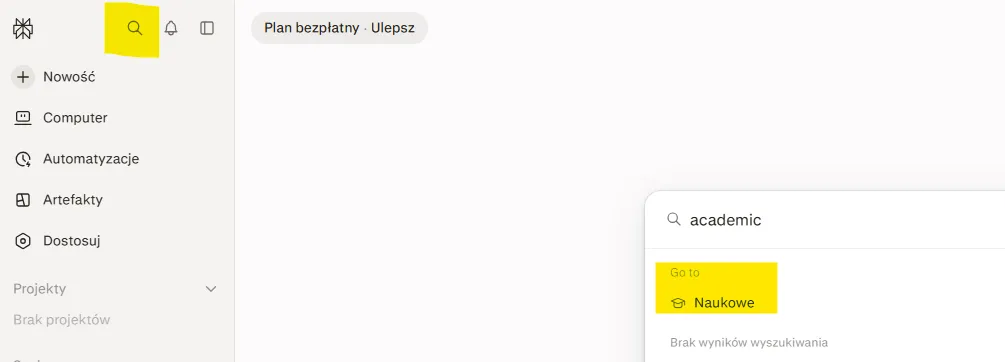
Perplexity searches the internet with every query, so it gives you access to the latest publications and current data. It's especially useful when information is scattered across reports, company websites, industry articles, academic publications and user discussions. At this stage it's worth narrowing the search to a specific type of source. On a personal account you choose it in the search field (e.g. Web, Academic or Finance). On business accounts the “Choose sources” option replaces this feature. This makes it easier to separate hard data from opinion.
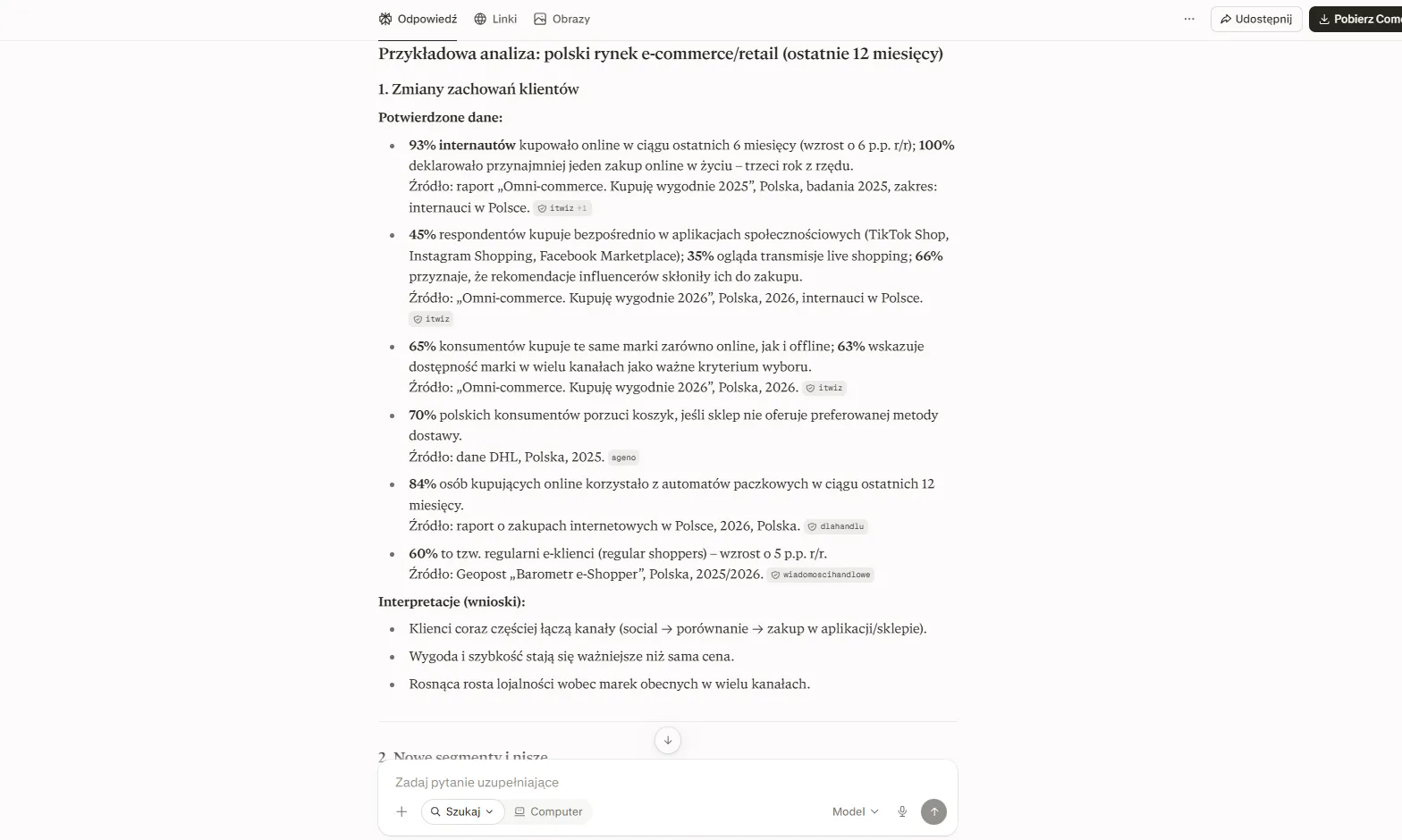
Don't stop at the sentence “the market is growing”, though. Ask what exactly is growing, over what period, in what geographical area, according to whom and using what methodology. In a strategy, “market growth of 15%” is only worth something when you know what the figure refers to.
A good prompt for the first stage might look like this:
“Analyse the most important changes in the Polish [INDUSTRY] market over the last 12 months. Focus on changes in customer behaviour, new segments, purchase barriers, technology, regulations and the actions of the biggest players. Separate confirmed data from interpretation. For every figure, give the source, the period of the study and the geographical scope. At the end, point out which changes may have a direct impact on the marketing strategy of the company [COMPANY DESCRIPTION].”
The last sentence matters most. It narrows the answer down to the changes that matter for your company.
How do you search for trends and tell them apart from passing popularity?
Perplexity is good for finding signals of change, but a topic's popularity alone doesn't mean the company should build a strategy on it.
Suppose interest in a particular content format, product ingredient or technology is rising sharply in your industry. The first answer should trigger further questions: since when has the trend been growing, who is interested in it, which sources confirm the change, does the interest translate into buying behaviour, and how does the trend fit the brand's position.
If a company sells a premium product to a very narrow group of professionals, a viral TikTok trend may have no strategic significance for it. On the other hand, a seemingly small change in the questions specialists type into Google can be a much more important signal, including for SEO.
In practice, assess a trend through three filters: relevance to the customer, fit with the brand and the possibility of turning it into a business result. Only after that check decide whether the trend deserves a place in the strategy.
Competitor analysis in Perplexity: don't look for things to copy
Competitor analysis is one of the most obvious uses of Perplexity. At the same time, it's easy to reduce it to a low-value list: competitor A runs Instagram, competitor B publishes on LinkedIn and competitor C has a blog.
First establish who you really compete with. A direct competitor sells a similar product to similar customers, but a completely different solution can fight for the same budget too. For a project management platform, the competition isn't only another platform. The customer may still work in a spreadsheet, use email or solve the problem by hiring an extra person. If you limit the analysis to companies that look similar, you'll miss some of the real alternatives.
Next, move from channels to positioning. Check who the competitor targets the offer at, which problem it highlights, what it promises, how it justifies the price, what proof it presents and which arguments it repeats most often. Analyse the homepage, landing pages, offer, sales materials, ads (including SEM campaigns), organic content and its positions in Google results, and customer reviews.
This is where Perplexity saves you the most time. You can ask for an analysis of several brands against one set of criteria, and then go to the cited materials and check whether the conclusions match what the companies actually communicate.
“Analyse the five most important competitors of the brand [BRAND] in the [MARKET] market. For each, identify the main target group, the main promise, the customer problems highlighted in the communication, the sales arguments, the price level, the credibility proof used and the dominant channels. Then point out the messages repeated by most competitors and the customer needs that none of the analysed brands addresses clearly. Support every conclusion with a source.”
This way you look for patterns and for the space where the company can say something different from everyone else.
How do you use Perplexity to understand your target group and user needs?
You don't build a strategy for “women 25-44” or “owners of small and medium-sized businesses”. A description like that helps set the scope of the analysis, but it doesn't yet say why someone buys, what blocks the decision and what criteria they use to compare the available solutions.
Good sources of insights are product reviews, comments, forum discussions, FAQ sections, questions addressed to companies and statements from users describing their own experiences. Don't treat them as a representative study of the whole market. Use them to detect patterns that you'll later confirm in other data.
If dozens of people independently describe the same problem, you get a hypothesis. If an industry report, search data and information from your own sales team confirm that problem, you have a much stronger basis for a decision.
So you can ask Perplexity:
“Research the most common problems, objections and selection criteria of customers buying [PRODUCT] in Poland. Use reviews, user discussions, forums, FAQ sections and credible consumer research. For each recurring problem, give example sources. Separate the opinions of individual users from conclusions confirmed across a larger number of materials.”
Information gathered this way is far more useful than an automatically generated persona with an invented name, hobbies and a favourite coffee.
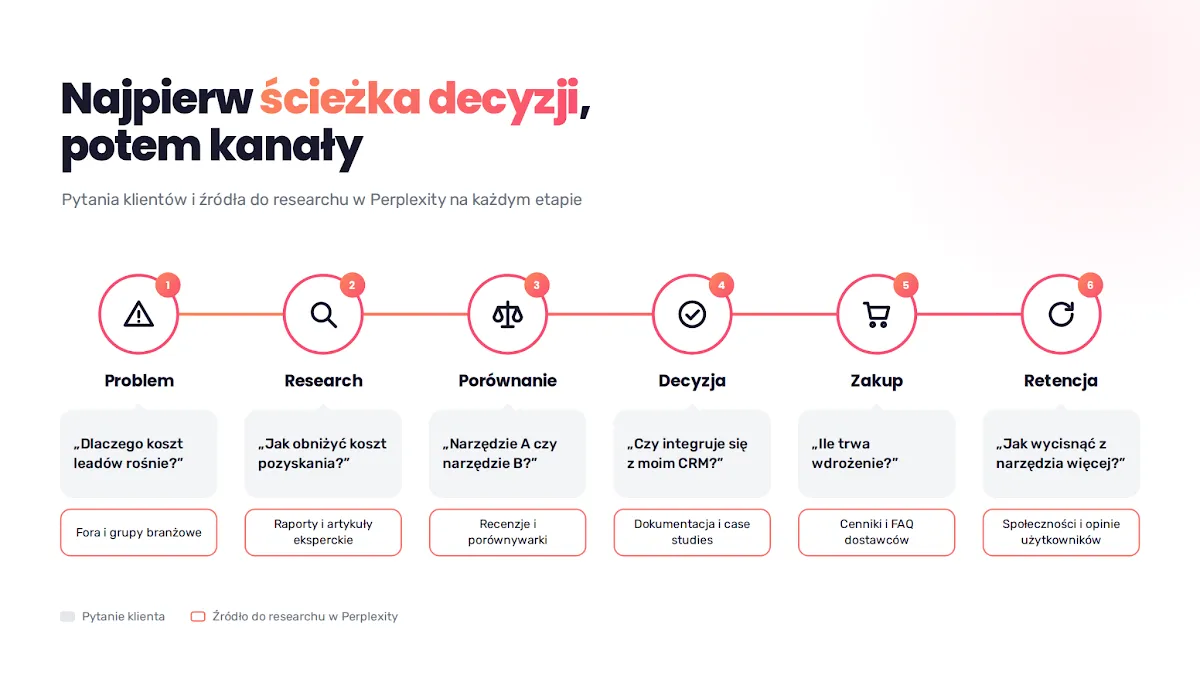
Customer journey: map the customer's path before you choose channels
Once you know the audience, check how they reach a decision. This step is easy to skip, yet it's exactly where you connect customer needs with communication.
A person who has only just noticed a problem looks for different information than a customer comparing two specific offers. In B2B, at the start of the journey the user's question might be “why are lead acquisition costs rising?”, and closer to the decision: “tool A or tool B?”, “how long does implementation take?” or “does the system integrate with my CRM?”.
Use Perplexity to collect the questions, concerns and information sources typical of each stage. Then confront this data with information from Google Search Console, your CRM, sales conversations, the on-site search, recordings of customer calls or campaign data.
This way you stop planning channels in isolation from how decisions are made. You don't ask “should we be on TikTok?”, but “where does our customer look for information at this stage, and what format will help them take the next step?”.
How do you turn Perplexity research into brand positioning?
At this stage you have information about the market, competitors and audiences. Now comes the part that Perplexity shouldn't do on its own: deciding what the company wants to stand for in the market.
An advantage appears only at the intersection of three elements: a gap in competitors' communication, a real customer problem and a quality your company actually delivers. If one of them is missing, you don't have an advantage yet, only a hypothesis.
Example: from research in Perplexity to a strategic decision
Suppose a company offers a CRM system for small service businesses and wants to increase its market share. The team initially assumes that the best differentiator will be a large number of automations.
But competitor analysis in Perplexity shows that most of the biggest players already communicate automation, integrations and a rich feature set very strongly. In this part of the market it's hard to build a distinctive position purely on the number of capabilities.
The next stage is analysing customer opinions. Reviews and discussions regularly mention long implementation, complicated configuration and difficulty persuading the sales team to use the CRM. The company's sales department confirms the same pattern: prospects ask not only about features, but also about implementation time and training.
The company checks its own data. Its average implementation time really is shorter than that of the solutions it's most often compared with.
What matters is where the conclusion came from: the Perplexity search revealed the problem, the company's own data confirmed its ability to solve it, and the competitor analysis showed an open communication space.
Only then does the strategic decision emerge: fast implementation and easy adoption of the tool by the team becomes one of the main pillars of communication. Instead of rebuilding the brand straight away, the company tests the hypothesis on a landing page and in a campaign, measures lead quality and the conversion rate, and then decides whether the argument deserves a bigger role.
The key step: how do you move from a Perplexity answer to a marketing decision?
This is where analysis turns into action, so it shouldn't end with a file containing 40 pages of information. Every significant observation must pass through a filter: “what does this information change?”.
A simple working table will help:
| Conclusion from the analysis | What the conclusion rests on | Strategic decision | Actions to test | Metric |
|---|---|---|---|---|
| Customers often worry about long implementation | reviews, competitors' FAQs, sales conversations | ease of implementation becomes one of the main arguments | a landing page showing implementation step by step | CVR / number of enquiries |
| Competitors mainly communicate the number of features | offer pages of the 5 main brands | we don't compete on the number of features | communication focused on how quickly the result is achieved | CTR / CVR |
| The number of questions about integration with tool X is growing | forums, search engine, support data | integration becomes part of the communication | a guide + an integration landing page | traffic / leads |
| Customers compare offers for a long time before buying | sales questions, competitors' content, CRM data | we strengthen the offer-comparison stage | a comparison of solutions and a case study | assisted conversions |
With a structure like this you'll immediately see the difference between information and a decision. “Competitors publish a lot on LinkedIn” is an observation. “Our target group uses LinkedIn when comparing suppliers, so we're testing expert content there to support the consideration stage” is already a strategic hypothesis that you can check.
Marketing communication: plan it only after the research
If you start by generating posts, ad slogans and campaign ideas, Perplexity will very quickly produce hundreds of proposals. The problem is that without prior analysis you don't know which of them make sense.
Communication should follow from decisions about the customer and positioning. First establish which problem you solve, how you differ from the alternatives and what the customer needs to learn to believe your promise. Only then move on to tone of voice, arguments, content formats and CTAs.
Perplexity is useful here for comparing the language used by competitors and by customers. If every brand in the industry promises “innovative solutions tailored to your needs”, you have a clear signal that copying this language won't make the company stand out. If customers describe their problem in completely different words, their language gives you a better starting point for communication.
How do you choose marketing channels with Perplexity's help?
A channel should serve a specific function on the customer's purchase path. A platform's popularity alone isn't enough.
Perplexity will help you check where competitors publish, which formats they use, where customer discussions happen and which platforms matter for a given group. Don't treat the answer as proof that a particular channel will be profitable for your company, though. Profitability is decided by data that Perplexity has no access to (we write about it later in the article), so always combine the information you've gathered with your own data.
If Perplexity points to the growing importance of YouTube in your category, but your company has neither video skills nor a production budget, that doesn't automatically mean YouTube should go into next quarter's plan. Strategy is also about consciously giving things up.
Order matters here: first you analyse the situation and goals, then you choose target groups, channels, budget and success measures. Starting from the choice of platform usually leads to a list of activities with no shared goal.
How do you write prompts for strategic work with Perplexity?
A good analysis prompt doesn't have to be long, but it has to define the task clearly. It works best when it includes the business goal, the market, the group under analysis, the period, the criteria, the type of sources needed and the way the conclusions should be presented. Also add an instruction to separate facts from interpretation.
Instead of:
“What are the e-commerce trends?”
use:
“I'm preparing a marketing strategy for a Polish online store in the [CATEGORY] category for 2027. Analyse changes in Polish consumers' shopping behaviour in this category over the last 12 months. Focus on the factors affecting the choice of store, price, delivery, trust, information sources and the use of AI when shopping. Prefer current industry reports, primary data and materials published in the period under study. Give a source for every figure. At the end, separate facts from hypotheses and point out three areas that need further verification.”
A query worded like this limits random information and forces a result closer to the problem you're actually working on.
Another rule is to work iteratively. Don't try to fit the whole strategic process into one prompt. The first answer should lead to further questions, and each subsequent interaction should develop the topic. If an interesting gap appears, dig into it. If the data conflicts, ask for a comparison of the methodologies. If a primary source is missing, ask Perplexity to find it.
How reliable are the answers? How to check the sources Perplexity cites
The visible source is a big advantage of Perplexity, but a citation appearing is not enough on its own. In the Pro Search documentation Perplexity explicitly states that information must be verified in the sources linked in the answer. The algorithm selects the sources for the answer, so don't assume it chose the best materials available.
Every time, check above all whether the source really confirms the sentence the tool wrote. Then assess whether the material is reliable: check the publication date, the period the data covers, the market, the research sample and the author of the material.
This matters especially for statistics. A study of American consumer behaviour from 2024 doesn't automatically describe the behaviour of Polish consumers in 2026. A report from a tool vendor may contain valuable data, but the vendor also has a business interest in presenting a particular problem. Comments from Reddit help you learn users' language and experiences, but they don't tell you what percentage of the whole market shares the same opinion.
For important decisions, confirm a conclusion in several independent, credible sources and go to the primary source. If an article cites a study, open the study. If a blog refers to data from a public authority, go to the authority's data. If Perplexity gives a number with no clear origin, don't carry it into a strategy or a client presentation.
Equally important is separating facts from interpretation. A fact might read: “the brand published 18 video items in three months”. The sentence “video is the brand's most important channel” is already an interpretation. To reach that conclusion you need additional data.
Perplexity doesn't know the data that really decides whether marketing pays off
The public internet shows only part of a company's reality. Perplexity will see a competitor's website, an ad, a press release, a job posting, a report, a review or a YouTube video. It won't see the competitor's customer acquisition cost, campaign profitability, actual budget, product margin, lead quality or the internal reasons behind a particular decision.
This matters because a competitor's attractive activity doesn't have to be effective. A company can run a loud campaign that generates a large reach but doesn't translate into sales. It can invest heavily in a channel it will abandon completely in six months.
Exactly the same applies to your company. Perplexity doesn't know the information in your CRM, order profitability, the results of cohort analysis, call centre data, operational problems or board decisions, unless you provide the right context. So don't build a strategy on external data alone.
The best way of working combines three layers: market data, the company's own data and tests. Perplexity speeds up the first very well. It doesn't replace the other two.
Perplexity, Google or ChatGPT: which to use when working on strategy?
Don't treat Google search and AI-based tools as substitutes where you have to pick one.
Google remains useful when you want to browse the results yourself and reach specific pages directly. Perplexity, as an AI search tool, speeds up information gathering when you need a synthesised answer built on many materials and want to move quickly between follow-up questions. ChatGPT works well for further work on the material: organising assumptions, analysing data you provide, preparing communication variants or developing hypotheses.
The boundaries between these tools shift with each new feature, so a simple split into tools that “have the internet” and those that “don't” quickly goes out of date. It's better to match the tool to the task: where you need to find sources, where to verify them, where to put data side by side and where to work through a conclusion.
The most common mistakes when using Perplexity for marketing strategy
- Treating the answer as a ready strategy instead of material for a decision.
- Questions that are too general, with no business goal and no company context.
- Analysing only direct competitors.
- Carrying trends into the strategy without checking the fit with the brand and the customer.
- Citing data without opening the primary source.
How do you use Perplexity after the strategy is ready?
Analytical work doesn't end on the day the presentation is approved. The market changes all the time: new competitors, products, messages, customer questions and technology solutions appear.
You can use Perplexity to check the strategy's key assumptions periodically. If the positioning rests on a specific market gap, check whether competitors have filled it. If the strategy uses a fast-growing trend, monitor whether the growth continues. If an important advantage of the company is a particular argument, watch whether customers still give it the same weight.
You don't have to change the strategy every month, though. It's enough to update regularly the knowledge it's based on. Gathering information then becomes part of ongoing market monitoring (market intelligence), not a one-off project before writing a document.
It's worth running analyses for a single brand or client in a separate project in Perplexity (the Projects feature). Searches and files are then in one place and easy to return to at the next update.
Perplexity speeds up research. You still build the strategy
The greatest value of Perplexity in strategic work is shortening the road from a question to materials that help you make a decision.
You can check the market faster, find competitors, compare their communication, collect the voice of the customer, reach studies and notice patterns that are easy to miss when browsing pages by hand. This leaves the marketer more room for work they shouldn't delegate to a tool: judging the significance of data, understanding the company's context and choosing what the company will do and what it will consciously not do.
So the simplest rule is this: don't ask Perplexity “what should my strategy be?”. Ask what information you need to make a better decision yourself.
FAQ: Perplexity in marketing strategy planning
Can Perplexity create a whole marketing strategy?
Perplexity will generate the structure of a strategy and proposed actions, but such a document won't replace a strategy built on business goals, company data, team capabilities, budget and verified information. You'll get the most from the tool by using it to gather and analyse the information needed to make decisions.
How do you use Perplexity for competitor analysis?
Start with a specific set of criteria: target group, positioning, main promise, prices, offer, sales arguments, channels and customer reviews. Ask for sources for every significant conclusion, then open the competitors' materials and verify the interpretation. Finally, look for recurring patterns and unmet customer needs.
How do you use Perplexity to research a target group?
Focus on customers' problems, motivations, selection criteria, objections and language. Analyse different types of sources and set the data found online against information from your own CRM, sales, customer service and analytics. Use public comments and reviews to detect hypotheses, not to define the structure of the whole market.
Can you trust the information from Perplexity?
Check every important conclusion in the source. Pay attention to the date, the author, the methodology, the market and the period covered by the study. Perplexity itself recommends verifying information with the materials linked in the answer.
Is Perplexity suitable for planning content marketing and SEO?
Yes. You can use it to collect audience questions, analyse the topics competitors cover, find sources and identify areas insufficiently covered in existing materials. It's also useful in SEO work, e.g. for collecting the questions users ask at a given stage of the purchase path. The content plan itself should follow from marketing goals, the needs of the target group and the role of content on the customer path.
Is the free version enough, or is it worth buying a Perplexity Pro subscription?
According to the Perplexity Help Centre (as of October 2026), the free version gives limited access to Research mode, and the Pro subscription extends it. With regular strategic work you can reach the limits quickly. Perplexity changes them often and doesn't publish exact numbers, so check the current terms on the help page before deciding.
Does Perplexity have a mobile app?
Yes. You can use Perplexity in the browser, in the mobile app and in the Mac app. Research mode is available in all of them, so you can finish an analysis started on a computer on your phone.