












What is link building and why does it matter for SEO?
Link building is the process of acquiring hyperlinks from other websites to your own site. It's one of the key elements of SEO, because external links help increase a site's visibility in search results, strengthen domain authority, and can influence traffic to the site.
In SEO in 2026, AI systems that analyse domain authority, content quality, and the credibility of linking sources are also becoming increasingly important. That's why effective link building should be based, above all, on valuable, topically relevant, and naturally acquired external links.
Strong, good SEO links: rules for building a link profile
Strong SEO links are those that come from authoritative, trusted, and topically related sites. Links like these carry more weight with search engine algorithms and can significantly improve a site's ranking in search results.
How does AI affect the way links are evaluated in SEO?
Google and AI systems are getting better and better at analysing link quality, domain authority, and source credibility. In SEO, it's not just the number of backlinks that counts, but above all their topical relevance, naturalness, and connection to valuable content.
That's why effective link building should support building brand authority and a site's expertise. In practice, AI can better recognise whether a link was placed naturally in the context of valuable content, or whether it's part of an artificial linking scheme.
That's why it's worth acquiring links from topically related places that are well regarded by users and that support your site's genuine expertise.
Key metrics and link profile in a link building strategy
- Source authority: Domain Authority and Page Authority are metrics developed by Moz that assess a site's strength and credibility.
- Topical relevance: links from sites with similar subject matter are more valuable than links from unrelated sources.
- Link diversity: it's worth having links from a variety of sources (domains) rather than many links from one place. It's also worth acquiring links to pages other than just your homepage.
- Anchor text: the text used for linking should be varied and descriptive, including keywords, your brand name, or just the URL.
How to start effective link building and acquire links?
- Link profile audit: before you start actively acquiring new links, it's worth examining your website's current link profile. Using tools such as Moz, Ahrefs, Majestic SEO, or SEMrush, you can get insight into your site's parameters: the number, sources, and quality of your current links. Valuable backlinks can help build brand authority and increase a site's credibility in line with E-E-A-T guidelines.
- Set goals: in the process of building links to your site, it's worth deciding straight away which subpages you want to acquire links for, in order to improve their visibility in Google search results. Or maybe you're focusing on promoting specific blog content? Defining your goals will help point your efforts in the right direction. It's also worth setting aside a budget for SEO activities that will be used solely to carry out your link building strategy.
- Competitor research: analyse where your competitors get valuable links to their site. This can help you identify potential sources for your own site and acquire valuable links to your page.
Regularly monitoring your link profile is key to success. It lets you identify new links, understand which strategies work best, and detect potentially harmful links early on. Your link building strategy should also take internal links into account, since they help Google's crawlers better understand your site's structure and support the flow of authority between subpages.
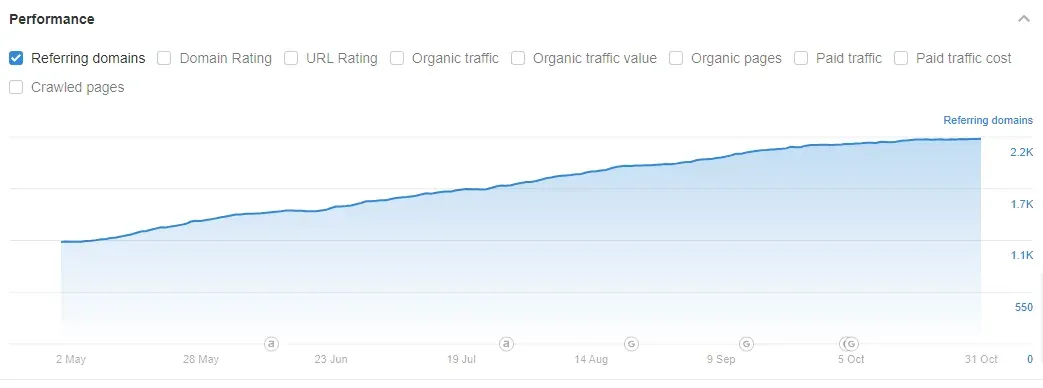
Chart of steady link acquisition from the ahrefs.com tool
Dofollow vs nofollow links: what's the difference?
In a link building strategy, it's worth understanding the difference between dofollow and nofollow links, since both types can serve a different function in your link profile. Dofollow links usually support SEO more strongly, while nofollow links help build a natural linking pattern, generate traffic, and increase brand visibility.
Dofollow links
By default, most links you add to your site are treated as “dofollow” links. This means search engines will follow these links through to other pages.
Dofollow links can pass “link juice” from one page to another. “Link juice” is a metaphorical SEO term that refers to the value and authority a link passes from one page to another. In practice, this means dofollow links can help improve the target page's ranking in search results.
If you want to recommend a site and believe it's valuable for your users, use a dofollow link.
Nofollow links
Nofollow links are those with the rel="nofollow" attribute in their HTML code. This attribute tells search engines not to follow the link or pass “link juice” to the target page.
Nofollow links don't pass “link juice”, so they don't directly affect the target page's ranking in search results. However, they can have an indirect effect on SEO by generating traffic to the target page or increasing brand awareness.
Nofollow links are recommended in certain situations, such as:
- Links in blog comments (to prevent spam).
- Links in adverts or paid posts (to comply with Google's webmaster guidelines).
- Other situations where you don't want to pass authority to the target page (e.g. links to competitors) or don't trust its content.
21 techniques for acquiring backlinks: discover ways to build links
1. Creating valuable content (content marketing)
One of the most effective ways to acquire natural external links is to create valuable content. When you publish original, useful, and interesting material, other sites are happy to link to your resource as a source of information. Offer unique, valuable information that will naturally attract valuable external links.
2. Guest posting and acquiring external links
Guest posting, in other words guest articles. Writing articles as a guest on other blogs or industry sites is another link acquisition method. It's important to choose sites with high authority that are related to your industry: publishing guest posts on other blogs in exchange for a link to your site.
3. Competitor research
One of the most popular methods is checking your competitor's site for links pointing to it. Use link analysis tools to see where your competitors get their links, then take action to get similar links.
4. Participating in online forums and industry communities
Taking part in discussions and sharing knowledge can be a great way to earn links. You can always include a link to your website in such a discussion.
5. Working with influencers
Link building relies on creativity. Influencers, meaning people with a large reach on social media or blogs, can be a valuable source of external links. By working with them, you can ask them to place a link on their site or profile.
6. Link exchange
Exchanging links with other sites related to your industry can be effective, but it's important to do this in moderation and avoid linking schemes that could be seen as manipulation.
7. Broken link building: how to acquire links from broken pages?
This broken link technique involves finding links on other sites that point to pages that no longer exist (so-called “broken” links), then suggesting to those sites' administrators that they replace them with a link to your resource. Tools such as Ahrefs or SEMrush can help you identify links like these.
8. The Skyscraper Technique
The “skyscraper” technique involves finding popular content in your industry, creating an even better version of it, and then reaching out to people linking to the original source to ask them to link to your version instead. Get a link placed on another site in exchange for improving and enriching someone's content: a win-win.
9. Link Reclamation
This involves recovering links that once pointed to your site but were removed for some reason. You can do this by contacting the owners of sites that used to link to you.
10. Take on an article exchange partnership
Article exchange involves writing content for a partner's website that includes a link to your site, and vice versa.
How to do it:
- Get in touch with site owners in your industry.
- Suggest an article topic that will be valuable to their readers.
- Include a link to your site within the article content.
- Publish your partners' articles on your own blog.
11. Publish expert articles, reports, and statistics on your blog
Creating valuable expert content that's unique and unavailable elsewhere attracts readers and encourages linking.
How to do it:
- Conduct industry research and analysis
- Write an article based on unique data
- Promote the content on social media and within the industry
12. Publishing content in online industry publications
High-quality online industry publications often attract many readers, and publishing an article in one can bring in plenty of valuable links.
How to do it:
- Identify the leading publications in your industry.
- Prepare a unique, valuable article.
- Contact the editors or site administrator and propose publishing it.
13. Sponsor an industry event or publication
Sponsoring industry events or publications can be a great way to earn valuable links.
How to do it:
- Choose an event or publication related to your business.
- Offer financial or content support in exchange for linking, meaning a link placed on your partner's site.
14. Partnership collaboration
Working with other entities in your industry, such as suppliers, business partners, or affiliates, can bring mutual benefits.
How to do it:
- Identify potential partners.
- Propose a joint project or initiative involving a link exchange.
15. Speaking at industry conferences
Speaking as an expert at a conference can bring not only recognition but also valuable links from conference websites and industry media.
How to do it:
- Identify the most important conferences in your industry.
- Propose a topic for your talk.
- After the event, make sure the organisers link to your site from the conference materials.
16. Taking part in training sessions
Running training sessions or workshops can be a great way to promote your expertise and earn valuable links.
How to do it:
- Prepare a training programme.
- Pitch it to various training organisers.
- Work with them on promotion and linking.
17. Share your knowledge: create an e-book
E-books are a great source of knowledge and can be used as a tool for earning links.
How to do it:
- Write an e-book on an interesting topic.
- Promote it on social media and industry forums.
18. Publish interviews with experts
Interviews with experts can attract the attention of many readers and generate valuable links.
How to do it:
- Offer an interview to a well-known figure in your industry.
- Publish and promote the content.
19. Use infographics
Infographics are visual representations of information that are easy to share and can attract plenty of valuable links.
How to do it:
- Create an infographic on an interesting topic.
- Promote it on social media and industry forums.
20. Sponsored reviews
Sending products or services to bloggers or influencers for review in exchange for a link. It's an unusual way of building external links, but creativity in SEO pays off well.
21. SEO satellite sites
Creating additional sites or blogs that link to your main site. Satellite sites are still a thriving way to acquire links to your site.
What mistakes should you avoid when building links?
It's worth keeping your link profile as natural as possible. Not all links are beneficial. In fact, some links can harm your SEO and worsen your rankings in search results. It's therefore worth avoiding:
- Acquiring links from low-quality sites: a link acquired this way won't add any value.
- Acquiring links from irrelevant or suspicious sites: links like these can harm your SEO.
Does acquiring links abroad differ from acquiring links in Poland?
Acquiring links abroad can differ from acquiring links in Poland due to differences in language, culture, search preferences, and the specifics of local markets. Here are a few key differences:
- Culture and customs: different countries may have different customs around building relationships and exchanging links. What's acceptable in Poland may be unacceptable, or less effective, in other countries. Understanding cultural nuances is important when building international relationships.
- Search engine algorithms: Google and other search engines may treat links differently depending on the country. For example, Google's algorithm may evaluate links differently in the Polish version of the search engine than in the American or German one.
- Law and regulations: rules on online marketing can vary from country to country. It's worth being aware of local regulations, for example around advertising, personal data protection, or spam.
- User preferences and behaviour: internet users in different countries may use the internet differently, search for information differently, and respond to content differently. Understanding local preferences is key to effective link acquisition.
- Business relationships: building relationships with foreign partners can require extra time and an understanding of business and language differences. In addition, link prices abroad are often higher than in Poland and can vary from country to country, which is also worth factoring in when acquiring links. What's more, for sponsored articles, you also need to add the cost of producing the article in, for example, German.
Link building SEO: a summary of effective link acquisition
Link building is a process. Acquiring external links requires commitment and ongoing work from an SEO specialist. The methods listed above are proven, effective techniques that will help build your site's authority with Google.
Remember, though, that quality should always matter more than quantity: it's better to have a few strong links pointing to your site than hundreds of weak ones. Even the best link building can't replace valuable content, technical optimisation, and a good user experience. Links should support your website's overall SEO strategy. It's worth acquiring links that have a real impact on your site's ranking.
FAQ: the most common questions about link building and acquiring SEO links
Why is link building important for SEO?
Link building matters because a link pointing to your site can increase its authority and affect your website's Google rankings. High-quality links help build a natural link profile and increase your site's visibility.
How do you acquire valuable SEO links?
To acquire valuable links, it's worth creating expert content, working with industry portals, and developing your content marketing. Effective link building relies above all on the quality of links, not their quantity.
What is a natural link profile?
A natural link profile is a diverse set of backlinks coming from different sources and sites. Google favours links from topically related sites and links acquired gradually over time.
What are dofollow and nofollow links?
Dofollow links pass on SEO value and can affect a site's ranking in search results. Nofollow links don't directly pass on authority, but they can still generate traffic and support your SEO efforts.
Do internal links matter for SEO?
Yes, internal links help Google's crawlers better understand your website's structure and support the flow of authority between subpages.
How do you assess link quality?
The most valuable links are high-quality ones from authoritative, topically relevant, and credible sites. The context of the link, the domain's profile, and the naturalness of the overall link profile also matter.
Does a strong external link affect SEO?
Yes, a strong external link from an authoritative site can have a positive effect on your site's rankings in Google search results and increase your site's SEO visibility.
Check out also: