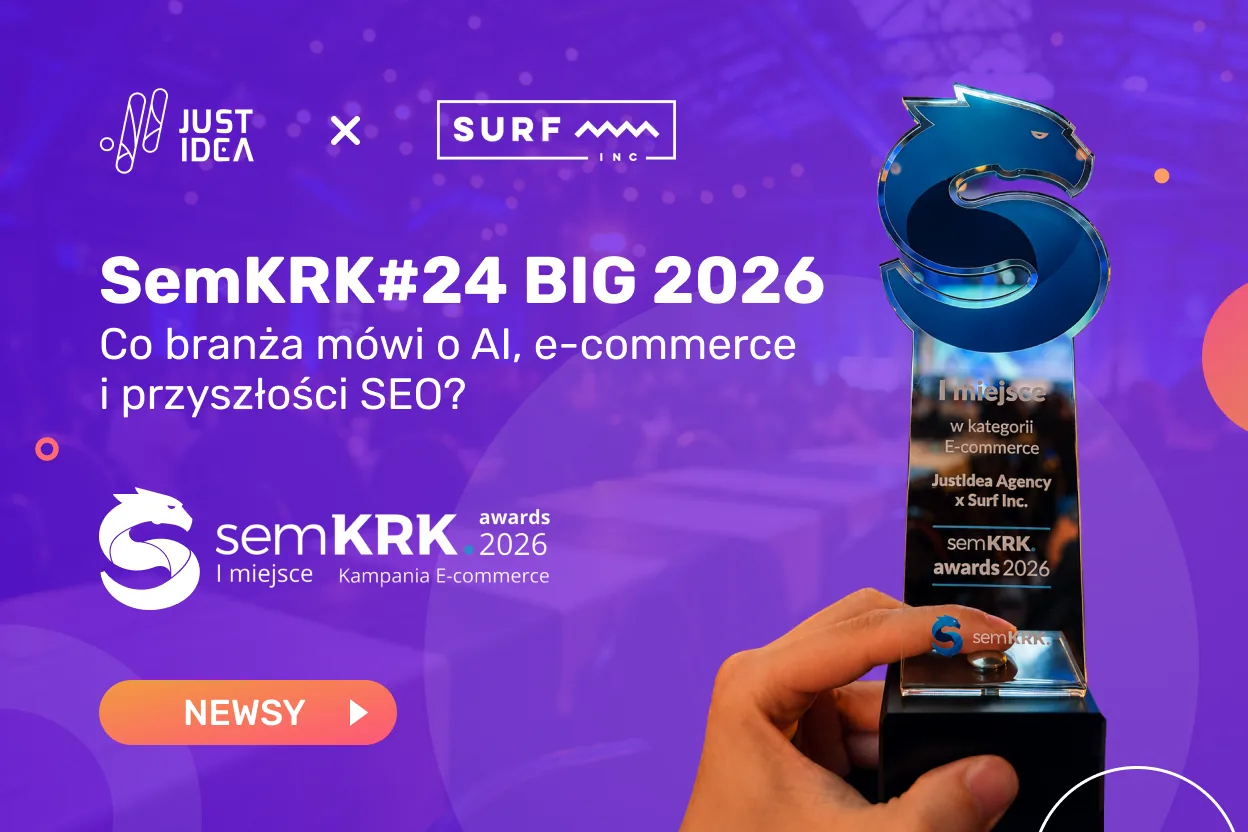










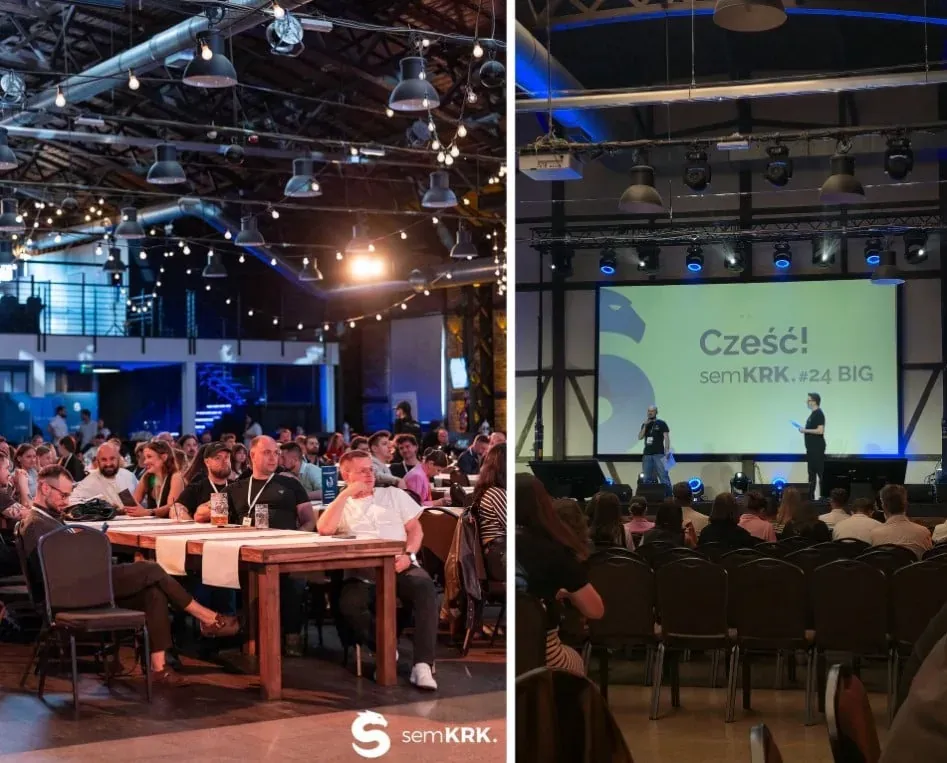
On 3 June 2026, Stara Zajezdnia in Kraków's Kazimierz district once again filled up with specialists in SEO, SEM, e-commerce, analytics and digital marketing. semKRK#24 BIG 2026 was an event that very clearly showed that a conversation about online visibility is increasingly also a conversation about AI, data, automation and brand. There was no shortage of concrete case studies, strong claims, hallway conversations and topics that will keep coming back in industry discussions for a long time. For us, this edition was special, because JustIdea Agency, together with Surf Inc., won the semKRK Awards 2026 trophy in the E-commerce category.
What is semKRK?
semKRK is one of the most recognisable industry events in Poland, focused on search engine marketing, web analytics, paid campaigns, SEO, content and e-commerce. Organised by DevaGroup, the conference has for years attracted people who want to hear not just about trends, but above all about practice: specific actions, results, mistakes, tests and changes that really affect companies' results.
This year's edition, semKRK#24 BIG 2026, took place on 3 June 2026 at Stara Zajezdnia, ul. Świętego Wawrzyńca 12, in Kraków. It was the 24th meeting in semKRK's history. Across all its previous editions, semKRK has already brought together more than 7,500 attendees, which shows clearly that this is not a random conference, but an important date in the digital industry's calendar.
The barcamp format: the line between stage and audience disappears
One of the most distinctive features of semKRK is its barcamp format. There are no several parallel stages to choose between. All attendees listen to the same talks, which gives later hallway conversations a natural point of reference. All it takes is to refer to a specific talk, claim or case study to start a conversation with someone who was just listening to exactly the same thing.
During semKRK#24 BIG 2026, there were 14 talks. Each had a compact format: around 20 minutes of presentation and 5 minutes for questions. Importantly, questions could be asked through a dedicated app, so attendees did not need to grab the microphone or speak in front of the whole room. The organisers also rewarded the best questions with industry books, which made the audience genuinely engaged rather than just passively present.
It is precisely this format that gives semKRK a less formal, more lively character. The stage provides knowledge, but the audience can immediately add to it with their own questions, doubts and experiences. In an industry that changes as fast as SEO and SEM, this kind of exchange is especially valuable.
Networking at semKRK: what happens between the talks
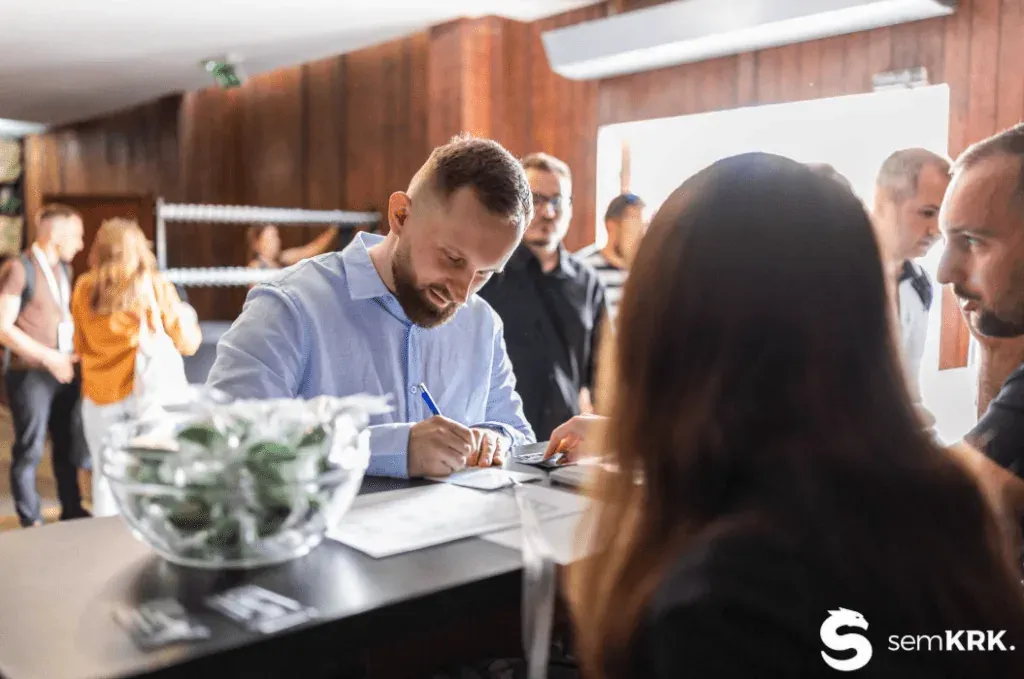
semKRK is not just about the talks. A very large part of the event's value happens between them: during breaks, at partner stands, in relaxation zones, at the bar, and later also at the after-party in Kazimierz. That is exactly where you can talk to other specialists, exchange experiences and see how similar challenges play out in different companies, industries and teams.
This year there was definitely no shortage of topics to talk about. AI came up practically everywhere: in SEO, SEM, content, analytics, e-commerce and campaign automation. Thanks to that, networking did not need forced icebreakers. All you had to do was ask how someone approaches AI Overviews, whether they are testing AI agents, how they measure brand visibility in generative search engines, or whether automation really does speed up work, or rather adds new problems.
Deckchairs, hallways and relaxation zones: this is where the real value is born
Stara Zajezdnia suits semKRK's character very well. The venue has its own atmosphere while also giving space for conversations that are less formal than a classic conference room. Deckchairs, relaxation zones in front of the building, partner stands, gadgets, books, industry magazines, a wheel of fortune and a final quiz made it easy to simply walk up, strike up a conversation and swap a few concrete observations between talks.
This atmosphere matters. The most interesting conversations often do not start with a formal introduction, but with a simple comment after a presentation: "it's similar for us", "we tried something like that", "we get completely different results" or "I wonder how that would work in e-commerce". It is precisely in these moments that the conference stops being just a place to absorb knowledge and becomes a space for a genuine exchange of experience.
How to prepare for networking so you leave with something concrete?
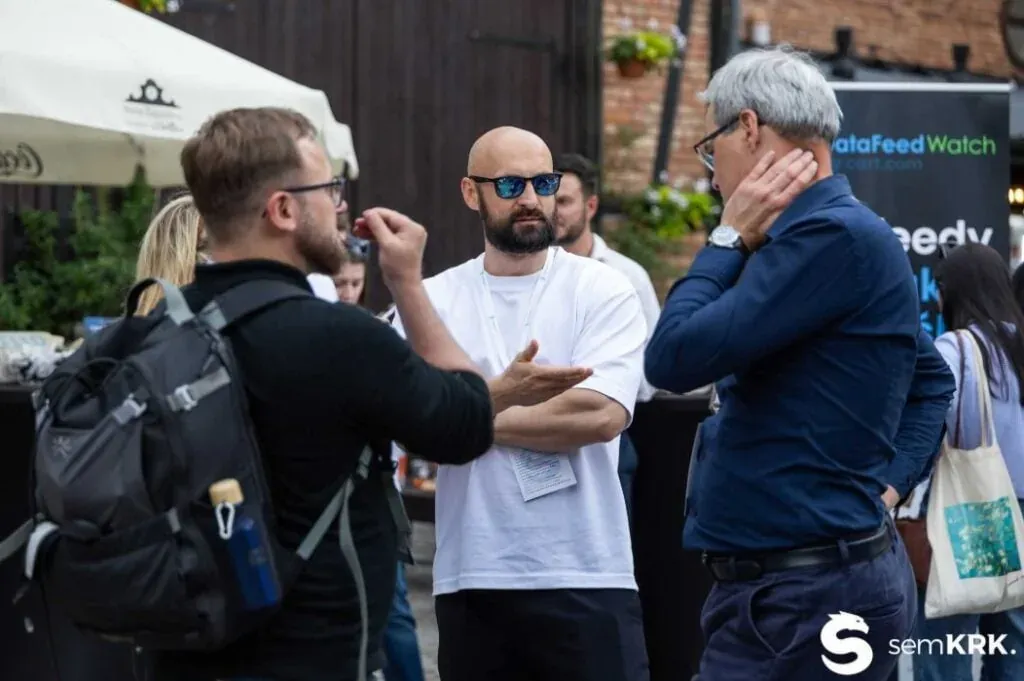
To make the most of the conference, it is worth preparing for it beforehand. This is not about drawing up a rigid schedule of conversations or treating networking as a sales task to tick off. It is more about knowing which topics you are bringing with you and who you would like to discuss them with.
Simple preparation works well:
- checking the agenda and choosing the talks closest to your current challenges,
- preparing a few questions for speakers or other attendees,
- briefly defining what you do and what you want to talk about,
- noting down specific ideas straight after conversations,
- being open to people outside your own specialism.
In practice, the most valuable conversations happen at the intersection of competencies. An SEO specialist can get a lot out of talking to someone from Google Ads, an e-commerce manager from talking to an analyst, and a content person from talking to someone who works in UX or automation. semKRK is a great setting for exactly this kind of connection.
"Let's talk AI, I do SEO, come say hi": semKRK networking in practice
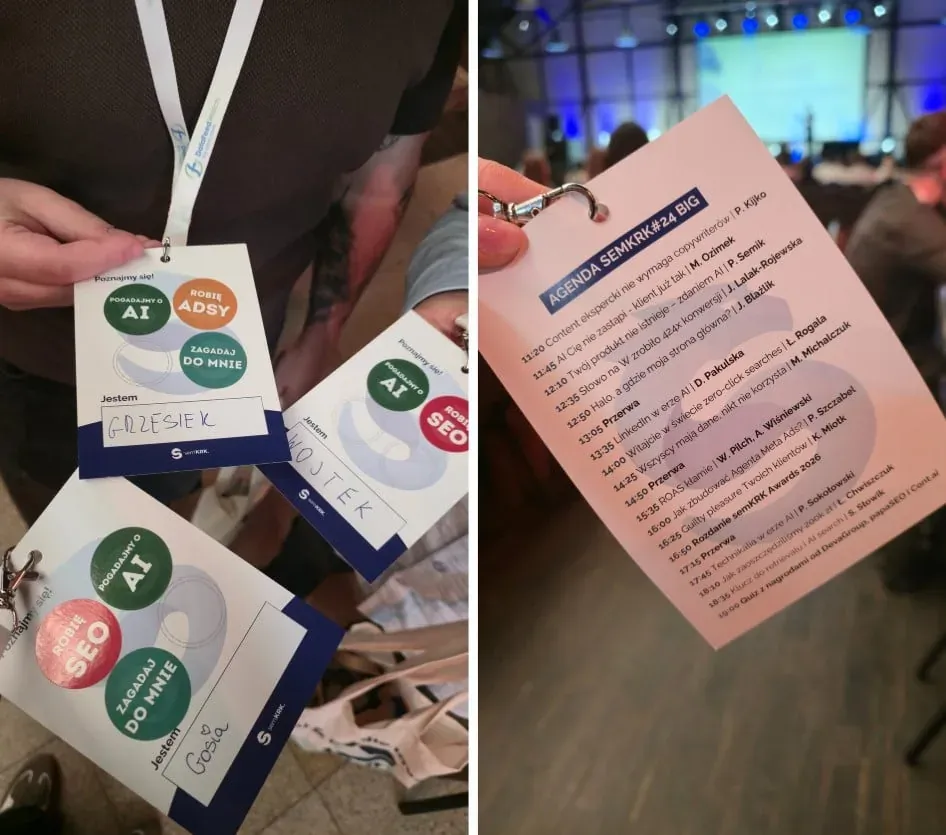
For us, semKRK was a great opportunity to talk about how AI is changing the work of SEO, SEM and e-commerce specialists. Not in theory, but in everyday work: data analysis, content creation, campaign optimisation, brand visibility and designing processes that need to work faster while still delivering quality.
We talked about how AI does not replace strategy. It can help with the work, it can speed up analysis, it can support content and campaigns, but you still need a person who understands the business context, can judge quality and knows what they actually want to achieve. This topic came through very strongly, both from the stage and off it.
For us, the conversations about e-commerce and AI agents were especially interesting. Increasingly, the question is no longer just "how does the user search for a product?", but also: "how can AI act as an intermediary in the purchase decision?". This changes the way we think about product data, descriptions, brand visibility and the whole purchase journey.
semKRK Awards 2026: JustIdea takes the trophy for the best e-commerce campaign
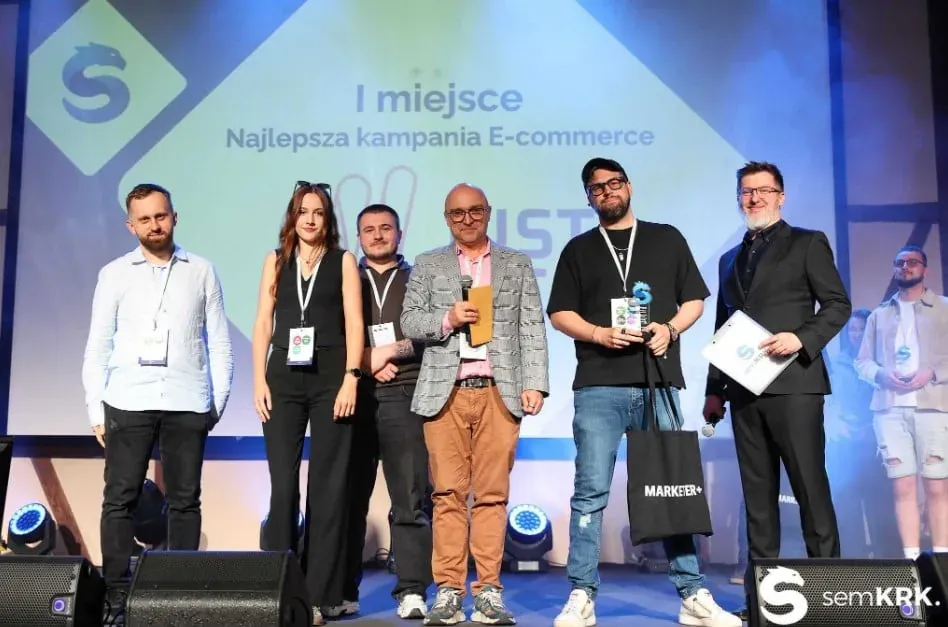
One of the most important moments of the event for us was the semKRK Awards 2026 ceremony. In the E-commerce category, we won together with Surf Inc. for the case study:
“Kto za 12 miesięcy będzie podejmował decyzje? Agenci AI w e-commerce” (Who will be making decisions in 12 months? AI agents in e-commerce)
This recognition means a great deal to us, because the semKRK Awards are judged by a panel of experienced industry experts. It is not a popularity vote, but a substantive assessment of the campaign, its assumptions, results and significance for the market.
The joy was even greater because this is our second gold in a row in the e-commerce category. In 2024 we won for the case study "Hockey Stick Growth Through a Data Warehouse Implementation", and in 2026 we came back with the trophy again. For us, this confirms that the direction we are developing in e-commerce projects, namely combining data, technology, strategy and a real understanding of the user, makes sense.
After the results were announced, there was a lot of emotion, pride and plain human joy. Moments like this matter, because behind every award there is not just slides and numbers, but above all the team's work: hours of analysis, decisions, tests and conversations with the client. That is why this trophy is more than an industry accolade for us. It is a signal that projects built on bold but well-structured thinking about the future of e-commerce can genuinely set the direction.
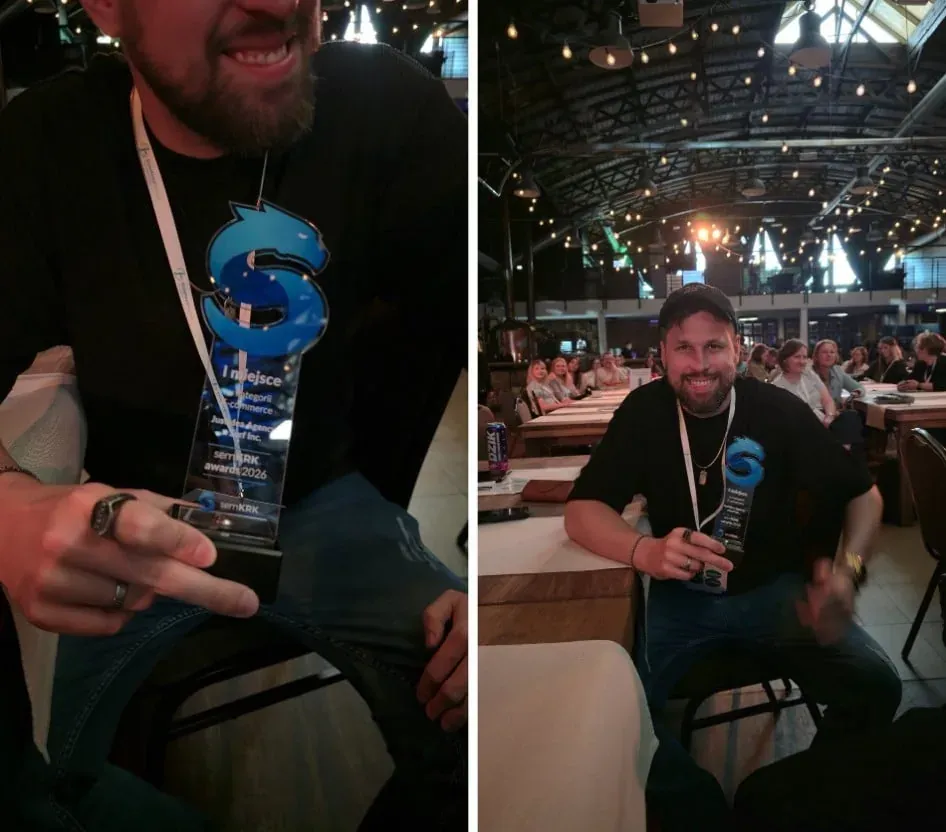
semKRK#24 BIG 2026 programme: what was on stage?
This year's programme was very strongly built around AI, brand visibility, data and marketing effectiveness. Topics on stage covered SEO, Google Ads, LinkedIn, expert content, analytics, campaign automation, AI Overviews and the changing way of measuring results.
A lot of attention was given to the fact that classic metrics are not always enough to assess how effective activities are. ROAS, Google rankings and organic traffic itself are still important, but without business context they can lead to the wrong conclusions. Increasingly, you need to look more broadly: at profitability, LTV, CAC, margin, data quality and the real impact of marketing on customer decisions.
AI in SEO and SEM: the leading theme of the whole edition
If you had to name one topic that tied the whole conference together, it would be artificial intelligence. AI came up in various contexts: from content creation, through campaign automation, to visibility in generative search engines. The conclusion was clear: this is no longer the future, it is the industry's everyday reality.
At the same time, a very sensible perspective came through in many of the talks. AI can speed up work, but it does not relieve specialists of the need to think. You still need to understand the strategy, the data, the user, search intent and the business goal. Tools can help, but on their own they will not decide what is valuable, credible and effective.
A wealth of case studies throughout the conference
One of semKRK's great strengths was its concrete case studies. Speakers showed not just trends, but also numbers, processes and results from real projects. There were examples of traffic growth, better use of data, budget optimisation, working with AI-supported content and a change in the approach to measuring campaign effectiveness.
This matters, because the marketing industry falls into trendy buzzwords very easily. Case studies help verify them. They show what actually worked, in what context and why. It is not about copying solutions one to one, but about understanding the way of thinking behind good results.
LinkedIn in the age of AI: the last bastion of authenticity, or a channel for automation?
One of the more interesting topics was the role of LinkedIn in a world where more and more content can be generated automatically. On the one hand, AI makes it easier to prepare posts, analyse topics or plan communication. On the other hand, the more similar, bland content that appears in the feed, the more authenticity matters.
In this context, the topic of E-E-A-T came through strongly: experience, expertise, authoritativeness and trust. LinkedIn can still be a good channel for building an expert brand, but it requires consistency and your own point of view. Posting often is not enough. You need to have something concrete to say.
Expert content without copywriters: provocation or the new reality?
The topic of AI-assisted content stirs up a lot of emotion, because it touches on the work of copywriters, experts and SEO specialists. During the conference, though, one thing came through strongly: it is not about removing people from the process entirely, but about dividing roles differently.
AI can help prepare a draft, analyse a topic, organise structure or scale content production. But you still need an expert to check the sense, the facts, the context and the quality. In practice, the best model is not "content without people", but content created faster, smarter and under the control of people who really understand the topic.
SEO in the new era: how to combine the fundamentals with the demands of generative search engines?
The new era of SEO does not mean the technical fundamentals have stopped mattering. Quite the opposite: a fast site, correct structure, crawlability, logical information architecture, HTTPS and good UX are still the foundation of visibility.
The environment is changing, though. Today you have to think not just about Google rankings, but also about whether the brand is recognisable, well described and credible to generative systems. Visibility in AI Overviews or ChatGPT is not the same as classic visibility in search results. These are related areas, but they require a slightly different approach.
Semantics, information consistency, brand authority, user experience and content quality matter more and more. SEO is not disappearing. It is simply expanding to add more layers.
Key takeaways from semKRK 2026 for SEO and SEM specialists
semKRK#24 BIG 2026 showed that SEO, SEM, analytics, content, AI and e-commerce are more closely connected today than ever before. You can no longer look at visibility purely through rankings, clicks or ROAS. You need to understand data, the user, the brand, technology and the real business impact of your actions.
For us, this edition was exceptional. We came back with a large dose of knowledge, many conversations and the semKRK Awards 2026 trophy in the E-commerce category. It was an intense day that showed clearly where the industry is heading: fewer random actions, more strategy, less blind automation, more deliberate use of AI.
And that is exactly why semKRK remains one of those events worth attending, not just to listen to the talks, but also to see what the industry really cares about.
FAQ: the most common questions after semKRK#24 BIG 2026
Will AI replace SEO and SEM specialists?
No. AI does not replace a specialist's strategy, experience and responsibility, but it is increasingly changing how the work gets done. It can speed up data analysis, content drafting, topic segmentation, campaign optimisation or report preparation, but you still need a person who understands the business context and can judge whether the result makes sense.
The main takeaway from the conference is simple: automation without expert oversight can increase the scale of activities, but it does not guarantee their quality. That is why the future of SEO and SEM is not about replacing people with tools, but about combining specialists' competencies with AI's capabilities more intelligently.
Are high Google rankings enough for a brand to be visible in AI?
Not always. Visibility in Google and visibility in generative tools are increasingly two different areas of strategy. A site can rank well in classic search results without necessarily appearing in AI Overviews or ChatGPT answers.
It is not just keywords that matter, but also semantics, the consistency of brand information, the authority of sources, content quality and the context in which the brand appears online. That is why SEO is not disappearing, but expanding with new layers: you still need to look after the technical fundamentals while also building a brand that AI systems will be able to recognise, understand and consider credible.
How do you create expert content in the age of AI?
The best approach is not "content without people", but content created faster and smarter under experts' control. AI can help prepare an article's structure, analyse topics, draft a first version of the text or organise information, but it should not decide on the substance on its own. In expert content, experience, facts, industry context, practical examples and consistency with the brand's communication are especially important. It should be a person who checks whether the text really answers the user's needs, whether it does not oversimplify the topic too much, and whether it builds trust. AI can be a great support for the process, but it should not be its only author.
Sources

Have a question about this article? Write to us.