












Your contact database keeps growing, forms keep getting filled in, and the pipeline stands still. In B2B, months often pass between the first contact and signing a contract, during which a potential client compares offers, looks for information and returns to the topic at their own pace. Lead nurturing determines whether, after all that time, they still remember your company and whether they consider it when they're ready to talk.
What affects the effectiveness of lead nurturing, and where does this process most often get stuck?
What Does B2B Lead Nurturing Involve with a Long Sales Cycle?
B2B lead nurturing means maintaining contact with a company that's considering a purchase but isn't yet ready for a sales conversation. It relies on content matched both to the decision stage and to the role of the specific person on the client's side.
In e-commerce, nurturing takes days and ends with an order. In the B2B model, the same mechanism stretches over quarters, involves several people at one company, and ends not with a purchase but with agreement to a meeting. Technically, this is powered by marketing automation, but the technology alone doesn't decide anything. What should you fill the months of silence between the first contact and the decision with?
The Decision Is Made by a Group, Not One Person
On the client's side, there's rarely just one decision-maker. Several people are usually involved in the buying process, who together need to identify the problem, compare available solutions, define requirements, choose a supplier, verify the choice and get sign-off from the remaining stakeholders. These stages don't always follow one another in order, and the team returns to some of them several times. Most B2B purchases result from changes happening inside the client's own organisation, not from a desire to try out a new tool.
That's why a sequence built as a straight line from sign-up to offer rarely matches the real buying process. Recipients move between stages and, at different points, need different arguments, materials and touchpoints.
How to Generate B2B Leads That Can Actually Be Nurtured
Lead nurturing starts even before the first message. An email address alone gives you little if you don't know what problem the recipient came with, what they were looking for and what stage of the decision they're at.
Contact Sources That Carry Information About the Problem
The value of a lead depends not only on the fact that it ended up in your database, but also on the information that comes with it. Four sources work best:
- content that answers buying intent: a comparison article or a cost calculator attracts people who are already defining their requirements,
- industry webinar: registration tells you the topic, and how much of the recording was watched tells you the level of interest,
- content gated behind a form (gated content): a market report or technical documentation reveals what stage of analysis the company is at,
- LinkedIn Ads campaigns targeting narrow groups of job titles: they cost more per contact but deliver leads from the right departments.
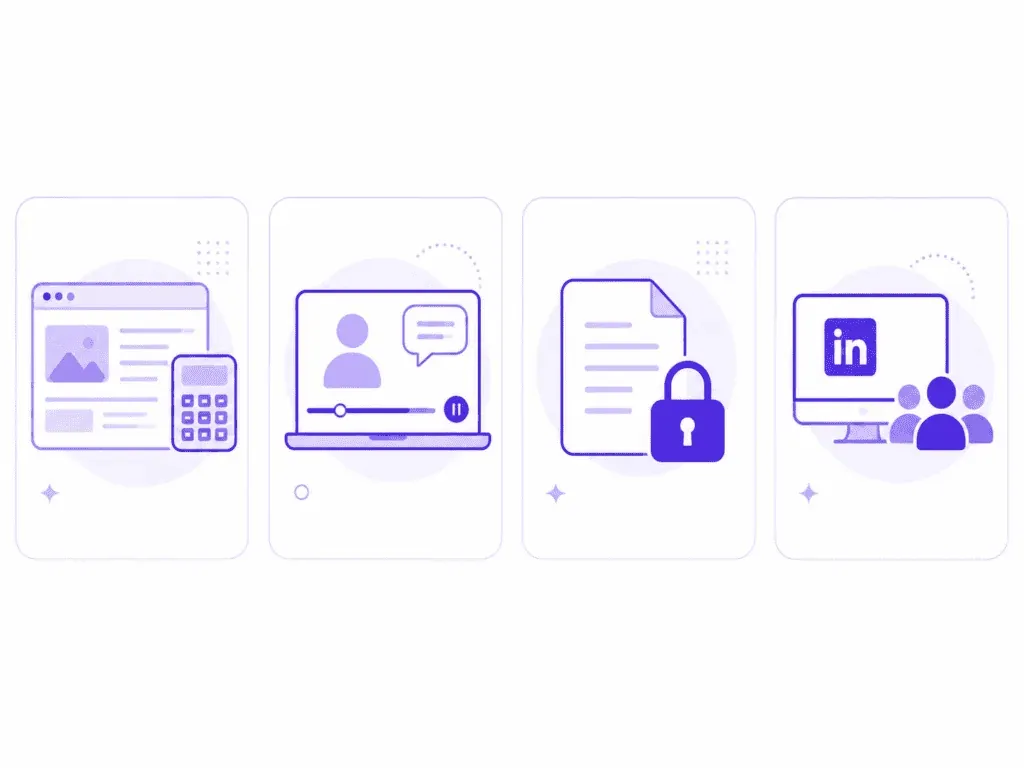
Each of these sources leaves a trace you can base your first message on. Without it, all that's left is sending the same thing to everyone.
A Form That Doesn't Close Off the Conversation
A form that asks for everything upfront can discourage the very people you care about most. At the first point of contact, collect the minimum: an email address, the company name and an answer to one question about the problem the client wants to solve. You can fill in the remaining information during later interactions.
That one question already gives you enough context to route the contact to the right communication scenario, instead of dropping them into one shared list.
Consent and Database Hygiene: The Baseline Condition
Since 10 November 2024, Poland's Electronic Communications Law (Prawo komunikacji elektronicznej, the law governing electronic communications) has been in force. Its Article 398 bans the use of electronic communication to send commercial information, including direct marketing, without the recipient's prior consent. The provision replaced earlier regulations from the Act on Providing Services by Electronic Means and the Telecommunications Law. In practice, this means consent should clearly cover the specific method of contact and the marketing purpose, and a generic "I agree to marketing" checkbox may not be sufficient.
The second issue is the state of the database itself. A contact who hasn't opened a single message in a year lowers your sending deliverability and distorts the statistics you use to evaluate your sequences. Database hygiene in B2B has an extra dimension: people change jobs, but the company email address stays. A quarterly review of inactive contacts, with a reactivation attempt before deletion, helps keep the database in good shape.
Lead Nurturing Strategies for a Sales Cycle Measured in Months
Effective B2B lead nurturing starts with a few decisions made even before you write the first message.
A Path Built Around the Problem, Not the Offer
A sequence built solely around the product runs out of steam quickly. It's hard to talk about a single tool for several months without repeating the same arguments. A path built around the client's problem gives you far more options: the cost of the current solution, the risks of switching, the criteria for choosing a supplier, or ways to justify the investment to the board. The product then appears as one of the answers, not the main topic of the whole communication.
Content Matched to the Client's Role
A finance director, a department manager and the person who will use the solution day to day all look at the same offer from completely different perspectives. Segmentation by job title, by data provided at sign-up, or by the topics a recipient chooses and clicks on, lets you match the material to their role. For one person that will be a return-on-investment calculation, for another a step-by-step implementation description, and for another a list of integrations.
Personalisation here isn't about inserting a first name into a subject line, but about providing answers to the questions that person will later have to ask, or hear, inside their own organisation.
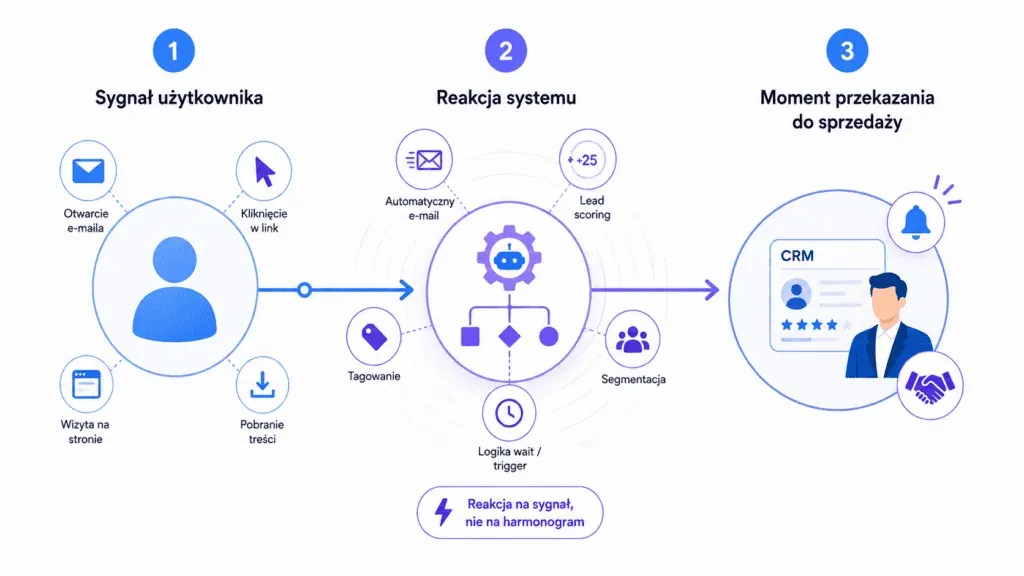
A Signal Instead of a Rigid Schedule
Sending a message every seven days regardless of the recipient's behaviour treats everyone the same. It works better when the next step is triggered by a specific event: a return visit to the pricing page, downloading a second piece of content, clicking a link to a case study. A signal like that indicates a change in the client's situation and deserves a different response than a week simply passing on the calendar.
Lead scoring reinforces this: points awarded for each successive user action. In its more advanced form, predictive lead scoring adds a forecast of the purchase probability calculated from historical data.
Three Nurturing Scenarios from Different B2B Models
The examples below come from different industries, but each shows a different mechanism for triggering the path.
Software House: After a Demo That Didn't End in a Decision
The demo went well, but the contact then goes quiet for six weeks. The reactivation path doesn't repeat the arguments from the presentation; instead, it fills in what may have been missing from the meeting: it shows an implementation at a client of similar scale, answers common questions about data security and gives an estimate of the workload required on the buyer's side.
Training Company: Segmentation by Webinar Behaviour
Attendees of a single webinar can need completely different communication. Those who stayed until the end get an invitation to a consultation; those who left halfway through get the recording with the implementation section flagged; and those who registered but never showed up get a shortened version of the material along with information about the next edition.
Subscription Service Provider: Returning to a Lost Opportunity
The company lost a tender fourteen months earlier. The contact stays in the database along with the end date of the contract with the competitor, and three months before that date, a short sequence kicks off: changes to the offer since the previous tender, a result achieved for a client in the same industry, and a proposal for a conversation.
Lost opportunities are one of the cheapest sources of new pipeline in B2B, and yet they often go unused.
When to Hand a Lead Over to Sales
Most contacts get lost not in the sequence itself, but at the interface between marketing and sales. A salesperson can reach out too early, before the client is ready to talk, or too late, once they're already talking to a competitor. That's why a clearly defined handover moment and a clear division of responsibility between the teams often deliver more than yet another automation scenario.
| Marketing Nurtures | Sales Takes Over |
|---|---|
| The contact downloaded one piece of content and didn't come back | The same person returns to the offer page within a week |
| Interest in the topic, no signal about budget | A question about pricing, terms or implementation timeline |
| One person from the company in the database | Two or more people from the same domain within a short time |
| The problem recognition stage | The requirements-building and supplier-selection stage |
Set the criteria in the right-hand column together with the sales team and record them as rules in your system. Add response time to them too, because a lead picked up two days later may already be worth much less. It's also worth planning a way back: if a conversation reveals that the decision is still a long way off, the salesperson should hand the contact back to nurturing instead of leaving them without further communication.
How to Measure B2B Lead Nurturing
Measurement based solely on opens mainly tells you about the health of your sends, not about the impact of nurturing on sales. With a buying cycle measured in months, you need metrics that connect recipient activity to further movement in the pipeline.
Metrics That Matter More Than Open Rate
The fullest picture comes from four numbers: the share of contacts that moved from nurturing into a sales conversation, the average time from first contact to that conversation, the percentage of leads rejected by sales, and the value of opportunities generated from nurturing paths. It's worth comparing these figures against your cost per lead (CPL), because a cheap lead doesn't necessarily mean a lead that actually adds something to the pipeline.
When to Evaluate Results
Evaluating results after a month will be too early if the buying cycle itself lasts much longer. You can draw the first conclusions about your content after a few weeks, by observing recipient behaviour at successive stages of the path. The impact on sales only becomes visible after a period close to the length of the whole cycle, which is often after two or three quarters.
That's why it's not worth turning off a sequence just because a sales effect isn't visible yet after a few weeks. In B2B, part of the value of nurturing only becomes apparent once a lead actually returns to the buying process.
In B2B, the Winner Is Whoever Stays the Longest
Most B2B companies have similar content, similar case studies and similar pricing arguments. What makes the difference is being present in the months when, on the surface, nothing seems to be happening: the client isn't replying, isn't clicking and isn't booking a meeting, but is still building a mental shortlist of suppliers they could go back to.
Well-planned nurturing lets you stay on that shortlist through content that's useful even before a purchase decision has been made. Regular sales messages with no new value do the opposite: they bring forward the moment when the recipient stops listening.

Found this topic interesting? Also check out:
- From Chaos to Efficiency: How Implementing a CRM System for Our Client Increased the Number of Qualified Leads in 4 Months
- What Is Marketing Automation and How Does It Work in Practice?
- How to Use AI to Personalise Communication?
FAQ Section: B2B Lead Nurturing
How Does Lead Nurturing Differ from a Drip Campaign?
A drip campaign sends a planned series of messages at fixed intervals, the same way to every recipient. Nurturing reacts to behaviour: it changes the content, order and timing of sends depending on what the contact has done. Drip can be one element of a wider process, but it can't replace it on its own.
How Long Does B2B Lead Nurturing Take?
As long as the buying cycle in a given industry takes: usually from a few months to more than a year for larger implementations. The best benchmark is the average time from first contact to signing a contract in your past deals. It's worth designing the nurturing path for that horizon, rather than squeezing it into a few messages sent within a month.
When Should You Hand a Contact Over to a Salesperson?
When a signal appears about the purchase itself, not just the topic: a question about terms, a return visit to the offer page, or activity from several people at the same company. Set the criteria together with sales and record them in the system, so the decision doesn't depend on gut feeling.
Can You Run Lead Nurturing Without a Marketing Automation System?
With a few dozen contacts, a spreadsheet and discipline with follow-ups are enough. Above that scale, running paths manually stops working, because no one can keep track of hundreds of deadlines and conditions. The system takes over the tracking, while the content and logic of the process remain with the team.
What Content Works in the Middle of the B2B Funnel?
Materials that help build requirements and justify the choice inside the client's company: cost calculations, descriptions of implementations of similar scale, comparisons of approaches, and answers to questions from security and procurement departments. Purely image-building content works earlier in the conversion funnel; the offer belongs only at the end.

Have a question about this article? Write to us.