











The About Us page is often treated as a mandatory formality. A short blurb about experience, a posed photo, a standard promise to put the customer first, and finally a “Contact Us” button. The problem is that exactly the same description could appear on any company's website in the same industry, and no one would notice the difference.
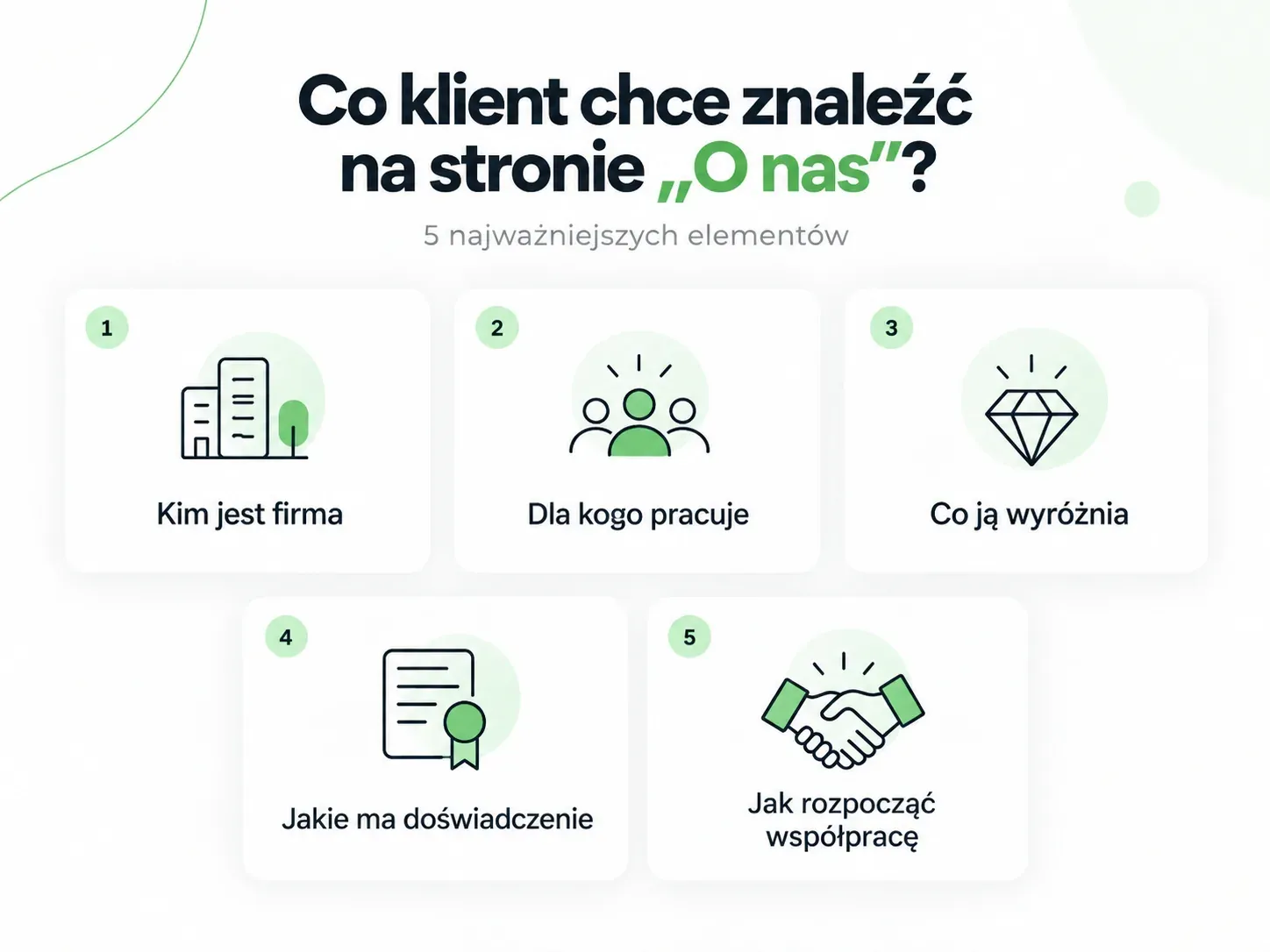
To write an About Us page that genuinely supports a potential customer's decision, it's worth combining basic information about the company with concrete evidence of its experience and credibility. This page should quickly explain who the company is, what it does, who it works for and why it can be trusted. This isn't about presenting the business solely from its own perspective. A user visits this part of the site because they want to verify the company before buying, sending a contact form or starting a conversation.
This page's importance is also growing from the perspective of SEO and AI-assisted search. Clear information about the business, the team, experience, specialisation and company details makes it easier for search engines to understand which organisation is behind the site. That doesn't mean, though, that it's enough to add a few trendy phrases about artificial intelligence or implement structured data. Useful, credible and unambiguous content remains the foundation.
So how do you write an About Us page that isn't just another generic company description?
Why you should write your About Us page from the customer's perspective
An About Us page should above all reduce a potential customer's uncertainty. Someone landing on a website for the first time may already know the offer, but still not know who will actually be responsible for delivering the service, what experience the company has, and whether the claims made in its marketing materials are backed up by facts.
This matters especially in service-based and B2B business. The higher the value of the engagement, the longer the decision-making process, or the greater the risk on the customer's side, the more information they'll want to check before the first meeting. The offer itself answers the question “what can I buy?”, while the About Us tab helps answer the question “is this the company worth buying from?”
That's why the text on an About Us page shouldn't be a corporate biography. The story of how the brand came to be can be interesting, but the user will view it through the lens of their own situation. If you describe ten years of company growth, it's worth showing what that experience means for customers at the same time. If you present a large team, it's also worth explaining which of that team's competencies matter from the customer's perspective.
It's a small shift in perspective, but it affects the whole of your communication.
How to write an About Us page: start with the most important information
The first screen of the page should clearly say what the company does and who it helps. It's not worth opening with the story of how the business was founded or an abstract mission statement. The visitor should understand immediately where they've landed.
Instead of “We create solutions that change the future of business”, it's better to state what services or products the company actually offers and for which target group. A marketing slogan can supplement your messaging, but it shouldn't replace it.
An example structure for the first paragraph might look like this:
“We're a digital marketing agency that helps B2B and e-commerce companies win customers through SEO, paid campaigns, content and technology. We bring together specialists from several fields, so strategy, delivery and results analysis don't operate as separate processes.”
In two sentences, you get information about who the company is, what its range of services covers, who it works with and how it operates. Only after that is it worth moving on to history, values or details.
This approach lets you present a clear value proposition right on the first screen of the page (above the fold). Instead of losing the user's attention on generalities or a long-winded introduction, the page immediately communicates what matters most. This means the visitor doesn't have to hunt for the point in later paragraphs, which improves user experience (UX) and also makes it easier for search engines to understand the page's topic.
How to write About Us copy that sets your company apart
One of the hardest parts of writing an About Us page is answering the question: what actually sets the company apart from its competitors?
“Years of experience”, “an individual approach”, “a comprehensive offer”, “professionalism” and “the highest quality” aren't yet differentiators. Virtually any company can use terms like these, regardless of what its business model looks like.
It's worth looking instead for traits you can describe concretely. If the customer has direct contact with the specialists carrying out the service, say so clearly. If most of the work is done in-house rather than through subcontractors, that can matter too. If the company specialises in a particular industry, has rare competencies, its own technology, or works to a specific model, that's exactly the kind of information worth presenting.
A good differentiator should answer three questions: what's done differently, what that looks like in practice, and why it matters to the customer.
Instead of writing:
“We believe in a partnership-based approach,”
it's better to show what that means in practice:
“From the start of the project, the client works directly with the specialist responsible for delivery, not solely with the sales department or an account manager. That means questions about the campaign, SEO or analytics go straight to the person working on the project.”
The second sentence is longer, but it lets the reader understand what the company actually means. The first remains just a claim.
How to present your company's experience without marketing slogans
The best way to demonstrate experience is with facts that don't need extra interpretation. The number of years on the market can be one of them, but on its own it's rarely enough.
A combination of several pieces of information says much more: how long the company has been operating, how many projects it has worked on, which industries it has experience with, what competencies the team has, and what results it has achieved on selected projects.
In practice, it's worth showing above all:
- years in business,
- the number of projects and clients,
- results from selected activities,
- certificates and awards,
- partnerships and industry publications,
- case studies,
- the team's competencies and specialisations.
That doesn't mean, though, that it's worth turning the About Us page into a set of numbers and statistics. Each one should have context and show something meaningful from a potential customer's perspective.
“500 completed projects” may sound impressive, but it tells a company looking for a partner for a very specific task very little. Sometimes experience gained on 30 projects in one demanding industry, or a few long-standing client relationships, is a much stronger argument.
Storytelling: how to tell your company's story from the customer's perspective
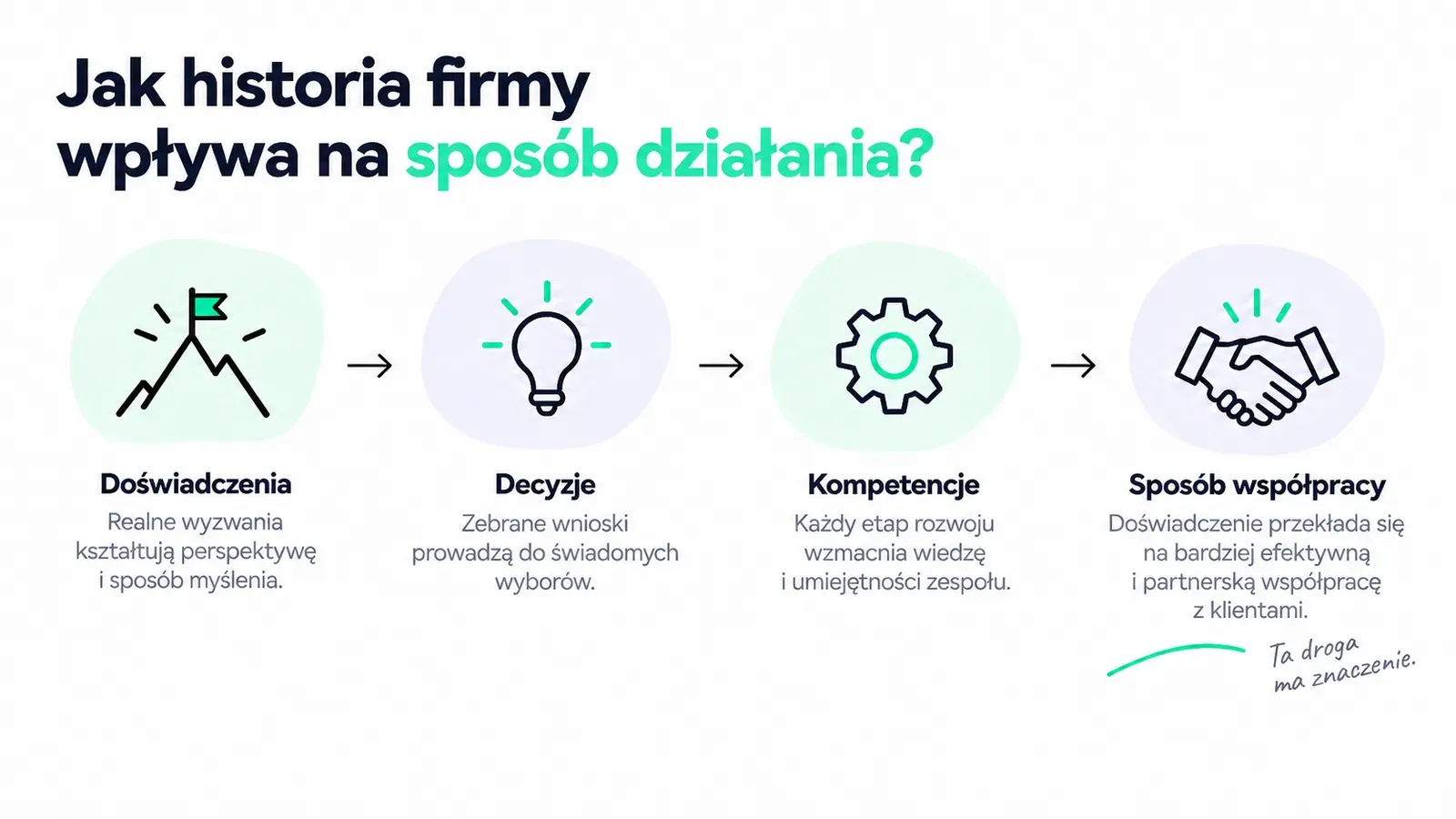
Storytelling works when the company's story explains how it operates today. A mere chronology of events isn't yet a story.
The founding date, the first office, new hires or a move to a bigger office can be interesting milestones, but a potential customer doesn't need a company chronicle. Turning points that actually changed the business are far more interesting.
Perhaps the brand was founded because its founders noticed a problem that existing companies weren't solving. Maybe, after a few years, some services were dropped in favour of focusing on a single specialisation. An important moment might have been building an in-house technology team, entering a new market, or changing the way projects were run after experience with the first clients.
A story like this helps people understand the company better, because it shows a cause-and-effect chain: a specific challenge arose, a decision was made, new competencies were gained, and a particular way of working was developed.
For a longer history, a timeline works well. It doesn't need to cover every single year. Four or five genuinely significant moments will be clearer than a dozen or so events that differ only by date.
Storytelling also doesn't require building a “zero to hero” narrative. A brand becomes more authentic when it tells a true story, not when ordinary events are given an unnecessarily dramatic spin.
How to present your team to build trust
Team photos give a company a human face, but from the customer's perspective, what matters most is who will work on the project and what experience they have.
For service businesses, the About Us page is the digital equivalent of a first meeting. Before submitting a form, a user wants to check whether the experts the brand talks about in its messaging are really on the other side. That's why it's worth expanding each team member's profile with specific specialisations, projects delivered, certificates or a link to their LinkedIn profile.
Not every employee needs a separate biography: with large teams, it's enough to present the key people and link from the About Us section to a dedicated page. To strengthen credibility, it's worth using authentic photos of people and the workplace, rather than impersonal stock imagery.
How to show your way of working and ease a potential customer's concerns
Many About Us pages tell you who the company is, but very little about what working with it actually looks like once you've signed a contract. That's a missed opportunity.
For a potential customer, the way of working together can matter just as much as the scope of services. This is especially true if they've had bad experiences with contractors before, don't know how delivery works, or are wondering how much involvement the project will require on their side.
There's no need to copy the process from your service page here. On the About Us tab, it's worth presenting the collaboration model from a relationship perspective: who's responsible for the project, how often meetings happen, where reports are shared, how feedback is submitted, and how decisions are made.
This is exactly the place where the phrase “a partnership-based approach” can be replaced with facts.
If the client has access to a shared dashboard, mention it. If results are discussed once a month in a meeting, that's worth pointing out too. If the project is managed by someone who understands both the business goals and the technical side, that can also matter when choosing a company.
A section like this helps build trust even before the first conversation, and it can reduce the questions that would otherwise come up later in the sales process.
How to build trust on your About Us page with social proof
The most credible information about a company often comes from outside the company's own description of itself. That's why an About Us page should combine the brand's claims with evidence.
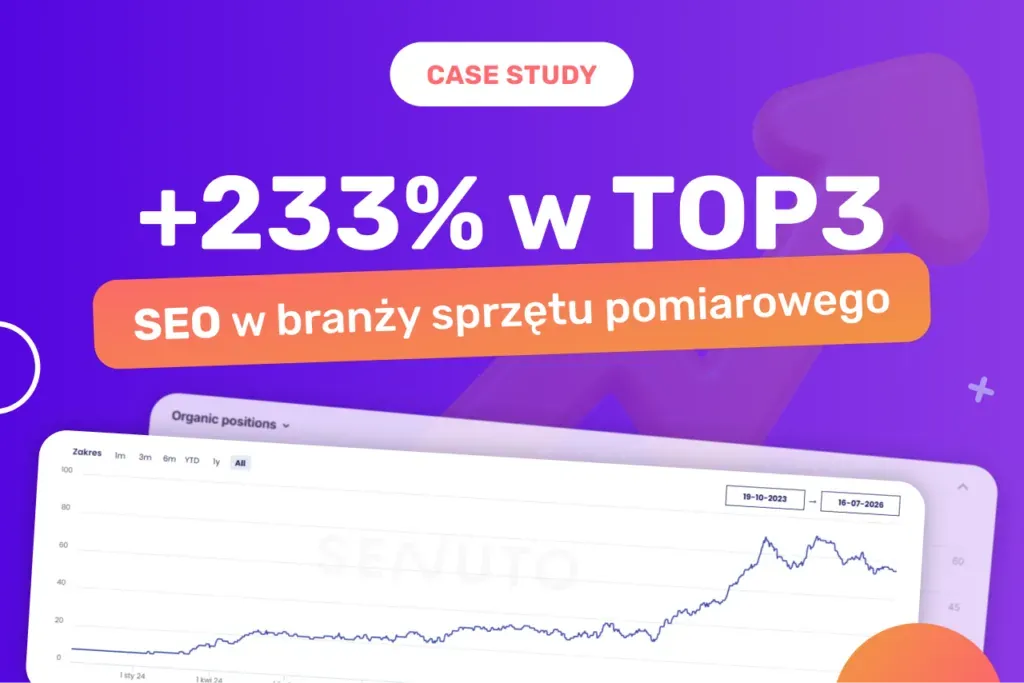
If you mention how effective the company is, it's worth pointing the user to a case study. If the company has worked with recognisable business partners, you can show their logos, provided you have permission to use them. If clients leave reviews, excerpts from the best recommendations can supplement the description of your work together. An award or certificate also has more value when it includes the organiser's name and the year it was granted.
It's worth being selective, though. Dozens of logos crammed into one place can make less of an impression than five well-chosen examples together with information about what was delivered for those clients.
Social proof works best when it sits close to the information it's confirming. It's a good idea to place an SEO case study next to information about the SEO team's experience, and a client recommendation about project communication next to the section describing your collaboration model.
Company mission and values: best shown through concrete decisions
“Transparency”, “growth”, “customer first” and “innovation” appear in the messaging of many brands. The values themselves aren't the problem. The problem arises when the reader sees no connection between them and how the business actually operates.
A company's values should be visible in the way it runs its business.
If transparency matters, you can describe what data and reports the client gets access to. If the company says it invests in developing competencies, you can point to training, certificates, internal knowledge-sharing or the team's expert activities. If one of the values is responsibility, it's worth showing how it shapes project planning and how risk is communicated.
Not every brand needs an elaborate “Our Values” section for this. Sometimes it's better to weave your values into the description of how you operate than to create separate tiles with three slogans.
The same goes for the company's mission statement. It should help the user understand what the organisation is aiming for and what problem it wants to solve. If the mission statement is so generic that it could be pasted onto any competitor's website, it probably needs sharpening up.
Optimising for SEO and AI algorithms: what to remember
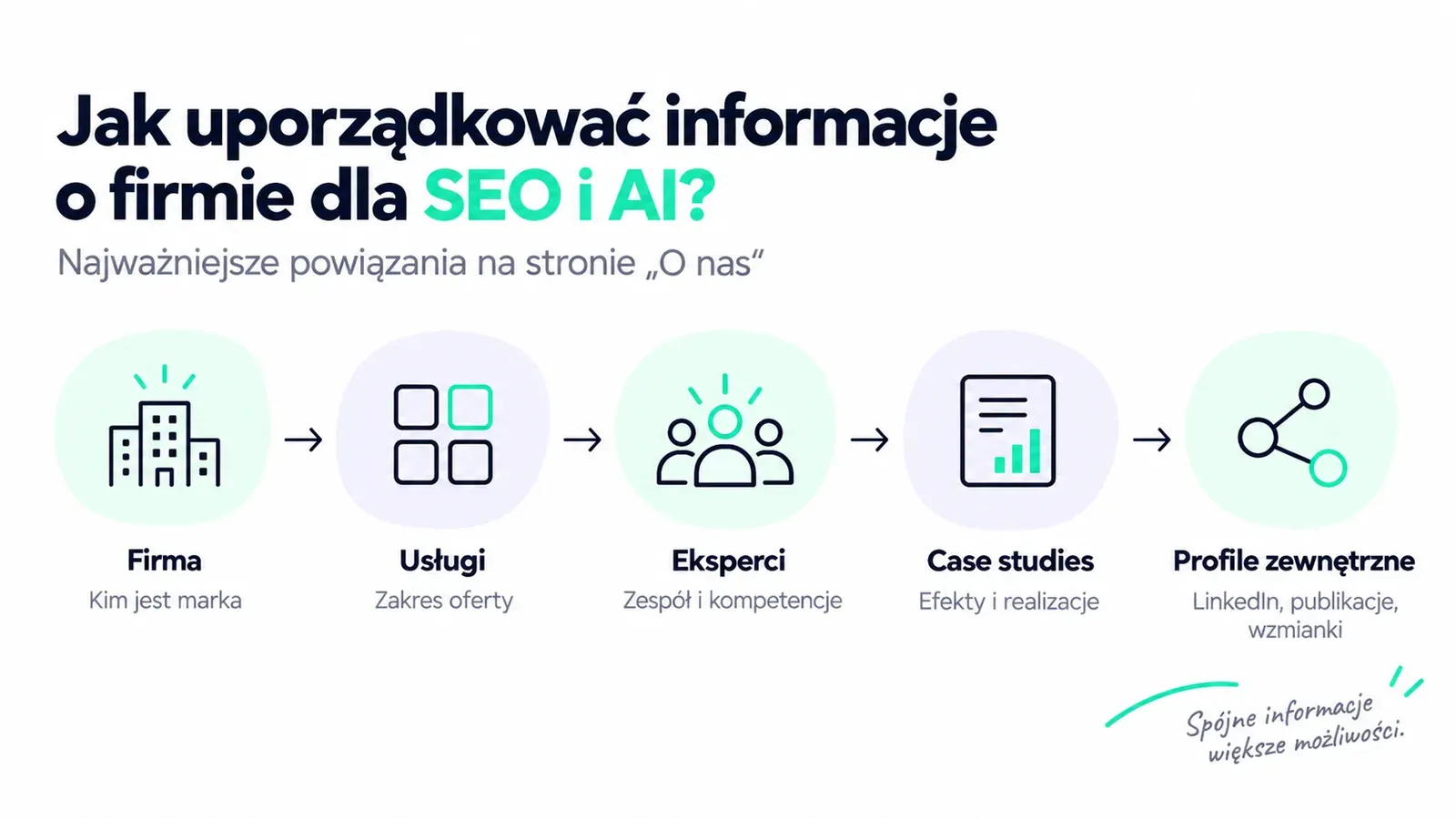
Unambiguous information about a company makes it easier for search systems and AI-based tools to correctly interpret what the brand does. In this context, GEO is also gaining importance, meaning activities aimed at improving brand visibility in generative search systems and AI-generated answers.
Concrete data is the foundation for SEO and AI: the scope of services, industries served, location, history, the team's competencies and consistent brand naming. If a company is described vaguely as a “partner in digital transformation delivering innovative solutions”, it's harder for systems to pin down exactly what it does. A clear statement is far more effective: “[Company Name] is a digital marketing agency providing SEO, performance marketing and content marketing services for the B2B and e-commerce sectors”. A statement like this is immediately understandable both to a human reader and to a system analysing the content.
For the page to give search engines and AI systems clear context about the company, it's worth taking care of three elements:
- A structure geared towards direct answers: it's worth placing the most important information about the business profile at the start of each section, then expanding on the details in the following sentences. Customer questions can be used as H2 or H3 headings if they match users' real needs.
- Deliberate internal linking: an About Us page shouldn't be a dead end. Links to service pages, case studies, blog posts or expert profiles help search engine crawlers connect the brand with specific topics and build context for the whole site.
- Structured data: on a page presenting a company, you can use
Organizationdata, which helps organise information about the organisation. If experts have their own profile pages, you can also considerProfilePagemarkup with a person marked asPerson. Structured data helps Google interpret the information on a page, but it doesn't guarantee better rankings or a particular way of being displayed in results.
It's worth remembering one more thing: don't create separate pages for near-identical phrases like “about us”, “about the company” or “company profile”. Instead of spreading the site's potential thin, it's better to build one strong page that fully serves the user's intent, gives algorithms hard facts, and has a clearly defined place in the site's architecture.
Is it worth adding an FAQ to your About Us page?
An FAQ can be useful if it answers questions that genuinely come up before a customer starts working with you. It's not worth adding one purely because “it's good for SEO”.
You can gather questions from sales conversations, contact forms, messages from clients or things that come up repeatedly in first meetings.
Example topics include:
- what kinds of companies you most often work with
- which services are handled in-house
- who's responsible for the project
- what starting a collaboration looks like
- where you can see past work
- whether the company works with clients from particular industries or markets
An FAQ remains a useful content format, but it shouldn't be treated purely as a technique for boosting visibility. Its primary function is to let the user quickly find information that might matter before they start working with you.
Call to action on your About Us page: what next step should you suggest?
A good About Us page shouldn't end without pointing to a next step. That doesn't mean every CTA has to lead straight to a sales form, though.
Someone who's only just discovering the brand may not be ready to get in touch. Some users will want to see past work first, others will move on to the offer, the team, or case studies. That's exactly why it's worth matching the call to action to where the reader is in their journey.
After presenting your experience, you can invite people to check out your projects. Next to the team section, invite them to get to know the experts. After describing how you work, you can suggest a consultation or a move to the contact form.
At the end of the page, a CTA leading straight to starting a conversation works well, but it should follow naturally from what came before. If the page has presented evidence, people and a way of working throughout, a message like “Let's talk about your project” will be a natural continuation. When only slogans have appeared before it, even the best button won't build the credibility that's missing.
For brands with a longer buying process, an alternative can be signing up to a newsletter, downloading a resource, or moving on to case studies. Conversion doesn't always mean sending an enquiry on the first visit.
Modular content structure: how to avoid rewriting your description from scratch
The key to building a page that stays relevant is separating the foundations of the business from the details that change quickly. The mission, the approach to customers, and turning points in the brand's history stay relevant for years. What changes is the make-up of the team, specific numbers, awards won and current case studies.
To avoid rewriting the text from scratch every year or so, it's worth designing it modularly. Weave your fixed content in with sections that are easy to update, such as tiles with key metrics, a reviews widget, or a dynamic list of experts. This keeps the whole structure stable, and an annual review comes down to a quick update of the data and any new work.
A good About Us page starts with specifics
An effective About Us page doesn't have to be long, but it should contain information specific to that particular company. Its job is to back up the brand's claims with hard evidence. The reader should quickly understand what the company does, who its offer is aimed at, and what working with it looks like. History and team photos should supplement these facts, not replace them.
Before publishing, it's worth running a simple test: remove the company's name and read the text again. If the same description could sit on a competitor's website, it's still too generic.
Does your About Us page still sound too generic? At JustIdea, we help put your messaging, SEO and brand visibility in order, so your page does more to help you win customers.
FAQ: frequently asked questions about About Us pages
Does every company need an About Us page?
It doesn't always have to be a separate page, but information about the company should be easy to find. For services and online sales, it helps people judge the brand's credibility faster.
How long should an About Us page be?
Long enough that the most important information can be found quickly. It's better to have a few clearly defined sections than one long description with no clear structure.
Does an About Us page affect SEO and AI?
Indirectly, yes. Consistent, up-to-date information helps better connect the brand with its business, services and experts.
Is it worth including your company's registration details on the About Us page?
Yes, if they add transparency and make it easier to verify the company. Full details can also go in the footer or on the contact page if there's no need to feature them in the main content.
Should an About Us page have its own contact form?
It doesn't need one. A clear CTA leading to contact, a consultation or the relevant page is enough, as long as the user easily understands what next step they can take.