














In the world of SEO and content marketing, one term keeps coming up more and more often: topical relevance. It has become one of the key factors influencing a site's position in Google. But what exactly is topical relevance, how do you build it, and why should it be the foundation of every content strategy? In this article, we show you how to use this concept to increase the visibility, authority and effectiveness of your marketing activities.
What is topical relevance and why does it matter so much in SEO?
Topical relevance is a website's ability to cover a given topic comprehensively, not through a single piece of text, but through a whole network of logically connected content. It's precisely these thematic connections that make Google recognise a site as a valuable source of knowledge.
Unlike the old approach to SEO, which relied mainly on keywords, topical relevance promotes depth of content, consistency and context. Importantly, topical relevance is not the same as topical authority. The first refers to the structure of the content, the second to the perceived authority of the site.
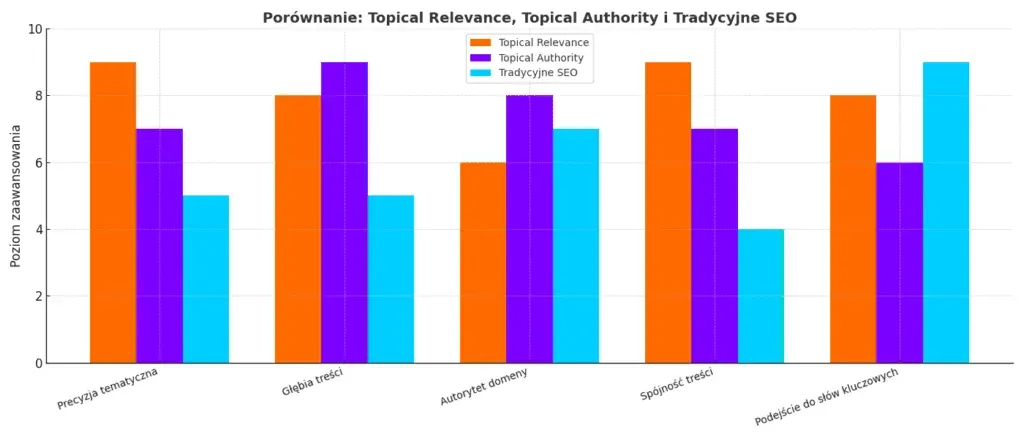
How does topical relevance work in a content marketing strategy?
Today, Google analyses not just what you write, but also how comprehensively you approach the topic. If you only create content aimed at individual phrases, your site won't be recognised as an expert source. But if you build a whole ecosystem of content around a single topic, you increase your chances of ranking highly.
Topical relevance in content marketing means creating thematic groups of content, linked together by internal links, shared subtopics and a shared user intent. The result? Greater clarity for Google, better indexing and a better user experience.
Building topical relevance step by step
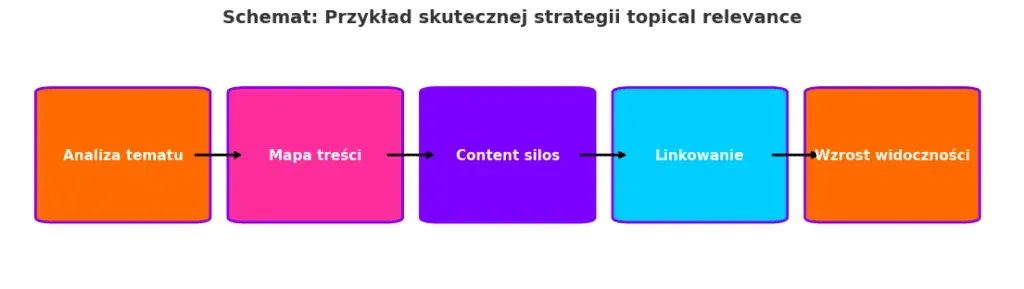
Effectively implementing topical relevance is a process that requires planning and consistent execution. The key steps are:
- Choosing your main topic - one consistent with your business profile.
- Selecting keywords - not just the main ones, but also semantically related ones.
- Creating a content silo structure - that is, groups of logically related content.
- Internal linking - connecting all the subpages into a coherent structure.
- Monitoring and updating - because topical relevance is a process, not a one-off action.
The most common mistakes that destroy your topical relevance
Many businesses start creating content without a well-thought-out strategy. This leads to topic duplication, scattered focus and a decline in the site's authority. Here's what's worth avoiding:
- Random topics - no connection to the site's main subject matter
- No internal linking - pieces of content don't connect to each other logically
- Poor keyword selection - no match with user intent
- No content structure - disorganised information architecture
- Content that's too generic - doesn't build expert value
An example of an effective content marketing strategy built on topical relevance
Say a company offers marketing automation tools. Instead of a single article about "marketing automation", it creates a whole series of related articles: about the tools themselves, data analysis, campaign automation, common mistakes and so on.
Each article links to the others, and together they form a logical content map. This helps Google better understand that the site is an expert in its field, which translates into:
- higher search rankings,
- more organic traffic,
- greater trust from your audience.
Summary and what's next?
Topical relevance is now the foundation of effective content marketing. If you want long-term SEO results, you need to think in terms of topics, not just keywords. Build content deliberately, create topic maps, group articles into silos and take care of your internal linking. It's a strategy that delivers results, both in rankings and in how clients perceive you. Want to implement topical relevance in your business? Get in touch with Justidea and we'll help you build an effective, well-thought-out content strategy.
See also: