














Did you know that updated content sees almost 50% more organic traffic compared with content that's never refreshed?
Content recycling has stopped being just a way to save time. In 2026, it has become a key part of AI optimisation strategy, especially now that Google AI Overviews appear in an ever-growing share of searches, and news-related queries in ChatGPT are growing at a dizzying pace.
In this article, we'll show you how to refresh old articles, increase your visibility in AI, and write content for AI in a practical, measurable way.
Content Recycling: What It Is and Why It Matters
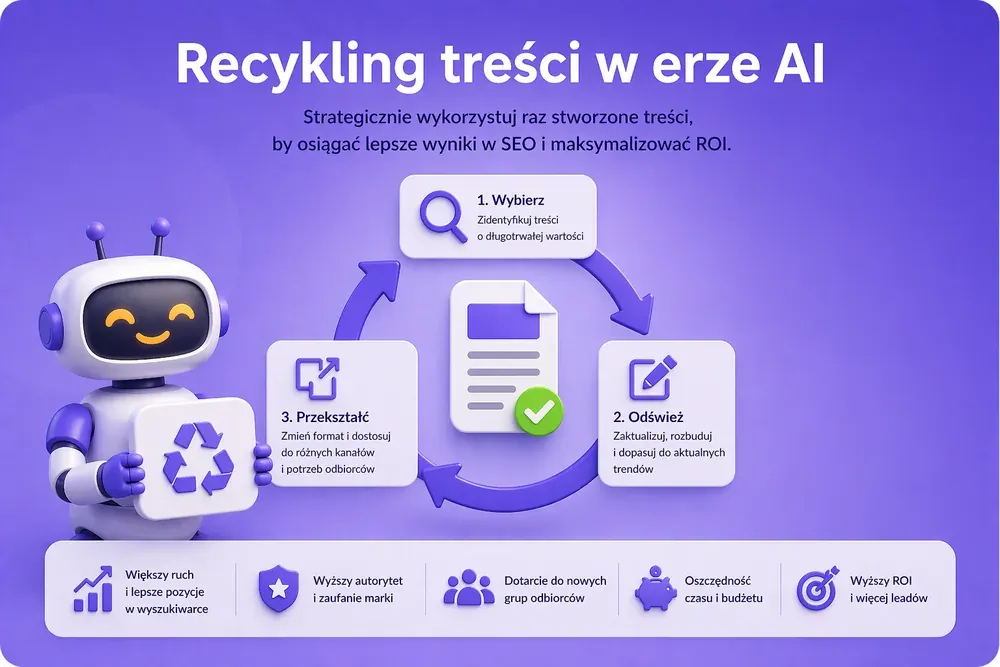
Content recycling is the strategic process of reusing previously prepared material by updating, modifying, reformatting, or expanding it. In practice, this covers both making changes to published content (revamping) and turning a single piece of content into several different formats suited to the specifics of individual communication channels.
Modern content recycling goes far beyond simple copying and pasting. It's a considered strategy that lets companies achieve a much higher ROI through consistent publishing. Data shows that a large majority of marketers repurpose their content, treating this practice as a key part of an effective strategy.
The recycling process involves identifying content with long-term value, updating it, and turning it into new formats so it better matches current trends and audience needs. The most valuable formats for recycling are long blog articles, reports and case studies, webinars and video recordings, expert interviews, and step-by-step guides.
The Evolution of SEO in the AI Era
Google has been using machine-learning-based algorithms for years. RankBrain analyses the intent behind user queries, BERT allows for a better understanding of the context of search phrases, and MUM understands and processes queries across different languages. AI Overview doesn't just display traditional lists of pages, it also generates detailed answers to users' questions, which reduces the number of clicks on organic results.
Google is placing more and more emphasis on E-E-A-T (Experience, Expertise, Authoritativeness, Trustworthiness). AI algorithms effectively assess content quality, so artificially padding text for SEO is no longer working. AI analyses search history, location, and user interest to deliver personalised results.
For effective branding strategies, it's crucial to get the maximum value out of every piece of content produced. What's more, modern tools for automating content recycling currently save a good deal of time compared with traditional content creation methods.
The Benefits of Refreshing Old Articles
According to current data, changing the publication date and refreshing posts can increase their impressions by up to four times. It's also worth noting that content marketing now costs significantly less than traditional marketing methods, while generating three times more leads than it used to. Companies that use content marketing achieve a significantly higher ROI than those that don't.
Content recycling supports the SEO process by removing cannibalisation and refreshing content. It helps keep the site organised and makes style and tone of voice consistent, especially when content is created by several people. It also lets you reach new audience groups and increase the number of potential customers.
Evergreen content keeps its value and relevance for a long time after publication. Unlike seasonal content, which quickly loses relevance, evergreen content generates steady traffic to the site, builds brand authority, and is cost-effective.
Content Audit for AI Visibility
Before you start refreshing old articles, carry out a thorough audit of their current visibility within the AI ecosystem. In 2026, analysing Google rankings alone is no longer enough. It's just as important to check whether your content appears in the answers from ChatGPT, Perplexity, Gemini, and Google AI Overviews.
Tools for Analysing AI Visibility
Monitoring AI visibility relies on three proven technical mechanisms. Prompt probing involves sending thousands of queries to different models and analysing whether your brand's name appears in the answers. Poll-based methodology eliminates random error through repeated tests on a representative sample. RAG tracking monitors which external sources a model pulls in real time, revealing whether your site is a trusted source for AI.
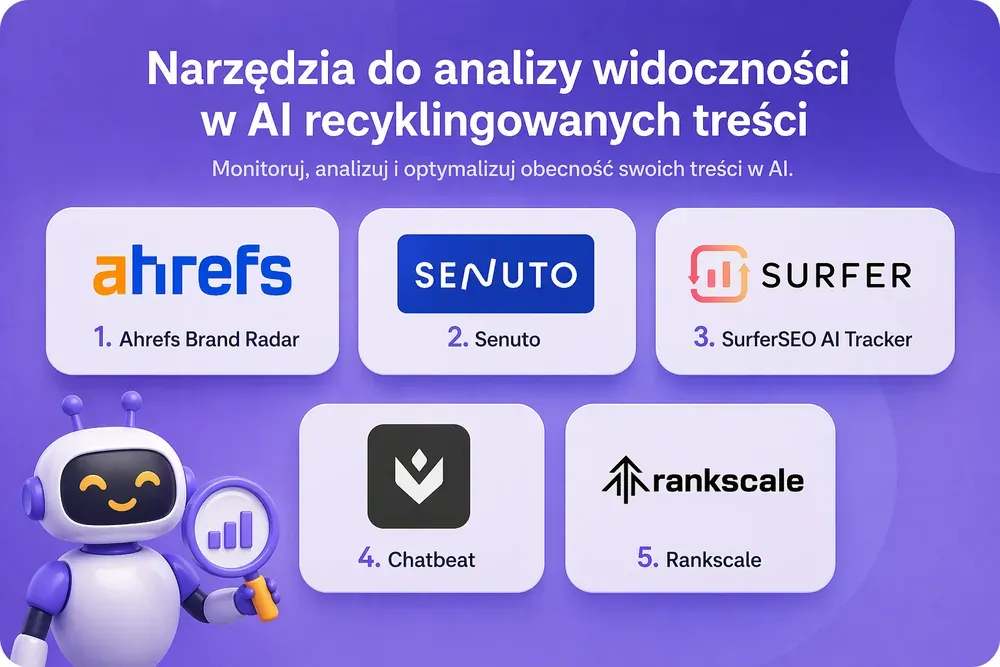
In practice, it's worth using the following platforms:
- Ahrefs Brand Radar monitors visibility in Google AI Overviews, ChatGPT, Gemini, and Perplexity, showing the correlation between brand mentions and AIO visibility
- Senuto offers native data for the Polish market, where a share of searches trigger an AI Overview
- SurferSEO AI Tracker tracks Prompt Coverage, Citation Share, and Assistant Recall in one dashboard
- Chatbeat monitors eight key AI models with a Brand Score showing brand exposure from 0 to 100%
- Rankscale simulates queries daily or hourly, providing a score for how AI-ready your site is
Assessing E-E-A-T Compliance
E-E-A-T stands for Experience, Expertise, Authoritativeness, and Trustworthiness. Google added the extra “E” in December 2022 in response to the growth of AI-generated content. Experience is the main thing that distinguishes text written by a human from text written by AI.
During the audit, check the authors' biographical notes for real photos and descriptions of their professional experience. Check whether the biography links to external publications and social media profiles that confirm their expertise. Assess authoritativeness using tools that monitor mentions online, such as Brand24 or SentiOne. Compare your Domain Authority (Moz) or Domain Rating (Ahrefs) scores with your competitors.
Trustworthiness, meanwhile, is built by SSL certificates, address details in the footer, and referencing the data sources used to create the content. Tools such as Google Search Console, Ahrefs, SEMrush, or Majestic let you analyse your backlink profile, domain authority, and brand mentions.
Identifying Content Gaps
A content gap is the difference between what your site covers and what users are actually looking for. Audit your current content, checking its substance and how up to date it is. Then analyse the search results for key phrases related to your industry. Identify your competitors and analyse their content and keywords.
Compare your site with your competitors, identifying areas where you're lacking. It's also worth drawing up a plan straight away for filling those content gaps, adding valuable material such as guides or instructions. Gaps can arise from a lack of content answering specific queries, missed keywords, or topics covered too superficially.
Analysing Competitors in AI Overviews
With Google AI Overviews, the SERP landscape is changing drastically. The generative summary takes up almost the entire first screen on mobile, naturally lowering CTR for organic results. More and more searches on Google Poland trigger an AI Overview. As a result of these changes, more and more sites are losing organic clicks, and this is a trend you can't simply work around. What you can do, however, is increase your chances of generating visits from the AI Overview section itself by being cited in the answer Google generates.
To do this, monitor which of your competitors' pages are already cited in AI Overviews, and which organic positions they hold. Check what kinds of queries their content appears for. This will let you identify the structural and topical patterns AI prefers when generating answers, and adjust your optimisation work accordingly.
The Process of Refreshing Articles for AI
An effective process for refreshing articles requires a methodical approach that combines SEO optimisation with the new requirements of AI search engines. In practice, you should start by clearly marking the changes for both users and Google's crawlers.
Updating SEO Content: Where to Start
Start with an audit of the specific article, marking any sections that are outdated, inaccurate, or need improving. Then carry out keyword research, checking whether the phrases you originally optimised the text for are still popular. In Google Search Console, you can identify new keywords the article is already ranking for naturally.
Focusing on articles ranking in positions 11-20 in Google results often brings the fastest results. Also identify texts with high impressions but low CTR, and material with falling organic traffic. It's worth focusing on articles containing outdated statistics, legal regulations, prices, or product rankings.
Adding New Information and Context
Introduce up-to-date data and statistics wherever the text references outdated sources. Google prefers fresh figures, and readers appreciate them too. Add new sections covering aspects of the topic that have emerged since the article was first published. On average, it's worth changing around 30-40% of the content in a refreshed article.
Expand the article with new user questions found in Google Search Console, creating FAQ sections. Improve the structure by reviewing the hierarchy of your H2 and H3 headings, breaking long blocks of text into shorter paragraphs. Articles with images, charts, or tables have a higher CTR in search results.
Optimising for AI Search Engines
AI models don't read articles linearly. They need a map of the terrain in the form of a clear, hierarchical structure. Each level of heading adds precision: metadata defines the context, the H1 confirms the focus, H2s divide the content into logical sections, and H3s spell out individual aspects.
A question-and-answer format mirrors the way questions are asked of AI. An effective Q&A is built from a specific question plus a concise answer containing figures or verifiable information. AI works better with content that has a clear structure, concrete definitions, and logical connections between sections.
Add Schema structured data that tells AI directly what type of content it's looking at. Use Article, FAQPage, or HowTo depending on the nature of the material. The length of your FAQ answers matters too: 2-4 sentences, around 40-320 characters, work best.
Adding Interactive Elements
Interactive content requires active participation from the audience and allows them to engage with it. According to the data, most users prefer interactive content. On top of that, audiences remember a brand better when it uses interactive content.
Add calculators, quizzes, or polls that increase user engagement. Interactive infographics let people explore data in a more engaging way. Enrich video with interactive elements such as buttons, quizzes, or mini-games. Content with interactive elements is twice as likely to be shared on social media.
Publishing and Promoting Refreshed Content
Change the publication date to today's date and mark the article as updated in its structured data. Add a note at the top of the article stating the update date. Submit the updated post in Google Search Console and request re-indexing: this will help Google's crawlers discover the changes faster.
Don't change the URL of an article that's already been indexed. Update the meta title and meta description, showing users right in the search results that the content is up to date. Promote refreshed material in your newsletter and on your social media profiles as an “Updated 2026 guide”.
How to Increase Your AI Visibility Through Content
Writing Answers to Specific Questions
Interactions with AI platforms are fundamentally based on questions. Users don't type in keyword fragments, they ask full questions in natural language. A question-based strategy involves mapping your audience's real queries and creating content that answers them directly.
To identify the questions people are actually asking, it's best to use the right tools. QuestionDB, for example, instantly generates content ideas by scanning the internet and surfacing the questions people actually ask online. AnswerThePublic uses autocomplete data from Google and Bing, presenting popular questions in an easy-to-read visualisation with question words such as who, what, where, when, why, and how. BuzzSumo, meanwhile, uses its Question Analyzer feature to aggregate questions from forums like Reddit, Quora, and Amazon, showing what users are genuinely looking for.
In practice, start with ten to twenty priority questions directly related to your offer and showing clear purchase intent. Each question should become the basis for a piece of content designed as the definitive answer, with the question in an H1 or H2 heading, a comprehensive answer addressing the full intent, and an FAQ section covering related questions.
Using AI for Content Recycling
Tools such as ChatGPT, Gemini, or Claude significantly simplify the content recycling process and let you create new, valuable variants of your material faster. AI helps with summarising long articles, rewriting content in a different style, creating a shortened version for social media, preparing a newsletter, adding an FAQ section, and even generating new headings or SEO-friendly meta descriptions.
This means you can ask AI something like: “Turn this article into 5 LinkedIn posts. Each post should be 150-200 words long and start with a question.” Prompts like this also work well: “Based on this excerpt, create a LinkedIn post of up to 1,200 characters. Use the tone of an expert sharing their experience. End with a question that encourages comments.”
Creating Different Formats From One Piece of Content
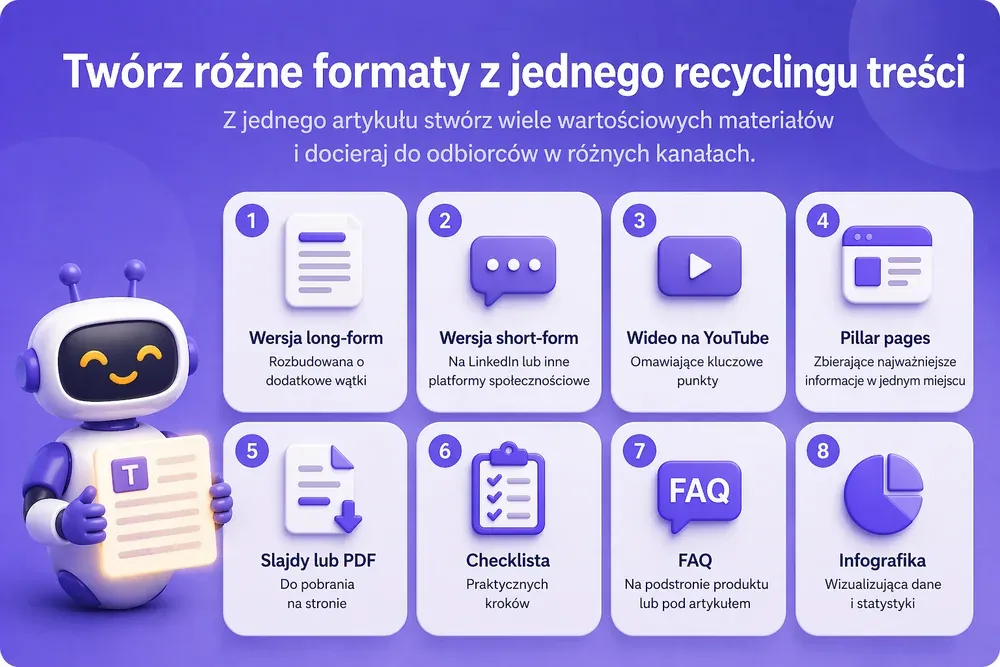
Content recycling isn't just about updating text, it's also about creating many variants of the same content. From one comprehensive article, you can create:
- A long-form version expanded with additional threads
- A short-form version for LinkedIn or other social platforms
- A YouTube video covering the key points
- Pillar pages gathering the most important information in one place
- Slides or a downloadable PDF for the site
- A checklist of practical steps
- An FAQ on the product page or beneath the article
- An infographic visualising the data and statistics
One article is often 10-20 micro-pieces of content that you can use separately as quotes, statistics, case studies, or lists of mistakes or tips. Visual formats do great on social media: based on an article, you can create an infographic, a carousel, a roadmap, a table, or presentation slides. This means a single piece of content lets you build visibility and your brand across a range of different channels.
Internal Linking and Building Structure
Internal linking plays a key role in a site's SEO, affecting not just its visibility in search results, but also how users and search engine algorithms assess its content. Properly implemented internal linking helps search engines understand a site's structure and the relationships between different pages, which contributes to more effective indexing of content by search engine crawlers.
Internal links should be placed naturally within the content, matching the topic and message of the given page. The link structure needs to be well thought out, connecting related URLs and topics with each other. The most internal links should point to the addresses containing the content that matters most to you. Correctly implemented internal linking helps you avoid pages competing against each other for a position in search results, so-called cannibalisation.
Measuring Results and Optimising
Monitoring the results of content recycling requires a new approach that goes beyond traditional Google Analytics metrics. In practice, you need to watch both classic organic rankings and your presence in AI-generated answers.
Tracking Rankings in Google and AI
Google Search Console doesn't provide a direct report on AI Overviews, but it does let you detect their impact indirectly. The first pattern is rising impressions alongside falling CTR: a keyword generates more impressions, but clicks fall despite a stable position. The second pattern is a stable position with declining clicks, especially for informational keywords like "what is it" or "how does it work".
Senuto, meanwhile, already offers native data for the Polish market for AI Overview queries. You can also build a dashboard in Looker Studio (formerly Data Studio), filtering for keywords with a position ≤10, impressions ≥50, and CTR <1%, comparing the current CTR with the figure from six months ago.
Analysing Traffic From AI Tools
Log into Google Analytics 4 and create an exploration report with the dimensions Snippet Start, Snippet End, and Landing page + query string. The fragment #:~:text= in a URL identifies traffic from AI Overviews, which can also make it easier to measure citations. It's also worth knowing that a referrer from an AI Overview often contains the parameters sca_esv and sxsrf, which you can use for conditional filtering.
Traffic from language models often arrives as direct/none because there's no referrer. A sudden increase in direct visits to specialist pages can signal that you're being cited by an AI chatbot.
Testing and Iteration
To check precisely whether, after recycling, your content has moved into the relevant model citations, you need to run repeated tests over a longer period of time. A/B tests let you compare two versions of the same element to identify the more effective option. It's worth testing one element at a time, letting the test run for at least a full week, and making sure your sample of users is large enough for statistical significance.
Avoid testing too many elements at once, and don't end tests before you've gathered enough data. Too small a sample of users leads to unrepresentative results.
Content Recycling as a Real Way to Increase Visibility
Content recycling in the AI era has stopped being optional. It has become the foundation of an effective online visibility strategy. We now have everything you need in one place to refresh old articles and increase their presence, both in Google and in answers generated by ChatGPT, Perplexity, or other language models.
To sum up, start by auditing your content, identify the material with the greatest potential, and update it systematically. In practice, the best results come from focusing on articles ranking in positions 11-20, and content with high impressions but low CTR.
Remember that the key to success is consistency, a structure that answers users' specific questions, and regularly measuring your results. The results will come faster than you think!
Check Out Also: