














Ranking in ChatGPT is not about arranging pages in order, but about selecting the content fragments that will be used to generate an answer. This is a fundamental shift compared with Google. Visibility no longer comes from your position in the results, but from whether your content is used as a source.
Language models such as ChatGPT, Gemini and Copilot are changing the way information is consumed. The user no longer browses a list of links, but receives a ready-made answer. In this model, it is not pages that win, but the specific content fragments that best answer the question.
This means classic SEO is evolving. Content quality and technical foundations still matter, but something else becomes key: whether your content is understandable, complete and ready for AI to use.
In this article, you will learn the 5 most important factors that decide whether ChatGPT uses your content as a source for its answers.
What is "ranking" in ChatGPT and AI Search?
Ranking in ChatGPT is the process of selecting the content fragments that best answer the user's query, not a classic list of results. AI does not show positions 1-10. Instead, it analyses the available content and builds an answer based on it.
The most important change is the unit of analysis. In SEO, you optimise a page or subpage. In AI Search, you optimise fragments of content. This means every section must be understandable and complete on its own.
A language model does not "read" a page in full. It selects specific fragments that match the question, then uses them to generate an answer. That is why content must be designed as a set of logical blocks, not one long text.
In practice, whoever provides the most relevant, unambiguous and easy-to-use answer wins.
Also read: SEO for AI Answers: how embeddings and RAG affect content visibility
How does ChatGPT "rank" content in practice?
The content selection process in ChatGPT is based on three elements: finding matching fragments, selecting the best context and generating the answer. The model first identifies content that is semantically related to the query, then selects the most relevant fragments, and finally builds the answer.
The key point is that the decision is made at the fragment level, not the whole-page level. AI assesses which parts of the content best answer the user's intent and uses only those. It is precisely this mechanism that makes the structure and quality of individual sections have a direct impact on visibility.
At this stage, specific factors come into play that determine whether the content is chosen. These are what decide the "ranking" in AI Search.
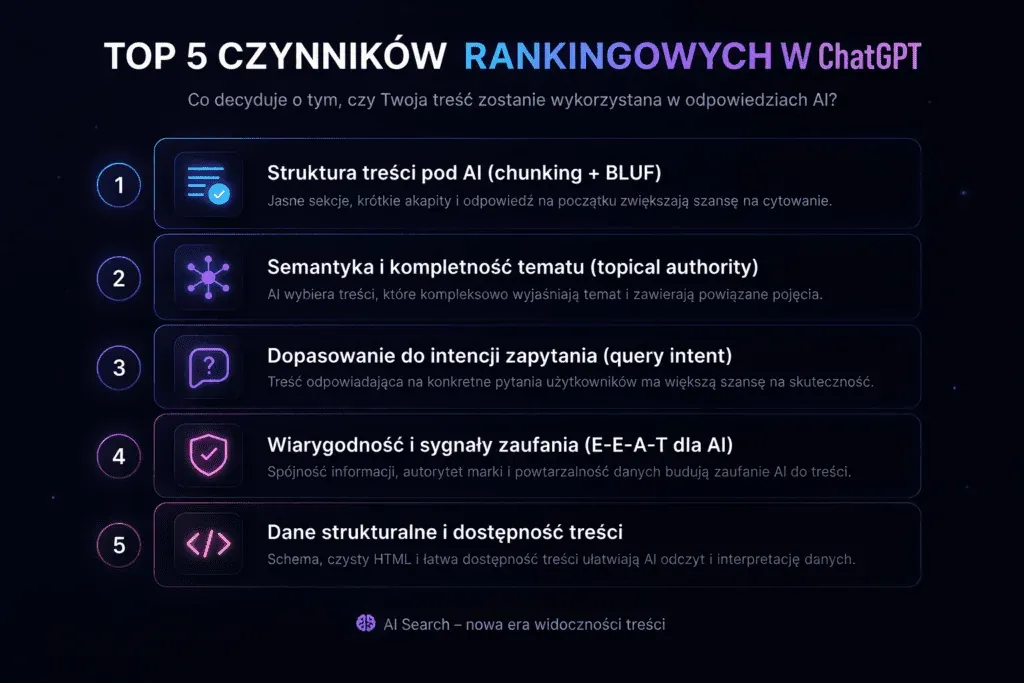
Top 5 ChatGPT ranking factors
Ranking factors in ChatGPT are not the equivalent of those known from Google. They do not decide a page's position, but whether a content fragment is used in the answer. AI analyses structure, semantics and match to the query, then selects the most useful fragments.
In practice, this means ranking in AI Search is based on the quality of the answer, not on optimising for specific keywords. Below you will find the 5 key elements that really affect visibility in ChatGPT.
1. Content structure for AI (chunking + BLUF)
The most important ranking factor in ChatGPT is a content structure that lets AI easily understand and use fragments. Language models do not analyse entire articles as one block. They split content into smaller parts and select the most relevant ones.
That is why chunking, meaning splitting content into logical sections, is crucial. Each section should answer one specific question or topic. In addition, using BLUF (answer up front) increases the chance that a fragment will be used by AI.
Content that is long, chaotic and not divided into sections has a much smaller chance of being used. AI needs clear, self-contained blocks of information.
2. Semantics and topic completeness (topical authority)
AI selects content that comprehensively covers a topic and includes related concepts. The mere presence of keywords is not enough. What matters is context and depth of the topic.
Language models analyse the relationships between concepts, known as entities. If content explains a topic broadly and covers various aspects and dependencies, it has a greater chance of being used.
A lack of semantics means a lack of context. In that situation, AI will choose another source that explains the topic better.
3. Matching query intent
ChatGPT operates at the level of intent, not individual keywords. The user asks a question, and AI looks for the answer that best solves their problem.
That is why content must be matched to specific scenarios: definitions, instructions, comparisons or purchase decisions. Sections such as "what is it", "how does it work", "why" or "how much does it cost" significantly increase the chances of being used by AI.
Content written purely for keywords, without taking intent into account, is less useful for language models.
4. Credibility and trust signals (E-E-A-T for AI)
AI prefers content that is consistent, credible and repeated across different sources. If a piece of information appears in multiple places and is consistent, the model treats it as more trustworthy.
The brand also matters. Recognisable sources and consistent communication increase the chance content will be used. AI avoids information that is inconsistent or contradictory.
In practice, this means building topical authority and content consistency has a direct impact on visibility in AI Search.
5. Structured data and content accessibility
Content must be accessible and readable by systems in order to be used. Structured data helps organise information and makes it easier for models to interpret.
The availability of content in HTML and the absence of technical barriers also matter. If content is hidden, hard to read or disorganised, AI has trouble using it.
Technical foundations still matter, but their role is to enable access to content, not to have a direct impact on ranking.
Summary: how to "win" the ranking in ChatGPT?
In ChatGPT, it is not the page that wins, but the answer. Visibility depends on whether your content is deemed the best source for solving the user's problem.
Three elements are key: content structure, semantics and matching intent. These are what decide whether a fragment is selected and used by AI.
SEO is not disappearing. Its direction is changing. Optimising for AI Search means designing content so that it is not only well visible, but above all useful as an answer.
The better your content answers specific questions, the greater the chance it will become part of the answer generated by AI.
Also read: