














AI Answers Is Changing SEO: Why Keyword Matching Is No Longer Enough
A few years ago, you could build visibility in Google mainly with a simple formula: pick a phrase, build a page "for that keyword", add meta tags and links, and fight for a position. This model still works, but it is increasingly not enough. The reason is simple: users are less often looking for a list of results and more often for a ready-made answer. And since the answer is generated by an AI system, the content that wins is the content AI can quickly understand, compare and safely cite.
From Search Results to "Answers"
In the world of AI Search, the logic of visibility is shifting from "ranking pages" to "selecting fragments of information". This is exactly why the concept of AI Answers / answer engines has emerged: the user asks a question, and the system doesn't just present results, it assembles an answer from them. In practice, this means you can have a good page and even a decent position, and still not be the source AI chooses for its answer. The key mechanism behind this is RAG (Retrieval-Augmented Generation). This approach works by having the model first search for matching content in a document base before it generates an answer, and only then summarise or combine it into a final response.
Visibility in AI Means Being "Retrievable", Not Just "Optimised"
This is where we get to the heart of it: for AI systems, what matters is not only whether a page contains a given keyword. What matters is whether the content can be efficiently "extracted" as a relevant fragment and matched to the intent behind the question. Google's documentation describes this process as the cooperation of two stages: retrieval and ranking, where you first search for candidates and then order them by relevance. This shifts the weight of optimisation towards semantics. Instead of the question "do we have the phrase in the text?", the question becomes "is our content the best answer to the user's problem, and can the AI system recognise that?".
What Does This Mean for Businesses and Marketers?
In practice, visibility in AI Answers is becoming a real source of traffic and leads, but only when the content is prepared in a way that supports three things:
- Semantic matching (embeddings, semantics),
- Easy extraction of fragments (chunking and structure),
- Relevance of the answer (ranking / reranking).
This is an important distinction, because embeddings are excellent at measuring semantic similarity, but on their own they don't always answer the question "does this document actually provide an answer". Google explicitly points out that reranking can give a more precise result than embeddings alone, because it evaluates the quality of the answer to the query. And this is where the business conclusion comes in: even if your page is "about the topic", AI may decide it isn't the best material for the answer, and cite a competitor with a better structure, definitions, examples and more "answer-ready" content.
This is exactly why SEO for AI Answers isn't just another trend to tick off, it's a change of standard: you need to design content so that it ranks well in Google and is ready to be used by AI models at the same time.

What Are Embeddings and Vector Representations
Embedding is a representation of text (or another type of data) as a vector of numbers that preserves information about meaning. In other words: instead of treating words as a "string of characters", the AI system converts them into numbers that describe the sense of the statement, which lets it compare content semantically rather than just by identical phrases.
Embedding in One Sentence: A Definition AI Can Easily Cite
Embeddings are vectors of meaning: numerical "fingerprints" of text that let you measure the similarity between a query and content based on sense, not a literal match of words.
How AI Turns Content into a Vector (Without the Maths)
The process looks simple from the user's perspective, though a lot happens underneath. A language model takes a piece of text and maps it to a point in a multidimensional space. Texts with similar meanings land "closer together", and texts with different meanings land "further apart". This is exactly why the system can recognise that two differently worded sentences are about the same problem and should return similar results.
In practice, embeddings are used at the search (retrieval) stage to quickly find documents or fragments of content that "match in meaning" the user's question. Only later, depending on the system, are the results further ordered and evaluated for whether they actually answer the question.
Why Vectors "Capture Meaning", Not Just Words
For years, classic SEO was based on the idea that a specific keyword should appear in strategic places. In the semantic approach, what becomes more important is whether the content covers the topic coherently and answers the intent. Embeddings help measure this, because they can recognise semantic closeness even when the vocabulary is different.
A real-life example. One user might type "optimising content for AI answers", another "how to write content that AI cites". These aren't identical phrases, but the sense is very close. If your article has a section that clearly explains the mechanism AI systems use to select sources and gives practical rules for preparing content, embeddings will "see" the similarity and can pull your page in as a candidate for the answer, even if you don't use exactly the same phrase in every paragraph.
What This Means for SEO and On-Page Content
From an SEO perspective, this means a shift in priorities. It's not about cramming in as many keyword variants as possible. It's about making the content semantically complete: including definitions, explanations of "how it works", examples and clear answers to user questions. This kind of content is better for people and easier for AI systems to use at the same time.
In a sales context, this has a very concrete consequence: if your landing pages and articles aren't written "for answers", you may be losing visibility exactly where the user makes a decision, in a ready-made AI answer. That's why, at JustIdea, we combine classic SEO with designing content for semantics and AI Search in practice: from information architecture, through section structure, to optimising the fragments with the best chance of being cited.
Vector and Semantic Search: How AI Selects Content for Answers
Vector search is one of the key mechanisms behind how AI systems select content for answers. Instead of checking whether a given phrase appears literally in the text, the system compares the semantic similarity between the user's question and fragments of content. This is exactly why, in the AI era, the pages that win are increasingly those that describe a topic broadly and logically, not just those that "hit the keyword".
Semantic SEO: Optimising for Meaning, Entities and Intent
Semantic SEO is an approach where you focus on what the user wants to achieve (intent) and which concepts and relationships are needed to explain the topic completely. In practice, this isn't about repeating the same phrase in several variants, it's about building content as a map of concepts: definitions, context, examples, applications, differences between concepts and typical questions.
Search engines and AI systems are getting better at recognising whether a page covers a topic coherently, and whether it addresses the user's real questions. This approach is naturally aligned with how embeddings work: "semantically rich" content usually has more points of contact with queries and matches better in semantic comparison.
What Makes a Page "Semantically Relevant"
If we had to reduce semantic relevance to a single criterion, it would be this: after reading this content, does the user really have an answer and can they move on to action? From AI's perspective, this means the content should contain not just generalities, but concrete information that can be used in an answer.
In practice, "semantically relevant" content shares a few common traits. First, it very quickly clarifies what the topic is about and sets the context. Second, it breaks the subject down into logical sections that can be cited independently of one another. Third, it moves from definition to practice: it shows how the topic affects business decisions, implementations, processes and results.
Example: Different Queries, Same Intent (AI Connects the Dots)
Let's imagine three queries:
- 1) "RAG SEO"
- 2) "how AI selects sources for its answer"
- 3) "optimising content for AI Answers"
At the keyword level, these are three different topics. But at the level of user intent, it's a very similar problem: "I want to understand how the AI answer mechanism works and how to prepare content to increase my visibility". Vector search lets the system notice this, because it compares meaning, not just linguistic form.
For SEO, this means an important shift: a single well-written article that fully explains the topic and gives practical conclusions can gather visibility across many different queries, even if not all of them contain the same phrases. This is exactly why, in semantics-based strategies, topical completeness (covering a topic to the end) often wins, instead of building dozens of thin pages for single keyword variants.
What This Means for Content and Sales Strategy
In a business context, vector search has a very simple consequence: if your content is written only for classic phrases and doesn't answer intent, you can be "invisible" in AI Answers even while you still hold decent positions in Google. This is especially important in industries where the user is looking for a specific recommendation, comparison or set of instructions, and the AI answer can become the first point of contact with the brand.
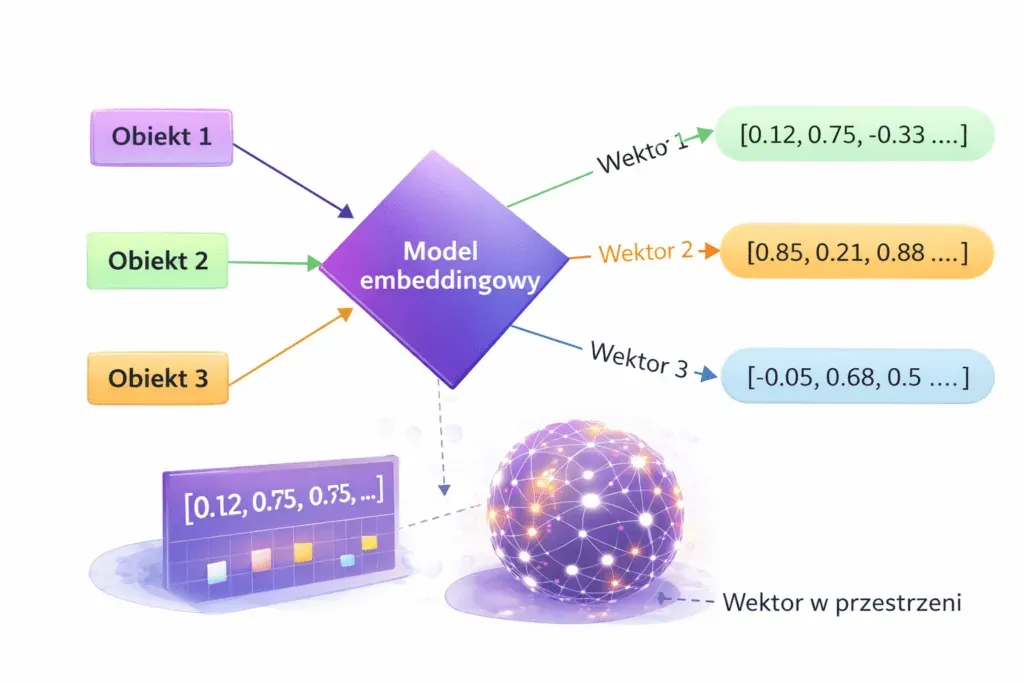
Example of a vector representation in SEO and AI
RAG in Practice: The Mechanism That Decides What AI Cites
If embeddings are the "language" AI uses to describe the meaning of content, then RAG is the mechanism that decides which sources are used to build the answer. The acronym RAG stands for Retrieval-Augmented Generation, and it can be understood as an approach in which the AI model first searches for matching information in documents, and only then generates an answer based on the context it found.
What RAG Is and Why It Exists At All
RAG is a way of combining search and content generation that lets AI answer questions based on specific sources, not just the "knowledge" stored in the model. This matters, because in many applications (especially business ones) what counts is currency, precision and the ability to point to where the information came from.
In an SEO context, this means one thing: your content can be not only a page to click on in search results, but also a source material that AI systems will use to build answers. If your content isn't easy to "extract" and understand, however, the model may skip it even when it's substantively good.
Retrieval, Ranking, Generation: What the Pipeline Looks Like
In practice, RAG can be broken down into three stages. This breakdown matters a lot, because it shows where SEO really has an impact on the outcome:
| Stage | What happens | What it means for SEO content |
|---|---|---|
| Retrieval | The system looks for the best matching fragments of content based on semantic similarity. | Content needs clear sections, definitions and fragments that are semantically "self-contained". |
| Ranking / reranking | Results are ordered to select those that answer the question best. | The fragments that win are the ones that answer the question directly, not just those that are "about the topic". |
| Generation | The model assembles the answer from the selected fragments (sometimes citing sources). | The more unambiguous the fragment, the greater the chance it gets cited or used. |
It's worth noting that the second stage can be critical. Semantic closeness alone (embeddings) isn't always enough, because "similar" doesn't mean "answering". This is why systems use reranking, which evaluates whether a given fragment actually solves the user's problem.
Why RAG Prefers Fragments (Chunks) Over Whole Articles
One of the most important reasons AI selects fragments instead of whole pages is efficiency. Working on shorter pieces of content lets the system:
1) search for matching information faster, 2) limit "noise" (unnecessary context), 3) build the answer from precise blocks that can be combined into a coherent whole.
This explains why a beautifully optimised article can still fail to be cited if it doesn't contain fragments that are self-contained answers. AI doesn't "read" a page like a human. AI more often "pulls out" a specific block of content that best matches the question.
Example: Blog vs Landing Page: Which Has a Better Chance of Making It into the Answer
Let's say the user asks: "What is RAG and how does it affect SEO?"
Variant A: a blog article has a section with a definition, followed immediately by a short explanation of the mechanism (retrieval, ranking, generation) and one practical conclusion for SEO. This kind of fragment is "self-contained" and very easy to use in an answer.
Variant B: a service landing page describes RAG only after several marketing paragraphs, without a definition, and the explanation mixes RAG with several other concepts. In this case, the system may decide it's hard to extract a clear answer fragment from it and look for a source elsewhere.
This doesn't mean a landing page can't be citable. It can, but it needs fragments that are "answer-ready" and set in a clear context, not hidden inside a general description of the offer.
Example: One Question, Several Types of Sources
Let's take another question: "How do you prepare content for AI Answers?"
In RAG-based systems, this kind of context-selection pattern often appears:
- • a short definition from an educational article (what AI Answers is),
- • a list of rules from a guide (how to write fragments for citing),
- • a fragment from documentation / analysis (why chunking and structure matter).
This is why the strategically strongest content combines all three elements: definitions, how the mechanism works and practical application. It's exactly in this kind of layout that AI systems most often find fragments suitable for use as an answer.
Conclusion: RAG Rewards Content That Answers in "Fragments", Not Generalities
If you want to increase the chance that your page is used as a source in AI Answers, you need to start thinking of your content as a collection of fragments that can be retrieved and used in a specific context. In the following sections, we'll go through the elements that most affect this process: chunking, semantic matching and the difference between similarity and real answer relevance.
Chunking Content for AI Answers: How to Write So AI Extracts the Right Fragments
If RAG is the mechanism that "builds the answer", then chunking is the practice that decides what that answer can be built from. In simple terms: an AI system very often doesn't work on whole articles, only on their fragments. This is why the structure of content and how it's split into sections stops being purely a matter of reader convenience, and becomes a real factor affecting visibility in AI Answers.
What Is Chunking (A Definition to Cite)
Chunking is splitting content into smaller, logical fragments that can be easily compared semantically to the user's question and retrieved as context for an AI answer. The best chunks are the ones that "work on their own": they have a clear topic, brief context and a specific piece of information or answer.
Why Chunking Is Critical in RAG and AI Search
RAG-based systems need to run a fast search for matching information across a large number of documents. Instead of analysing each page in full, they split content into smaller blocks, create embeddings for them, and only then check which fragments are closest to the user's query. This approach has several consequences. First, AI finds a specific answer more easily when it's contained within a single fragment. Second, blocks that are too large blur the topic, while blocks that are too small can lose context and stop being unambiguous.
In practice, chunking is therefore a trade-off between precision and context. Content that's split well not only improves the chance of the fragment being found, it also makes it easier for the AI system to safely use it in an answer.
Typical Chunking Parameters (Ranges Worth Understanding)
Across tools and implementations, you'll often find fairly similar ranges that help keep a balance between quality and processing cost. It's worth knowing them even if you're not technically implementing RAG, because these values show how the system that selects context "thinks".
| Parameter | Most common range | What happens when it's set wrong |
|---|---|---|
| Fragment size | around 256-512 tokens | Too large: mixes several topics. Too small: loses context and becomes ambiguous. |
| Overlap | around 10-20% | No overlap: cuts off definitions and ideas mid-thought. Too much overlap: repetition and "noise". |
| Type of split | by section / paragraph / semantically | Mechanical cutting can tear apart logical parts and hurt retrieval relevance. |
These values aren't a "magic recipe", but they describe the direction well. If a fragment is meant to answer the user's question, it needs to be short enough to get to the point, and at the same time complete enough that it doesn't need filling in from elsewhere.
3 Chunking Strategies and What They Mean for SEO Content
1) Fixed-size chunking (mechanical split every X characters) This is the simplest approach: the system splits the text at a set length. It's technically fast, but in marketing and SEO content it can be risky, because it can cut a definition in half or separate an example from its conclusion.
2) Section-based / recursive chunking (split by headings and structure) This approach is much closer to how a sensible SEO article is built. Each H2/H3 heading and its content can form a natural topical fragment. For blogs and guides, this is usually the best baseline, because the content structure matches the reader's intent.
3) Semantic chunking (split by meaning) This is the most "intelligent" form, where the system tries to detect topic boundaries and split the text at points where the thread naturally changes. It gives the best match in retrieval, but requires more work or better tools.
Example: Same Content, Different Citability
Let's say an article has one long block titled "SEO for AI Answers", where you describe embeddings, RAG, chunking and reranking all at once. For a human, that might be "fine", but for AI a fragment like that is too broad to become a good answer to one specific question.
Now the second variant: you split that part into three short sections:
• What is RAG? (definition + pipeline) • What is chunking? (definition + practical rules) • Embeddings vs reranking (the difference + impact on relevance)
In this layout, AI can very easily cite a specific answer. If the user asks about RAG, the system takes the fragment about RAG. If they ask about chunking, it takes the fragment about chunking. It doesn't have to compromise within one overly broad block.
How to Write "Retrieval-Ready" Content (Practical Rules for SEO)
Good chunking practices in SEO can be implemented without touching code or vector databases. It's largely a matter of editing and information architecture. First, each section should have one topic and a clear thesis. Second, it's worth writing definitions in the first 1-2 sentences of a section, because this makes the fragment easier to retrieve as an answer. Third, short examples that close the thought and show an application work well.
In practice, paragraphs that answer the user's question directly work best. If a section is titled "What is chunking?", the first sentences should really answer that question. If instead you start with a backstory, a digression or general slogans, the fragment becomes less unambiguous and harder to retrieve.
The Most Common Mistakes (That Lower the Chance of Your Content Being Used in AI Answers)
A few typical problems keep coming up in the context of AI Answers. The first is mixing topics in one section, so the fragment doesn't answer a single question. The second is a lack of definitions and specifics, meaning a section "about something" but without an answer. The third is too much volume in one block, where the reader has to fish out the point themselves, and AI often has no reason to reach for it.
If you treat your content structure as a set of fragments meant to be retrieved and used in answers, chunking stops being a technical detail. It becomes a strategic advantage in SEO, because it increases the chance that your page becomes the source, not just another result.
Cosine Similarity: How to Measure the Semantic Match Between Content and Intent
In classic SEO, we often compare content to a keyword in a fairly simple way: we check whether the phrase appears in the title, headings and text, and then assess whether the topic is "covered". In the semantic approach, however, an extra question comes up: is this content semantically similar to what the user is looking for? This is where cosine similarity comes in, one of the most popular measures of vector similarity, which lets you assess how close together two embeddings are.
Cosine Similarity in One Sentence (A Definition to Cite)
Cosine similarity measures how semantically similar two texts are by comparing the direction of their vectors (embeddings) in semantic space: the closer the score is to 1, the greater the similarity.
What Cosine Similarity Is About (Simply and Practically)
The most important thing is that cosine similarity doesn't look at the length of the text, only at the "direction of meaning". This means a short answer can be very semantically similar to a long article, if both describe the same problem. This fits perfectly with the realities of AI Search, because the model often selects fragments (chunks) that answer the question, even if they're short.
In practice, this looks as follows: you have the embedding of a query (e.g. "how to prepare content for AI answers") and the embedding of a content fragment from your page. Cosine similarity tells you how "semantically similar" they are. If the score is high, the fragment has a better chance of being treated as a relevant candidate in retrieval.
How to Interpret the Results (As a Rough Guide)
It's worth approaching this pragmatically. There's no single universal "good/bad" threshold for every industry and every embedding model, but you can adopt working ranges that help with analysis:
| Cosine similarity | How to read it | What it usually means for SEO |
|---|---|---|
| 0.00-0.30 | Low similarity | The content probably doesn't answer the intent, or is on a different topic. |
| 0.30-0.55 | Moderate similarity | Something touches the topic, but lacks specifics or is too general. |
| 0.55-0.75 | Good match | The content is topically relevant; usually just needs a better structure and answers. |
| 0.75-0.90+ | Very high match | The content strongly answers the intent and has strong retrieval / citation potential. |
These thresholds are best treated as a starting point for testing, not as dogma. In practice, even content with a high cosine similarity may not get cited if it doesn't answer the question clearly or its structure is too "loose". This is exactly the difference between semantic similarity and real answer relevance, which we'll cover in the next section.
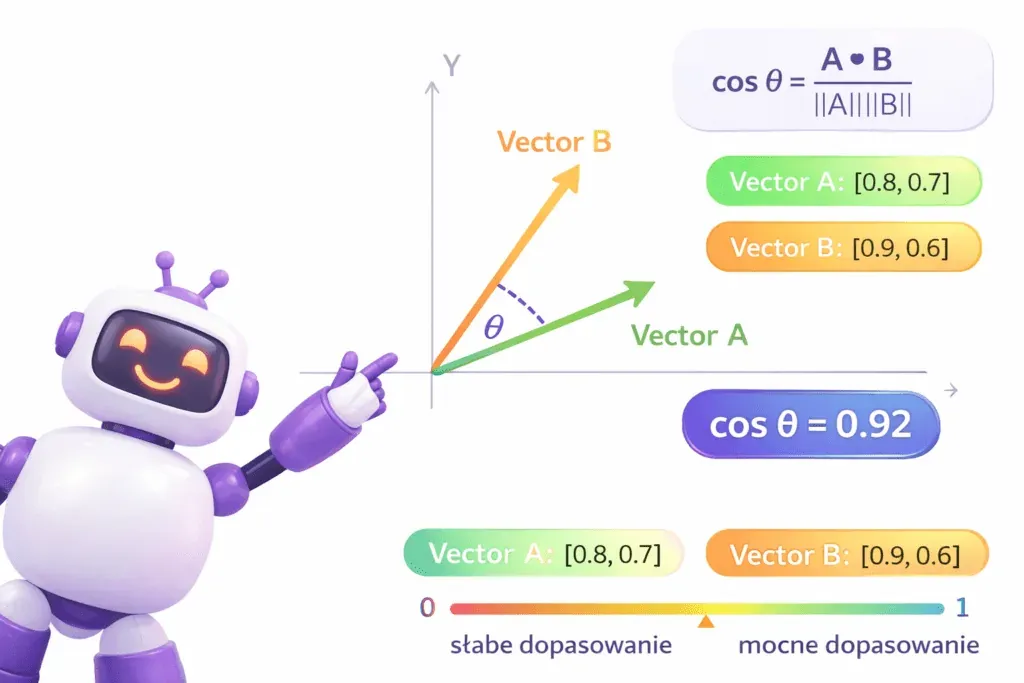
Example visualisation of angle versus distance matching in the context of cosine similarity
How to Use Cosine Similarity in SEO: 3 Real Applications
1) Auditing how well sections match intent You can compare the embedding of a phrase (or question) with the embeddings of specific page sections. If you see, for example, that the section "How does RAG work?" scores 0.82 while the "Chunking" section only scores 0.46, you have a clear signal of where the content needs strengthening, clearer definitions or better context.
Example: a service page about "SEO for AI" has a heading about embeddings, but describes them very generally. Cosine similarity against the query "embeddings in SEO" is moderate (say, 0.51). After adding a short definition, an example and the difference between embeddings and reranking, the score can jump to a "good match" level, because the content starts to really answer the question.
2) Detecting semantic cannibalisation In the classic view, cannibalisation is two pages "fighting" over the same phrase. In the semantic view, the problem looks broader: two pages might not share identical keywords, yet still describe the same thing. Cosine similarity between pieces of content (or their sections) lets you see whether you have several pieces of content on your site with very similar meaning, competing for the same set of intents.
Example: one article is titled "RAG SEO", another "AI Answers and SEO". If both have very similar sections on retrieval and chunking, they may compete semantically. Sometimes the better fix is to merge the content, or split the topics into different intents.
3) Meaning-based internal linking With internal linking, we often go by "manual" matching: we feel that two pages are related. Vector comparison lets you approach this methodically: if two pieces of content have high semantic similarity, the link is natural and supports the topic. If the similarity is low, the link may feel forced and dilute the information architecture.
Example: What This Looks Like for a Specific User Question
Let's say the user asks: "How do you prepare content for AI Answers?"
You have three fragments on the page:
A) a section about "AI Search" (general, trend-focused), B) a section "Chunking Content" (specific, practical), C) a section "Embeddings vs Reranking" (comparative).
In retrieval, fragment B will most often win, because it practically answers the question. Fragment A might have decent semantic similarity, but is too general. Fragment C might be valuable as additional context, but isn't the first choice. This shows that cosine similarity is a good pointer in the right direction, but ultimately what matters is whether the fragment is "answer-ready".
Conclusion: Cosine Similarity Is a Diagnostic Tool, Not a Goal in Itself
The best way to think about cosine similarity in SEO is this: it's a metric that helps you locate problems with content-to-intent matching faster. If the score is low, you're probably missing context, a definition or a concrete answer. If the score is high, you have a good foundation, but you still need to make sure the fragment is clear, unambiguous and easy to use in an AI answer.
Embeddings vs Reranking: Why "Similar" Doesn't Always Mean "The Best Answer"
If you work with semantic search or analyse content for AI Answers, you'll very quickly run into a phenomenon that seems counterintuitive at first glance: a fragment of content can have high semantic similarity to a user's question and still not be the best answer. This is exactly where the distinction between embeddings (semantic similarity) and reranking (assessing the quality of the answer to the question) comes in.
Embeddings: Quickly Finding Semantically Similar Candidates
Embeddings are excellent for the retrieval stage, meaning the search for "candidates" for the answer. The system compares the vector of the question with the vectors of content fragments and selects the ones that are semantically closest. This is fast, scalable and works well even when the question and the content are phrased in different words.
The problem is that embeddings don't always distinguish between the subtle difference between a fragment that is "about the topic" and a fragment that actually answers a specific question. In practice, embeddings can treat both a definition and a general description as similar, even if the user is looking for step-by-step instructions.
Reranking: Selecting the Fragment That Really Answers the Question
Reranking is the stage where the system takes the already-selected fragments (candidates) and evaluates which of them best fit the user's question. Here "answer quality" comes into play, not just semantic similarity. In practice, a reranker may favour a fragment that contains a specific explanation, definition, example or instruction, even if its embedding is marginally less "close" to the query than another fragment.
Documentation and analyses of semantic search often stress that reranking can improve the relevance of results, because it acts as a filter for "is this a good answer?" rather than just "is this similar?".
Example: Two Fragments About RAG, but Only One Answers
Let's say the user asks: "What is RAG?"
You have two fragments on the page:
Fragment A (general): "RAG is an approach that combines AI and search, thanks to which systems can generate answers based on data."
Fragment B (answer-ready): "RAG (Retrieval-Augmented Generation) is an approach in which AI first searches for matching content fragments (retrieval), and only then generates an answer based on them (generation)."
Both fragments are semantically similar, so embeddings may rate them very highly. But from the user's perspective, fragment B is the better answer: it's precise, defines the acronym and explains the mechanism. Reranking will often pick exactly this kind of fragment, because it recognises that it's "more answer-ready".
An SEO Example: "How Do You Prepare Content for AI Answers?"
Let's take the question: "How do you prepare content for AI Answers?"
The page has two matching blocks:
Fragment A (trend-focused): "AI Answers is the future of search, which is why it's worth investing in modern content and taking care of content quality."
Fragment B (practical): "To increase your chance of being cited in AI Answers, create sections with definitions and short answers, use a logical split into fragments, and put the most important conclusions at the start of a section."
Again: embeddings may treat both fragments as similar, because both talk about AI Answers and content. But reranking almost always prefers fragment B, because it contains concrete rules. And this is exactly the moment when content stops being "a description of the topic" and becomes an answer.
What This Means for SEO: Write for Questions, Not Concepts
The most important conclusion from the embeddings vs reranking distinction is very practical. If you want your content to be selected for an AI answer, it has to meet two conditions at the same time:
1) it has to be semantically relevant (embeddings must "catch" it), 2) it has to be answer-ready (reranking must judge it the best fragment).
In practice, this shifts the way you write content. It's not enough to have a section "about RAG". You need a section that answers: what RAG is, how it works and what it changes. It's not enough to have a page "about AI SEO". You need fragments that answer real user questions: "how do I prepare content", "what affects citation", "how do I split text", "which matters more, a definition or an example".
Mini-Checklist: How to Write Fragments That Win at Reranking
If you want your fragments to be selected not only by embeddings, but also by reranking, it's worth sticking to a few rules. First, answer the question directly in the first sentences of the section. Then add a short explanation of the mechanism. Finally, add an example or a practical conclusion. This layout is readable for humans and, at the same time, maximally "answer-ready" for the system.
In the next part, we'll look at how to increase the chance of your content being cited in AI Answers in a systematic way: from structure, through semantic topic coverage, to elements that help build credibility and context.
How to Increase the Chance That AI Cites Your Content
Whether your content gets used as a source in AI Answers rarely depends on a single factor. It's usually the sum of small decisions: how the structure is built, whether the sections answer questions, whether concepts are clearly defined, and whether the content includes elements that increase credibility and clarity. Below you'll find practical rules that genuinely improve the "citability" of content in retrieval- and RAG-based systems.
1) Write "Entity-First": About Concepts and Relationships, Not Just Phrases
AI models and search engines working semantically understand content better when it's built around entities (specific concepts, objects, processes) and the relationships between them. In practice, this means that instead of focusing on a single keyword, it's worth clearly defining the most important concepts and showing how they connect.
Example: if the topic is "SEO for AI Answers", the content should feature and explain related entities such as embeddings, vector search, retrieval, chunking, reranking and user intent. This way, the fragments of text aren't just about "AI SEO", they also have semantic anchor points that make it easier for the system to match them to questions.
2) Answer User Questions Directly (In the First Sentences of a Section)
One of the simplest rules, and one that works surprisingly well: if the heading implies a question, the first sentences should contain the answer. In retrieval systems, the fragments that win are often the ones that are unambiguous and "self-sufficient". If a section starts with a digression or an overly general introduction, the fragment loses its qualities as a ready-made answer.
Example: the heading "What is RAG?" should contain a definition with the acronym spelled out in the first paragraph, followed only later by an analogy and further explanation. That way, even if the system only pulls 2-3 sentences, it still has a complete answer.
3) Build Sections as Self-Contained "Knowledge Blocks"
In AI Answers, what matters are fragments that can be pulled out without the context of the whole article. This is why sections with an internal structure work well: definition, mechanism, example, conclusion. This is an ideal layout for both humans and retrieval.
Example: in a section about chunking, the definition alone isn't enough. A better fragment for citing also explains "why" and "how it affects AI answers". That way, AI doesn't have to add its own assumptions and is more likely to use your text as the source.
4) Add Examples That Close the Point (And Aren't Too General)
Examples act like "anchors of meaning". AI matches fragments more easily when they not only describe something, but also show an application in a real situation. For the reader, this is also the moment where theory turns into practice.
Example: instead of the sentence "AI selects the most relevant sources", a short clarification works better: "If a user asks 'how do I split content for AI Answers', the system will more often select a fragment with concrete chunking rules than a general section about AI trends".
5) Use Short "Takeaway:" Style Summaries
A single summary sentence at the end of a section often makes a big difference. For the user, it's a quick recap; for AI, it's a great fragment to use in an answer. It's worth making such sentences concrete rather than "motivational".
Example summary: "In practice, AI cites content built from short, unambiguous fragments that answer specific user questions."
6) Maintain "Topical Completeness" Without Padding the Text
Content that gets cited by AI often shares one trait: it covers the topic completely, but does so in an organised way. Text that's too short can be incomplete; text that's too long can be diffuse. This is why the best layout is one where every thread has its own section, but the sections are tight and concrete.
Example: instead of making one big chapter "AI in SEO", it's better to split the topic into RAG, embeddings, chunking and reranking. This way, the user finds the answer more easily, and AI has ready-made fragments for retrieval.
7) Use Credibility Signals: Definitions, Precision and Consistency
In the context of AI Search, content credibility doesn't rely solely on "domain authority". What also counts is whether fragments are precise, unambiguous and consistent. If you use the term "vector search" in one place and "semantic search" in another, without explaining the relationship between them, the fragment becomes less semantically stable.
Example: if you introduce the term "reranking", add two sentences explaining that it's the stage of assessing the relevance of an answer among the candidates returned by embeddings. A fragment like this is much easier to cite and harder to misinterpret.
Conclusion: Citability Is the Result of Structure and the Quality of "Answer Fragments"
In practice, the content that wins isn't just "nicely written" or "packed with keywords". What wins is content organised like a set of ready-made answers: it has definitions, examples, clear conclusions and a logical structure. If you treat your content as a source AI is meant to pull fragments from, it will be easier for you to design articles and landing pages that not only rank in Google, but also have a real chance of becoming part of an AI answer.
7 Applications of Embeddings and RAG in SEO (For Business, Not Just Geeks)
Embeddings and RAG are often associated with "engineer" solutions, but in practice they're also very useful in classic SEO processes. Importantly, this isn't about futuristic implementations, but about concrete ways to plan content better, assess how well content matches intent, and build page structure so that it's readable for both people and AI systems. Below you'll find 7 applications that most often translate into a real improvement in visibility.
1) Content Audits for AI Search and Semantic Gaps
In a classic SEO audit, we often check whether content has the right headings, the right length, and whether it contains the basic elements. The semantic approach lets you go a step further: check whether the content has "full semantic coverage" relative to the user's intent. If you compare the sections of your page against a set of questions or topics, you'll quickly see where definitions, explanations of the mechanism or practical examples are missing.
Example: a page about "SEO for AI" describes how AI is changing search, but has no section on chunking or on the difference between embeddings and reranking. In this case, the content may be "about the topic", but it isn't semantically complete for a user looking for a practical answer.
2) Topic Clustering and Content Planning for Topical Authority
Embeddings work great for grouping topics, because they can connect queries that are semantically similar even when they sound different. This lets you build topical clusters based on intent, not just shared words.
Example: the phrases "RAG SEO", "AI Answers and rankings" and "how AI cites content" can end up in a single cluster, because they concern the same problem. This lets you create one strong pillar piece and several supporting articles instead of 10 pages with too narrow a scope.
3) Detecting Semantic Cannibalisation
Cannibalisation doesn't always look like a conflict over an identical keyword. Two pages often compete for similar intents, even though they use different language. Comparing content semantically lets you find situations where you have several pieces "about the same thing", and the system doesn't know which one is more important.
Example: the article "What Is RAG SEO" and the article "How to Write for AI Search" have very similar fragments about retrieval and chunking. If both rank for similar queries, you might consider separating the intents more clearly, or strengthening one as the main source.
4) Choosing Internal Links Based on Meaning
Internal linking is more effective when it connects content that's genuinely related by intent. In the semantic approach, you can assess this not just "by feel", but also through the semantic similarity between pages or sections.
Example: if you have a guide on AI Answers and a separate piece on "semantic search", a link between them is natural, because the user probably wants to understand the technical basis. A link to general content like "what is SEO", on the other hand, can dilute the topic and add nothing in terms of intent.
5) Checking the Consistency of Service Landing Pages (Does AI Understand What You Sell)
This application is often underrated. A landing page can have good SEO, but if it's written imprecisely, AI systems may struggle to clearly understand exactly what you're offering. Semantic analysis helps you catch whether the page has clear definitions of services, scope, context and differences from other offers.
Example: if, on a "SEO for AI" service page, you mix concepts like "AI marketing", "automation", "AI copywriting" and "SEO" without clear boundaries, the content becomes semantically blurred. From AI's perspective, this can be a signal that the page isn't the best source to cite for questions about RAG or embeddings.
6) Recommendations for Expanding Content Based on Missing "Answer Blocks"
In practice, you very often don't need to write everything from scratch. It's enough to add the missing blocks that close off the topic. These can be short fragments: a definition, an example, a checklist or a "most common mistakes" section. It's exactly these kinds of elements that increase your chances of retrieval and citation.
Example: an article about AI Search is missing a short answer to the question "why does AI take fragments instead of whole articles?". Adding 5-7 sentences explaining chunking can significantly increase the article's value and its usefulness in AI answers.
7) Building Knowledge Bases and FAQs Ready for AI Answers
Knowledge bases, guides and FAQ sections are formats that "fit" retrieval perfectly, because they're naturally built from short questions and answers. If you want your brand to be cited, this kind of content is often the most efficient route, because it provides ready-made fragments that AI can use without needing to interpret.
Example: instead of one long article about "AI SEO", you can also create a series of short pieces: "what is RAG", "what are embeddings", "how does reranking work", "how to prepare content for citation". Each of them can be a self-contained source, and together they build topical authority.
Summary: Embeddings and RAG Give You Practical Tools for Better SEO
The biggest advantage of the semantic approach is that it combines analytics with practice. On one hand, you can plan content and page structure better; on the other, you can more quickly diagnose why content doesn't answer user intent. Next, we'll move on to a short "AI-ready SEO" checklist that lets you assess whether content has a real chance of being used in AI answers.
The "AI-Ready SEO" Checklist for Businesses (Quick Audit)
In the world of AI Answers and semantic search, it's easy to fall into the trap of thinking you need complicated technical implementations to improve visibility. In practice, many problems can be diagnosed with a simple checklist. If your content isn't "AI-ready", it's usually not because you lack technology, but because you lack clear answer blocks, a coherent structure and semantic completeness.
The checklist below works like a quick audit. You can run it against a blog article, a service landing page, an e-commerce category or a knowledge base. The best way to read it is this: if you answer "no" on several points, that's exactly where the biggest opportunities to improve visibility in AI Answers lie.
1) Does the content answer user questions directly (without digressions)?
The most citable fragments are the ones that start with the answer. If a heading reads like a question ("What is RAG?"), the first paragraph should contain the definition, with further explanation only afterwards. Otherwise, the fragment becomes less unambiguous, and AI will more often pick a source that answers more simply and quickly.
Test example: take the first paragraph under an H2/H3 heading and check whether, after reading it, the user knows the answer. If not, the section needs rebuilding.
2) Does each section have one topic and can it be cited independently?
In AI Search, fragments act like "building blocks" that can be retrieved and used as context. If one section mixes three different threads, retrieval can work worse, because the system doesn't know what's most important in that fragment. Ideally, every section has a clear topic and leads the reader from definition to conclusion.
Test example: if you have a section "AI in SEO" that talks about embeddings, RAG, chunking and tools all at once, it's better to split it into several smaller blocks.
3) Does the content contain "answer blocks" (definitions, rules, conclusions)?
Citable content is content you can pull specifics from. This is why the following work great: definitions in 1-2 sentences, short rules (how to do something) and one-sentence conclusions at the end of a section. Without such blocks, an article might be correct, but it won't be "answer-ready".
Test example: try to find 3 sentences in the article that could be cited as a ready-made answer. If that's hard, you're missing fragments with a high density of information.
4) Does the content have semantic topic coverage (topical completeness)?
AI and semantic search engines prefer content that closes off the topic. This doesn't mean "write as long as possible", it means "don't skip key elements". If a user is looking for information about RAG SEO, they usually expect to learn: what RAG is, how retrieval works, why chunking matters and what reranking does. If some of these elements are missing, the content looks incomplete.
Test example: list 5-7 concepts that are essential for the topic, and check whether they're explained in the content, not just mentioned.
5) Are the examples in the content concrete and set in a real scenario?
Examples build clarity. AI matches a fragment more easily when it shows an application. The best examples aren't "general", they refer to real situations: a landing page, a blog article, a user question, a purchase decision, a tool comparison.
Test example: if your examples could fit any industry and any topic, they're usually too general. It's good when an example comes "straight from SEO life".
6) Does the content structure support chunking (short, logical fragments)?
Chunking doesn't mean you have to split text into microsequences. It's about making fragments logical: paragraphs shouldn't be huge, sections should have clear topics, and the most important information should appear close to the heading. This increases the chance that the system retrieves the right fragment and uses it as context for the answer.
Test example: if one H2 section has 15 paragraphs and covers several topics, AI may retrieve a fragment at random, or not at all.
7) Do you have clear signals of credibility and consistency of concepts?
In a semantic world, inconsistent terminology can weaken content. If you use several terms for the same thing (e.g. "AI Search", "answer engines", "AI answers"), it's worth showing that these are related concepts and clarifying the differences. The same goes for terms like embeddings, retrieval and reranking. Short clarifications make content more stable and less prone to misinterpretation.
Test example: if the reader has to guess whether "semantic search" is the same thing as "vector search", it's worth clarifying the relationship between the terms in 2 sentences.
Audit Result: A Quick Scoring Table
If you want to approach this methodically, you can score each category on a 0-2 scale. It's simple, but it helps you quickly set priorities.
| Area | 0 | 1 | 2 |
|---|---|---|---|
| Answer-readiness | No direct answer | Partial | Answer at the start of the section |
| Structure and chunking | Chaotic | Average | Logical knowledge blocks |
| Topical completeness | Gaps in topics | Mostly covered | Topic closed off |
| Examples and practice | No examples | Isolated examples | Concrete scenarios |
| Consistency of concepts | Unclear | OK | Unambiguous |
If you score 2 in most areas, your content is well prepared for AI Answers. If several points show zero, that's a sign that the problem isn't a "lack of AI", it's the structure and quality of the fragments. In the summary, we'll pull this together into concrete conclusions: what's worth doing quickly, and what to plan as a strategy.
The "AI-Ready SEO" Checklist for Businesses (Quick Audit)
In the world of AI Answers and semantic search, it's easy to fall into the trap of thinking you need complicated technical implementations to improve visibility. In practice, many problems can be diagnosed with a simple checklist. If your content isn't "AI-ready", it's usually not because you lack technology, but because you lack clear answer blocks, a coherent structure and semantic completeness.
The checklist below works like a quick audit. You can run it against a blog article, a service landing page, an e-commerce category or a knowledge base. The best way to read it is this: if you answer "no" on several points, that's exactly where the biggest opportunities to improve visibility in AI Answers lie.
1) Does the content answer user questions directly (without digressions)?
The most citable fragments are the ones that start with the answer. If a heading reads like a question ("What is RAG?"), the first paragraph should contain the definition, with further explanation only afterwards. Otherwise, the fragment becomes less unambiguous, and AI will more often pick a source that answers more simply and quickly.
Test example: take the first paragraph under an H2/H3 heading and check whether, after reading it, the user knows the answer. If not, the section needs rebuilding.
2) Does each section have one topic and can it be cited independently?
In AI Search, fragments act like "building blocks" that can be retrieved and used as context. If one section mixes three different threads, retrieval can work worse, because the system doesn't know what's most important in that fragment. Ideally, every section has a clear topic and leads the reader from definition to conclusion.
Test example: if you have a section "AI in SEO" that talks about embeddings, RAG, chunking and tools all at once, it's better to split it into several smaller blocks.
3) Does the content contain "answer blocks" (definitions, rules, conclusions)?
Citable content is content you can pull specifics from. This is why the following work great: definitions in 1-2 sentences, short rules (how to do something) and one-sentence conclusions at the end of a section. Without such blocks, an article might be correct, but it won't be "answer-ready".
Test example: try to find 3 sentences in the article that could be cited as a ready-made answer. If that's hard, you're missing fragments with a high density of information.
4) Does the content have semantic topic coverage (topical completeness)?
AI and semantic search engines prefer content that closes off the topic. This doesn't mean "write as long as possible", it means "don't skip key elements". If a user is looking for information about RAG SEO, they usually expect to learn: what RAG is, how retrieval works, why chunking matters and what reranking does. If some of these elements are missing, the content looks incomplete.
Test example: list 5-7 concepts that are essential for the topic, and check whether they're explained in the content, not just mentioned.
5) Are the examples in the content concrete and set in a real scenario?
Examples build clarity. AI matches a fragment more easily when it shows an application. The best examples aren't "general", they refer to real situations: a landing page, a blog article, a user question, a purchase decision, a tool comparison.
Test example: if your examples could fit any industry and any topic, they're usually too general. It's good when an example comes "straight from SEO life".
6) Does the content structure support chunking (short, logical fragments)?
Chunking doesn't mean you have to split text into microsequences. It's about making fragments logical: paragraphs shouldn't be huge, sections should have clear topics, and the most important information should appear close to the heading. This increases the chance that the system retrieves the right fragment and uses it as context for the answer.
Test example: if one H2 section has 15 paragraphs and covers several topics, AI may retrieve a fragment at random, or not at all.
7) Do you have clear signals of credibility and consistency of concepts?
In a semantic world, inconsistent terminology can weaken content. If you use several terms for the same thing (e.g. "AI Search", "answer engines", "AI answers"), it's worth showing that these are related concepts and clarifying the differences. The same goes for terms like embeddings, retrieval and reranking. Short clarifications make content more stable and less prone to misinterpretation.
Test example: if the reader has to guess whether "semantic search" is the same thing as "vector search", it's worth clarifying the relationship between the terms in 2 sentences.
Audit Result: A Quick Scoring Table
If you want to approach this methodically, you can score each category on a 0-2 scale. It's simple, but it helps you quickly set priorities.
| Area | 0 | 1 | 2 |
|---|---|---|---|
| Answer-readiness | No direct answer | Partial | Answer at the start of the section |
| Structure and chunking | Chaotic | Average | Logical knowledge blocks |
| Topical completeness | Gaps in topics | Mostly covered | Topic closed off |
| Examples and practice | No examples | Isolated examples | Concrete scenarios |
| Consistency of concepts | Unclear | OK | Unambiguous |
If you score 2 in most areas, your content is well prepared for AI Answers. If several points show zero, that's a sign that the problem isn't a "lack of AI", it's the structure and quality of the fragments. In the summary, we'll pull this together into concrete conclusions: what's worth doing quickly, and what to plan as a strategy.
The New Visibility Equation: Google + AI Answers
Search is entering a stage where content competes not only for a position in Google's ranking, but also for whether it becomes the source of an answer in AI systems. In practice, this means a change in how we think about content marketing and SEO: the materials that win are not just "about the topic", they're built from fragments that can be retrieved and used as concrete answers.
The main mechanisms driving this are fairly consistent. Embeddings help AI systems match a question to content semantically, vector search lets them quickly find candidates, RAG assembles the answer based on the retrieved context, and reranking selects the fragments that actually answer the question. In practice, this means "optimising for AI Answers" isn't about adding a few phrases, it's about designing content in an organised, answer-ready way.
What You Can Implement Quickly (Without Changing Your Whole Strategy)
If you want to improve the "AI-ready" character of your content without a revolution on the page, it's worth starting with the things that have the biggest impact on retrieval and citability. Tidying up sections, adding definitions in the first sentences after headings, splitting overly long blocks into logical fragments, and adding short examples are the fixes that usually deliver the most value for the least cost. This is also one of the reasons the "section by section" approach works so well: every part can be strengthened so that it becomes a self-contained answer block.
What's Worth Treating as a Strategy (To Build an Advantage)
If you're aiming for a lasting advantage, the most important thing is building content in a semantic model: topical clusters based on intent, not just phrases. In practice, this means planning topics as a map of relationships (e.g. RAG → chunking → embeddings → reranking), organising information architecture, and developing materials so that they "close off the topic" instead of repeating the same generalities across several articles.
This approach is also beneficial for classic SEO, because semantically complete content often ranks for many query variants, not just one keyword. On top of that, it naturally builds topical authority and increases the chance that the user comes back to the page as a source of knowledge.
The Most Important Thought to End On
AI doesn't reward the "most optimised" content: it rewards the content that's easiest to turn into an answer. If your materials have clear definitions, logical sections, practical examples and conclusions, the chances increase that they'll perform well both in Google and in AI Answers.
Going forward, it's worth looking at your content exactly the way retrieval systems do: as a collection of fragments that should be unambiguous and useful on their own. It's exactly this shift in perspective that turns "SEO for AI Answers" from a slogan into a real process of building visibility.
Bibliography / Sources
- Google Cloud: materials on semantic search and reranking (Vertex AI / Search)
- Databricks: guides and practices on chunking and RAG
- IBM: papers on RAG (Retrieval-Augmented Generation) and how retrieval works
- Pinecone: materials on embeddings and vector databases (vector search)
- Search Engine Land / industry analyses of changes in search and AI's impact on SEO
Also Check Out:
- Vibe Coding: What It Is and How This New Approach to Programming with AI Works
- Link Building in the Context of AI: How Artificial Intelligence Is Changing the Rules of SEO
- Nano Banana: Everything You Need to Know About the Image Editor in Gemini
- How Does AI Support SEO Activities?
- What Is Perplexity AI? Features and Applications
- Google AI Mode in Poland: A New Era of Information Search