














Until recently, programming meant having direct control over every line of code. Today, it increasingly relies on something completely different: precisely formulating your intent and letting artificial intelligence handle the implementation. As language models develop, the definition of "writing code" is undergoing a fundamental shift. A similar shift can be seen in marketing, where AI takes over execution and the human is left with the decision of what to do and why, which is exactly how a marketing agency works today.
Vibe coding isn't another framework or a trendy tech buzzword. It's a new way of working, in which the engineer stops focusing on the manual implementation of algorithms and starts acting as the system's architect: the person who designs the logic, structure and direction of the software's development. Programming shifts from the level of syntax to the level of vision, decisions and the "vibe" that gives meaning to the whole system.
Where Did Vibe Coding Come From?
Vibe coding is the result of an evolution in programming that gained popularity thanks to the dynamic development of artificial intelligence technology. Its origins go back to when AI assistants such as ChatGPT and Copilot started supporting developers, automating part of their work and allowing for faster code creation. Instead of writing code line by line, the developer becomes more of a "director" of the process, formulating queries for the AI, which then generates the relevant code fragments based on them.
It all started with simple coding-support tools that automatically completed code fragments based on a few keywords. Over time, artificial intelligence algorithms became advanced enough to take on more complex tasks, such as debugging, testing or generating code in response to more complex questions. Vibe coding is a natural next step in this evolution, changing the way developers work day to day by introducing a more dynamic and interactive approach to building software.
Vibe Coding vs Classic Programming
This new approach to programming, supported by artificial intelligence, differs fundamentally from the traditional model, in which the developer manually writes every line of code. In the classic software development process, the developer handles both writing and testing the code, which requires great precision and long hours of work on every detail. This approach gives full control over the project, but it's time-consuming and can be exhausting, especially for more extensive applications.
Modern AI-based methods, on the other hand, change this dynamic by introducing technology that helps developers generate code. Instead of writing code from scratch, the developer formulates queries for the system, which then generates the fragments needed based on them. This approach significantly speeds up the software development process, letting the developer focus on higher levels of abstraction, such as designing features and optimisation.
Although AI makes everyday work easier, it doesn't completely replace traditional programming. It still requires the developer to have solid fundamentals, an understanding of the generated code and the skill of formulating queries properly.
How Does Vibe Coding Work?
Vibe coding isn't a one-off click of a "generate" button. It's a dialogue between human and machine, based on a rapid exchange of information. The whole process is much more dynamic than in the traditional model, because it relies on the AI implementing the user's vision immediately.
Conversation Instead of Code Implementation
Instead of spending hours manually implementing every feature and analysing errors, interaction with the AI system plays the key role in this modern approach to programming. The developer formulates queries, and based on them the AI generates code fragments that can be tested immediately. This method feels more like a conversation than traditional coding, where the system becomes a helpful tool rather than just a passive means of carrying out a task. This lets developers move faster to testing and verifying solutions, instead of focusing on every line of code. The interactive process also allows the application to be adapted instantly to new needs, without having to manually implement everything from scratch.
The Loop: Prompt → Code → Test → Fix
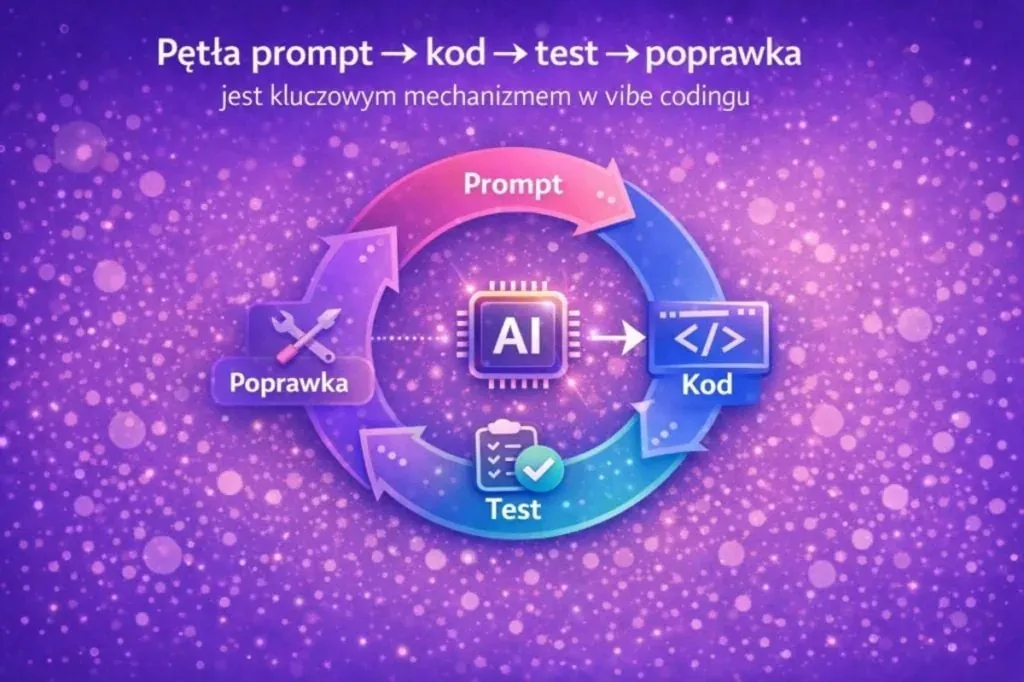
The prompt → code → test → fix loop is a key mechanism in vibe coding that lets developers make changes quickly and efficiently. The developer formulates a query (prompt) in natural language, and the AI generates the relevant code fragment. The code is then tested, and the test results allow fixes to be applied immediately, which are tested again in the next iteration. This process allows code to be generated and tested within the project's context almost instantly.
This kind of rapid loop lets developers apply fixes on the fly, with every change tested immediately, making the whole app development process more dynamic. Developers can react to test results and adjust the code to new needs on an ongoing basis, which makes the software development process significantly faster and more flexible. What's more, thanks to this loop, developers can focus on the overall goals of the project rather than the detailed tasks involved in implementing every element of the code.
Accepting Changes Without a Full Review
In the traditional programming process, every change to the code required a detailed review to make sure it wouldn't have a negative effect on other parts of the system. Developers had to spend time thoroughly checking every change, which introduced delays into the app development process. In vibe coding, thanks to the use of artificial intelligence, the process of accepting changes is much faster. The AI automatically tests the fixes introduced, allowing their impact on the rest of the code to be verified immediately.
Debugging Through Logs and Errors
Traditional debugging is often a tedious case of "finding a needle in a haystack": manually analysing logs and tracing every line of code in search of an error. Vibe coding flips this around. The AI not only identifies faults in real time, but immediately suggests ready-made fixes based on the generated error messages. As a result, the developer stops being a detective analysing the code's past and becomes a decision-maker who simply approves the solutions provided by artificial intelligence.
Vibe Coding and the Developer's Work
Shifting the workload from manual implementation to collaboration with language models forces developers to build entirely new skills. In the world of vibe coding, traditional competencies, such as knowledge of syntax or proficiency in line-by-line debugging, become supporting tools rather than the main focus of the work. What becomes crucial is the ability to break complex problems down into smaller modules the AI can understand, and the skill of verifying the system's architecture for consistency and performance.
From Writing Code to Managing the Process
In traditional programming, the developer is responsible for every stage: from writing the code to testing and debugging it. In vibe coding, the developer takes on the role of "project manager", overseeing interactions with AI tools. The AI becomes the main executor of tasks, while the developer provides it with context, guidance and corrections that help adapt the code to the project's requirements.
Speed vs Maintainability: Striking the Balance in Vibe Coding
Vibe coding significantly speeds up the software development process, enabling fast code generation and instant fixes. This lets developers focus on rapid prototyping and testing new ideas, which is especially useful in the early stages of a project. However, this speed doesn't always go hand in hand with maintainability. Although AI can generate code in the blink of an eye, it may need later fixes to keep its quality and readability high. The key is finding the right balance between speed and care for code quality, to avoid building up what's known as "technical debt", which can hinder the project's further development.
What Stays the Same: Tests, Git, Security
Although vibe coding significantly changes the way code is written, the fundamentals of software engineering remain unchanged. Automatically generating application fragments doesn't remove the responsibility to test them; quite the opposite, it increases the importance of tests as a mechanism for verifying decisions made by language models. Tests are precisely what become the first line of defence against subtle logical errors that can slip through in a fast, iterative style of work.
It's similar with version control. Git doesn't lose its importance in the world of vibe coding; in fact, it plays an even more significant role, letting you track changes generated by AI, compare alternative solutions and safely roll back to stable versions of the code. In practice, the repository becomes a record of the dialogue between the developer and the AI tool. Security, on the other hand, remains an area where uncritical trust in generated code can be especially costly. Language models don't always account for current threats or the specifics of the production environment, which is why every line of code, whether written by hand or generated in response to a prompt, requires a conscious analysis of its vulnerabilities and risks.
Tools for Vibe Coding
In vibe coding, just as in traditional programming, choosing the right tools is crucial for the effectiveness and quality of the work. With the help of modern AI-based technologies, developers can choose the tools that best suit their needs, from AI-powered IDEs, through app builders, to terminal tools and AI models. Here's how different types of tools perform in different scenarios:
AI-Powered IDEs (e.g. Cursor/VS Code): When They're Best
Integrated development environments (IDEs) with AI, such as Cursor or VS Code with built-in AI assistants, are tools that help developers write code faster by offering suggestions, code completion and instant generation of code fragments based on queries. These tools work best in everyday work, where the developer builds the application step by step. The AI helps write code by suggesting solutions based on the existing context, automatically detecting errors or suboptimal code fragments.
AI-powered IDEs are excellent tools for working on larger projects, where everyday support in the form of suggestions and automation can significantly speed up application development.
App Builders (e.g. Replit/Lovable): Fast MVPs
For developers who want to quickly build a working prototype or minimum viable product (MVP), app builders such as Replit, Bolt or Lovable are a great solution. These tools make it possible to build applications quickly and without the need to set up complicated infrastructure. With AI support, these builders let you generate code based on simple queries, allowing ideas to be tested almost instantly.
App builders work best in situations where you need to quickly validate an idea or create a test version of an application, for example for a presentation or a first round of user testing. Although they don't offer full control over the code, they're an excellent tool for prototyping.
Terminal Tools: When CLI Is Better
Although graphical interfaces are the standard for most development tools, terminal-based CLI tools (Command Line Interface) are still invaluable in many cases. Tools such as coding agents in the CLI, which let you create and edit code without a graphical interface, can be ideal when speed, simplicity and full control over the process matter most.
The CLI is often preferred when working on large projects, where the developer needs to focus on major system operations, process automation (e.g. through scripts) or interacting with servers. The terminal allows operations to be run in the background, development environments to be controlled and databases to be managed. Although it's not a tool for everyone, for more advanced developers who value speed and full control, terminal tools combined with AI can be powerful support in everyday work.
Models and Token Costs: The Most Expensive Model Doesn't Always Win
Choosing the right AI model to support a developer's work is crucial. Although the latest AI models, such as those offering enormous computing power, may seem like the best choice, in reality they don't always mean the best efficiency. The choice of model depends on the specific needs of the project and the available budget.
AI models vary in cost, and most of them are based on a token system, which means the cost of using them grows as query volume increases. In some cases, especially for prototyping or building an MVP, cheaper AI models may be sufficient. It's important to understand how the model will be used and choose one that best matches the needs of the given project. Cheaper options are often enough for basic tasks, while the most expensive models may only be justified for more complex processes, where the quality of the generated code is critical.
| Tool | Type | Main Use | Advantages | Disadvantages |
|---|---|---|---|---|
| AI-powered IDEs (e.g. Cursor/VS Code) | Integrated development environment | Writing code, debugging, automatic code completion, AI suggestions | Makes the developer's day-to-day work easier; automatic code completion; instant testing | Can create dependency on AI; generated code sometimes needs later fixes |
| App builders (e.g. Replit/Bolt) | App builder | Fast prototyping, building MVPs, testing ideas without advanced infrastructure | Fast prototyping; no need to build advanced infrastructure; intuitive | Limited control over the code; low scalability for larger projects |
| Terminal tools (CLI) | Terminal-based tools (CLI) | System operations, automation, project management, text-based code editing | Fast and simple operations; full control over the environment; excellent for automation | Can be harder to use for less experienced users; no GUI |
| AI models (e.g. OpenAI, GPT-4o) | Artificial intelligence models | Code generation, code fixes, automatic solution suggestions | Generates code based on queries; quick to apply fixes; flexibility | Can be costly with intensive use; requires good prompt-writing skills |
When Vibe Coding Makes Sense, and When It Doesn't
Although vibe coding is gaining popularity and offers many benefits, it isn't always the best solution in every situation. Depending on the type of project, team and goals, it may be more or less suitable. There are scenarios where vibe coding can significantly speed up the app development process, but there are also situations where using it can introduce complications.
Side Projects and Hackathons
Vibe coding works excellently for side projects, hackathons and other situations where speed of execution and testing ideas in a short time matter most. In such circumstances, when the goal is to quickly build a prototype or MVP (minimum viable product), vibe coding allows code to be generated and fixed almost instantly, letting developers focus on developing ideas rather than precise implementation.
In hackathons, where time is limited, vibe coding can be a huge advantage, letting teams focus on creativity and experimentation. Automatic code generation by AI makes it easier to test new concepts and quickly roll out fixes, which is crucial when the goal is to present a working prototype in a short amount of time. This approach also increases team productivity, since less time is spent on routine tasks related to writing and fixing code.
Solo Work vs Team Development
For solo work, vibe coding can be an excellent solution, letting an individual developer quickly implement ideas, test them and easily apply fixes. As a one-person team, the developer can use AI to generate code that they can then analyse, correct and develop on their own. This provides great flexibility and speeds up the work process.
In the context of team development, however, vibe coding can be more problematic if it isn't managed properly. In teams where several people work on the same project, it's necessary to maintain code consistency, communicate between team members and carefully plan and document changes. Vibe coding, which allows AI to generate code quickly and easily, can introduce chaos, especially if there isn't enough oversight of the generated code fragments. In such teams, proper quality control is essential, and vibe coding can sometimes lead to problems with maintaining the code or introducing confusing, hard-to-manage code fragments generated by AI.
Limitations of Vibe Coding
Although vibe coding offers many benefits, such as speed and ease of code generation, it isn't without its drawbacks. There are several areas where it can cause difficulties, especially over a longer period or in more complex projects.
Lack of Full Understanding of the Code
One of the main limitations of vibe coding is that the developer doesn't always fully understand the code generated by the AI. The AI is great at generating code based on queries, but it doesn't always explain how a given fragment works or why it was designed in a particular way. This can be problematic, especially when errors appear that are hard to diagnose, because the developer doesn't have full knowledge of the structure and logic of the generated code. As a result, this can lead to difficulties in debugging or the need to spend more time fixing problems that could have been spotted earlier in a traditional coding process.
Data Security Problems
For more advanced projects, where security is a priority, vibe coding may not always provide an adequate level of data protection. Because AI generates code based on queries and can't predict every potential security threat, the developer needs to stay vigilant and make sure the generated code doesn't introduce security gaps. AI may not be able to account for the most current cyber threats or implement security best practices, which can lead to unsafe code fragments if it isn't properly checked by an experienced developer.
Technical Debt
Although vibe coding allows for fast code creation, it can also lead to what's known as technical debt. This is a situation where code generated in a hurry, without full review, becomes hard to maintain and hard to develop further in the future. Although this may initially seem fast and effective, over a longer period such code requires frequent fixes, and extending it becomes increasingly difficult.
High Token Costs
Another limitation associated with vibe coding is the token costs of using certain AI models. Models such as GPT-4 rely on a pay-per-token system, which means that the more often you use AI tools to generate code, the higher the costs will be. For projects that require intensive use of AI or prolonged work with large amounts of data, costs can become significant. For some teams or companies with a limited budget, this can be a serious barrier. That's why it's important to carefully plan when and how to use such tools, so you don't exceed your budget while also not reducing the quality of the work.
Why Vibe Coding Won't Replace Classic Programming
Despite its advantages, vibe coding won't replace classic programming. Although artificial intelligence can speed up the code generation process, it can't replace the creativity, contextual understanding and complexity management that are essential in programming. Building software isn't just about technically writing code; it also involves making design decisions that require a deep understanding of the problem and specific needs. AI can support automation, but it won't replace human intuition and creativity in creating unique solutions. What's more, in more complex projects, such as distributed systems, developers need to understand the interactions between different parts of the application and anticipate the effects of the changes they make. AI doesn't manage the complexity of systems the way an experienced developer does.
Frequently Asked Questions About Vibe Coding
Is Vibe Coding Suitable for Beginners?
Yes, vibe coding can be an excellent option for people who are just starting their programming journey. Thanks to AI-assisted tools, beginners can focus on describing what they want to achieve, instead of worrying about syntax or implementation details. This lets them quickly test ideas and learn through experimentation. However, although vibe coding can make it easier to get started, it's worth being aware that understanding the basics of programming is still important for using such tools effectively in the future.
Do You Need to Know How to Program to Use It?
No, knowing how to program isn't necessary to start using vibe coding. In this approach, AI tools do most of the work, and the user simply formulates their intent, describing what they want to achieve. Many vibe coding tools (such as Cursor or Replit) offer interfaces that let you build working applications with minimal technical knowledge. In the longer term, however, knowing the basics of programming can help you better understand the generated code and adapt it to more advanced needs.
Do I Need to Know English to Program This Way?
Although AI models (such as GPT-4 or Claude) understand Polish very well, most technical documentation and function names in code are in English. You can write prompts in Polish, but knowing basic English technical terms makes it much easier to work with AI and understand any errors that come up.
Is Vibe Coding Suitable for Commercial Projects?
Vibe coding can be useful in commercial projects, but with certain caveats. It's an excellent solution for rapid prototyping, building MVPs, and for projects where time is critical and full control over the code isn't a priority. In production projects that require high quality, security and scalability, this approach can be problematic, because the generated code is often harder to maintain and isn't always optimal. If you plan to use vibe coding in commercial projects, remember to verify the generated code, test it and, if necessary, refactor it.
Check out these related articles: