














Artificial intelligence (AI) is making inroads into many areas of life, and one of the most exciting fields where this technology is finding application is music. Lyria 3, developed by Google as part of the Gemini platform, marks a major breakthrough in AI-powered music creation. Lyria 3 not only changes the approach to music production but also offers a wide range of new possibilities for artists, music producers and anyone who wants to express themselves through sound. The aim of this article is to explain how Lyria 3 works, its features, and the impact it could have on the future of the music industry.
What is Lyria 3?
Lyria 3 is a generative tool created by Google as part of the Vertex AI platform, part of the company's cloud ecosystem. It is one of the most advanced artificial intelligence systems designed specifically for creating music. What makes Lyria 3 a unique tool? Above all, its ability to instantly turn text or prompts into full musical compositions, all in just 30 seconds.
How does Lyria 3 work?
Lyria 3 uses algorithms based on Generative AI, which can analyse the tone, style and structure of music. Working with the Google Cloud platform provides access to vast data resources, allowing Lyria 3 to generate tracks in various musical genres, from classical to electronic. Generative tools are also changing the route users take to reach a brand, and today that route is shaped by AI SEO positioning.
Thanks to this, users can enter a few sentences or keywords, and Lyria 3 will generate music matching those instructions in the blink of an eye. This is a solution that lets artists and music producers quickly experiment with new melodies, harmonies or compositional structures, without needing advanced composing skills.
Music personalisation is one of Lyria 3's key features. Users can modify tracks by changing the instruments, tempo or arrangement of the composition. This level of customisation gives creators full control over the final result, significantly increasing the tool's value in the creative process.
Why is Lyria 3 groundbreaking?
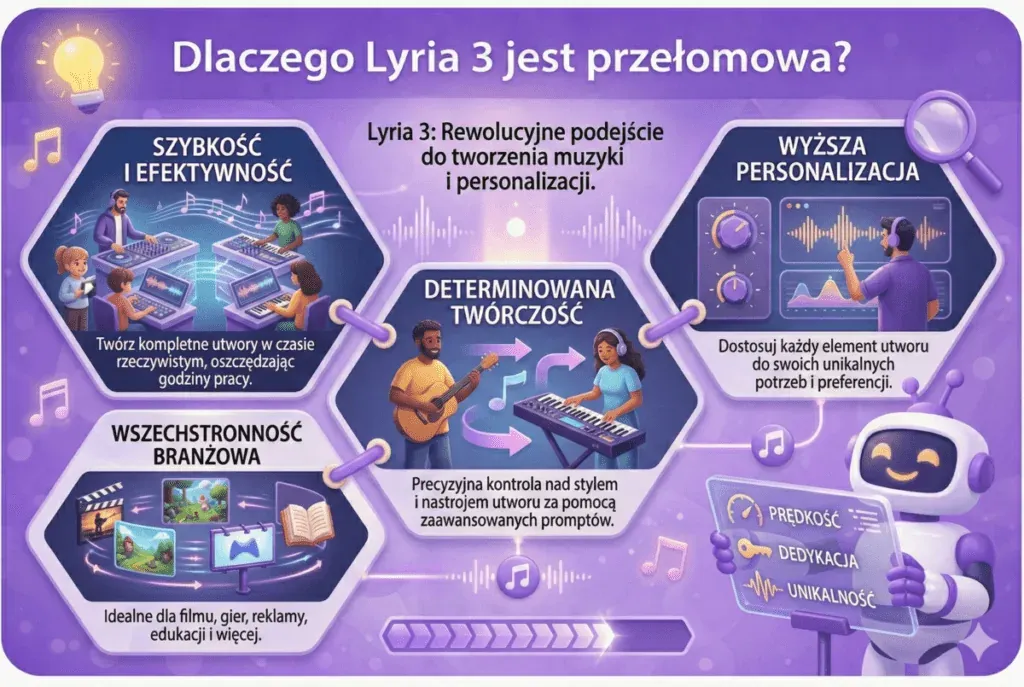
Lyria 3 is more than just a music generation tool. It is an example of a revolution in the approach to creating music, one that is changing the rules of the game in the music industry. Below are the key reasons why Lyria 3 has the potential to revolutionise the market:
1. Speed and efficiency
Lyria 3 makes it possible to generate music in real time, which is a huge advantage for artists and music producers. As a result, the process of creating music, which traditionally could take hours, can now be completed in a matter of seconds. Instead of spending long hours on every part or melodic line, Lyria 3 allows a full track to be created quickly, significantly speeding up the entire creative process.
2. Creativity without limits
Thanks to Lyria 3, music can be created not only by professional composers but also by people without advanced musical training. This tool makes creating music accessible to anyone with an idea for a melody, even without the skills needed to compose it themselves. In this sense, Lyria 3 helps democratise music, opening it up to a wider circle of creators.
3. Personalisation and uniqueness
Lyria 3 allows full personalisation of the generated tracks. Users can adapt compositions to their individual needs, making it possible to create music that is unique and tailored to their own preferences. This feature makes Lyria 3 a valuable tool for professional producers too, who need quick yet original ideas for soundtracks.
4. Use of the technology across industries
Although Lyria 3 is primarily a tool designed for the music industry, its applications can reach much further. Thanks to generative artificial intelligence, Lyria 3 can be used in other industries, such as video games, film, advertising or education. Music generated by AI can serve as a soundtrack for films, video games and animations, and can also be used in music education, bringing a new quality to learning how to create music.
What lies ahead?
Although Lyria 3 is already revolutionising the process of creating music, its future looks even more exciting. Over time, artificial intelligence, including Lyria 3, will become even more advanced, allowing for the creation of music with greater complexity and richer emotion and nuance. What exact possibilities will the future of this technology bring? Here are a few predictions:
1. Creating more complex music
Currently, Lyria 3 allows music to be created in various styles, but the future of this technology brings the possibility of generating more complex compositions. It is expected that in the future AI will be able to create tracks with an even more complex structure, richer in subtle harmonic, rhythmic and instrumental transitions, requiring a deep understanding of music.
2. Personalising music to the creator's emotions
One of the most exciting aspects of Lyria 3's future is its potential to match music even better to the personal emotions and preferences of creators. Over time, AI will be able to analyse not only musical parameters but also the emotional tone of the work, adapting the track to the artist's current feelings: joy, sadness, tension or energy.
3. Integration with interactive forms of entertainment
Thanks to its advanced technology, Lyria 3 has the potential to become part of interactive forms of entertainment, such as video games or VR/AR applications. In video games, AI could generate dynamic music that changes depending on the player's actions, while in films it could adapt to the characters' emotions. This could enrich the user experience even further.
4. AI as the artist's co-creator
In the future, Lyria 3 could become a more advanced co-creator, rather than just a tool supporting creative work. AI would be able to suggest different directions for developing a composition, experimenting with new chords or rhythms that the artist could then develop further. This would make the creative process more dynamic and full of surprises.
5. Collaboration between creators on a global scale
In the future, Lyria 3 could make it easier for artists from different parts of the world to collaborate. Thanks to cloud technology, creators will be able to share their music projects, and AI will help synchronise the work of teams. Such a global, virtual "jam session" could change the way music is created on an unprecedented scale.
6. Using AI in music education
Lyria 3 could also be an extremely valuable tool in music education. With AI, students could easily experiment with music, create their own compositions and learn about music theory in a more accessible way. Artificial intelligence could explain complex musical concepts, making it easier for young creators to learn and develop.
| Benefit | Description |
|---|---|
| Fast music generation | Lyria 3 allows the creation of a full music track in just 30 seconds, saving creative time. |
| Track personalisation | Users can adjust the tempo, instruments and mood of the generated music to suit their needs. |
| Accessible to everyone | Thanks to its intuitive interface, Lyria 3 is accessible to both professional musicians and amateurs, who don't need to know music theory. |
| No need for advanced skills | Create music without needing knowledge of music theory or composing skills. Ideal for beginners. |
| Ability to create music in various genres | Lyria 3 supports many musical styles, from classical to electronic, allowing for the creation of diverse compositions. |
| Generating unique compositions | Lyria 3 works in the cloud, meaning you can access your projects from anywhere with an internet connection. |
| Integration with professional software | The ability to export music to popular DAW (Digital Audio Workstations) programs such as Ableton Live or Logic Pro, giving full control over production. |
| Increased work efficiency | Thanks to automating the creative process, artists can focus on more creative aspects, saving time on technical details. |
| Easier collaboration with other creators | Lyria 3 enables collaboration with other musicians, which is particularly useful when working in teams to create music. |
| Music education | Thanks to its music generation features, Lyria 3 can be used as an educational tool for people learning music theory and composition. |
| Working with emotions and moods | AI analyses the input data to adapt the music to the creator's emotions and mood, giving a deeper connection to the creative process. |
A New Era of Music Creation
The future of Lyria 3 and artificial intelligence in music looks very promising. Thanks to increasingly advanced algorithms, AI will be able to create music with even greater depth, more complex in structure and full of emotion. Lyria 3 not only allows for the fast generation of tracks, but also enables their full personalisation, adapting them to the creator's emotions and combining them with various forms of interactive entertainment.
The coming era of AI-generated music does not, however, mean the end of human creativity. Quite the opposite: artificial intelligence will become an invaluable tool in the hands of artists, supporting them in realising their creative visions and opening up new possibilities in music production. Lyria 3 is only the beginning of this exciting development.
How to Access Lyria 3: Step by Step
1. Go to the official Lyria 3 website
To start using Lyria 3, visit the official Lyria model page on the DeepMind platform: https://deepmind.google/models/lyria/
2. Register or sign in to your Google account
If you haven't already, you need to register for Google Cloud or sign in to an existing Google account. Lyria 3 is part of the Google ecosystem, and access to it is tied to a Google Cloud account.
- Click the "Sign in" or "Register" button on the Lyria website.
- Use your Google account to access the model.
3. Start generating music
Once signed in, go to the Lyria 3 page and click the button to generate music. You can choose your musical preferences, such as genre, tempo, style and instruments, and Lyria 3 will then start generating music based on your settings.
4. Personalise the music
After generating a track, Lyria 3 allows for further personalisation, for example:
- Changing the instruments.
- Adjusting the tempo.
- Adding different sound layers.
5. Export and share the music
Once you are happy with the result, you can export the track in various audio formats (e.g. MP3, WAV). In addition, Lyria 3 lets you share the generated music on various social media platforms, such as YouTube, Instagram or SoundCloud.
Lyria 3 is an innovative tool that is bringing music into a new era: the era of artificial intelligence. Thanks to its advanced features, music creators can quickly generate unique tracks that match their individual preferences and emotions. In the future, this technology has the potential to evolve even further, enabling the creation of more complex compositions, better matching to creators' moods, and full integration with interactive forms of entertainment. Lyria 3 is only the beginning of a revolution that could completely change the way we perceive and create music.
FAQ: Frequently Asked Questions about Lyria 3
1. Can Lyria 3 create a complete music track from scratch?
Yes, Lyria 3 was designed as a generative model that can produce a coherent music track based on a text prompt. The user specifies the style, mood or general concept, and the system creates a composition matching these guidelines. In practice, this means that even a short description can become the starting point for a full soundtrack.
2. Do you need to know music theory to use Lyria 3?
No. One of the key assumptions behind Lyria 3 is lowering the barrier to entry into the world of music creation. The model was designed to understand natural language, meaning ordinary verbal descriptions.
3. How does Lyria 3 differ from traditional DAW software?
Traditional DAW (Digital Audio Workstation) programs require manually composing, recording or programming every track. Lyria 3 works differently: it uses an artificial intelligence model that generates music based on a description.
4. Where can you access Lyria 3?
Information about the model and current access options can be found on the official Google DeepMind website. Depending on how the tool is made available, access may be through Google Cloud platforms, including Vertex AI.
Check out also: