








In short
- In AI Search, what counts is whether a model mentions or cites your brand, not your site's position. A tool should cover at least five places (ChatGPT, Perplexity, Gemini, Google AI Overviews and Google AI Mode) and measure mentions, citations, share of voice, sentiment and AI traffic.
- The ranking includes Ahrefs Brand Radar, Senuto, SurferSEO, SEOstation, Chatbeat, Profound and Otterly.AI, among others. For a start on the Polish market, a pairing works well: one tool with a broad range of engines (e.g. Ahrefs Brand Radar) and one focused on Polish Google (Senuto or SEOstation).
- According to a Senuto study from August 2025, AI Overview was triggered by 24.17% of searches on Polish Google. Before you start monitoring, check your robots.txt: what removes a site from ChatGPT's answers is blocking OAI-SearchBot, not GPTBot.
Artificial intelligence is changing how people look for information. Have you noticed that more and more users are finding answers to their questions without clicking on any links at all? A growing share of queries now ends directly in an AI-generated answer, without a visit to any website.
Unlike traditional search engines, language models don't rank websites: they rewrite, summarise and reinterpret content, often blending information from multiple sources. This completely changes the definition of visibility in AI results. Today, the real question isn't “what position does my site rank at?”, but “does artificial intelligence mention my brand when people ask about my product category?”
Users are increasingly turning to ChatGPT, Gemini and Perplexity to find answers, discover products and services, and even navigate directly to websites. Because of this, classic SEO metrics are no longer enough. You need specialised tools that let you monitor your brand's visibility in the new AI ecosystem.
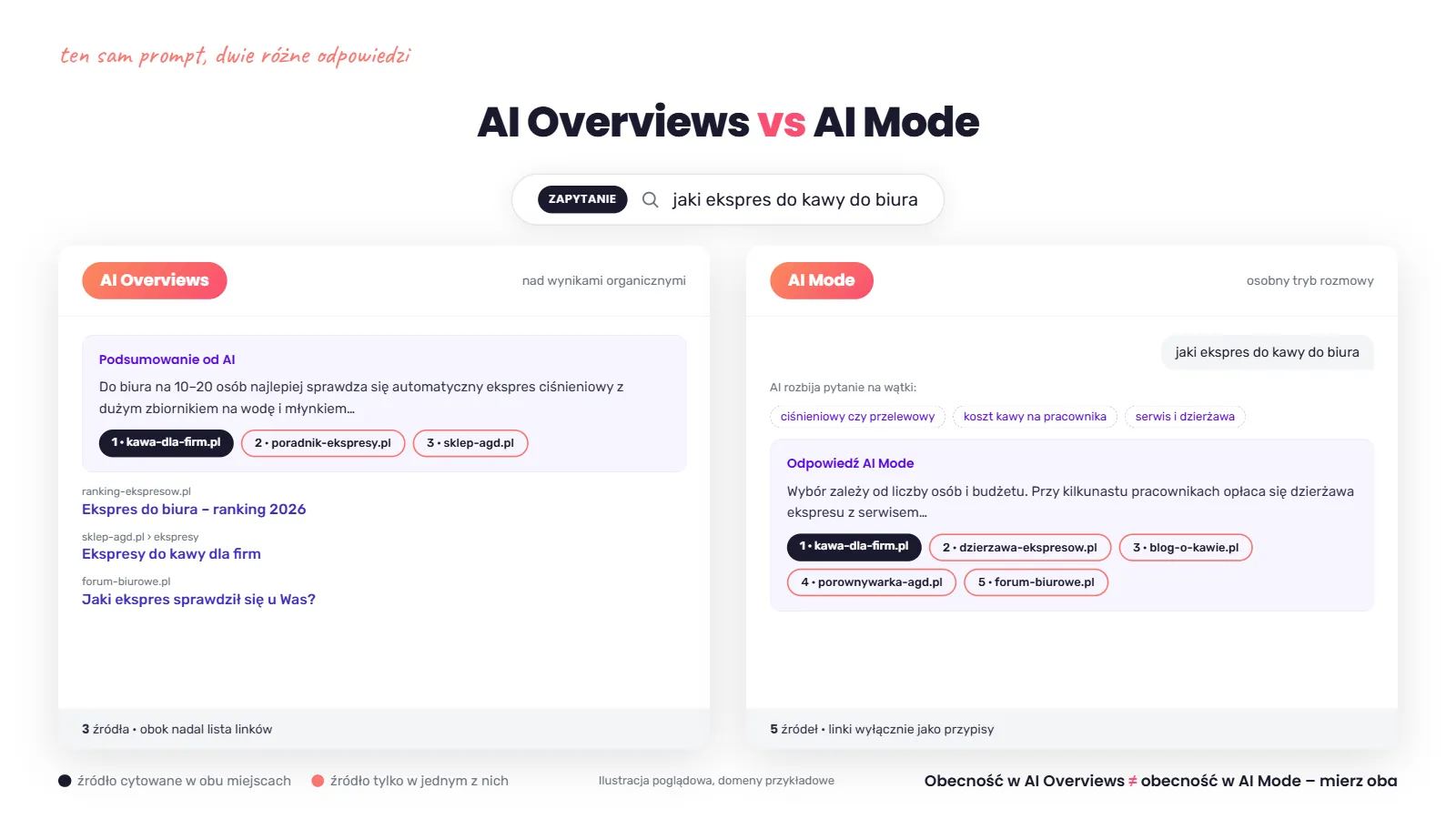
In 2026, Google's AI in search joins this mix in two forms: AI Overviews above the organic results, and AI Mode, a separate mode for having a conversation with the search engine. Each of these places picks its sources in its own way, so a good position in one doesn't guarantee a presence in the other.
In this article, you'll find a comparison of the most important tools for tracking visibility in AI search engines, from well-known giants like Ahrefs and Senuto to specialised platforms such as Chatbeat and Rankscale. This will help you find out which one best fits your needs and helps you stay competitive in an era where artificial intelligence is becoming the main intermediary between your brand and your customers.
What Is Generative Engine Optimization (GEO) and How Does It Differ from SEO?
GEO is optimising content so that language models are willing to draw on it, cite it and describe your brand correctly. It's about matching content to a specific user question, not to a single keyword. A model breaks a query into several sub-queries, collects fragments from many pages and builds one answer from them. The winner is whoever has the fragment that best answers one of those sub-queries.
Classic SEO fights for a click from a list of results. GEO fights for a place in the answer itself: for a mention, for a link in a footnote, or for the model to recommend your product first. Both approaches share a foundation: an indexable page, a well-thought-out structure and content matched to the user intents behind the query. That's why the tools described below are useful both in SEO and in GEO.
Monitoring is only one element of GEO. If you'd like to see a broader model of activities covering content, brand authority, consistency of information and presence beyond your own domain, see the 5 pillars of GEO.
How to Choose a Tool for Analysing AI Search Visibility
Choosing the right tool for analysing AI search visibility requires understanding the features that separate average platforms from truly valuable ones. With the rapid growth of AI Search, traditional SEO metrics are no longer enough.
Features Worth Paying Attention To
Above all, an effective tool should track visibility across multiple AI engines at once. The best platforms monitor at least five places: ChatGPT, Perplexity, Gemini, Google AI Overviews and Google AI Mode. A good platform should also run thousands of queries for each brand to ensure statistically significant data. Before you start paying for monitoring of model answers, also check whether AI crawlers can read your site correctly. You can do that in our free AI visibility checker.
Pay attention to reporting that covers:
- competitor analysis,
- detailed reports broken down by AI model, topic category and sentiment,
- visibility tracking over time,
- the full text of the models' answers, not just metrics: without it, you can't verify what AI actually says about your brand.
Some tools, such as Profound and Scrunch, also offer action recommendations categorised by impact and effort required. Multilingual coverage is also important: not all tools work beyond English, which can be critical for international projects.
Also check whether the tool lets you add your own prompts. Ready-made sets of questions are handy to start with, but they rarely match how customers really ask about your category, especially in Polish.
Differences Between Classic SEO Monitoring and AI Search Monitoring
While traditional SEO focuses on traffic and rankings, meaning your visibility in search results, AI monitoring introduces new metrics: “share of voice” in answers and “weighted position” in multi-source results. Whether you're cited as the first or the fourth source can determine how engaged a user is.
In AI Search, you don't track rankings but the frequency of mentions, the sentiment in AI-generated content, and the prompt patterns that trigger a response. This complexity requires new monitoring frameworks.
AI SEO metrics include:
- AI mentions: how often your brand appears in AI answers,
- AI citations: how often your brand is cited as a source,
- share of voice: how visible your brand is compared with competitors,
- sentiment: how positively or negatively AI describes your brand,
- AI traffic: how many visits reach your site from chatgpt.com, perplexity.ai or gemini.google.com (you can see this in GA4 in the traffic sources report).
When choosing a tool, make sure it offers both monitoring and practical, actionable guidance: knowing about your visibility is only the starting point of an effective strategy.
AI Overviews and AI Mode: Why Measure Both
AI Overviews is a block of answers above the classic results. It appears only for some queries, and a list of links still stands next to it. AI Mode works differently: it's a separate search tab where the user holds a conversation and asks follow-up questions, and links appear only as sources for the answer. In practice, AI Overviews and AI Mode can cite different pages for the same query, because AI Mode more often breaks the question into several threads.
That's why your visibility in AI Overviews doesn't yet tell you how you do in AI Mode. If your tool measures only one of them, you have half the picture. Of the tools described in this ranking, both places are covered by Ahrefs Brand Radar and Profound, among others.
How to Measure AI Visibility Step by Step
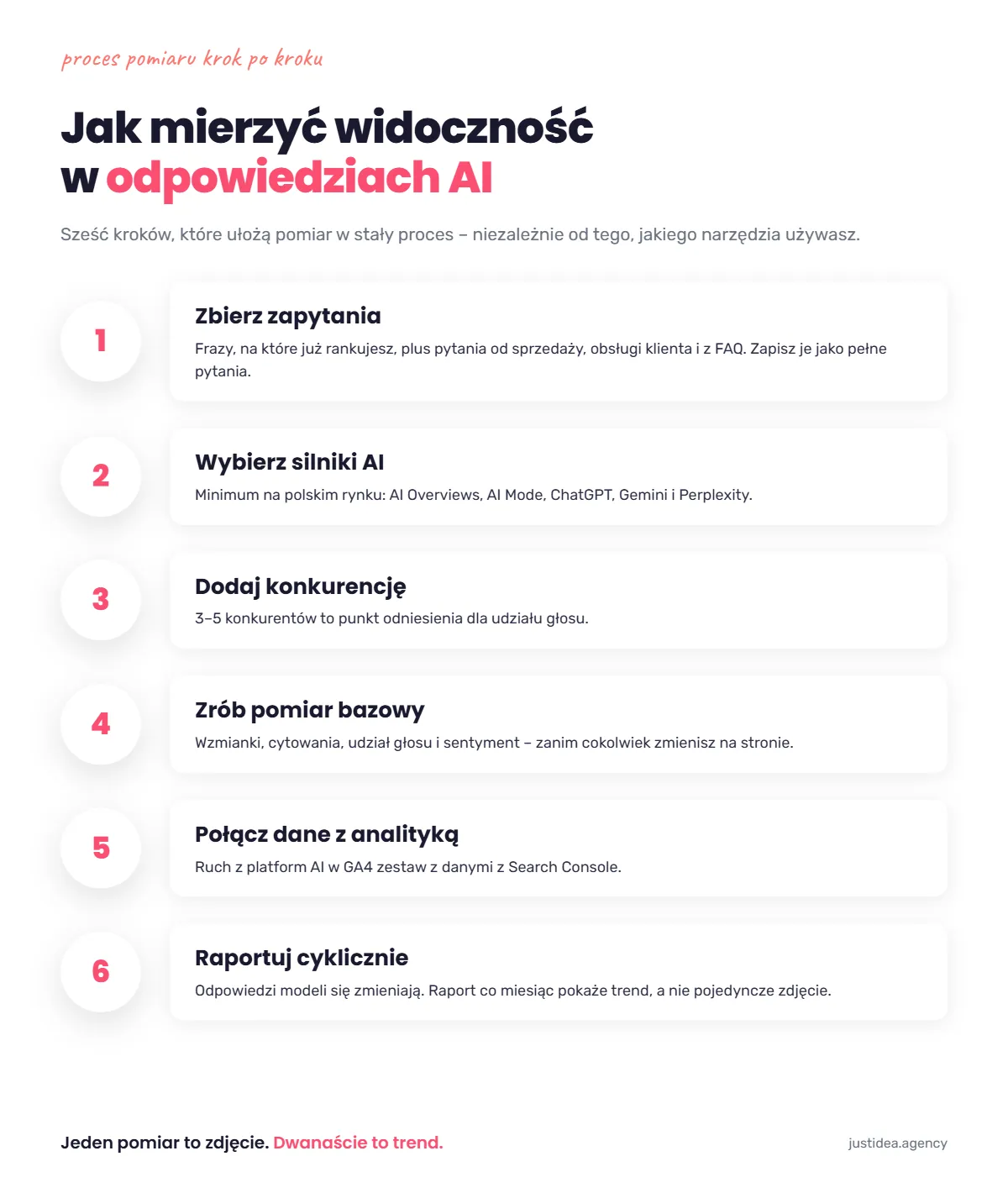
Whichever tool you choose, it's worth turning measurement into a regular process:
- Collect your queries. Start with the phrases you already rank for, and add questions from the sales team, customer service and your FAQ section. Rewrite them as full questions, the way a user would type them into a chat.
- Choose your engines. On the Polish market, the minimum is AI Overviews, AI Mode, ChatGPT, Gemini and Perplexity.
- Add your competitors. Without 3-5 competitors, share of voice has no point of reference.
- Take a baseline measurement. Record mentions, citations, share of voice and sentiment at the start, before you change anything on your site.
- Combine the data with analytics. Check traffic from AI platforms in GA4 and compare it with the data from Search Console.
- Report regularly. Model answers change, so a single measurement is only a snapshot. A monthly report will show the trend.
Ahrefs Brand Radar
Ahrefs, a recognised giant in the SEO industry, has introduced features for monitoring visibility in AI search engines. The AI References feature lets you track how often sites appear in results from AI-based search engines such as Google AI Overviews, ChatGPT, Gemini and Perplexity.
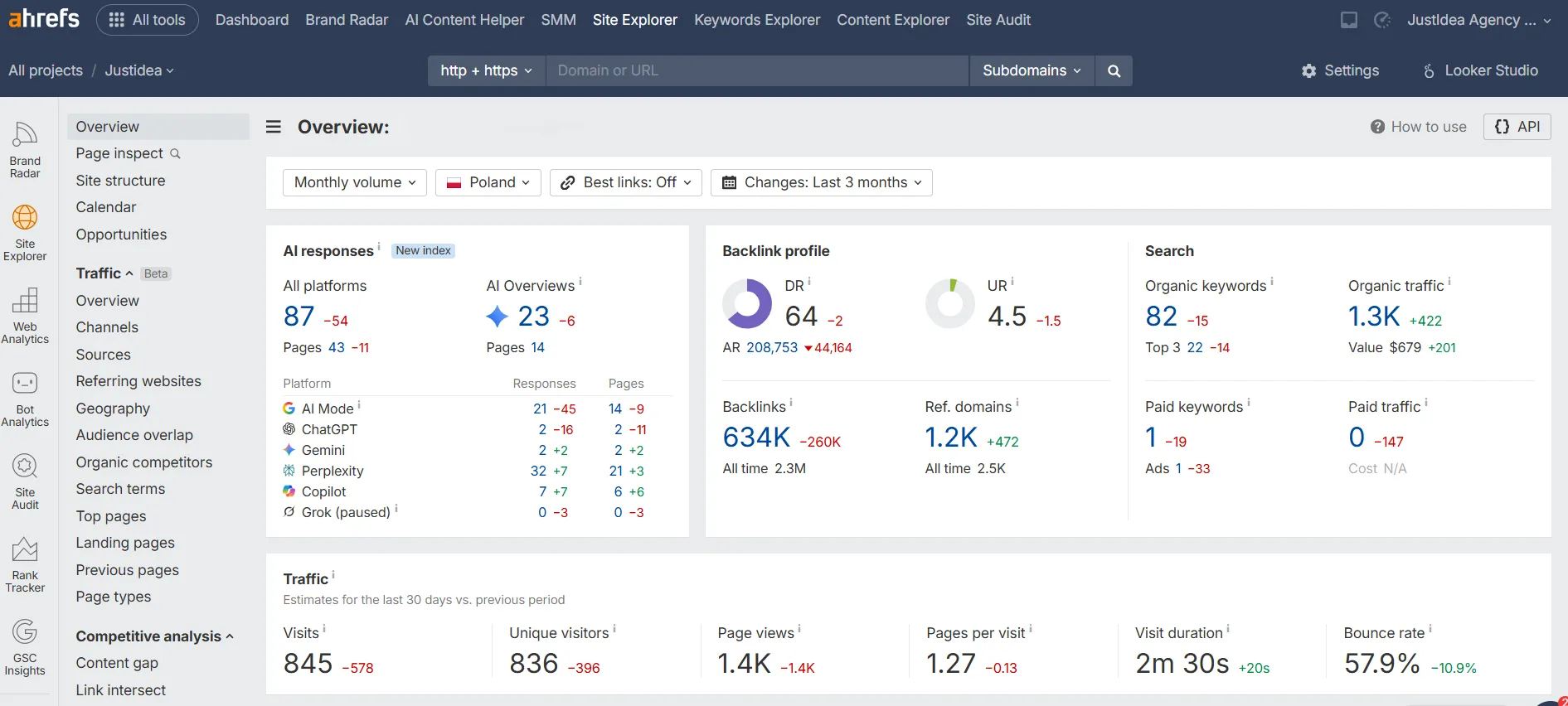
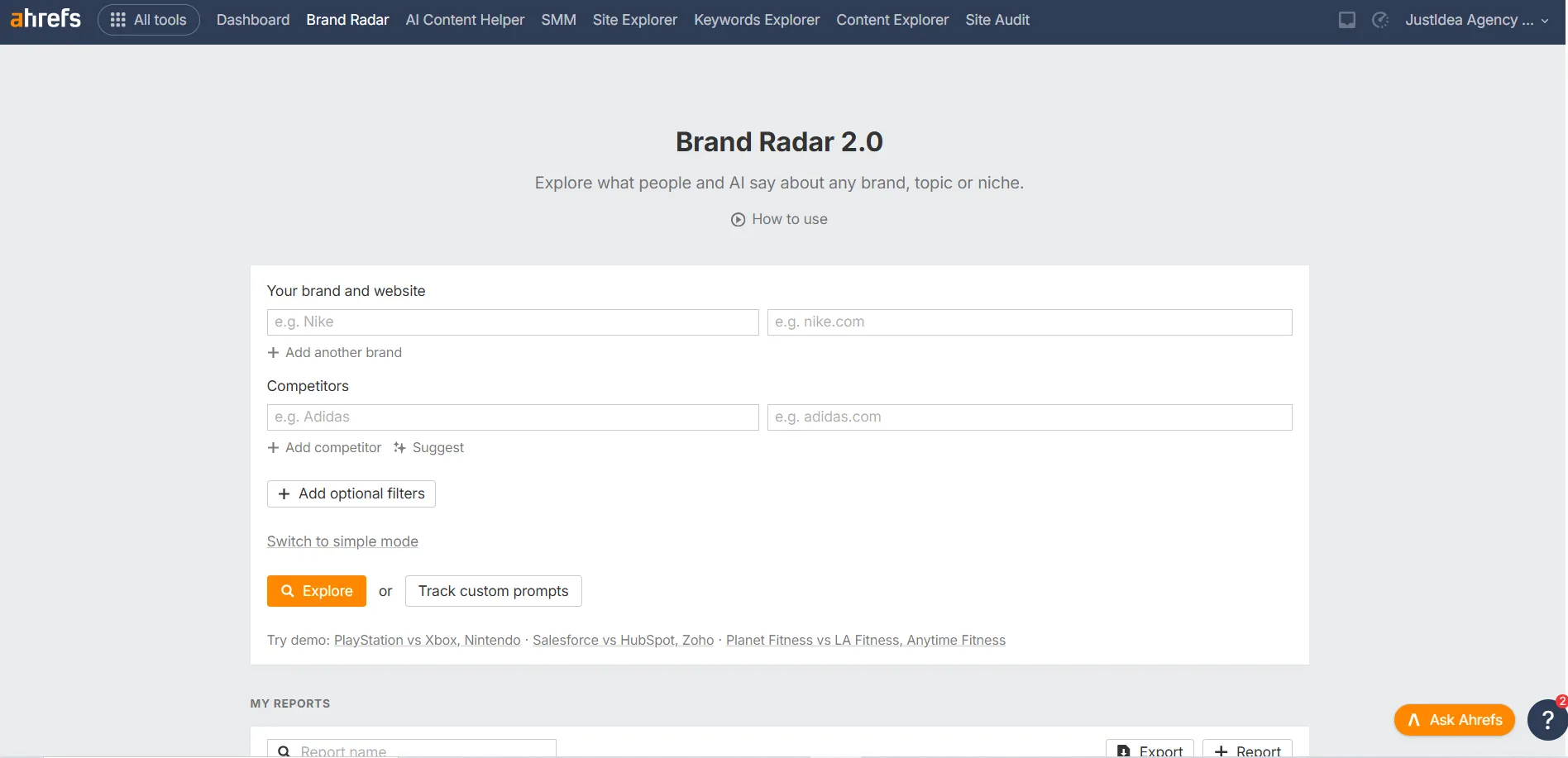
The flagship tool is Brand Radar, a comprehensive AI visibility analysis platform organised into three reports: AI Visibility, Search Demand and Web Visibility. This structure makes it easier to connect data from different sources and understand how content on the web affects AI answers.
The list of places monitored in Brand Radar has grown: besides ChatGPT, Gemini, Perplexity and AI Overviews, it now also covers Google AI Mode, Claude, Copilot and Grok. The report shows the full text of the models' answers along with links to sources, so you can see straight away which of your competitors' pages AI cites instead of yours.
Brand Radar stands out from the competition thanks to:
- using real queries from the Ahrefs keyword database instead of synthetic prompts,
- the ability to track your brand's exact position in AI answers (1st, 2nd or 3rd),
- analysis of ranking changes before and after the introduction of AI Overview
The tool also lets you group prompts into topics, analyse content gaps and track AI citations. Ahrefs' 2025 study found a strong correlation (0.664) between brand mentions on the web and visibility in Google AI Overviews, while traditional backlinks show a much weaker correlation (0.218). The takeaway for you: a brand's authority in AI is built largely outside your own site.
Senuto: Visibility Analysis and AI-Driven SERPs
The Polish platform Senuto stands out from the competition with an extensive AI Overviews module, designed specifically for analysing AI search visibility in the Polish market. According to a Senuto study from August 2025, as many as 24.17% of searches on Polish Google triggered an AI Overview. That means almost one in four queries gave the user a ready-made answer without a single click on a link.
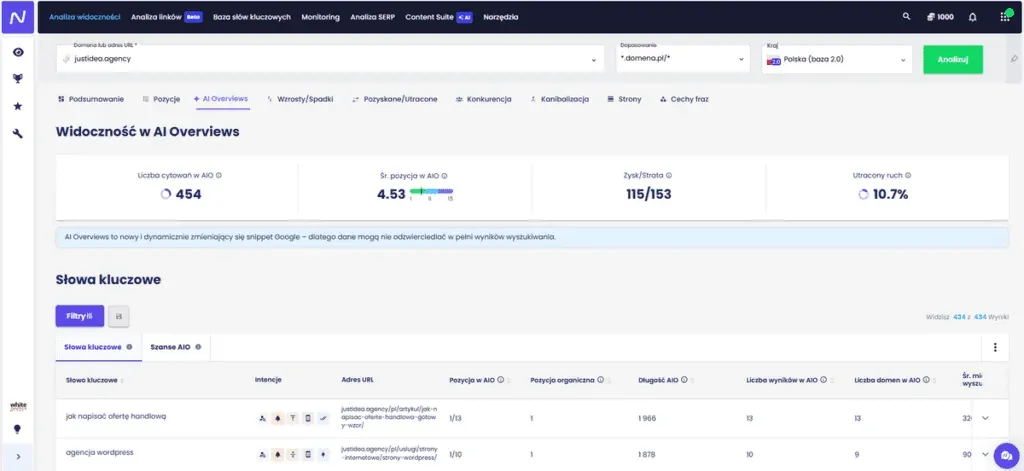
Senuto lets you check:
- for how many of your domain's keywords AI Overview appears,
- which keywords AI is “eating” and where traffic might be leaking from,
- who is cited in the answers and what organic rankings those sites hold.
The company has also introduced new KPIs for the AI era, such as AI Citation Count (the number of times content is cited in AI answers) and Attribution Rate (the percentage of answers that clearly attribute data to the brand). The comparative analysis feature between domains is particularly valuable, letting you check who dominates AI Overviews and how keywords are split between competitors.
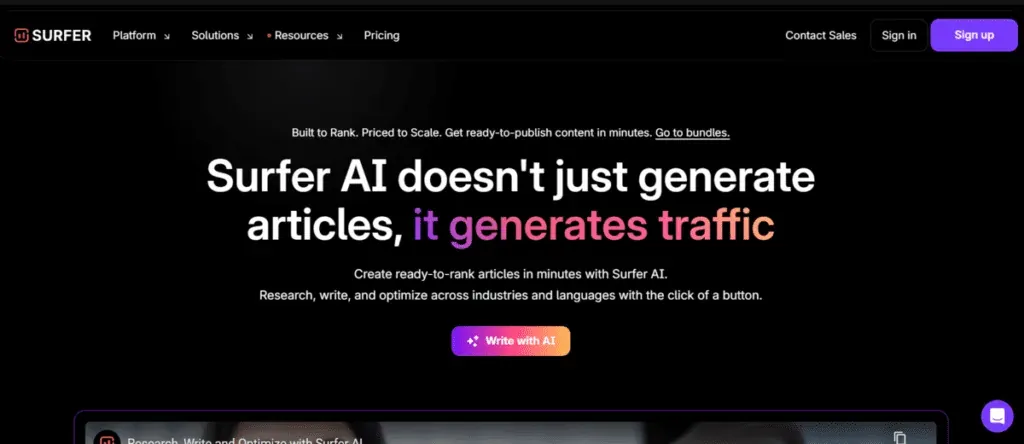
SurferSEO (AI SEO Made Simple): A Hybrid of Content and AI Search Analytics
SurferSEO has introduced an innovative approach to AI search visibility, combining content optimisation with monitoring your brand's presence in AI tools. The flagship AI Tracker feature lets you track when, where and how often AI tools such as ChatGPT and Google Gemini mention your brand in answers to user queries.
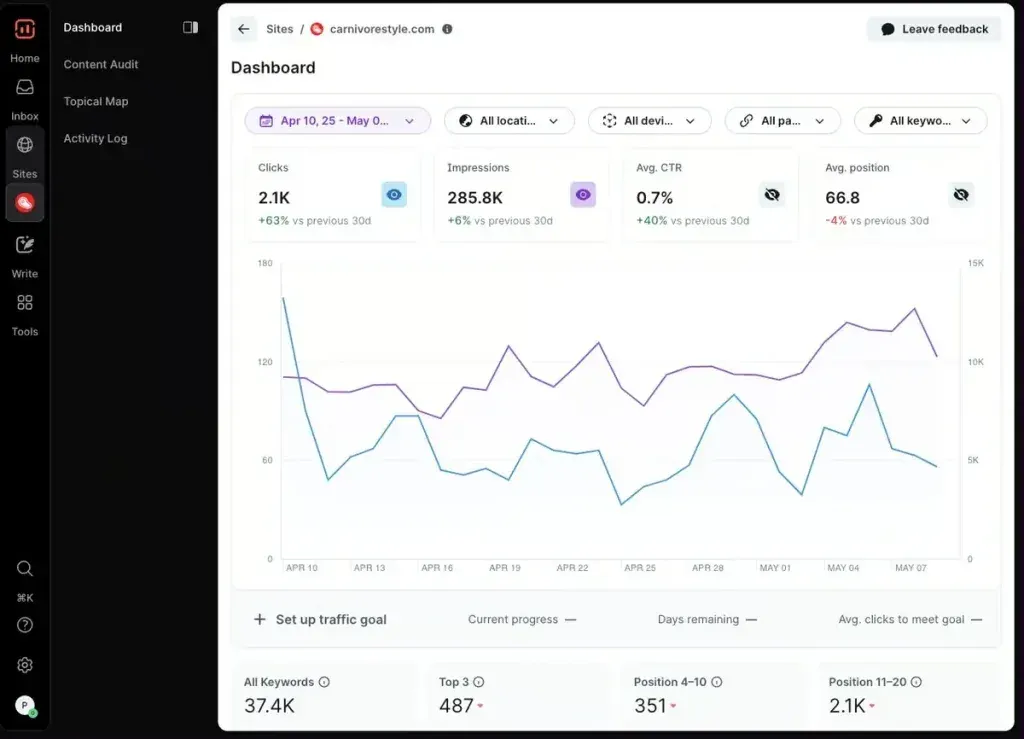
What sets this tool apart above all is its integrated workflow: you can optimise pages and then track their appearance in AI engines from a single dashboard.
Surfer focuses on three metrics:
- Prompt Coverage: does your brand appear in answers to buyers' questions?
- Citation Share: how often do AI assistants cite you as a source?
- Assistant Recall: do AI assistants correctly repeat your facts?
The platform also offers AI SEO, a comprehensive approach optimised for content discovery by AI assistants. With features such as Content Score, Auto-Optimize and Coverage Booster, Surfer helps you create “citation-ready” content that can be visible even when a page ranks outside the top ten results.
SEOstation: Ranking and Visibility Monitoring in AI Search
In response to the growing importance of AI Search, SEOstation has introduced a feature for monitoring rankings in AI Overviews. SEOstation lets you track whether your site appears in AI Overviews in Google search results.
This functionality stands out for how simply it integrates with an existing monitoring system. A new “GOOGLE AIO” column appears in the ranking summary, which you can easily turn on or hide in the view settings. Your position in AI Overviews is also visible on charts, letting you track changes over time, exactly as you would for standard organic results.
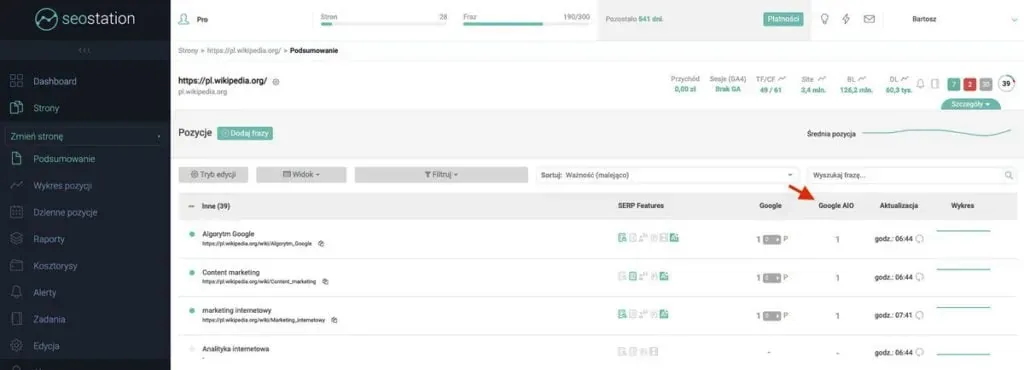
A presence in AI Overviews delivers high exposure even without ranking in the top positions in traditional results, which is why tracking this element is now a standard item in any report where you check your site's visibility in Google. AI Overviews appear above traditional results and include links to sources, so you also get a list of new visibility opportunities.
SEOstation also stands out in Poland for its affordable price and clear interface, which makes it an attractive choice, especially for freelancers, micro-agencies and business owners handling their own SEO.
Chatbeat: A Specialised Tool for AI Chatbots
Chatbeat stands out as a specialised tool used exclusively for tracking brand visibility in AI-based chatbots. Unlike traditional platforms that monitor user statements, Chatbeat focuses on analysing what the AI algorithms themselves say about your brand.
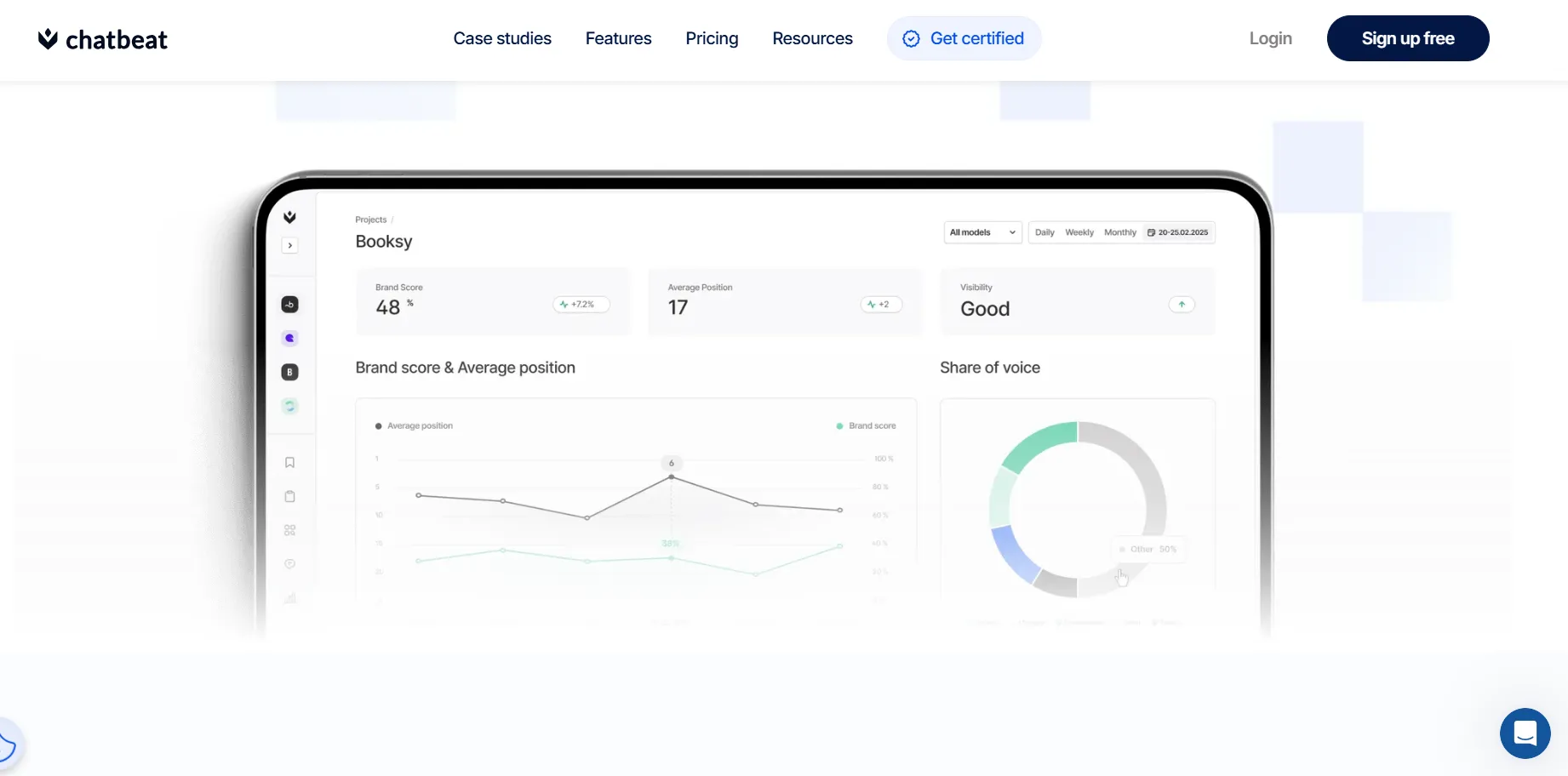
The tool monitors eight AI models: ChatGPT, Gemini, Claude, Perplexity, DeepSeek, Grok, Copilot and Google AI Overviews. Above all, Chatbeat runs structured prompts on these platforms to check how they respond to questions about your brand, product or industry.
The platform's main strength is its set of precise metrics. Brand Score (0-100%) shows how often and how prominently your brand appears in AI answers, where 100% means maximum exposure: the brand ranks first in every query. Chatbeat also measures Median Position, Visibility Rating, and Share of Voice (your visibility compared with competitors).
With Chatbeat, you can check chatbots' exact answers, understand the context of mentions, and identify the sites AI models rely on most often.
Rankscale: Brand Presence in AI Answers
Rankscale has changed how brands track their presence in the AI ecosystem. This GEO platform was built specifically to analyse, monitor and optimise brand visibility in AI-based search engines.
The platform simulates daily or hourly queries on ChatGPT, Perplexity, Google AI Overviews, Claude, DeepSeek, Mistral and other AI engines. This gives you comprehensive data on whether your content is being cited, which domains appear in the answers, and what position your brand holds.
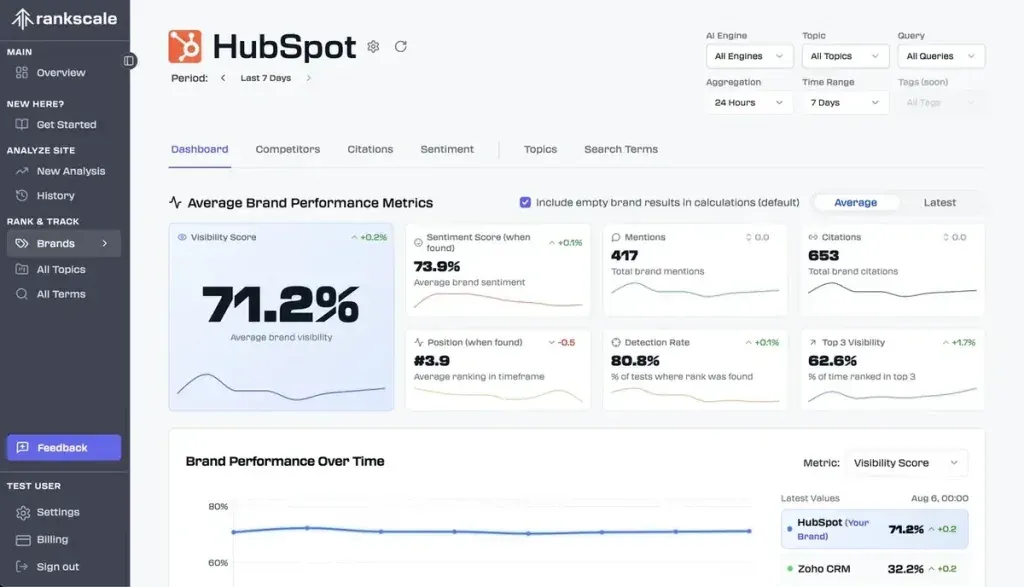
Rankscale features:
- A central GEO console aggregating all brand performance metrics, competitor analyses and citation sources
- AI Presence monitoring showing where and how often your brand appears in AI results
- Automatic identification of competitors appearing in AI answers
- Analysis of the sources AI uses to build its answers
- Sentiment analysis showing how AI perceives your brand
The feature that carries out an in-depth AI analysis of your website is particularly valuable, providing an AI-readiness score with a detailed breakdown across categories: content, authority, SEO and engagement.
Rankscale suits marketing, SEO and product teams that need structured visibility reporting and daily performance analysis of AI-generated search results.
Knowatoa: Sourcing and Citations from AI Models
Knowatoa is a specialised platform built to monitor how brands are perceived and represented by AI models. The tool lets companies check whether artificial intelligence accurately describes their products, maintains a positive brand image, and tracks visibility relative to competitors.
Above all, Knowatoa tracks which sources are most often cited by AI models, helping you understand where AI-generated content comes from. The platform monitors four models: ChatGPT, Claude, Perplexity and Google Gemini, providing detailed information about how each one presents your brand.
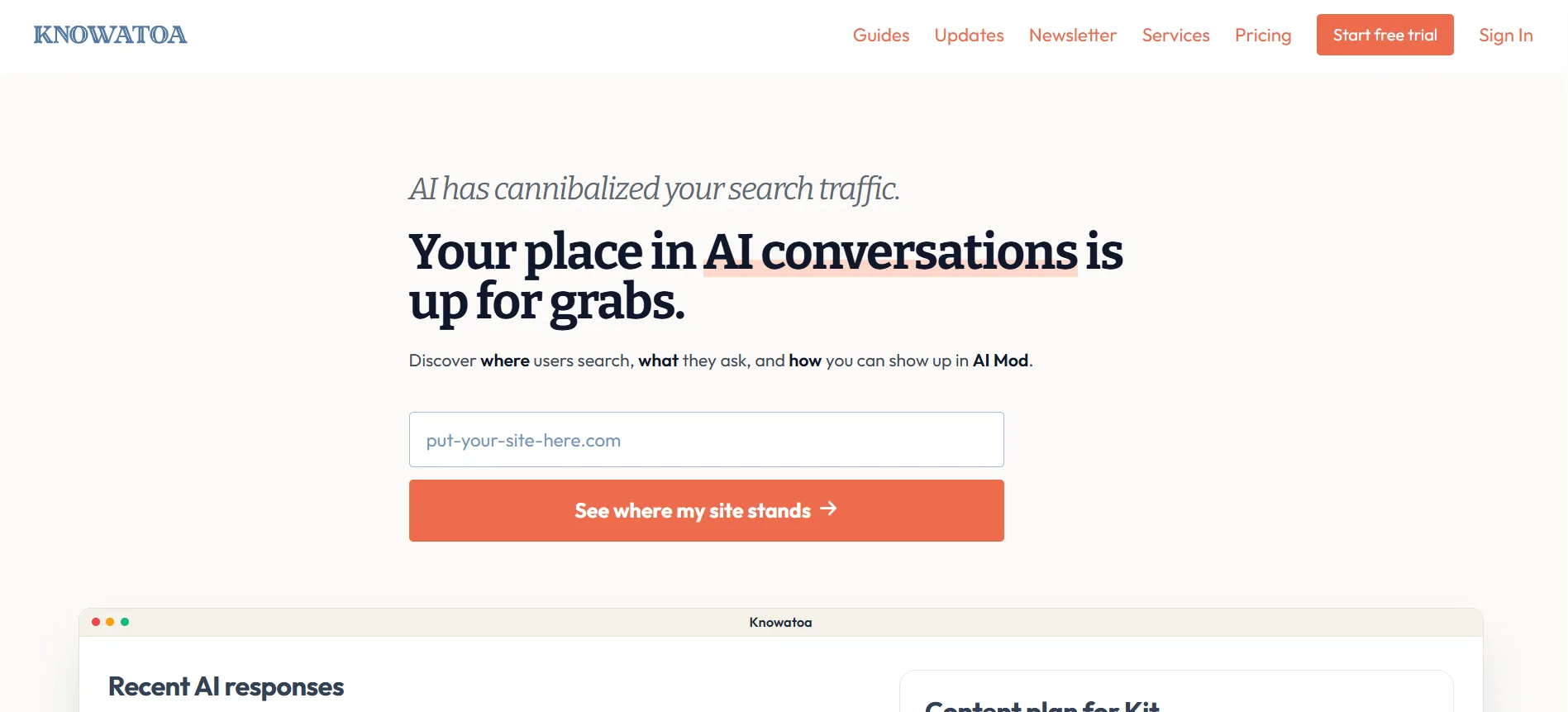
A unique feature of the tool is its proprietary BISCUIT Framework, which lets marketers analyse how AI describes, prioritises and recommends companies in commercial queries. This gives you personalised recommendations for improving your AI visibility.
Knowatoa's main features include:
- cross model AI tracking: tracking brand presence across different AI models,
- citation reporting: analysis of the domains and pages appearing in AI answers,
- locale support: monitoring visibility across different languages and regions.
The tool offers an access API for custom integrations and data extraction, and also integrates with Zapier, enabling workflow automation.
ZipTie.dev: AI Search for Developers and Open-Source Projects
ZipTie.dev was one of the first tools to let developers and open-source creators monitor their visibility in AI search engines. The platform tracks three AI engines: Google AI Overviews, ChatGPT and Perplexity, giving developers precise data on how their repositories and technical documentation are presented by artificial intelligence.
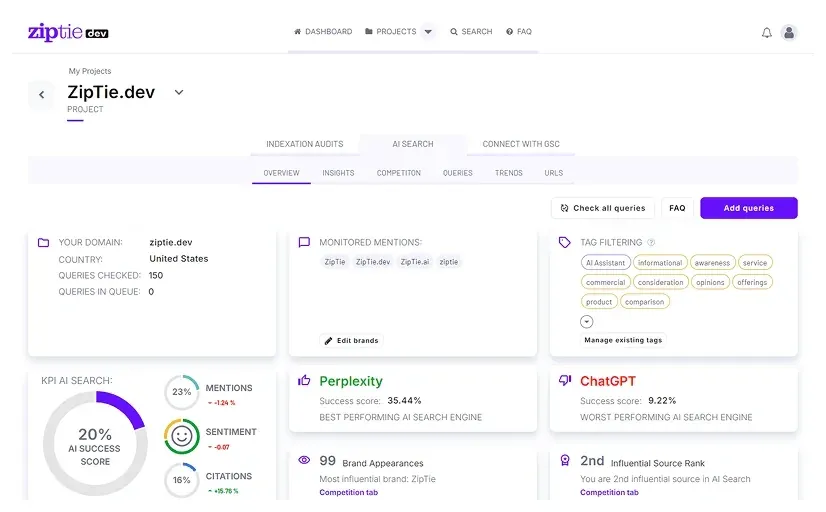
The tool focuses on three basic indicators: mentions (how often the brand appears in AI answers), citations (when AI links to the site as a source of information), and sentiment (how positively AI talks about your project). ZipTie also shows which specific domains have the greatest influence on AI answers in your industry, which gives you a valuable clue for your promotional strategy.
ZipTie monitors results across many regions, including the US, Canada, Australia, the UK, India and Brazil. This lets international open-source projects check their visibility across different markets.
ZipTie shows the full text of AI answers, so besides the metrics you see exactly what the model wrote about your brand. In the Insights tab you'll find the pages of your site that influence the models' answers most strongly. The tool also points to Reddit discussions that AI draws information from.
The tool also lets you export data in CSV format for advanced analysis, which is especially useful for specialists who prefer their own analytics solutions.
Profound: Monitoring LLM and AI Agent Answers
Profound gives enterprises a detailed view of how they're presented in AI-generated answers. This advanced platform monitors brand visibility across AI models: ChatGPT, Google AI Mode, Google AI Overviews, Google Gemini and Microsoft Copilot.
The tool stands out for its precise analysis of the sentiment in AI statements about a brand, which lets you adjust your marketing strategies effectively. Profound also tracks sources and citations in AI answers, so you know exactly where information about your company comes from.
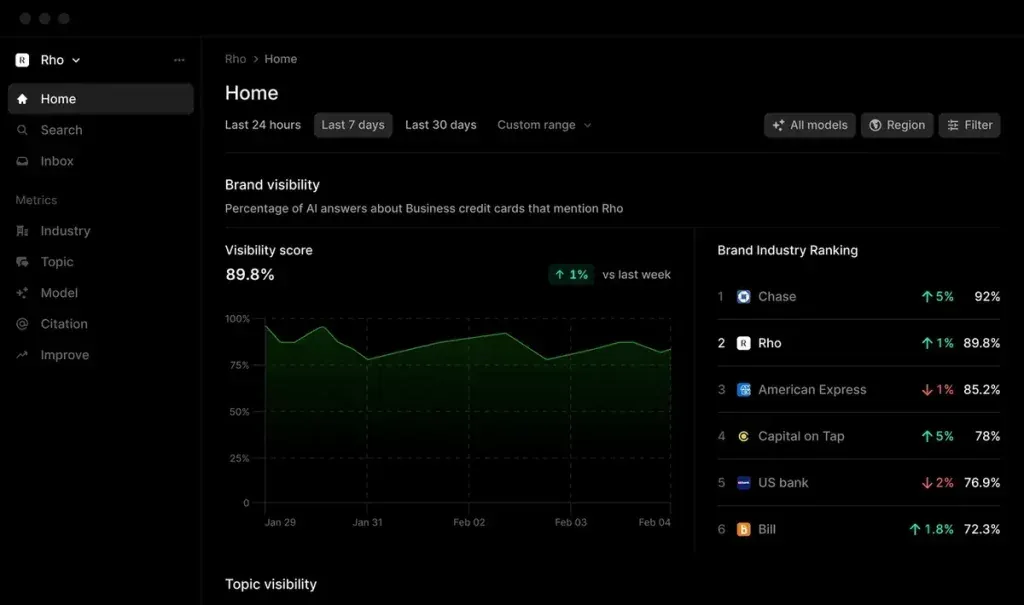
With the Conversation Explorer feature, you get access to real user prompts and the brand mentions that result from them. Answer Engine Insights, meanwhile, provides complete dashboards analysing mentions, sentiment and share of voice.
Profound has also introduced a feature for monitoring search volume in AI engines in real time, letting you understand how often given topics come up on platforms such as ChatGPT and Perplexity.
Otterly.AI: Content Analysis and Visibility in Generative Answers
Otterly.AI was built as a platform specialising in monitoring and optimising brand visibility in AI engines. The tool tracks brand presence across five systems: ChatGPT, Perplexity, Google AI Overviews, Google Gemini and Microsoft Copilot. Recognition of its effectiveness is confirmed by its “Gartner Cool Vendor for AI in Marketing” award.
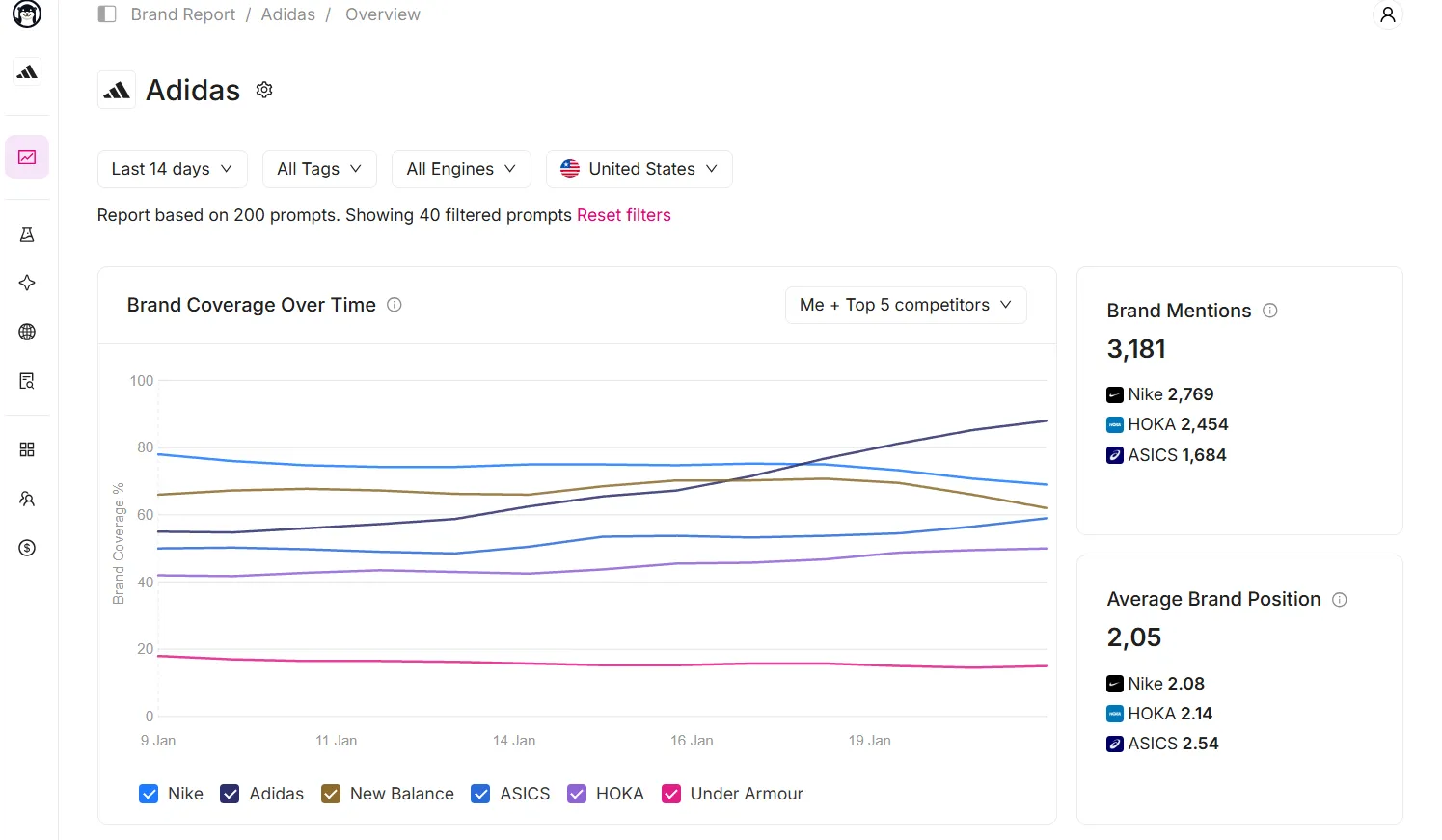
The platform provides a Keyword Monitoring Overview showing whether Google triggers an AI Overview and whether ChatGPT and Perplexity mention your brand. The Weekly Link & Brand Tracking feature lets you track changes over time. In March 2025, Otterly.AI published a study covering 10,000 keywords and 100,000 cited pieces of content, which shows how visibility in AI answers is changing.
The Analytics Dashboard answers questions: how often AI Overviews appear, how many brands are mentioned in the answers, and how many links are cited. You can also export all the cited links for any given keyword.
Otterly.AI also monitors brand sentiment and position, letting you understand how AI perceives and presents your brand. This gives you a complete picture of your content's visibility within the AI ecosystem and lets you optimise your marketing strategies effectively.
Waikay: Analysing What AI Models Know About Your Brand
Waikay takes a unique approach to AI visibility monitoring, focusing on a brand's actual presence in answers generated by language models. The platform offers multilingual support, letting global brands analyse regional trends.
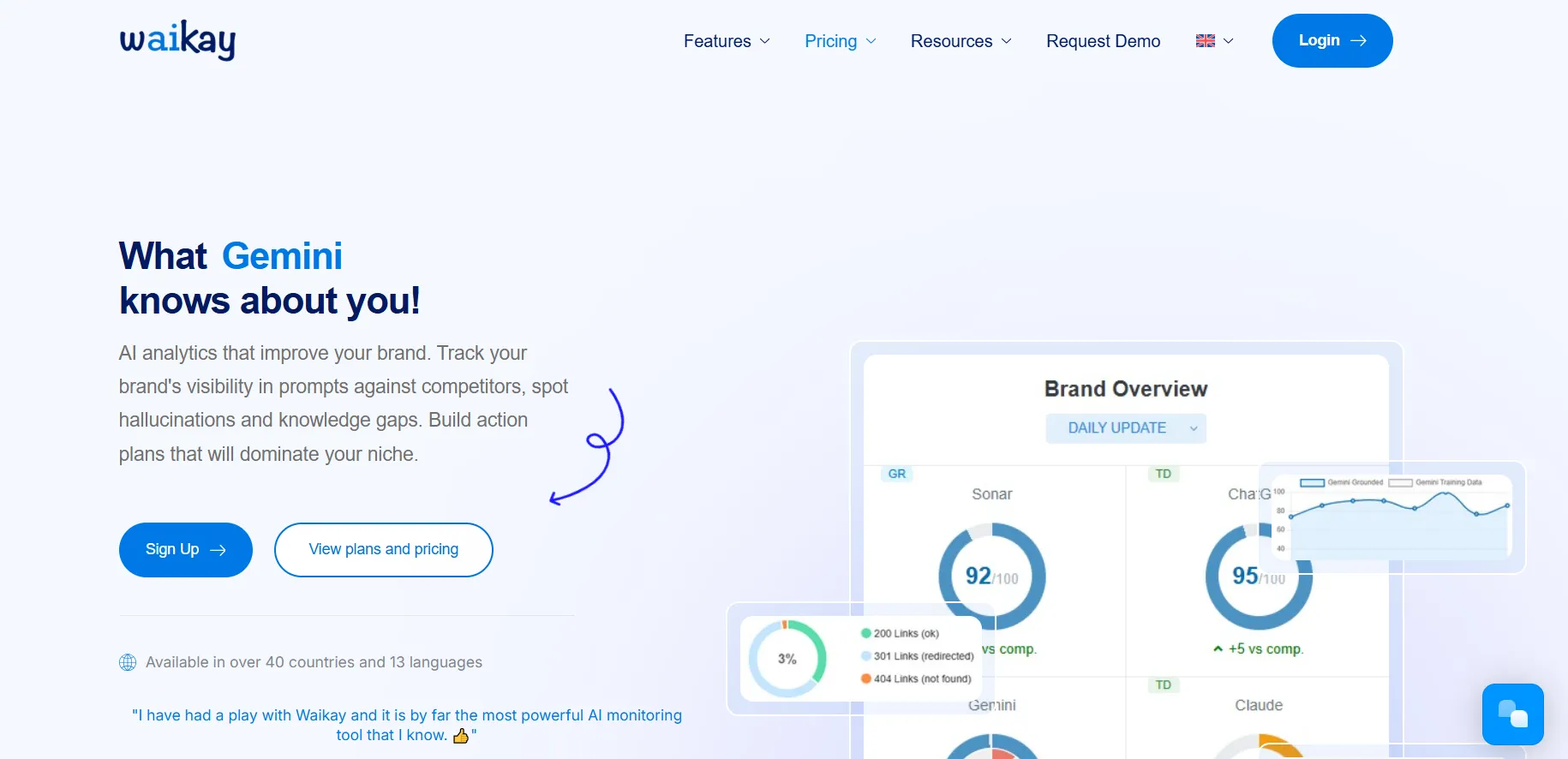
The tool analyses the main AI models, including ChatGPT, Gemini, Claude and Perplexity, using patented technology based on knowledge graphs and named entity recognition (NER). This means it tracks keyword mentions, understands context and the relationships between entities.
Above all, Waikay provides a Brand Overview dashboard with a comprehensive AI Knowledge Score for each brand across individual models. It also offers:
- tracking brand visibility in prompts over time,
- fact-checking on important topics,
- comparison with competitors,
- creating specific AIO action plans.
Waikay stands out for its Fact Tracker feature, which extracts the declarative statements AI models use to describe your brand. This is complemented by Knowledge Maps, which visually present your brand's strengths and weaknesses compared with competitors.
The tool also monitors the sources cited by AI, automatically checking links for status codes and redirects.
KNWN.app: Tracking AI Models' Information Sources
KNWN.app specialises in analysing the information sources AI models use when generating answers. The tool runs realistic prompts through leading AI platforms, then analyses the answers for brand mentions, citations and context. This shows you how often your brand is mentioned, how it's presented, and which sources influence AI-generated answers.
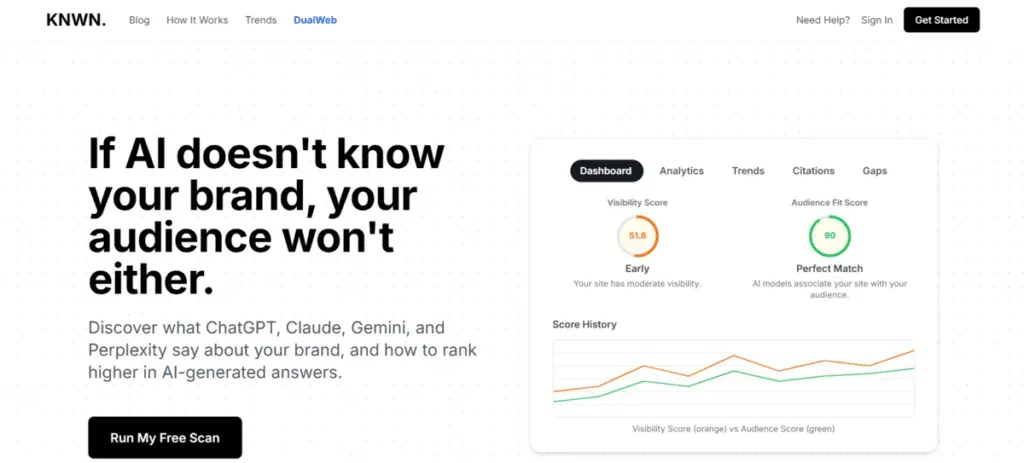
The platform uses seven metrics to assess AI visibility:
- LLM Visibility: how often the brand appears in ChatGPT, Gemini, Claude and Perplexity,
- Extractability Score: how easily AI can cite your content,
- Embedding Clarity: how well your content maps semantically to queries,
- Entity Coverage: how well the brand is defined as a structured entity,
- Topical Authority: dominance within a topical niche,
- AI Referrals: traffic driven by AI tools,
- Visibility Trend: how visibility changes over time.
KNWN also lets you install a tracking script that records AI-generated traffic reaching your site. Based on its research, the company has identified six signals that tell AI a site is a credible source: a clear definition of the entity, structured content with schema.org markup, topical authority, semantic relevance, temporal consistency, and a presence in spaces accessible to AI.
AmIOnAI: Content Analysis and Visibility Scoring
AmIOnAI focuses on a practical approach to monitoring visibility within generative AI ecosystems. The tool tracks how often your brand appears in AI answers, then delivers weekly action plans with specific recommendations for improving your visibility.
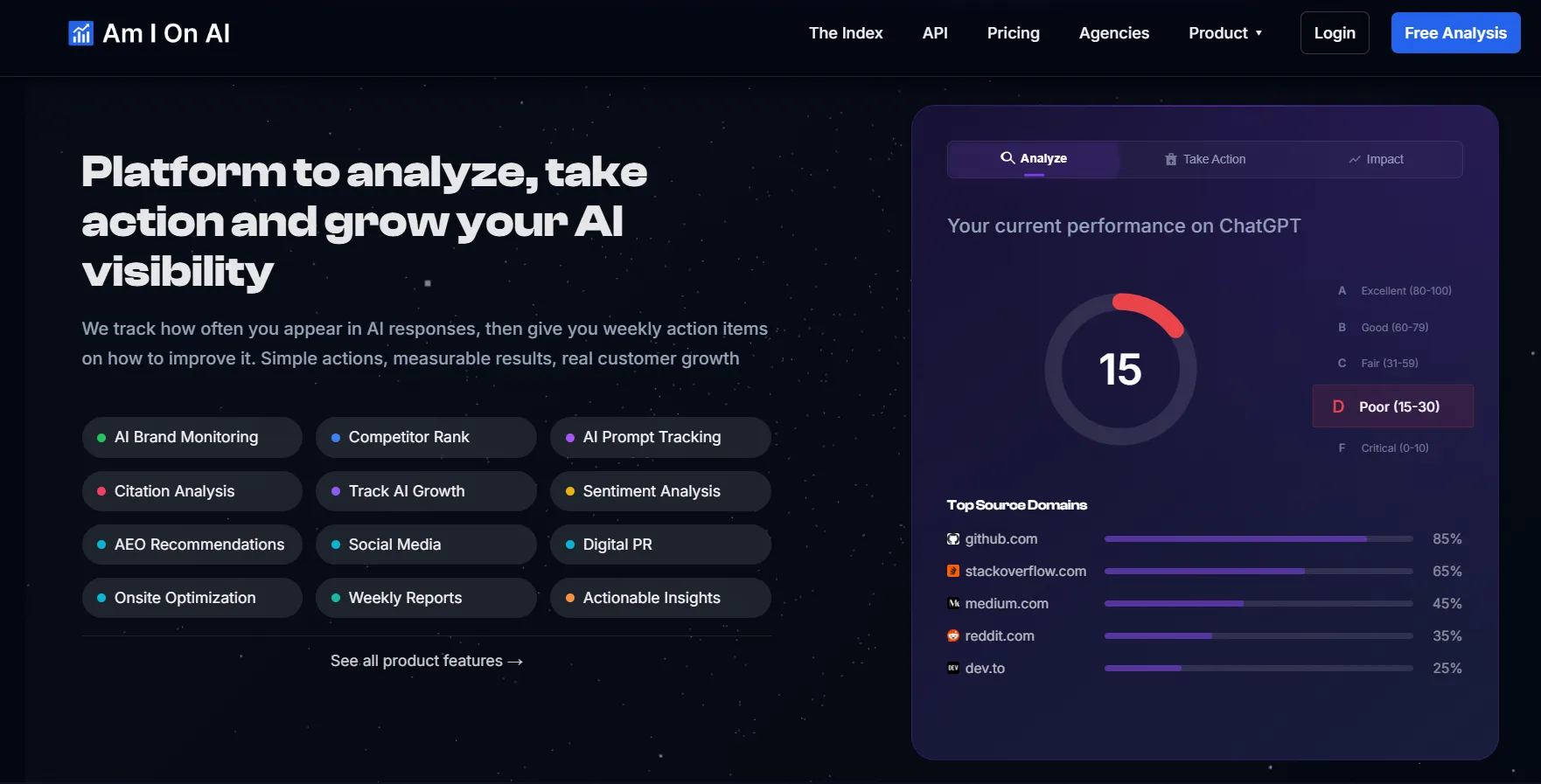
The platform uses seven indicators for a comprehensive assessment of brand presence across AI models, including ChatGPT, Perplexity and Gemini. The AI Visibility Score is particularly valuable, showing the percentage of prompts in which your brand appears. Competitor Rank lets you compare your visibility with competitors, while Sentiment Analysis assesses whether mentions are positive, neutral or negative.
AmIOnAI also stands out for its precise analysis of the sources that influence AI recommendations. The Source Analysis feature identifies the most influential domains, making it easier to understand which sites affect visibility within AI ecosystems.
Rather than just providing data, AmIOnAI suggests targeted actions: from genuinely engaging with relevant subreddits, through creating educational video content, to optimising site structure for better understanding by AI. All recommendations are based on analysis of real ChatGPT answer data, ensuring personalised and effective strategies.
For teams that need programmatic access, the Mindshare API lets you integrate AI visibility metrics with your existing tools.
AthenaHQ: Reporting on How AI Uses Your Content
AthenaHQ, built by former Google Search and DeepMind experts, is an advanced solution for companies looking for precise citation reporting in AI engines. The platform stands out above all for its proprietary Citation Engine (ACE), a tool that uses ML models trained on millions of AI search results to predict the probability of content being cited.
This gives marketing teams the ability to prioritise the initiatives with the greatest visibility potential.
AthenaHQ offers a complete package of analytical features, including:
- Real-time tracking of the sentiment behind brand mentions
- Monitoring the sources cited by AI engines
- Performance comparison with competitors at the level of specific prompts
The tool runs on a credit-based system, providing flexibility for different use cases. Integrations with GA4, log files from Vercel/Cloudflare/AWS, and platforms such as Shopify and Webflow further enrich the platform's analytical capabilities.
Writesonic: Content Visibility in AI and Chatbots
Writesonic provides advanced analytics for AI-generated traffic, revealing previously invisible visits to your site by AI systems such as ChatGPT, Claude and Google Gemini. Above all, the tool tracks every interaction AI bots have with your content through server-side tracking, while traditional analytics platforms miss these visits entirely.
The platform monitors brand visibility across ChatGPT, Gemini, Perplexity and more than 10 other AI platforms, delivering real-time data on visibility, sentiment and citations. Writesonic also offers in-depth AI search analytics: you can filter by platform, sentiment, topic or specific prompts.
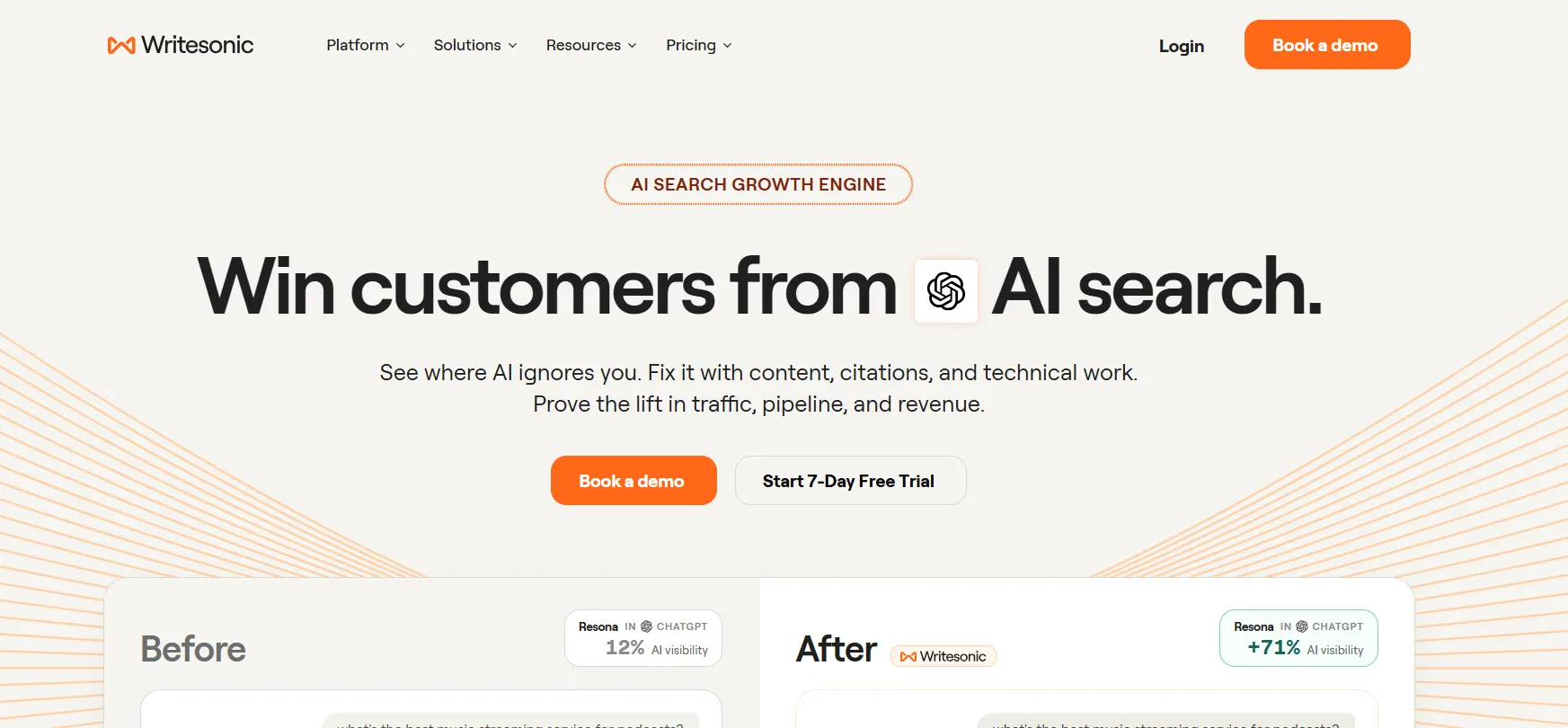
Writesonic's AI Bot Analytics contains four modules: an overview dashboard, source analysis, page analysis and audit logs. This gives you a precise view of which content attracts AI bots' attention and how that translates into actual human traffic.
Writesonic's unique value lies in combining monitoring with action. Rather than just tracking visibility, the platform identifies citation gaps and content opportunities, suggesting specific actions to increase visibility in AI results.
Scrunch: Citation Data Analysis and Recommendations in AI Search
Scrunch focuses on in-depth analysis of citations in AI search engines, helping you understand how AI models interpret and use your content. The tool lets you discover which pages are most often cited by AI and identify citation gaps between your brand and your competitors.
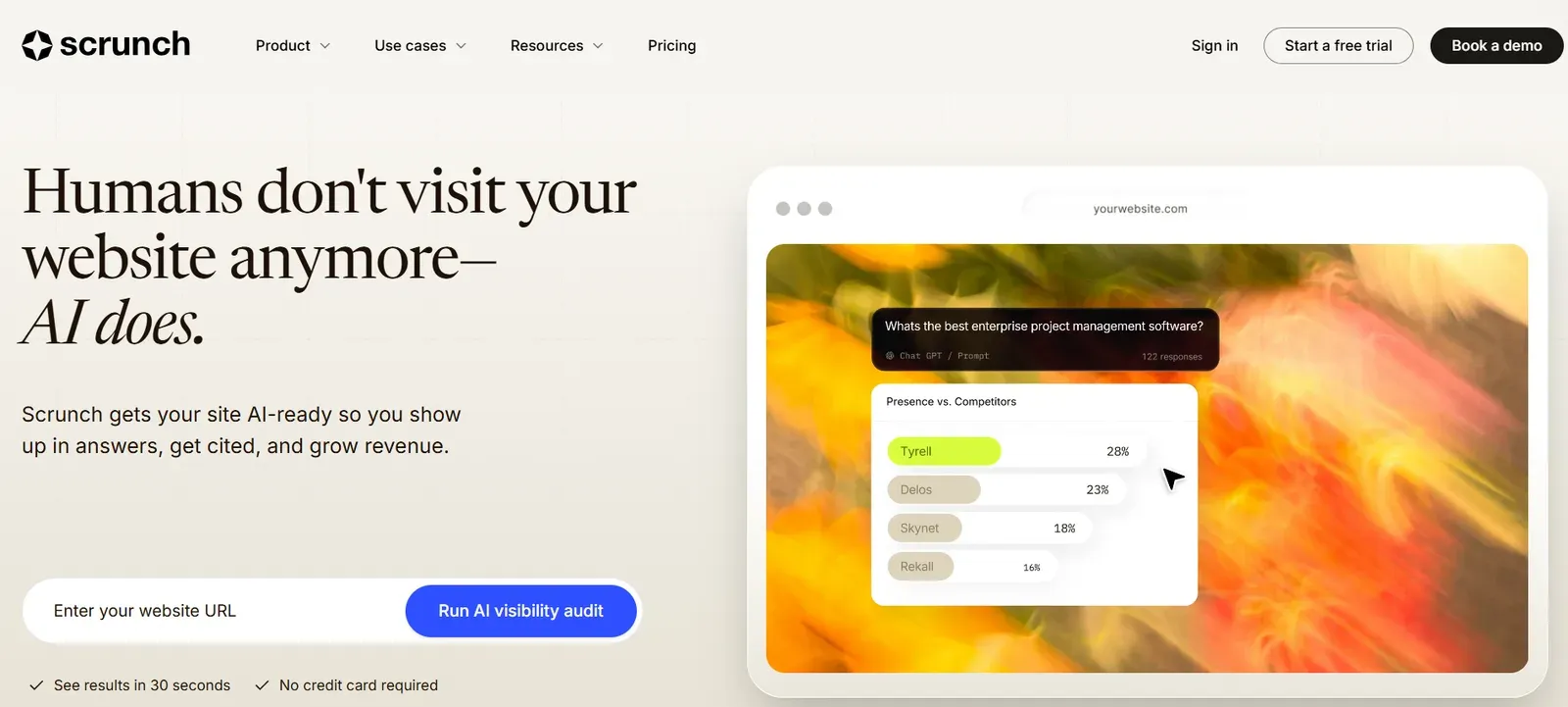
Using ready-made sets of industry prompts combined with your own queries, Scrunch measures these indicators: brand visibility, share of voice (SOV) and citation gaps. Automatic error detection helps you quickly identify technical problems preventing AI models from correctly processing your content.
The platform provides valuable answers to key questions: Is my content cited by AI models? Which sources are considered authoritative in my category? How can I increase the number of citations to improve my visibility?
The competitor analysis feature is particularly valuable, letting you discover where competitors are cited and your brand isn't. Scrunch also helps you analyse competitors' citations to find content gaps and identify influential external domains that appear most often in AI answers.
Peec AI: Competitor Assessment and Content Visibility
Peec AI stands out as a platform for tracking brand presence in AI-generated answers. The tool monitors visibility across AI engines such as ChatGPT, Perplexity, Gemini, Claude and DeepSeek, delivering valuable data on how AI presents your brand.
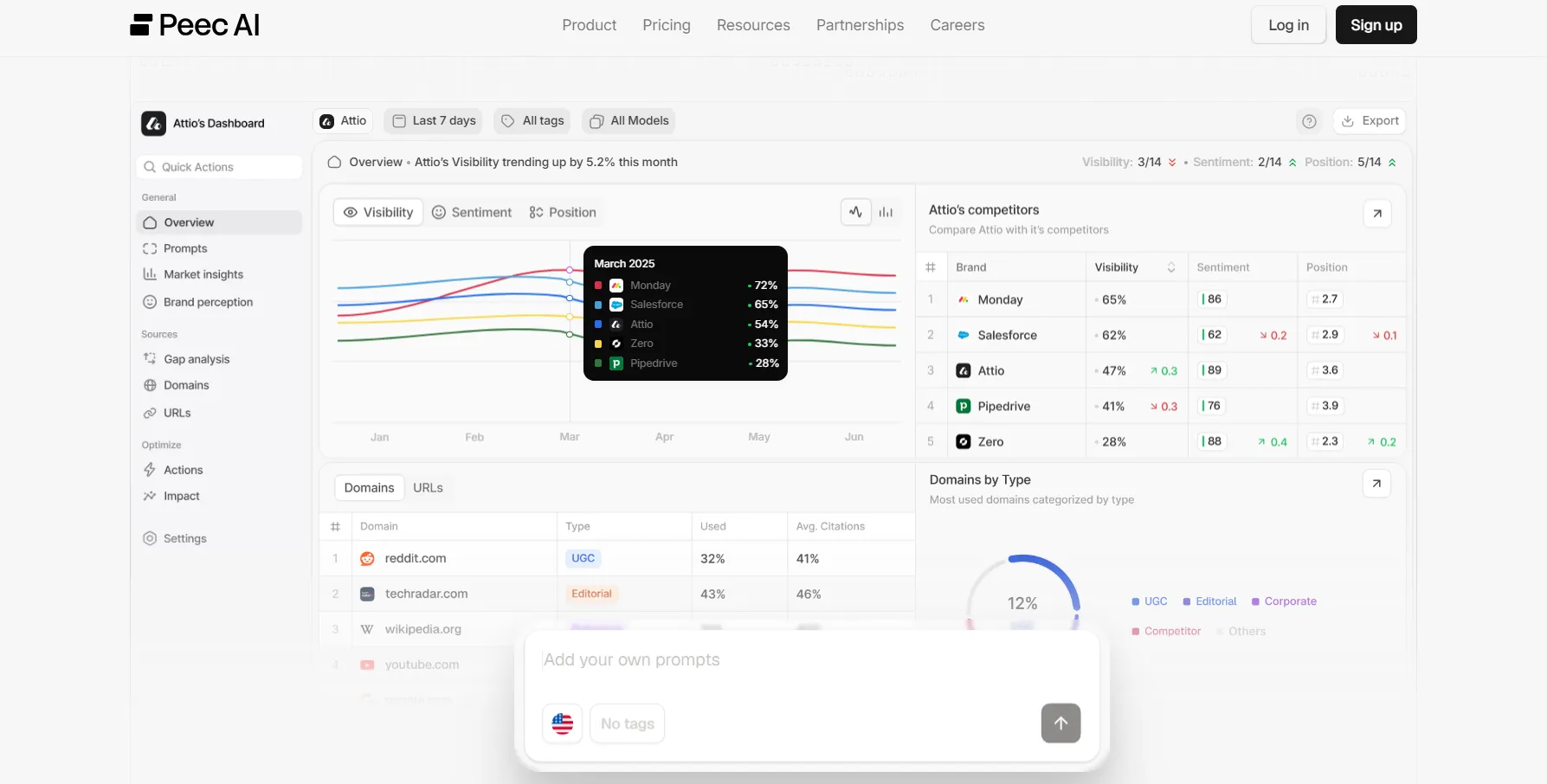
Peec AI's dashboard acts as a control centre where you can analyse the Visibility section, showing your brand's share of voice compared with competitors. Industry Ranking lists all the sites you've added, along with their position, sentiment and percentage of visibility in chats. The Recent Mentions feature also tracks where and how often your brand appears in AI answers.
An important advantage is the analysis of the sources cited by AI, both at the domain level and for specific URLs. The Sources tab shows the percentage of chats using a given source and the average number of citations.
Peec AI offers multilingual support and analytics across different regions, making it an ideal tool for global brands. Despite its solid monitoring features, the platform has limited functionality when it comes to guidance on improving visibility and requires external tools for content optimisation.
Nightwatch: Ranking Monitoring Extended with AI-Driven SERP Data
Nightwatch has extended its traditional ranking monitoring with advanced features for tracking visibility in AI search engines. The platform lets you monitor the presence of your pages in answers generated by ChatGPT, Claude, Gemini and Google AI Overviews, presenting this data alongside classic search rankings.
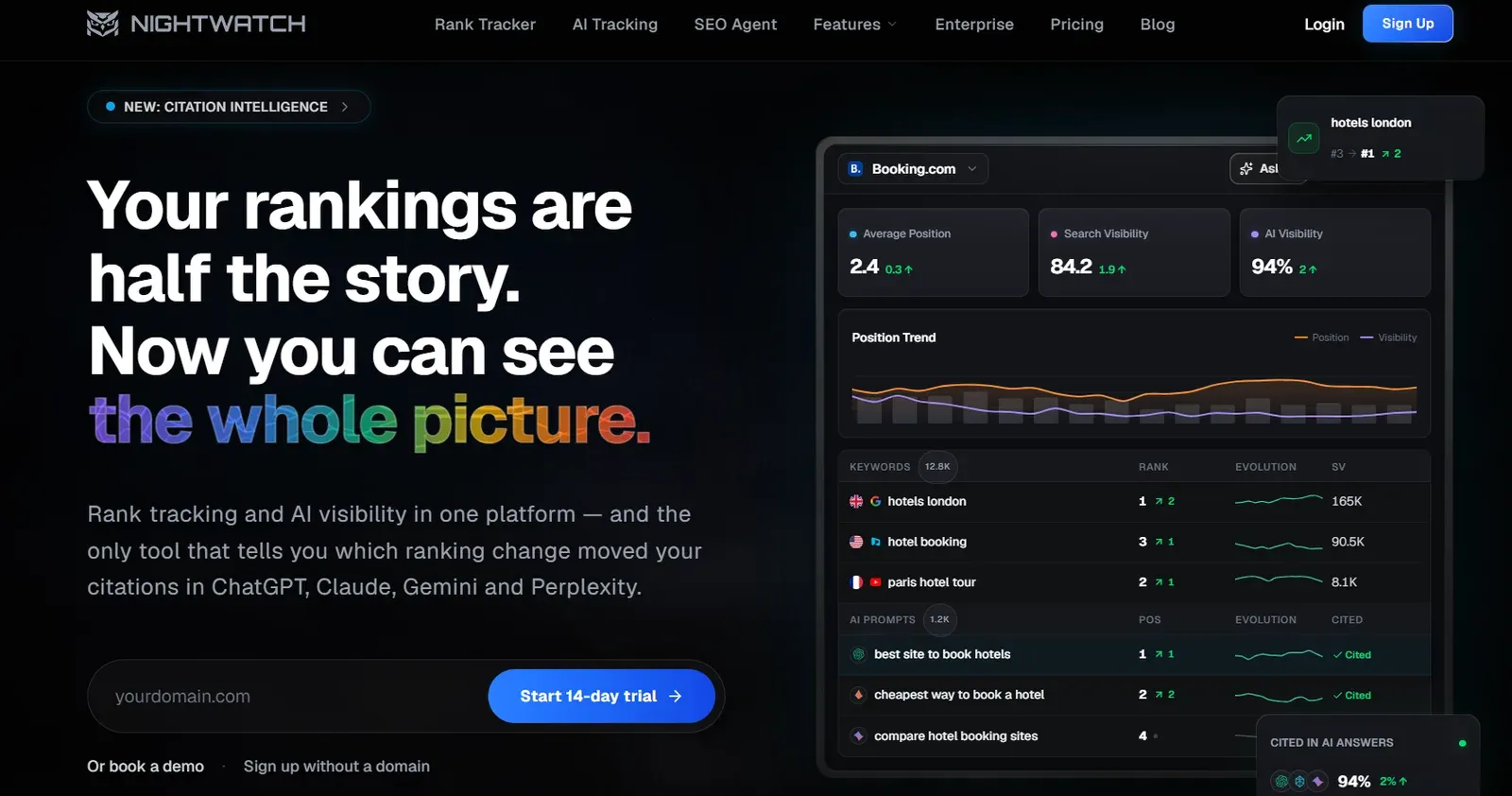
Above all, Nightwatch stands out for its integrated dashboard, where you can analyse results from traditional search engines and AI platforms at the same time, eliminating the need to use multiple tools. The flagship LLM Tracking feature shows whether your pages appear in AI answers for relevant keywords.
A standout advantage of the tool is its precise local tracking. Nightwatch offers monitoring in more than 100,000 locations worldwide. This lets you check rankings for specific cities, districts and even postcodes, which is invaluable for multi-location strategies.
The NightOwl system automates technical SEO audits, detecting issues such as unindexed pages or duplicate content. There's also a predictive analytics feature that helps forecast keyword potential.
Nightwatch suits both individual specialists and agencies managing multiple clients.
ClickUp: A Project Management Tool Supporting AI Search Visibility Analysis
ClickUp doesn't measure AI visibility itself: it's a project management tool. It made it into this roundup because it organises work around the data from the tools described above, turning monitoring results into tasks, deadlines and documentation. Unlike specialised analytics platforms, ClickUp lets you integrate AI visibility tracking into teams' everyday workflow.
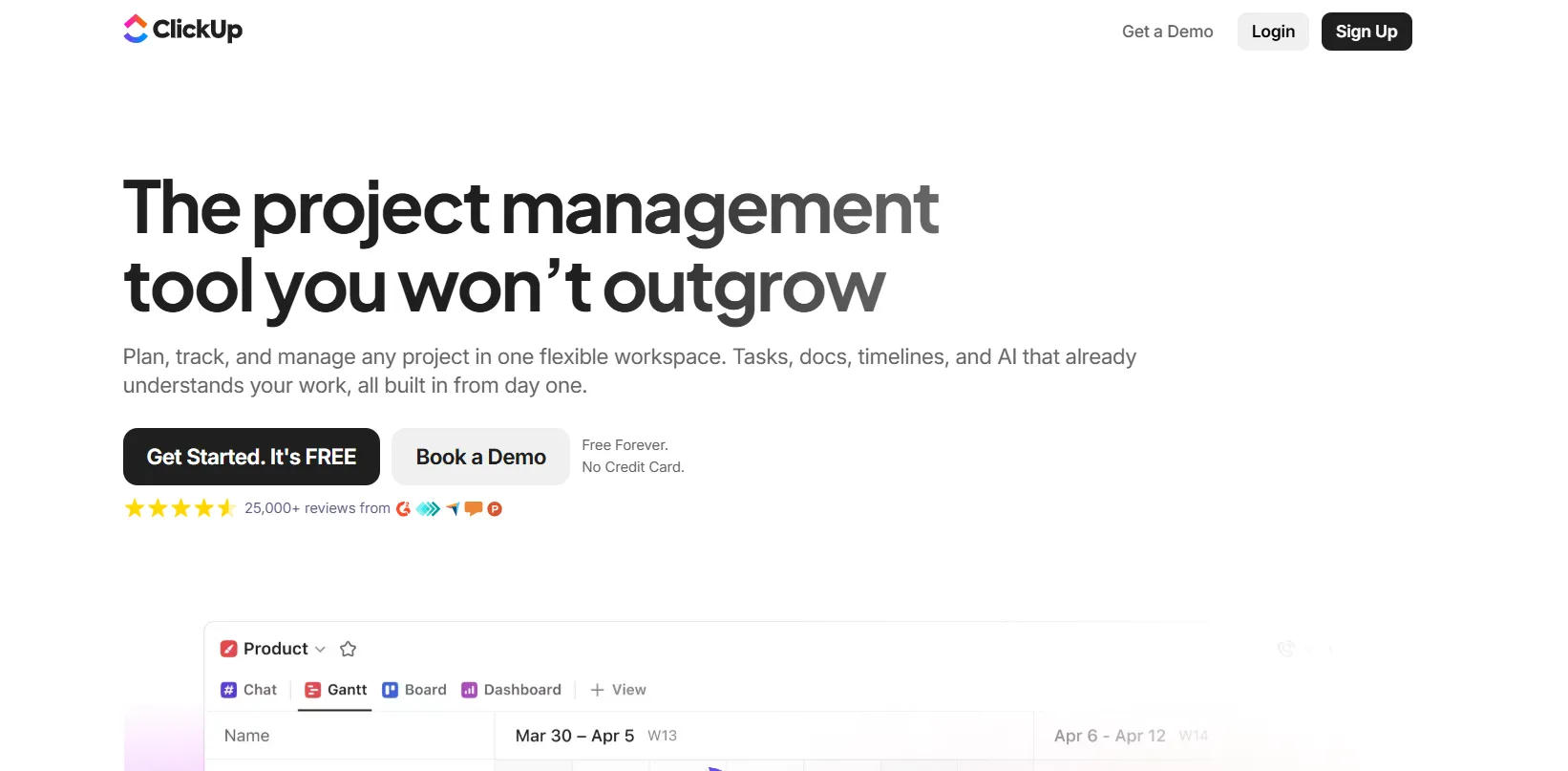
With the Workflow Management feature, you can organise tasks related to AI Search monitoring in a structured way. For example, a marketing team could create a task called “Investigate missing brand mentions in Perplexity” with subtasks assigned for analysing AI knowledge sources or testing prompts.
In ClickUp's automations you can set rules that react to a change in a task's status, for example when someone marks a mention as “Not mentioned” after the next measurement. The system can then assign a research task to the relevant team or send an email notification. You do, however, have to supply the mention data itself from your monitoring tool.
ClickUp Docs also provides a centralised knowledge management system for documenting AI search results and collaborating on visibility improvement strategies. You can create reports on AI Search trends, save screenshots of AI answers, and analyse competitor rankings.
ClickUp Brain is particularly useful: an AI assistant that searches your tasks, documents and chats. If your team records measurement results in ClickUp, you could ask it, for example: “How often did our brand appear in ChatGPT's answers last month?” or “Which competitors were mentioned more often by Perplexity AI?”
Technical SEO and AI Citation: What to Check on Your Site
Even the best monitoring tool won't help if an AI bot can't read your site. Before you start writing new content, check the basics, because technical SEO decides whether you get into the game at all.
AI Crawlers in robots.txt
Each AI platform has several bots with different jobs. Take OpenAI: GPTBot collects data for training models, while OAI-SearchBot handles search in ChatGPT. Blocking GPTBot doesn't remove you from ChatGPT's answers, but blocking OAI-SearchBot does. PerplexityBot works in a similar way. Go through your robots.txt and firewall rules (e.g. in Cloudflare), because a block at server level is sometimes set by default, without the SEO team's knowledge.
Content in Raw HTML
The ChatGPT, Claude and Perplexity bots usually don't render JavaScript. If a product description, a price or an FAQ section only loads in the browser, these models won't see it. Google renders JavaScript, so AI Overviews and AI Mode are less sensitive to this, but it's not worth relying on Google alone.
Structured Data and Bing
schema.org markup (Organization, Product, FAQPage) helps models correctly recognise your brand and its offer. It's also worth making sure you're indexed in Bing, because Copilot uses its index, and so, in part, does search in ChatGPT. Submit your site in Bing Webmaster Tools, quickest by importing from Google Search Console.
How to Increase Your AI Visibility: Strategies That Work
Monitoring will show you where you stand. To increase your AI visibility, combine the data with several actions:
- Answer directly at the top of the page. Models readily cite passages that give a full answer in 2-3 sentences. An answer buried in the fifth paragraph has a smaller chance.
- Use question-style headings. A subheading like “How much does an SEO audit cost?” maps onto queries better than “Pricing”.
- Be specific. Prices, dimensions, lead times and data in tables are material that AI readily quotes.
- Build mentions beyond your own site. As the Ahrefs study showed, brand mentions on the web correlate with a presence in AI Overviews more strongly than links do. Reviews, industry rankings, interviews and forum discussions all count.
- Create content with real value. A copy of what's already in the TOP 10 gives the model no reason to cite you specifically. Your own data, case studies and your team's experience do.
Comparing the Tools: Which One Should You Choose?
The table below shows the range of engines monitored, as of October 2026. Vendors regularly add new models and change the scope of their plans, so check the current list of supported platforms before choosing a tool.
| Tool | Monitored engines | Best for |
|---|---|---|
| Ahrefs Brand Radar | ChatGPT, Gemini, Perplexity, AI Overviews, AI Mode, Claude, Copilot, Grok | Agencies and large brands with a budget for a full SEO suite |
| Senuto | AI Overviews | Companies operating in the Polish market |
| SurferSEO | ChatGPT, Gemini and others | Content teams |
| SEOstation | AI Overviews | Freelancers and small businesses |
| Chatbeat | 8 models, including Claude, DeepSeek, Grok | Monitoring brand presence in chatbots alone |
| Rankscale | ChatGPT, Perplexity, AI Overviews, Claude, DeepSeek, Mistral | Daily GEO reports |
| Knowatoa | ChatGPT, Claude, Perplexity, Gemini | Analysing cited sources |
| ZipTie.dev | AI Overviews, ChatGPT, Perplexity | Technical and open-source projects |
| Profound | ChatGPT, AI Mode, AI Overviews, Gemini, Copilot | Enterprises |
| Otterly.AI | ChatGPT, Perplexity, AI Overviews, Gemini, Copilot | International brands |
| Waikay | ChatGPT, Gemini, Claude, Perplexity | Checking what AI “knows” about a brand |
| KNWN.app | ChatGPT, Gemini, Claude, Perplexity | Tracking AI traffic on your site |
| AmIOnAI | ChatGPT, Perplexity, Gemini | Ready-made action plans |
| AthenaHQ | ChatGPT, Perplexity, AI Overviews, AI Mode, Gemini, Copilot, Claude, Grok, DeepSeek, Meta AI (range depends on the plan) | Forecasting citation opportunities |
| Writesonic | ChatGPT, Gemini, Perplexity and more than 10 others | Analysing AI bot visits to your site |
| Scrunch | ChatGPT, Claude, Gemini, Perplexity, AI Overviews, AI Mode, Copilot, Meta AI, Grok | Finding citation gaps relative to competitors |
| Peec AI | ChatGPT, Perplexity, Gemini, Claude, DeepSeek | Competitor analysis |
| Nightwatch | ChatGPT, Claude, Gemini, AI Overviews | Local SEO and agencies |
| ClickUp | n/a (work organisation) | Teams that want to turn data into tasks |
| PromptWatch | ChatGPT, Claude, Gemini, Perplexity and other AI platforms | Brands and agencies that want to combine monitoring of mentions, citations and competitors with visibility optimisation |
| Promptmonitor | ChatGPT, Claude, Gemini, Perplexity, Google AI Overviews, AI Mode | Monitoring visibility, mentions, sources and competitors in AI answers |
Choosing the right solution depends on your specific needs. Large brands with an international reach should consider platforms with multilingual support, such as Waikay or Otterly.AI. Polish companies, on the other hand, can take advantage of local solutions offered by Senuto or SEOstation, which specialise in monitoring AI Overviews in the domestic market.
An effective AI visibility strategy requires both tracking and action. Tools such as Profound, AmIOnAI and Scrunch provide specific recommendations for improving a brand's presence in AI-generated answers. SurferSEO, meanwhile, combines content optimisation with monitoring, creating a comprehensive workflow for content teams.
If you're not sure where to start, choose one tool with a broad range of engines (e.g. Ahrefs Brand Radar) and one focused on Polish Google (Senuto or SEOstation). A pairing like that covers both chatbots and AI Overviews in the domestic market.
FAQ: Frequently Asked Questions
What Is the Difference Between GEO and SEO?
SEO fights for a position in search results and for a click. GEO fights for an AI model to mention your brand or cite your page in its answer. The foundation is shared: an indexable page, a good structure and content matched to intent.
Which Tool Should You Choose for the Polish Market?
For analysing AI Overviews on Polish Google, Senuto and SEOstation work best. If you also want to measure ChatGPT, Gemini and Perplexity, add a platform with a broader reach, e.g. Ahrefs Brand Radar.
Can You Check AI Visibility Without a Paid Tool?
Yes, but only on a small scale. Type a dozen or so questions into ChatGPT, Gemini and Perplexity and note whether your brand appears. In GA4, check traffic from AI platform domains. Manual measurement won't give you a trend or a comparison with competitors across hundreds of queries, though.
Does Blocking GPTBot Remove My Site from ChatGPT?
No. GPTBot collects data for training models. Search in ChatGPT is handled by OAI-SearchBot, and blocking it is what takes you out of the answers.
Do I Need to Be in the TOP 10 to Get into AI Overviews?
No. AI Overviews also cite pages from outside the top ten if they contain a passage that answers the query accurately. A high organic position does improve your chances, though.
How Often Should You Measure AI Visibility?
A monthly report is enough to track the trend. During big changes to your site, campaigns or product launches, it's worth measuring weekly.
Summary
AI visibility monitoring shows whether your brand appears in model answers, how often it's cited and how it compares with the competition. Measurement alone isn't enough: it's worth combining the results with content optimisation, technical SEO and building your brand's presence beyond your own site.
When it comes to SEO for language models, continuous monitoring and data-driven optimisation are a must if you want to increase your brand's presence in AI answers. Start by checking the technical basics, take a baseline measurement and compare your results with competitors every month. This will help you keep your edge in an era where AI is becoming the main intermediary between brands and customers.