













Google AI Overview in Poland: How Is It Changing SEO and What to Do to Avoid Losing Visibility?
Google is once again changing the rules of the game. The rollout of AI Overview to Polish search results is a genuine revolution that can significantly affect the visibility of websites, the effectiveness of SEO efforts and user behaviour. The new way the search engine presents content means that some results are being displaced by generative, AI-based answers.
In practice, this means falling CTR, a rise in queries without clicks ("zero-click searches"), and the need to rethink content strategy. Companies and marketers need to adapt quickly if they don't want to fall behind. That's why in this article we'll look at exactly what AI Overview is, how it works and, most importantly, what to do to keep your website visible and generating valuable traffic.
It's worth remembering that AI Overviews don't completely replace traditional search results, but they do strongly change how Google Search is used. Alongside classic organic results, an AI-generated overview of information increasingly appears, answering the user even before they click any link. For content creators, this means a new SEO reality in which it's no longer just about ranking in the TOP3, but also about the chance of appearing in AI Overviews as a cited source.
What Is Google AI Overview?
The Google AI Overview feature is a new way of presenting information in search results, based on artificial intelligence. Its purpose is to give users direct, synthesised answers without the need to click on links. For marketers and SEO specialists, this is a breakthrough that changes the rules of the game in search positioning.
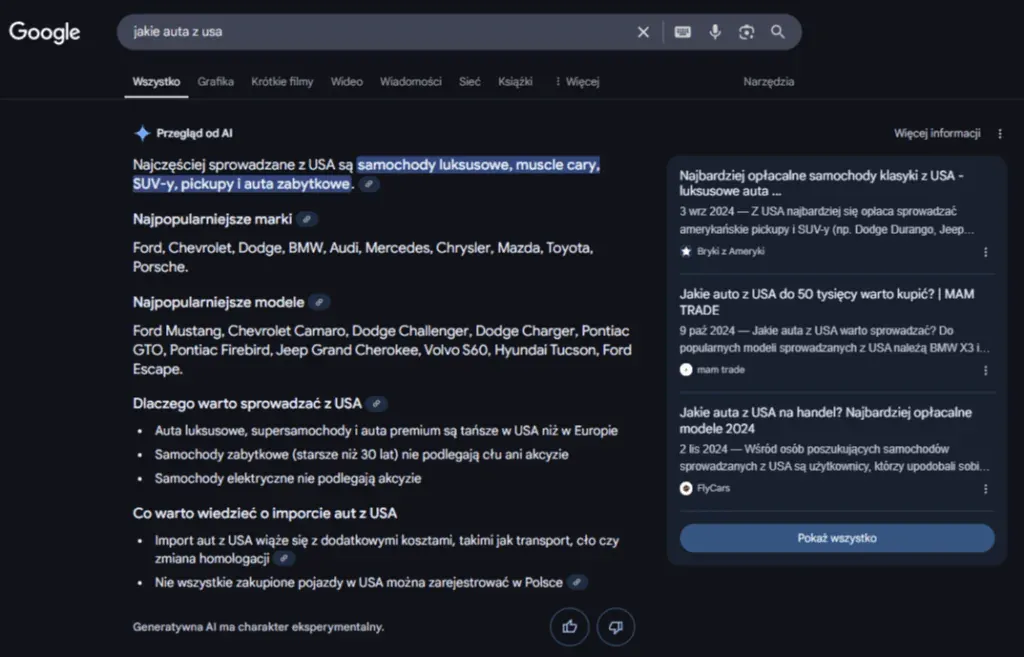
Example of AI Overview results
Definition and How AI Overview Works
AI Overview generates short, coherent answers to user queries, drawing on content from various sources available on the internet. This mechanism not only aggregates information but also processes it and formulates it in a response resembling a conversation. Cited sources also appear in the answer, which may gain additional exposure, although this doesn't always mean more traffic to the site.
In practice, the AI overview works like an intelligent snapshot of the most important information on a given topic. Google's search feature analyses the user's query, interprets their intent, and on this basis creates a synthesised summary based on multiple sources at once. For the user, this means faster access to answers, while for website owners it means the need to create more expert and helpful content.
How It Differs From SGE and Featured Snippets
Although AI Overview is sometimes confused with earlier features such as SGE (Search Generative Experience) or featured snippets, it differs from them significantly:
- SGE was an experimental phase in limited locations, AI Overview is the official rollout.
- Featured snippets present a fragment of one chosen page, AI Overview synthesises multiple sources.
- AI Overview uses a more advanced language model (Gemini) and has greater interpretive "freedom".
This new search feature therefore works differently to classic rich snippets or featured snippets, because it isn't limited to presenting a single fragment of text. AI Overviews in Search create their own answer, drawing on multiple sources and contexts at once. This is exactly why the appearance of AI Overviews is such a big change for the SEO and content marketing industry.
What Technology It's Based On (Gemini / Generative AI)
The whole system is based on the Google Gemini model, Google's flagship generative artificial intelligence solution. It's what analyses billions of data points to provide the most accurate answer possible. It runs on Large Language Models (LLM), combining the context of the query with current knowledge.
Google is also currently developing AI Mode, a more conversational way of using the search engine. This clearly shows that AI in Google Search will develop in the direction of natural conversation with the user, rather than just presenting a list of links.
Where and When It Was Rolled Out (USA to Poland)
Google AI Overview was initially launched in the USA in 2023 as part of experimental tests. The official rollout to European markets, including Poland, took place in the first quarter of 2025. AIO visibility is now growing dynamically, covering more and more queries, especially informational and how-to ones.
Which Queries Trigger AI Overview?
AI Overview doesn't appear for every search. Google's algorithms decide whether to display it depending on the type of query and the user's intent. In Poland, the reach of this feature keeps expanding, which is why understanding when and why it appears is key to any SEO strategy.
Informational, How-To, Medical and Culinary Phrases
The highest activity of AI Overview can be observed for informational and educational queries. These include, among others:
- medical phrases ("how to lower blood pressure")
- lifestyle topics ("how to make homemade bread")
- technology questions ("how does a VPN work")
- everyday how-to guides ("how to remove a wine stain")
In such cases, AI Overview takes over the search results space, presenting the user with a synthesised answer, often without the need to click on any link. AI Overviews in Search appear especially often for complex questions that require combining several pieces of information at once. Google then assumes that the user can get help faster through an AI-generated summary than by analysing multiple web pages themselves.
Examples of Queries From Polish Google
In Polish search results, you can already see AI Overview for phrases such as:
- "how does a graphics card work"
- "what helps with a cold"
- "tomato soup recipe"
- "why can't I fall asleep"
This clearly shows that the algorithms focus on queries with a clearly defined informational intent, where the answer can be summarised in a few sentences.
When AIO Doesn't Appear (Transactional, Local Phrases, etc.)
AI Overview doesn't appear for queries where the user shows an intent to buy or is looking for a specific place. This includes:
- transactional phrases ("buy iPhone 15", "best WordPress hosting")
- local searches ("dentist Krakow", "sushi restaurant Warsaw")
- navigational queries ("Facebook login", "Allegro (Poland's largest online marketplace) contact")
Google avoids interfering with this type of result, leaving room for ads and classic organic results.
Search Intent and the AI Overview Mechanism
User intent plays a key role in triggering AI Overview. If a query suggests the need for quick, concise information, the AIO mechanism activates automatically. For marketers, this is a signal that it's worth carefully analysing keyword groups and segmenting them by intent type: informational, transactional, local and navigational.
How Does AI Overview Affect SEO and CTR?
The introduction of AI Overview isn't just a visual change: it's also a powerful shock to existing traffic acquisition models. Companies and publishers are feeling clear changes in clicks, visibility and the effectiveness of advertising campaigns. Understanding these changes is key to developing an effective SEO strategy in this new reality.
Until recently, the fight for high Google rankings was based mainly on securing a place in the TOP10 organic results. Today the situation looks different, because AI Overviews appear above traditional search results and often capture the user's attention before the first click. This means that even pages holding high rankings can see drops in organic traffic and CTR.

Statistics: Drops in Organic and Ad CTR
Since AI Overview was rolled out in the USA, and later in Poland, many websites have seen organic CTR drops of as much as 30-45% for informational queries. Google Ads, which previously dominated above the results, are also losing visibility, now appearing lower, below the AI block.
Some industries, especially education, health and how-to content, report a noticeable drop in clicks despite maintaining TOP3 rankings. This is a signal that ranking alone is no longer enough: you need actions that increase your chances of being cited by AI Overview.
Google AI Overviews are therefore changing how SEO effectiveness is interpreted. In the past, a high ranking in search results almost automatically meant more traffic. Now the user often gets the answer directly in the AI-generated summary and doesn't go on to visit the site.
The Rise of "Zero-Click Searches"
One of the main effects of AIO is the growing share of so-called zero-click searches, meaning searches after which the user doesn't click on any result. According to Sistrix analyses, the share of such searches in some categories already exceeds 60%. Users get the answer directly in AI Overview and end their interaction with the search engine. This creates challenges, but also opportunities: if your brand is cited as a source, it can gain trust and recognition, even without a click. Visibility in AI Overviews is therefore starting to play a role similar to that once played by featured snippets: it builds authority and increases brand awareness.
It's also increasingly said that AI Search is changing the very model of how the search engine is used. Users don't always want to browse multiple websites any more. In many cases, they expect a quick, specific, AI-based answer that solves their problem immediately.
Reduced Traffic From Educational Phrases
AI Overview features hit educational content particularly hard, content that used to be the foundation of many content marketing strategies. Phrases like "what is SEO" or "how to start a business" generate less traffic, because AI already provides the answer within the search results. For many publishers, this means having to rethink their content: moving from passive information towards expert, unique and citable content. Google is increasingly promoting content that's genuinely helpful to users, rather than text written purely around keywords.
In practice, this means that classic encyclopaedic-style articles are losing significance. Content based on experience, data, case studies and original analysis is gaining ground instead. It's exactly this kind of material that has the best chance of appearing in AI as a valuable source.
Increased Visibility for Brands Cited in AIO
On the other hand, brands that appear as a source of information in AI Overview see an increase in visibility and user trust. Even if this doesn't translate directly into clicks, it builds authority in the eyes of both Google and customers. The introduction of Google AI Overview means that a brand's presence in AI answers can be just as valuable as a classic organic ranking. For many companies, being cited by AI is becoming a new way of building expertise and recognition online.
That's why it's worth optimising content with potential AI citation in mind, something we'll cover in more detail later in this article.
How to Check Whether AI Overview Is Affecting Your Site
Before you start changing your SEO strategy, you need to be sure your site is actually being affected by AI Overview. Google doesn't provide a direct AIO report in Google Search Console, so you need to combine several methods, from manual analysis to advanced SEO tools.
It's worth remembering that the impact of AI Overviews can look different depending on the industry, content type and search intent. Some sites experience a clear drop in organic traffic, while others gain extra visibility thanks to citations in AI Overviews.
Manual Analysis (Incognito + Phrases)
The first step is to manually check whether your key phrases trigger AI Overview. Run searches in incognito mode to eliminate result personalisation. Enter phrases related to your business, such as how-to queries or definitions, and observe whether an AI block appears above the results.
Pay attention to whether your domain is cited as a source of information. The appearance of a logo, URL or brand name in AIO is a strong authority signal worth using in your marketing communication. It's also a good idea to monitor which types of phrases most often trigger AI Overviews. This makes it easier to identify which content sections are most at risk of losing clicks.
Google Search Console: What to Look At (CTR vs. Position)
Although Google Search Console doesn't directly report the presence of AI Overview, you can draw important conclusions by analysing the relationship between CTR and position. If you see that your page maintains high rankings but CTR has dropped sharply, this may mean that AI Overview has captured a significant share of user attention.
It's also worth analysing data at the query level, filtering for informational and educational phrases. Comparing periods before and after the rollout of AI Overviews lets you spot changes that aren't obvious at first glance. Analysing mobile user behaviour becomes especially important, since AI Overviews appear very aggressively on mobile devices and often take up a large part of the screen.
Tools for Analysing AI Overview
Specialist SEO tools can also help:
- Sistrix: lets you track visibility in search results and analyse changes in the context of AI Overview.
- Seer Interactive: publishes analyses showing which phrases most often trigger AI Overviews.
- ZipTie.dev: a tool for monitoring visibility in AI Overviews and changes in the SERPs.
- Looker Studio: lets you build your own dashboards for analysing CTR, clicks and organic traffic.
More and more SEO platforms are developing features related to AI Search and monitoring brand presence in AI-based answers. You can therefore expect visibility analysis in AI to become a standard part of SEO reporting.
How to Build Your Own Dashboard
When building your own dashboard in Data Studio (formerly Looker Studio), it's worth integrating data
from Google Analytics and Google Search Console. This lets you quickly spot which phrases are losing clicks and how a page's visibility changes after the introduction of AI Overviews.
The most important elements of the dashboard are:
- CTR vs. average position charts,
- analysis of informational phrases,
- monitoring click drops,
- mobile vs. desktop comparisons,
- analysis of changes in organic traffic.
This makes it possible to react to changes faster and plan your content strategy for AI Search more effectively.
SEO Strategy in the Age of AI Overview
The emergence of AI Overview forces a new way of thinking about SEO. Previous efforts based on securing a TOP3 spot on Google are no longer enough, especially for informational queries. In the age of generative artificial intelligence, an effective strategy must combine technical SEO with building authority and creating content that can be cited by the algorithm. This is exactly the context in which a new term appears: GEO.
What Is GEO (Generative Engine Optimization)?
Generative Engine Optimization is the evolution of classic SEO, adapted to AI mechanisms such as AI Overview, ChatGPT or Bing Copilot. GEO focuses on creating content that is:
- precise and specific,
- citable,
- optimised for source authority,
- easy to digest, yet rich in knowledge.
GEO also assumes building semantic consistency and using data structures (e.g. schema.org) so that content is better "understood" by AI.
Why E-E-A-T and Domain Authority Matter Even More
AI Overview draws information mainly from credible sources. That's why the algorithm rewards even more strongly pages that meet the E-E-A-T guidelines (Experience, Expertise, Authoritativeness, Trustworthiness). To increase your chances of being cited:
- Make sure the author is visible on every article.
- Provide sources, research and references.
- Strengthen internal linking and your backlink profile from industry domains.
- Publish expert content, not just general AI-generated summaries.
All of this increases a domain's authority in the eyes of AI, which in turn translates into citations in AIO.
How to Create AI-Citable Content
If you want your content to become a source for AI Overview, you need to change your approach to writing it. Here are the key rules:
- Write precise definitions and answers in the opening paragraphs.
- Use subheadings with key phrases (phrased as user questions).
- Enrich your content with data, quotes, checklists and expert statements.
- Build text in a "question, answer" format, which makes it easier for AI to identify content.
All of this not only helps Google cite your content, but also improves the quality of the content and its usefulness to readers.
Optimising Content for AI Overview
For your content to be used by AI Overview, it's not enough just to write it well. It needs to be properly structured, formatted and made credible. In the age of artificial intelligence, what matters isn't just what you write, but also how you present it and what value you deliver to users and algorithms.
How to Build Content Sections So AI Cites Them
Key to being cited by AI are clear, self-contained sections of content that directly answer specific questions. Here are a few rules worth implementing:
- Place concise definitions and answers at the start of paragraphs or under question-style headings.
- Use questions as H2/H3 headings, matching the most common user queries.
- Avoid padding: AI processes clear, substantive paragraphs better.
- Ensure a logical structure: each section should have a clear topic and purpose.
Example: instead of the title "Benefits of SEO", use "Why Is It Worth Investing in SEO?" and start with a one-sentence answer before expanding on the topic.
How to Strengthen Expertise (Authorship, References, Citations)
AI prefers content from experts. That's why it's worth:
- Always crediting the author with their name, role and photo.
- Adding citations or references to research, external sources and industry authorities.
- Including links to scientific, government or industry sources.
- Creating content based on the company's experience or case studies.
All of this increases the credibility of your text in the eyes of both algorithms and users.
Examples of Good Content and Formats: Guides, Checklists, Expert Answers
Not every form of content is suitable for AI citation. The best performers are:
- Step-by-step guides: specific, solving one problem.
- Checklists: giving quick, organised knowledge.
- FAQ and Q&A: ready-made answers to user questions.
- Expert opinions: unique content based on the author's or company's experience.
If you want to be cited by AI Overview, build content as if you were explaining the topic to a high school student: specific, clear and to the point, but with the authority of an expert.
Who Will Gain and Who Will Lose From AI Overview?
The introduction of AI Overview doesn't affect all industries and types of websites equally. For some companies, it's a huge opportunity to build an expert position, for others, it's a serious threat to their business model. What matters is understanding which sectors stand to gain, and which should urgently rethink their approach to SEO.
Winners: E-Commerce, Local Services, Expert Blogs
The industries that fare best in this new ecosystem are those that aren't directly displaced by AI Overview, or that can use its presence to increase their reach:
- Online shops: transactional phrases still rarely trigger AIO, which keeps e-commerce visibility stable.
- Local services: AI Overview doesn't interfere with local results, so local businesses can expect largely unchanged traffic.
- Expert blogs and authors: if you create content based on experience and have authority, you have a good chance of being cited in AIO.
Brands that understand the rules of GEO and build content with citability in mind can significantly increase their recognition, even if direct traffic doesn't grow immediately.
Losers: Content Portals, "Encyclopaedic" Blogs, AdSense Sites
There are also sites that lose the most. In particular:
- Content portals: creating generic, non-personalised content purely for SEO, lose clicks when AI answers on their behalf.
- Encyclopaedic blogs: relying on traffic from informational phrases, e.g. "what is X", without expert value.
- AdSense-monetised sites: every lost click means fewer ad impressions and lower revenue.
If a business model relies on traffic from cheap content and high volumes of impressions, AI Overview can significantly undercut its foundations.
Examples of Impact by Industry
The impact of AI Overview varies clearly by industry:
- Finance and law: AI often cites expert sources: strong brands gain, weaker ones fall out of the game.
- Medicine and health: a huge number of phrases trigger AIO: only authorities with a good reputation gain.
- Cuisine: recipes are often given without a source: food blogs are seeing drops in clicks.
- IT and technology: frequent citations of expert blogs and forums (if they have high E-E-A-T).
What's Next for Google AI Overview?
AI Overview is just the beginning of a deeper transformation in how users interact with the search engine. Google is constantly developing its algorithms, integrating more forms of artificial intelligence and moving towards more natural, conversational experiences. Understanding the direction of these changes lets you prepare a content strategy for the future, rather than reacting after the fact.
Personalisation of Results
One of Google's priorities is personalising AI-generated answers. In the future, AI Overview may take into account search history, the user's location, interests and even writing style, to deliver more tailored content. This means two different queries could trigger different answers, even if they're identical in wording. Brands will need to define their target groups even more precisely and optimise content for specific personas.
Conversations With AI and Voice Search
Google is testing more and more conversational features, including "Ask more" or "Continue this conversation", which let users hold a dialogue with AI without leaving the search results. AI Overview could therefore evolve into a tool that doesn't just answer, but also advises and guides the user through the decision-making process. Voice search will take on new significance, and content written in a conversational style, with natural language and questions, will become even more valuable.
The Role of Google Gemini and Integration With Other Google Products
Google Gemini, the foundation of AI Overview, will be integrated with other Google products, such as:
- Gmail (smart reply suggestions),
- Google Workspace (generating summaries of documents and meetings),
- YouTube (AI-generated descriptions and tags),
- Google Shopping (AI product recommendations in shopping results).
This shows that AI Overview isn't just the future of SEO, but also the future of the entire Google services ecosystem.
Possible Directions for Development (Video, Images, Interactivity)
AI Overview won't be limited to text. We can expect:
- Generated images and graphics illustrating answers,
- Interactive elements such as quizzes and fillable checklists,
- Video summaries or recommended multimedia content,
- Visual SEO as a new area of content optimisation.
All of this makes SEO strategy more complex, but it also creates new opportunities for creative marketers.
Summary: How to Prepare for the AI Revolution in Search?
Google AI Overview isn't a temporary change: it's the beginning of a new era in searching for information. It affects both organic visibility and how content is created. For companies that want to stay competitive, this is the ideal moment to implement actions adapted to the search engine's new paradigm.
The 5 Most Important Actions Worth Implementing Today
To make sure your site not only survives but also makes the most of AI Overview's potential, focus on the following steps:
- Audit your informational phrases: check which of them trigger AI Overview and how they affect CTR.
- Strengthen E-E-A-T: update author profiles, provide sources, build domain authority.
- Create citable content: format content according to GEO and AI readability principles. Whether the content and structured data on your pages reach AI crawlers even without JavaScript, our free AI visibility checker will show you.
- Integrate data from GSC and external tools: monitor the impact of AI Overview in real time.
- Experiment with formats: guides, checklists, Q&A and expert content have the greatest potential for citation.
AI Overview as an Opportunity, Not Just a Threat
Despite the obvious challenges, AI Overview also brings new opportunities. Being cited by AI can build an expert image, increase user trust and generate so-called "trust traffic", which converts better than classic SEO traffic. Companies that understand this mechanism early will gain an advantage that's hard to catch up on.
Get Help From the Experts: Justidea Agency
Not sure where to start? The Justidea team is happy to help you understand the impact of AI Overview on your industry. Get in touch with us and let's develop an SEO strategy ready for the AI era together.
Check out also:
- ChatGPT in SEO: See How to Use AI in Search Positioning
- Ranking: The Best Tools for Generating AI Prompts
- SEO Prompts in ChatGPT: How to Create and Use Them?
FAQ: Frequently Asked Questions About Google AI Overview
Can I Influence Whether My Site Gets Cited in AI Overview?
There's no official way to "submit" content to AI Overview, but Google favours sources considered credible, expert and up to date. This is helped by E-E-A-T factors, correct HTML structure (e.g. answers formatted as headings and lists), structured data, and gaining links from industry websites.
How Long Does Content Stay in AI Overview? Does Google Rotate Sources?
Google dynamically updates content in AI Overview, and sources can change depending on content freshness, user intent and competing material. Some citations stay for many weeks, others rotate daily.
Does AI Overview Also Work on Mobile Search?
Yes, AI Overview is available in both the desktop and mobile versions of Google Search. The mobile version often has a slightly different layout, but the content and sources are the same.
Can I Block AI Overview for My Site?
There is currently no official mechanism that lets you exclude a site from being cited in AI Overview (unlike, for example, noindex). In theory, removing content from the index or significantly lowering page quality could "remove" it from citations, but this isn't recommended.
Does AI Overview Take Into Account Comments or Forum Data?
In some cases, yes: if comments are substantive, popular and well indexed, they can be used as a source. This applies to sites such as Reddit, Stack Overflow or Quora, as well as forums with strong industry authority.
How Can I Tell AI Overview Traffic Apart From Traditional Results Traffic in GSC?
Google Search Console doesn't separate clicks from AI Overview from classic organic results. To estimate this, you need to analyse drops in CTR and clicks at the query level, comparing data from before and after the rollout of AI Overview.
Is It Worth Investing in Google Ads for Phrases That Have AI Overview?
It depends. Ad CTR may drop in the presence of AIO, but you can still achieve good results if the ad is visually appealing (extensions, ratings, links) and the phrase has high purchase potential. A/B testing and campaign result analysis are key here.