












Google's introduction of AI Overviews is one of the biggest changes to search results in recent times. Instead of a classic list of links in SERP form, users increasingly get a ready-made answer generated by artificial intelligence, with no need to visit a website. For users, this is convenient. For website owners, it means a potential CTR drop and a real reduction in organic traffic.
More and more SEO specialists are noticing a drop in GSC clicks while positions in the TOP10 stay the same. This raises a question: is this a temporary shift, or the start of a new search engine model? On top of that, Google has introduced AI Mode, which could restrict classic results even further and shift the weight of traffic from organic clicks to AI-generated answers in a conversational format, similar to chatting with, for example, ChatGPT.
In this article, I'll explain exactly what AI Overviews is, how it affects CTR and organic traffic, which industries are losing the most, and what actions you can implement to increase visibility in both search results and AI.
What Is AI Overviews and How Does It Change Google Search Results?
AI Overviews is a new element of Google's search results, where instead of a classic list of links, the user gets an AI-generated summary answer. This mechanism is based on Google's language models and analyses multiple sources at once to create a synthetic answer to the query. In practice, this means users increasingly find the information they need without having to click on an organic result.
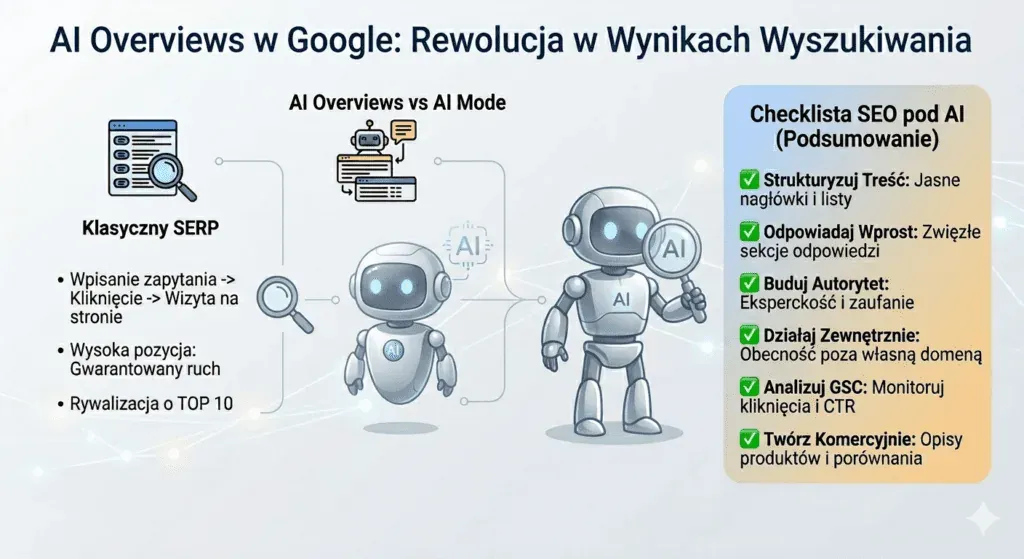
Until now, the search engine worked on a relatively simple pattern: the user typed a query, and Google presented a list of pages matching the search intent. A position in the TOP10 meant a good chance of a click and traffic to the site. With the arrival of AI Overviews, this model is starting to change. The AI-generated answer appears above the classic results, often taking up a significant part of the screen, especially on mobile devices.
As a result, users may get a complete answer before even seeing the first organic link. From a user-experience point of view, this is a convenient solution. From the perspective of website owners, however, it means a potential drop in CTR, because some queries stop generating site visits: the keyword position doesn't change, but the site's organic traffic falls. The user gets the information directly in the search results.
Google explains the introduction of AI Overviews as a way to speed up the search process and better match answers to user intent. The system analyses content from multiple pages, identifies the key information, and generates a short summary along with a list of sources. In many cases, these are pages that rank in the TOP of organic results, but not always.
The biggest change is the shift in the role of organic results. Instead of being the main place to find information, they become a supplement to the AI-generated answer. This means AI Overviews are starting to affect not only how people use the search engine, but also the organic traffic model that has been the foundation of SEO strategy for years.
How Does Google Generate Answers in AI Overviews?
The AI Overviews mechanism is based on combining Google's classic ranking system with artificial-intelligence models. In practice, this means the search engine still analyses billions of pages and evaluates their quality, authority and match to the user's query, but instead of just presenting a list of links, it uses this data to generate a synthetic answer.
The process starts the moment a query is typed into the search engine. Google first identifies the user's intent and checks whether the query qualifies for an AI-generated answer. Not all keywords trigger AI Overviews: they are most often informational and how-to questions.
If a query meets the conditions, the system analyses content in Google's index. AI models identify the most important information from several sources and then combine it into a coherent summary. The generated answer appears at the top of the search results and often also includes a list of the pages the information was drawn from.
It's worth stressing, though, that a page being listed as a source in AI Overviews doesn't always translate into clicks. Users often get a sufficient answer right at the search-engine level, which can lead to a CTR drop and reduced organic traffic. That's exactly why more and more SEO specialists analyse data on the drop in GSC clicks, trying to understand which queries are most susceptible to this effect.
Google says AI Overviews are meant to direct users to valuable sources and increase the visibility of expert content. In practice, though, this means a change in how traffic is distributed in the search engine. Instead of clicks being split between several organic results, some queries now end directly in the search results, without the user visiting a page.
AI Mode vs AI Overviews: Key Differences
While AI Overviews are already changing how people use the search engine, Google is developing another piece of the ecosystem: AI Mode. Both solutions are based on artificial intelligence and generating answers, but their role in the search results is completely different. Understanding this difference is key, because the two systems can have a different impact on the CTR drop and on how visible sites are in Google's results.
AI Overviews is an element of the classic search-results page. It appears above the organic results and presents a short summary answer along with a few sources. In this model, the user still sees the traditional list of results and can visit a page if they want to explore the topic further. Even so, the mere appearance of the AI summary means some queries end without a click, simply because it appears first.
AI Mode goes a step further. Instead of a single block of an answer, the user gets an interface similar to a conversation with a chatbot. The system generates a longer answer, can ask follow-up questions, and can expand on the topic in further steps. In this model, classic search results become even less visible, because the user stays within the AI interface.
From an SEO perspective, the difference matters. With AI Overviews, pages can still appear as information sources and pull in some traffic. In AI Mode, the user often doesn't leave the search environment at all. This means a potentially bigger drop in GSC clicks compared to the situation before the introduction of AI Mode, AI Overviews and various types of LLM models.
It's worth remembering, though, that both AI Mode and AI Overviews are still being developed and tested by Google. Depending on how they are rolled out globally, they could significantly change how users all over the world use the search engine.
The Impact of AI Overviews on CTR and Organic Traffic

The appearance of AI Overviews in search results is changing how users interact with Google. Instead of browsing several results and picking the most relevant link, they increasingly get a ready-made answer generated by artificial intelligence. This is a fundamental change in the search model that directly affects the CTR drop and organic traffic.
In the classic SEO model, a place in the TOP10 of search results meant a good chance of a click. Sites competed for the top spots, because the higher the position, the bigger the share of traffic. With AI Overviews, part of this logic stops working. The AI-generated answer appears above the organic results and often takes up a significant part of the screen, especially on mobile devices.
As a result, users can find the information they need without having to visit a page. This leads to a phenomenon known as zero-click search, meaning a search that ends without a click on a result. For many informational queries, this means a real drop in GSC clicks, even if the page keeps a high position in Google's rankings.
This doesn't mean every industry feels this impact in the same way. The most exposed are how-to, definitional and informational queries, meaning those that can be answered with a single summary. In these cases, AI Overviews can capture a significant share of the user's attention. Transactional queries, or ones that require comparing offers, on the other hand, still more often lead to clicks on organic results.
For SEO specialists, this means having to change how they interpret data. A drop in traffic doesn't always come from losing position in the search results. Increasingly, it's the effect of a change in how Google presents answers. AI Overviews don't just affect CTR, they're also gradually reshaping the organic traffic model.
Which Industries Are Losing and Which Are Gaining from AI Overviews?
The impact of AI Overviews on organic traffic isn't the same across all industries. Search engine data shows that the biggest changes appear in areas where the answer to a query can be given in a short form. This applies especially to informational, how-to and definitional queries.
In these cases, AI Overviews can generate a summary that fully answers the user's question. If the answer is sufficient, the user no longer needs to visit the source page. It's precisely in these areas that a CTR drop and a noticeable drop in clicks in Google Search Console most often appear.
The content most exposed to this effect is knowledge-based and how-to content: for example, health, education, marketing, law, or broadly understood "how to" queries. On these topics, AI Overviews can generate a short instruction or definition that satisfies the user's basic need.
On the other hand, there are industries that still generate a relatively high level of clicks. This applies mainly to transactional queries and situations where the user needs to compare products, offers or services. In these cases, AI Overviews can help with getting oriented on a topic, but it doesn't completely replace the need to visit a page.
AI Overviews and E-commerce: Impact on Sales and Product Visibility
For online shops, AI Overviews could change how users find products through search. In the traditional search model, the user typed a query, and Google presented a list of pages with offers, comparisons or product rankings. With the arrival of AI Overviews, some of this information can now be given directly in the search results.
In many cases, users still need detailed information, such as price, product availability, customer reviews, or a precise comparison of models. This kind of data still requires visiting the shop's page, which is why purchase-oriented queries remain relatively resistant to the drop in GSC clicks.
For online shops, this means putting more emphasis on content that goes beyond basic product information. Detailed descriptions, comparisons, reviews, buying guides and expert materials increase the chances of appearing in AI Overviews, as well as improving traffic from organic search results.
AI Positioning: How to Increase Visibility in AI Overviews and AI Mode
As AI Overviews and AI Mode develop, the way content is used in search results is changing. In classic SEO, the goal was to achieve a high position in Google's rankings. In the AI-based model, it's also becoming increasingly important whether content gets used as a source in the system-generated answer.
AI analyses content in a way similar to a human: it looks for fragments that clearly answer the user's question. That's why the article's structure, clear headings and sections that answer specific queries matter a great deal. Pages that explain a topic clearly have a better chance of appearing as an information source in AI Overviews.
It's also worth remembering that AI doesn't analyse a single page in isolation from the context of the whole domain. What matters is the site's authority, its topical consistency, and whether the site is recognised as a source of knowledge in a given area. The more credible the domain, the higher the probability that its content will be used by the answer-generating system.
We're also seeing the growing importance of brand presence in various places online. AI analyses information from many sources at once: articles, forums, social media, and expert publications. This means that AI positioning increasingly goes beyond optimising a single site and involves building visibility on external sites too.
In practice, SEO strategy is starting to expand to include actions that increase the chances of appearing in AI-generated answers. This includes creating expert content, publishing analyses and data, building brand authority, and developing a presence across multiple channels. In a world where AI Overviews and AI Mode are growing in importance, visibility in search increasingly means visibility in AI answers, not just in the classic list of results.
The Future of Organic Traffic in the Age of AI Overviews
The arrival of AI Overviews and the development of AI Mode suggest that the organic traffic model we've known for years is starting to change gradually. In the classic approach, the search engine acted as an intermediary, directing users to websites that provided answers. In the AI-based model, some of those answers now appear directly in the search results.
In practice, this means an increasing number of queries end at the search-engine level. The user gets a summary, and only for more complex topics do they go on to a page to read the full material. This is exactly why, in many projects, we're seeing a CTR drop and a drop in GSC clicks, even though the site's visibility in search results stays stable.
At the same time, organic traffic isn't disappearing, its character is changing. Increasingly, these are visits from users who want to learn more about a product, an offer, or the details of a service they're looking for. Simple questions can be handled by AI Overviews.
As AI Overviews and AI Mode develop, SEO doesn't stop existing, it evolves. Content expertise, domain authority, and a presence across the various information sources that AI systems draw on are becoming increasingly important. In the longer term, visibility in search will mean not just a high ranking position, but also a presence in AI-generated answers.
FAQ: Frequently Asked Questions About AI Overviews and CTR
Does AI Overviews Always Cause a Drop in CTR?
Not in every case. AI Overviews most often affects informational queries, where the answer can be presented in a short form. In these situations, users can get the information they need without visiting a page, which leads to a CTR drop.
How to Check the Drop in GSC Clicks After AI Overviews Rolls Out
The simplest way is to analyse data in Google Search Console. It's worth comparing the number of impressions, clicks and CTR for specific queries across different periods. If the number of impressions stays stable while a drop in GSC clicks appears at the same time, this could be the effect of AI Overviews appearing in the search results.
Can You Rank Directly in AI Overviews?
You can increase a site's visibility in AI Overviews by carrying out SEO activities aimed at optimising content for the AI systems used in search.
In practice, this means sites can increase their chances of appearing in AI answers through additional optimisation work. This includes adapting the content structure, preparing materials in a way that makes them easier for AI systems to interpret, and building the site's topical authority.
So we can talk about SEO for AI Overviews, meaning a set of actions aimed at increasing the probability that a site's content will be used as a source in the AI-generated answers in search results.
How Can AI Mode Affect Organic Traffic?
AI Mode develops a search model based on a conversation with the AI system. Instead of a short summary, as in AI Overviews, the user gets a detailed answer and the option to ask further questions in a dialogue format.
In this scenario, some queries can be handled directly within the AI interface, without the need to visit individual pages.
How Google AI Overviews Affect CTR and Organic Traffic: Summary
AI Overviews are changing how people use Google's search engine. Instead of a classic list of links, users increasingly get a synthetic answer generated by artificial intelligence. In many cases, this leads to a CTR drop and a drop in GSC clicks, especially for informational queries.
This doesn't mean organic traffic disappears completely, though. AI Overviews mainly affects informational queries, for which the system can generate a direct answer in the search results. In these cases, users often no longer need to visit a page, which leads to a CTR drop.
The situation is different for service, offer or product queries. When users want to learn about an offer, check product details, or compare solutions, they still need to visit a page. That's why the impact of AI Overviews is much smaller for commercial or transactional queries.
If your company wants to be better prepared for the changes in search, it's worth considering support from experienced specialists. The JustIdea Agency team helps companies adapt their SEO strategy to the new realities of AI-based search.
See Also