














Searching for information is looking less and less like a simple list of links, and more and more like a conversation with an advisor who analyses context, compares options, and delivers a ready-made answer. Users no longer always go straight to a website, because they increasingly get their answer in ChatGPT, Gemini, Perplexity, or Google AI Mode. For brands, this means a major shift in how visibility is built. SEO still remains the foundation of a presence in search results, but in 2026 GEO, meaning Generative Engine Optimization, is becoming increasingly important.
What is GEO, and why is it changing brand visibility in AI Search
GEO, or Generative Engine Optimization, is a way of optimising content, data, and a brand's online presence for answer-generating systems. In classic SEO, the main question is whether a page ranks highly in Google Search. In GEO, the more important question becomes whether AI can understand the brand, correctly describe its offering, and cite it as a credible source when answering specific queries.
This is an important difference, because users increasingly don't browse through many pages themselves. They ask a question and expect a ready answer. They might ask ChatGPT which tool would be best for their business, ask Gemini to compare services, or check in Perplexity which brands are most often recommended in a given category. In this environment, visibility in AI isn't just about being indexed. It's about a brand's presence in AI answers, citations, recommendations, comparisons, and the contexts that influence a user's decisions.
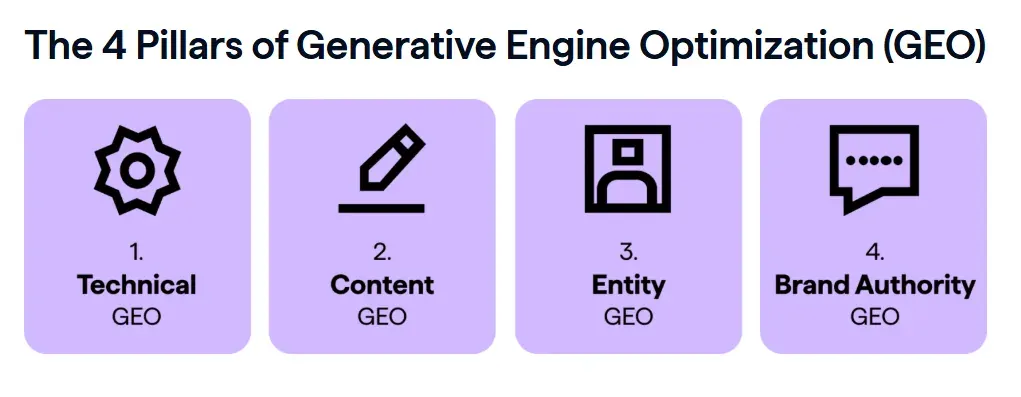
In practice, GEO changes brand visibility because it shifts the focus from pure ranking to the usefulness of information. A brand can have good rankings, stable organic traffic, and an extensive blog, but if its content is unclear, inconsistent, or too generic, AI models may choose a competitor instead. Not because the competitor has “nicer copy”, but because it's easier to understand, quote, and embed in an answer.
How does GEO differ from traditional SEO
Traditional SEO focuses on making a page well visible in the search results. What matters are keywords, information architecture, internal linking, link profile, page speed, indexing, and matching content to user intent. That's still the foundation. Without classic SEO, it's hard to talk about effective AI visibility, because language models and AI search engines still draw on content available on the internet.
| Area | SEO | GEO |
|---|---|---|
| Main goal | Visibility in classic search results | Brand presence in AI-generated answers |
| Key question | Will the user find the page on Google? | Will AI cite or recommend the brand? |
| Main environment | Google Search, organic results, SERP | ChatGPT, Gemini, Perplexity, Google AI Overviews, Google AI Mode |
| Optimisation approach | Keywords, technical SEO, linking, content | Knowledge structure, authority, data consistency, answers to questions |
| Query type | Short-tail and long-tail phrases | Conversational and problem-based queries |
| Measuring results | Rankings, clicks, traffic, CTR, conversions | Citations, mentions, brand presence in AI answers, recommendation context |
| Role of content | Attracting traffic and answering user intent | Providing AI with credible material to generate an answer |
| Risk | Drop in search result rankings | Brand absent from AI answers, or competitors recommended instead |
The difference also concerns the way you think about content. In classic SEO, we often work around phrases such as “SEO”, “SEO agency”, “marketing strategies”, or “keywords”. In GEO, you need to go a step further and understand how users phrase full, conversational queries. They no longer just type a short phrase. Increasingly, they ask: “which agency can help me improve my brand's visibility in AI while also improving my classic SEO?” Answering that requires content with greater precision, deeper context, and clear evidence of credibility.
How the way we search for information is changing in 2026
In 2026, searching for information looks less and less like typing two words into a search engine, and more and more like a conversation with an advisor. Users don't always want a list of links. They often expect a specific answer, a short comparison, an interpretation of data, or a recommendation tailored to their situation. That's exactly why AI Search is changing how brands should think about their presence online.
The example is simple. In the past, a user might have typed “najlepsza agencja SEO Kraków” (best SEO agency in Kraków) into Google. Today they might ask ChatGPT: “which marketing agency can help me combine SEO, AI SEO, and AI visibility monitoring, if I have an online store and want to increase the number of enquiries?” That's no longer a simple keyword. It's intent, context, a problem, and an expected outcome, all in one query.
Pillar 1: data structure and technical readability for AI
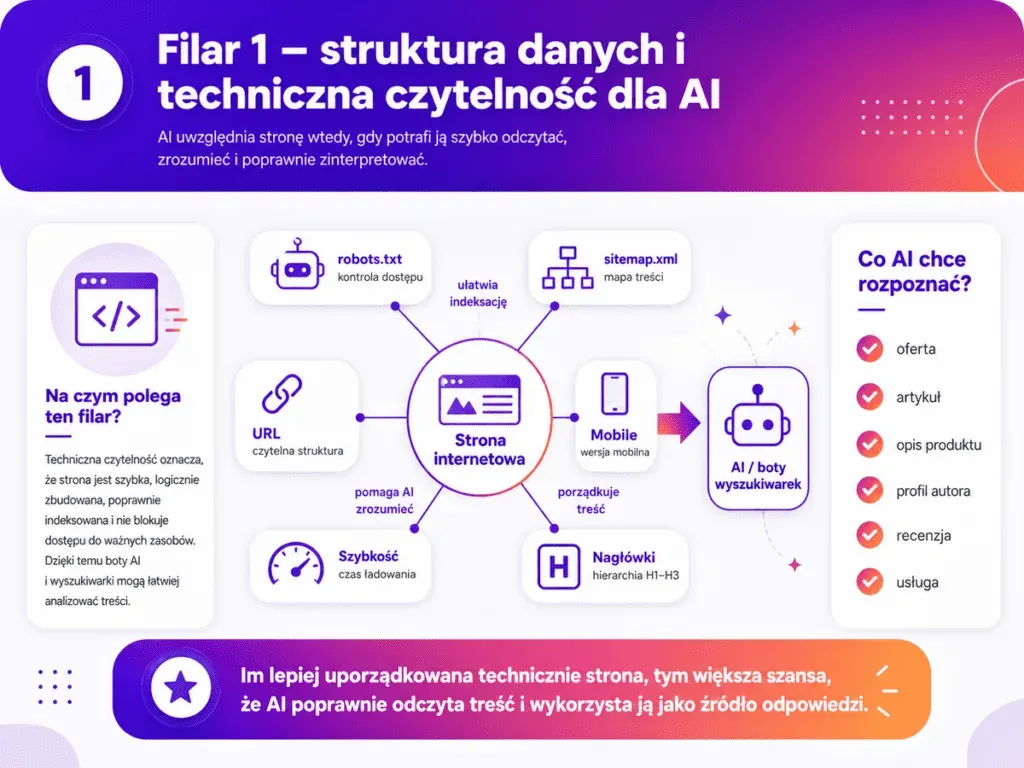
The first pillar of GEO concerns whether AI can technically read and interpret a page. Even the best content won't be effective if AI bots, search engine crawlers, or systems analysing a site's content have trouble accessing the data. Technical readability means a site is fast, logically built, correctly indexed, and doesn't block access to important resources. The simplest test of this pillar takes a few minutes: our free AI visibility checker checks whether the ChatGPT, Claude and Perplexity crawlers can get into your site and what they see there without JavaScript.
This includes things like the robots.txt file, the sitemap, URL structure, the mobile version, load time, and a correct heading hierarchy. In classic SEO, these elements were the basics. In GEO, their importance grows, because AI systems need fast, unambiguous access to content. When AI analyses a page, it looks for signals that help it understand what's on that page: an offer, an article, a product description, an author profile, a review, or a service.
The importance of schema.org structured data
In the context of GEO, data types such as Organization, Person, Article, Product, Service, Review, and FAQPage carry particular weight. They make it easier for AI to recognise who authored the content, which brand is behind the site, what the offer is about, what users' reviews say, and which passages answer specific questions.
This doesn't mean that schema.org acts like a magic visibility switch, though. Structured data helps AI understand a page, but it doesn't replace the quality of the content. If an article is vague, the offer is imprecise, and the brand is inconsistent in other sources, implementing schema on its own won't make Google AI Overviews, ChatGPT, or Perplexity start citing it.
We've written more about structured data in the context of AI in this post: Structured Data (schema.org) and Content Visibility in AI Models
How AI interprets a website
AI analyses a page differently from a human, although the goal is similar: to understand what the content is about and whether it can be trusted. A model doesn't just look at a single keyword. It tries to read context, the relationships between concepts, the consistency of the information, and how specialised the source is.
If a page describes “AI visibility” but does so chaotically, without definitions, examples, or links to SEO, an LLM may judge the content to be less useful. But if the article explains what AI visibility is, how to measure it, how AI Search works, why structured data matters, and how to track a brand's presence in AI answers, the system has far more to latch onto.
Pillar 2: content that answers users' questions
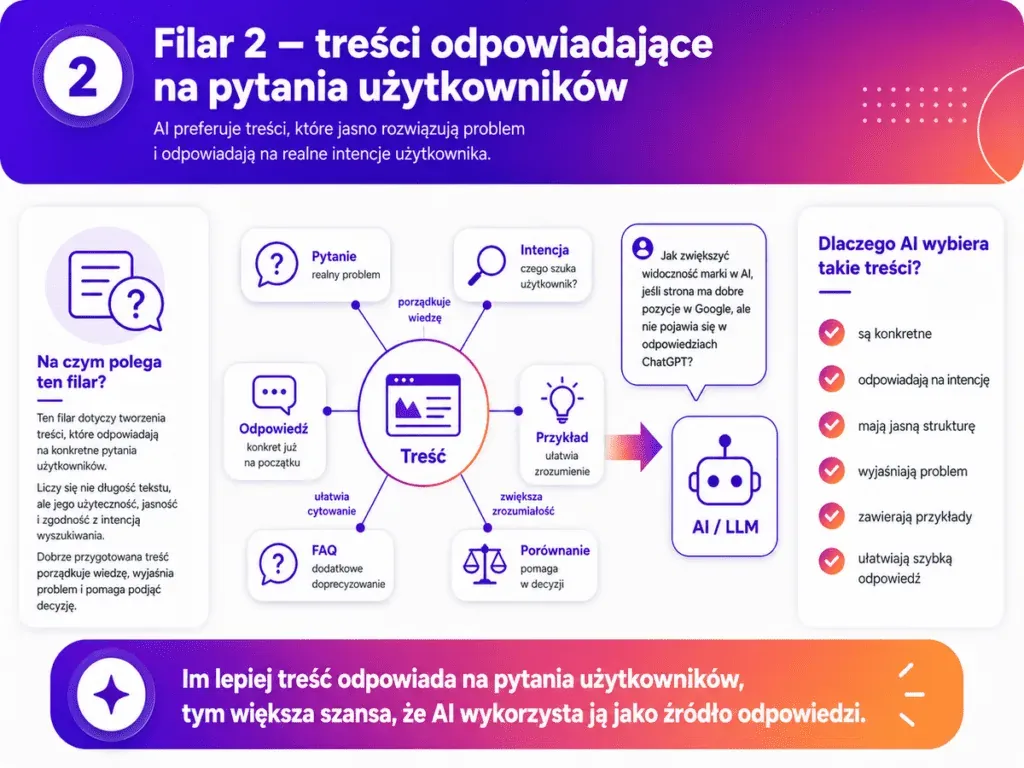
The second pillar of GEO concerns content that answers users' real questions. It's not about producing long articles purely for the sake of length. It's about creating material that solves specific problems, organises knowledge, and helps people make decisions. In classic SEO, keyword analysis played a major role for years. It's still important, but a list of phrases alone isn't enough.
In 2026, users increasingly phrase their queries conversationally. Instead of typing “AI SEO”, they might ask: “how do I increase my brand's visibility in AI if my site ranks well on Google but doesn't appear in ChatGPT's answers?” That kind of intent requires content that doesn't just contain the phrase, but actually explains the problem.
Create precise content for GEO
Content built for GEO should be precise, well-structured, and specific. It's worth starting sections with a clear answer and then developing the topic with an example, context, and a practical explanation. This helps the user grasp the point faster, and makes it easier for AI to process the passage as a potential answer.
Why does AI favour content written as answers?
Language models prefer content that is logical and easy to break into fragments. This means a single paragraph should make sense on its own. If a passage of an article answers a specific question, AI can more easily use it in a generated answer. That doesn't mean every text should consist of short, dry definitions. Good content for GEO still has to be natural, expert, and engaging. The difference is that it should lead the reader step by step: first the answer, then the explanation, then an example, and finally the wider context.
Pillar 3: brand authority and credibility (E-E-A-T)
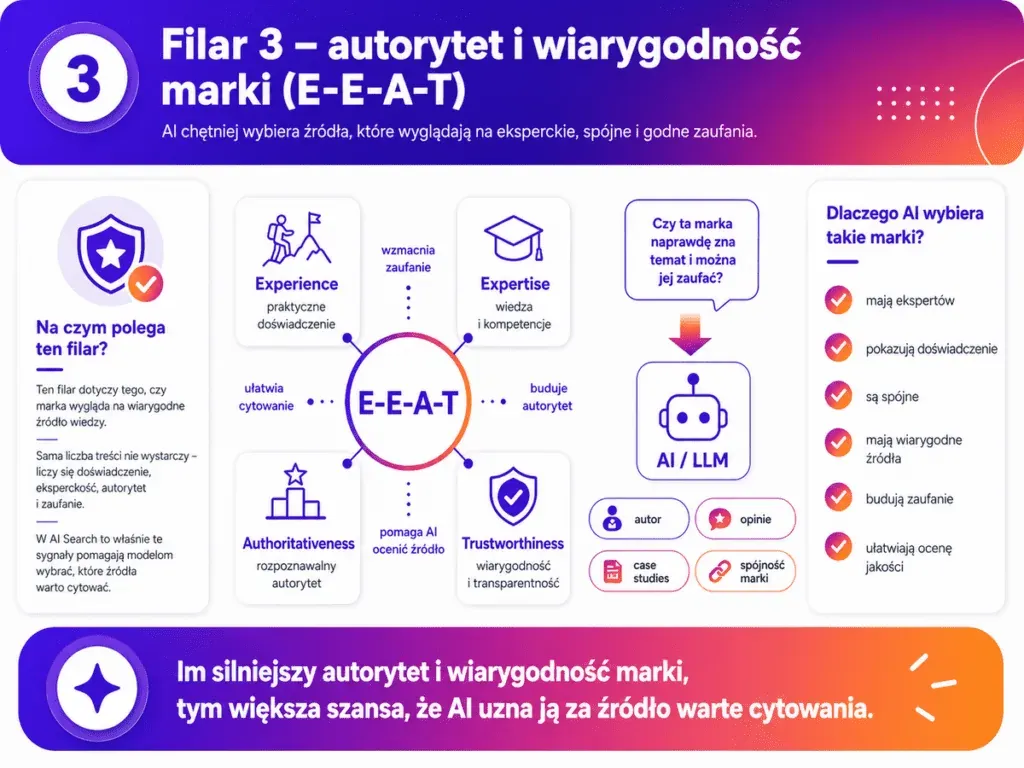
The third pillar of GEO is brand authority and credibility. AI doesn't choose sources just because they have a lot of content. It chooses the ones that look expert, consistent, and trustworthy. This is where E-E-A-T comes in: Experience, Expertise, Authoritativeness, and Trustworthiness.
In simple terms, E-E-A-T means experience, expertise, authority, and trustworthiness. It's a set of signals that help assess whether a piece of content was prepared by someone who genuinely knows the subject. In the context of brand visibility in AI Search, this element becomes especially important, because language models have to decide which sources are worth citing and which are better left out.
The importance of authors, reviews, and external signals
A brand's credibility in AI is influenced not only by the content itself, but also by signals confirming that the brand genuinely knows the subject.
- Authors: show who is responsible for the content and what experience they have.
- Opinions: confirm how users rate the brand in practice.
- Reviews: strengthen trust, especially when they are specific and consistent.
- Citations: show that other sources refer to the brand or its content.
- External publications: build authority beyond the brand's own site.
- Industry mentions: help AI recognise the brand as part of a given topic or market.
Pillar 4: context and data consistency across the whole ecosystem
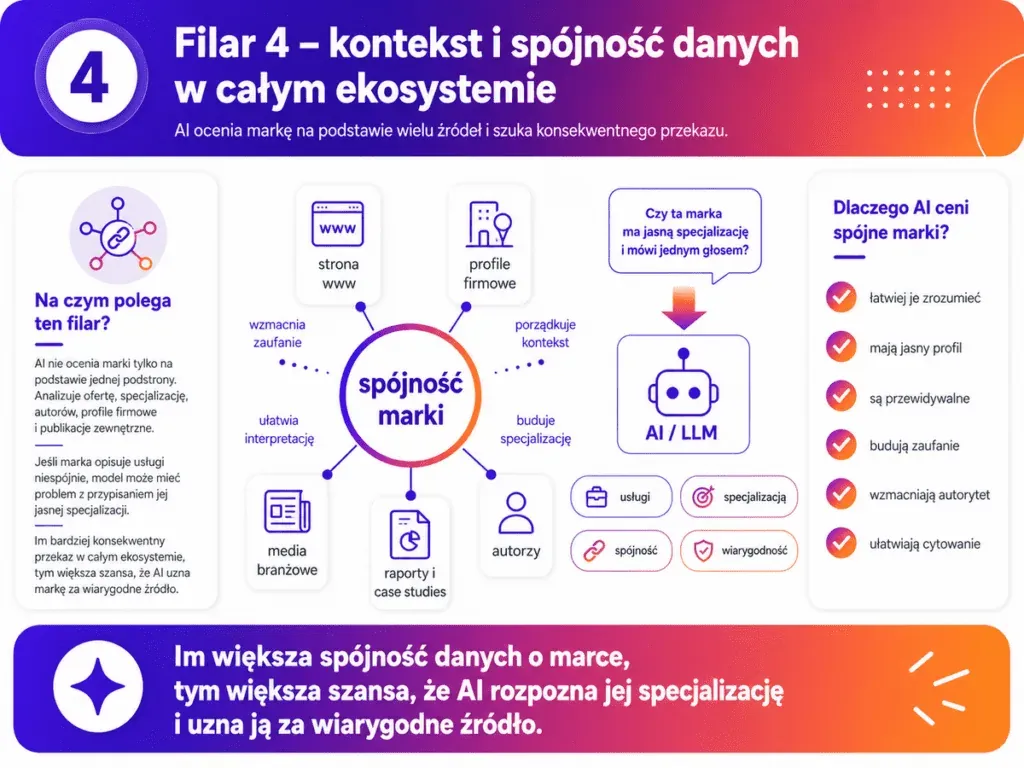
The fourth pillar of GEO concerns context and data consistency. AI doesn't judge a brand based on a single page alone; it analyses the bigger picture: the offering, specialisation, authors, company profiles, external publications, and how consistently information repeats across different sources.
If a brand describes its services inconsistently, AI may struggle to assign it a clear specialisation. That's why information on the site, in company profiles, reports, and industry media should reinforce the same message. The more consistent the brand's image, the greater the chance that AI models will treat it as a credible source.
What is a knowledge graph, and what are entities in SEO
A knowledge graph is a way of organising information through connections between concepts, people, brands, products, places, and topics. You can picture it as a map where each entity is a point, and the relationships between them form a network of meaning. An entity, meanwhile, is a specific thing that can be recognised and described, for example a brand, a person, a service, a tool, a city, or a product.
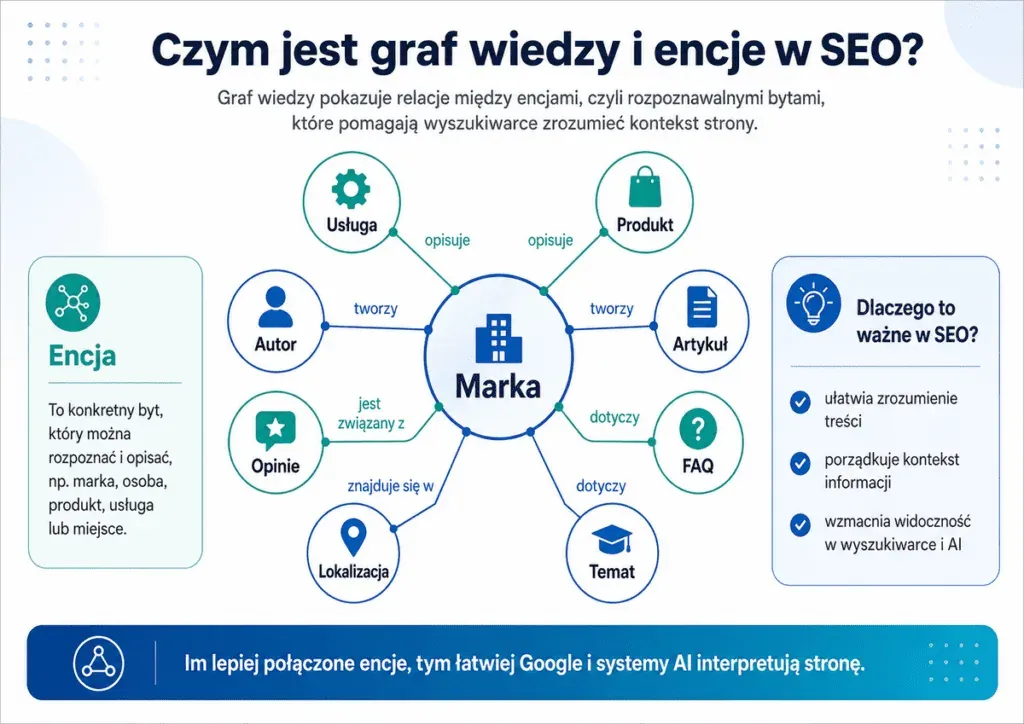
In SEO, entities help search engines understand content better. In GEO, their importance is even greater, because language models don't rely solely on simple keyword matching. They try to understand relationships. If an article is about GEO, it should naturally connect that topic to SEO, AI Search, Google AI Overviews, ChatGPT, Perplexity, Gemini, LLMs, structured data, E-E-A-T, visibility monitoring, and brand authority.
Pillar 5: content distribution and presence beyond your own site
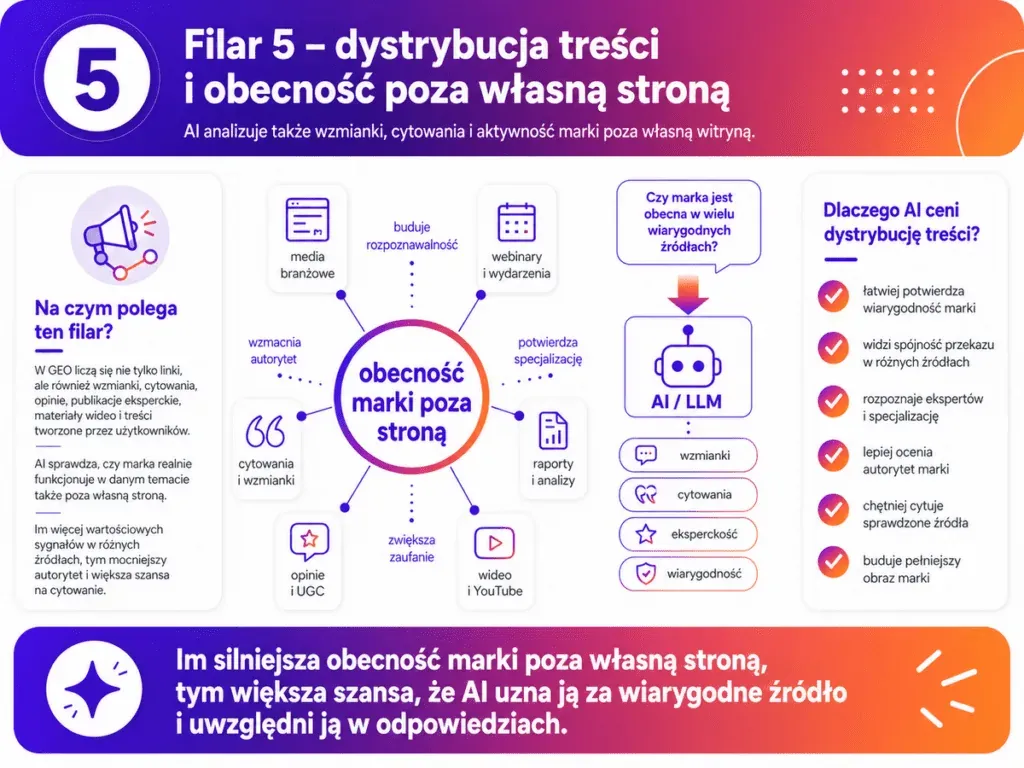
The fifth pillar of GEO is content distribution and presence beyond your own site. In classic SEO, people often talked about link building. In GEO, you need to look more broadly. It's not just links that matter, but also mentions, citations, discussions, reviews, expert publications, media appearances, video content, and user-generated content.
AI doesn't have to rely solely on the company's own site. It can analyse different sources to check whether a brand genuinely functions within a given topic. If a company publishes a guide about GEO but doesn't appear anywhere else in the context of AI Search, its authority may be weaker. But if the brand's experts speak in industry media, publish a report, take part in webinars, and are cited by others, the credibility signal grows.
How does AI combine data from different sources?
AI combines data from different sources to build the most coherent answer possible. Language models can draw on information from websites, documentation, articles, industry sources, knowledge bases, reviews, forums, company profiles, and search results. With tools like Perplexity, citing sources is especially visible, while Google AI Overviews and AI Mode integrate answers directly into the search experience.
The importance of UGC, industry media, and PR
UGC, or user-generated content, refers to content created by users. This can include opinions, reviews, comments, questions, forum discussions, community posts, or material published by customers. In the context of GEO, this kind of content matters because it shows how a brand functions in users' real language.
If customers frequently praise a company for a specific trait, for example effective reporting, smooth communication, or the ability to combine SEO with analytics, AI can read that as a reputational signal. Conversely, if the same problems keep recurring in UGC, AI models can factor that context in too. That's why managing reviews is no longer just part of customer service. It's becoming part of a brand's AI visibility strategy.
The future of GEO and brand visibility in AI Search
The future of GEO will become increasingly tied to how users make decisions. Search engines won't disappear, SEO will still matter in 2026, and classic search results will keep generating traffic and sales. What will change is how users arrive at a page. Increasingly, they'll talk to AI first, ask for a comparison, check a recommendation, and only afterwards click a link or type the brand's name into Google.
The greatest advantage will go to companies that don't treat GEO as a passing trend. Effectiveness in AI Search requires a well-organised site, structured data, content that answers users' questions, authority, consistent information, and a presence beyond your own site. It isn't a single optimisation, but a process of building trust across the whole AI ecosystem.
See other articles related to AI
- Lyria 3 from Google: A Revolution in AI Music Creation
- Top 7 Best AI Video Generation Tools
- Discover Midjourney: How to Create AI Images
- Differences Between AI, ML, and DL: How to Use Them at Work
- 5 Best Language Models in 2025 You Need to Know
FAQ
Will GEO replace classic SEO?
GEO won't replace classic SEO. Search engine optimisation is still the foundation of visibility online, because it's responsible for indexing, content structure, technical site quality, and organic traffic. GEO adds a new layer on top of that: optimisation for AI Search, AI answers, and visibility in language models.
How do you measure visibility in AI?
You can measure AI visibility by analysing whether a brand appears in the answers of ChatGPT, Gemini, Perplexity, Google AI Overviews, and other AI tools. It's worth tracking the number of mentions, the context of recommendations, citations, competitors' presence, and the queries where the brand is left out.
Does Google Search Console show AI visibility?
Google Search Console is still a very important tool for SEO analysis, but it doesn't show the full picture of a brand's AI visibility. You can use it to analyse queries, clicks, impressions, and changes in organic traffic, but a brand's presence in AI answers requires separate monitoring.
How do you increase visibility in AI Search?
To increase visibility in AI Search, you need to take care of your site's technical readability, structured data, expert content, consistent brand information, and external signals. It's also important to update content regularly and create material that answers users' real questions.
Why is structured data important for GEO?
Structured data helps AI and search engines understand what a piece of content is. It makes it easier to recognise an author, an organisation, a service, a product, a review, a question, or an article. Structured data alone doesn't guarantee AI visibility, but it makes a page easier to interpret and strengthens other SEO and GEO efforts.
Can a brand rank highly on Google but stay invisible in AI?
Yes, that's possible. A brand can have good SEO results, but if its content is too generic, it lacks authority signals, or information about the company is inconsistent across different sources, AI may pick a competitor instead. That's why visibility in search results and visibility in AI Search need to be analysed side by side.
Sources:
- https://www.lumar.io/blog/best-practice/4-pillar-geo-strategy-framework-for-ai-search-visibility/
- https://generative-engines.com/GEO/
- https://backlinko.com/generative-engine-optimization-geo
- https://medium.com/write-a-catalyst/5-geo-strategies-to-make-ai-search-engines-recommend-your-brand-in-2026-6fdff91805fa
- https://www.yotpo.com/blog/ranking-ai-search-geo-tips/
- https://www.icypluto.com/blog/5-geo-strategies-to-dominate-ai-search-in-2026