














Rapid advances in artificial intelligence mean professional audio recordings are now available to everyone, with no studio, expensive equipment or voice actor needed. ElevenLabs is currently one of the most powerful AI voice synthesis tools. It lets you create a digital voiceover in minutes that sounds surprisingly natural, capturing emotion, intonation and character. With it, you can generate voiceovers for YouTube videos, adverts, podcasts, online courses, presentations or sales materials, quickly, cheaply and fully in line with your brand's image.
What's more, ElevenLabs lets you not only choose from thousands of ready-made voices but also clone your own voice (based on as little as a dozen or so seconds of recording). This opens up entirely new possibilities for creators, experts and companies that want to keep a consistent, recognisable tone of communication across all their materials.
What Is ElevenLabs and How Does AI Voice Synthesis Technology Work?
ElevenLabs is currently one of the most advanced tools for speech synthesis based on artificial intelligence. In simple terms, it turns any text into a very naturally sounding voice, so realistic that it is often hard to tell apart from a recording of a human voice actor.
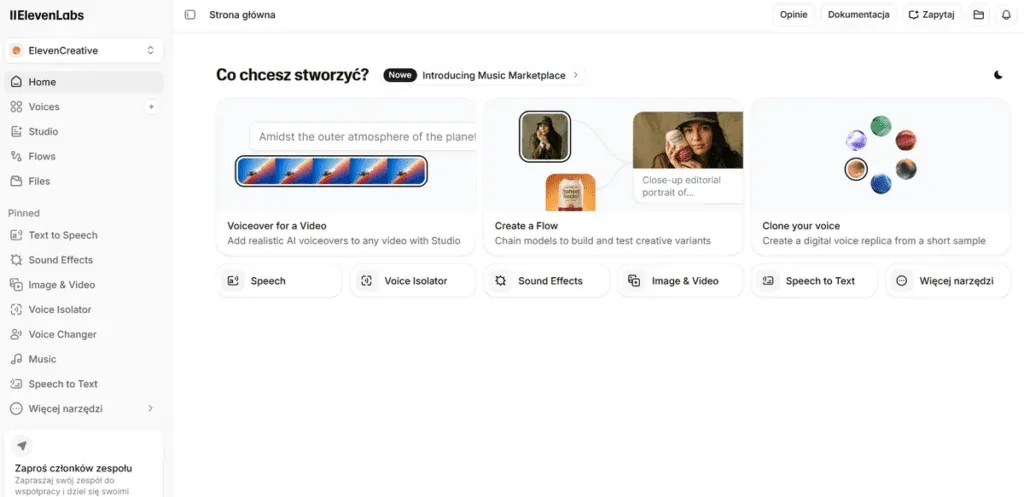
It works very simply: you type the text, choose a voice (or create your own), adjust a few parameters, and within seconds you get a finished audio recording.
Compared with older text-to-speech solutions, ElevenLabs stands out above all for its quality. It can far better capture intonation, emotion, natural pauses, accents and pace of speech. As a result, the same text can sound completely different: calm and matter-of-fact in an educational piece, dynamic and persuasive in an advert, or warm and engaging in storytelling. The technology analyses thousands of hours of human speech, so the voice it generates sounds authentic and matches the chosen communication style.
In practice, a digital voiceover from ElevenLabs works perfectly for:
- YouTube videos and video materials,
- podcasts and audiobooks,
- adverts and promotional spots,
- online courses and webinars,
- corporate presentations and sales materials.
For companies and creators, this means a huge saving in time and money: you no longer need to book a recording studio, pay a voice actor or make a dozen rounds of corrections. You can generate everything yourself, quickly and in any quantity.
Why Create a Digital Voiceover? Uses in Business and Marketing
More and more companies realise that a professional voice in audio and video content is one of the most effective ways to build trust and engage audiences. A digital AI voiceover lets you achieve this effect without renting a recording studio, hiring a voice actor or spending weeks on production.
With tools such as ElevenLabs, you can generate a naturally sounding recording in minutes that fits your brand image perfectly. You have full control over the tone, pace and style of delivery, so the same message can sound different: more expert in B2B materials, more dynamic on social media, or warm and engaging in content marketing. As a result, companies work faster and more flexibly, and can scale content production without a significant rise in costs.
AI Voiceovers in Content Marketing
Content marketing has long stopped being limited to text and graphics. Today, audio and video content matters enormously. A digital AI voiceover lets you instantly turn a blog article, product description or ready-made script into a professional recording for a video, podcast or educational material. This means brands can create narration for videos, grow their own podcasts and produce valuable content without extra production resources. AI support also makes it easier to quickly test different versions of a message and respond to audience needs, which translates into greater engagement and better campaign results.
Automating Audio and Video Production
One of the biggest advantages of using AI in audio is process automation. Instead of a multi-stage process of recording, editing and repeated corrections, a finished piece of content can be produced in literally a few minutes. This is a particularly big advantage in marketing, where the speed of publishing is crucial. An AI voice generator lets you not only create new content quickly but also update it easily: you just change the text when the offer or message changes, with no need to re-record from scratch.
Cost Savings and Content Scaling
Traditional audio recordings involve high costs: renting a studio, paying a voice actor, and the time needed to complete the whole project. A digital AI voiceover radically cuts these expenses. At the same time, it makes it easy to scale production: you can generate dozens or hundreds of recordings in different languages and versions tailored to specific customer groups. This lets companies grow the reach of their marketing activities without a proportional increase in budget, giving a real competitive edge in today's fast-moving business environment.
Creating a Digital Voiceover in ElevenLabs: Step by Step
The process of creating a digital voiceover in ElevenLabs is fairly simple, even if you have never used AI voice generation tools before. All you need to do is prepare the text, choose the right voice, adjust the settings and generate the audio file. The most important thing, however, is not to treat this process purely as a technical exercise. A good digital AI voiceover should match the character of the brand, the target audience and the purpose of the specific material. A sales advert will require a different tone from an educational video, and yet another tone from a professional corporate presentation. That's why, before you start work, it is worth deciding whether the voice should sound expert, dynamic, calm, emotional or neutral.
Choosing a Voice and Adjusting Parameters
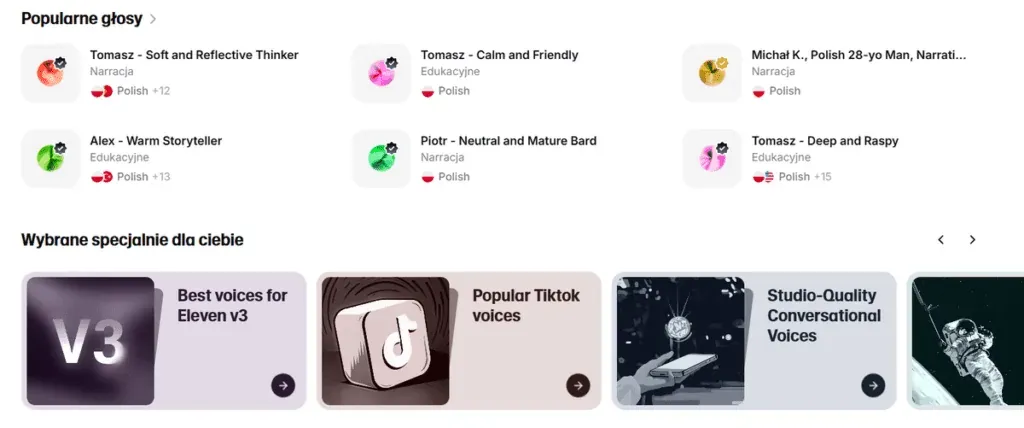
The first step is choosing the voice that best suits the planned recording. ElevenLabs offers various types of voices, differing in timbre, pace, style of delivery and level of expressiveness. It is worth testing several variants, since the same text can create a completely different impression depending on the voice chosen. You can then adjust settings such as voice stability, naturalness, expressiveness or similarity to the chosen model. These are exactly the parameters that determine whether the AI voice generator sounds calmer, more advert-like, more emotional or more professional. For business materials, it is best to avoid excessive expressiveness and focus on clarity, credibility and fluency of delivery. A well-configured AI voiceover should reinforce the message, not draw attention away from the content.
Entering Text and Generating Audio
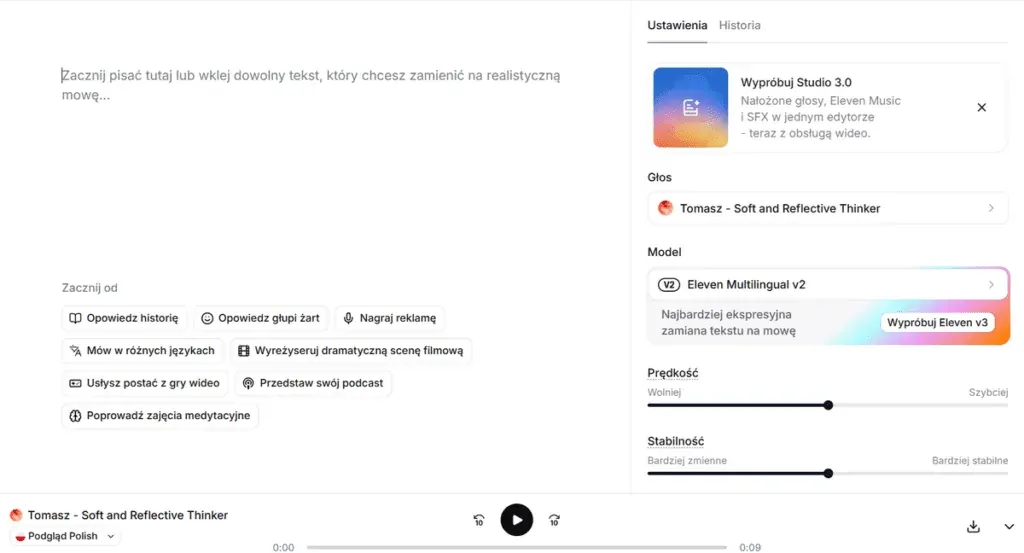
The next step is entering the text that is to be turned into a recording. It is worth remembering that text written for audio should differ from a classic blog text. Sentences should be shorter, more natural and easy to say out loud. It helps to add commas, full stops and logical pauses, since they affect the rhythm of the recording. Before generating the final version, it is a good idea to prepare a few variants of the text and check which one sounds the most natural. AI voice synthesis is getting better and better at intonation, but the quality of the result still depends on how well the script is prepared. After clicking the generate option, ElevenLabs creates a finished audio file that you can listen to, correct or generate again. This makes creating an AI voiceover a fast process of testing and optimisation.
Exporting and Using the Recording
Once the recording has been generated, you can download it and use it in your chosen materials. The audio file works well as narration for a YouTube video, the voice in an advert, the soundtrack for a presentation, a podcast, an online course or sales material. Before publishing, though, it is worth listening to the recording in the context of the whole project, ideally together with the image, music or animation. This makes it easier to judge whether the pace of delivery, the tone and the length of the pauses fit the final composition. A professionally prepared AI voice can significantly raise the quality of a brand's communication and speed up content production. Importantly, once the process has been set up, it can easily be repeated to create further materials in a similar style. That's exactly why a digital AI voiceover is especially valuable for companies that regularly publish audio and video content.
How to Train Your Own Voice (Voice Cloning) in ElevenLabs
Training your own voice in ElevenLabs, known as voice cloning, involves creating a digital voice model based on recorded audio samples. In practice, this means the system analyses the timbre, pace of speech, accent, intonation and other distinctive features of your delivery, and then reproduces them in new recordings generated from text. This solution can be especially useful for personal brands, experts, online creators and companies that want to maintain a consistent tone of communication across many materials. Voice cloning lets you create recordings faster, without having to sit down in front of a microphone every time. At the same time, it is worth remembering that AI voice cloning should be used responsibly, with the consent of the person whose voice is being reproduced.
What Voice Cloning Involves
Voice cloning in ElevenLabs is based on providing voice samples that the tool uses to create an individual voice profile. The better the quality of the recordings, the more natural and credible the final result will be. It is best to prepare material recorded in a quiet environment, free of noise, reverb, background music or technical interference. It is also important to speak naturally, at different paces and with varied intonation, since this helps the system better recognise your style of delivery. Your own AI voice can later be used to generate narration, adverts, educational videos, podcasts or corporate messages. A well-prepared digital AI voiceover helps maintain brand recognisability and speeds up audio content production.
The Most Common Mistakes When Cloning a Voice
The most common mistake when cloning a voice is using poor-quality recordings. If the sample contains noise, echo, uneven pace, a quiet voice or background sounds, the result can sound artificial and less professional. A second problem is too few samples, or recordings delivered in a single, monotonous style. In that case, the AI voice generator has less data to work with to reproduce natural expressiveness. It is also worth avoiding overly long, complicated sentences in the texts you later generate with the tool, as they can reduce the fluency of the recording. Good results only come from combining quality input material, a properly prepared script and testing different settings. This lets ElevenLabs create a voice that sounds natural, consistent and credible.
Best Practices for Creating a Naturally Sounding AI Voiceover
Although tools such as ElevenLabs offer very advanced AI voice synthesis, the final quality of the recording largely depends on how the user prepares the text and configures the settings. A naturally sounding AI voiceover is the result of combining the technology with a deliberate approach to creating audio content. Unlike writing traditional text for a blog or website, here it is crucial how a given piece of content "sounds", not just how it looks. That's why it is worth treating the recording process like working with a real voice actor, taking into account the rhythm of delivery, emotion and the end listener. Applying a few proven practices can significantly improve the quality of your materials and make it so the listener cannot tell a synthetic voice from a human one.
How to Write Text for Speech Synthesis
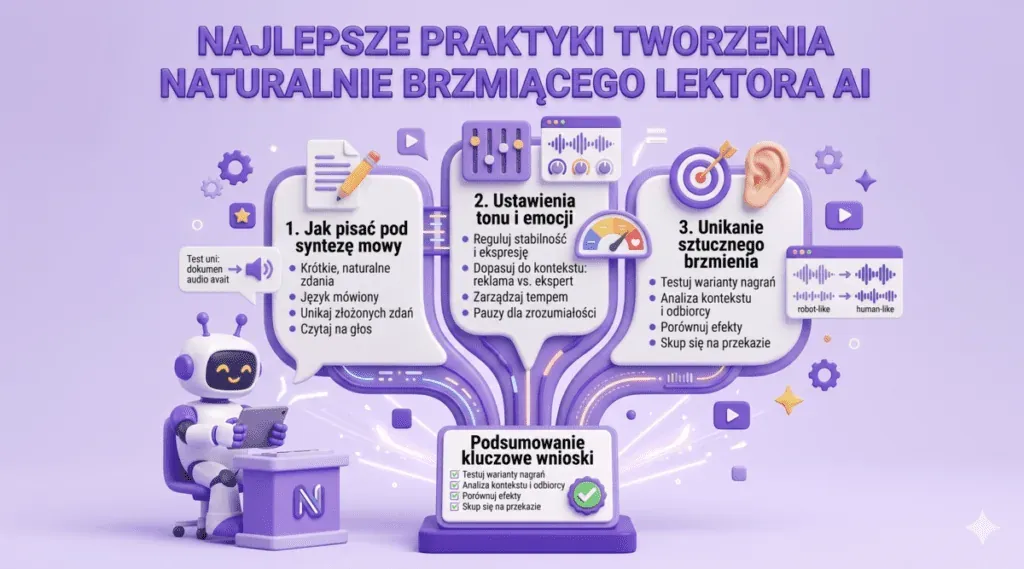
The foundation of a good recording is a properly prepared text. For audio, you should avoid long, complex sentences and complicated language constructions. Instead, it is worth using shorter, more natural phrases that resemble spoken language. It also helps to break the content into logical chunks and use punctuation that affects the rhythm and pace of reading. Text for speech synthesis should be simple, clear and matched to the audience: a script for an advert will look different from one for an educational piece. It is also good practice to read the text out loud before generating it: if it sounds unnatural, the AI voice generator will not deliver it convincingly either.
Settings for Tone, Emotion and Pauses
Another element affecting the quality of the recording is the settings available in the tool. ElevenLabs lets you adjust parameters such as voice stability, expressiveness and pace of delivery. Depending on the purpose of the material, you can achieve a more dynamic or a calmer effect. AI voice settings should be matched to the context: an advert needs more energy, while expert material should be more measured and matter-of-fact. Pauses also matter enormously, as they affect how the message is received and how understandable it is. Well-planned gaps between sentences make the AI voice sound more natural and easier to listen to.
Avoiding an Artificial Sound
One of the biggest challenges when working with AI is avoiding the effect of artificiality. This most often results from a combination of overly complicated text, poor settings or a poorly matched voice. To prevent this, it is worth testing different variants of the recording and comparing the results. Sometimes a small change to the text or the parameters can significantly improve the final quality. A natural AI voiceover is one that does not draw attention to its own form but supports the message and lets the listener focus on the content. That's why it is worth treating ElevenLabs as a tool for optimisation and experimentation, rather than for one-off generation of recordings with no quality control.
How Much Does ElevenLabs Cost, and Is It Worth Investing in AI Voice?
The cost of using ElevenLabs mainly depends on how much content you create and which features you need. The platform runs on a subscription model: it offers a free plan to start, plus several paid packages suited to both individual creators and companies.
You can safely test the tool at no cost at all, and only later decide whether it's worth moving to a paid plan. The most important thing, though, is to look not just at the price but above all at the time saved and the significant simplification of the entire audio production process. For many people and companies, ElevenLabs quickly becomes a cheaper and more convenient alternative to traditional recording with a voice actor.
Available Plans and Prices (as of 2026)
ElevenLabs offers the following subscription tiers:
- Free plan: ideal to start with. Gives you 10,000 characters a month and lets you test the quality of the voices and the basic features.
- Starter: $6/month, the first plan that makes real sense, with commercial rights and access to Instant Voice Cloning.
- Creator: $22/month (often on promotion at $11 for the first month), the most popular choice among creators. Offers 100,000 characters, professional voice cloning and higher audio quality.
- Pro: $99/month, for more advanced users and agencies (500,000 characters plus extra API features).
Above these are even pricier Scale and Business plans for large teams and high-volume production.
Your choice of plan should depend on your real needs. If you create content occasionally, Starter or Creator will be enough. With regular production of a few to a dozen or so pieces of content a month, Creator or Pro usually pays for itself quickly.
What Affects the Real Cost of Generating a Voice?
Several factors affect the total cost of using the tool. The most important is the amount of text generated: the more material you create, the more of your limit you use up. The quality of the generated voice also matters, as does the use of extra features such as voice cloning or more advanced settings. It is also worth considering the business context: if this solution lets you publish content faster, test different messages and cut production costs, the investment starts to pay off. In many cases, a tool like this lets you not only optimise spending but also scale up your activities without needing to grow your team.
Alternatives to ElevenLabs: Comparing Speech Synthesis Tools
Although ElevenLabs is one of the most popular voice generation tools, several other solutions are also available on the market and worth considering. Each has its own strengths and works well for slightly different uses, from simple system messages to advanced marketing projects. Choosing the right tool should depend on your business needs, budget and the recording quality you expect. Below you will find a comparison of the most important platforms that can serve as an alternative to ElevenLabs.
| Tool | Voice Quality | Personalisation / Voice Cloning | Best Use | Skill Level / Ease of Use | Starting Price (per month) |
|---|---|---|---|---|---|
| ElevenLabs | Very high, the most natural | Outstanding (Instant + Professional Voice Cloning) | Content marketing, adverts, YouTube, podcasts, videos | Easy for beginners / very advanced | Free → Starter $5 / Creator $22 |
| PlayHT | Very good | Good (fast cloning + emotions) | Podcasts, longer-form audio, marketing | Medium / advanced | from around $29-39 |
| Amazon Polly | Good, stable (more technical) | Limited (mainly enterprise) | IVR systems, business applications, large AWS projects | Advanced (for developers) | Pay-as-you-go (from around $4-16 per million characters) |
| Google Cloud Text-to-Speech | Good, but technical | Limited | Apps, voice assistants, Google integrations | Limited | free tier + pay-as-you-go |
Google Text-to-Speech
Google's solution is one of the oldest and most stable speech synthesis technologies in the world. It is built on the powerful Google Cloud infrastructure, which makes it the number one choice for developers building complex ecosystems. It works well above all in mobile apps, voice assistants and systems where reliability, low latency and deep integration with other cloud services are crucial. Despite access to WaveNet technology, Google's voices still sound somewhat more "technical" and less emotional than the competition. For this reason, they are used less often in creative marketing and more often in system messages, navigation or content readers on websites.
Amazon Polly
Amazon Polly is an advanced service within AWS (Amazon Web Services), built with scalability and enterprise use in mind. It offers a wide choice of voices in many languages, including "Neural" versions that significantly improve the fluency of speech. Its biggest advantage is flexibility: Polly allows precise control of pronunciation using SSML tags, which is extremely useful for companies and developers who need full control over accent or pace. Although it is an extremely stable and cheap tool for mass production, it still falls behind newer AI solutions when it comes to conveying deep, human emotions. It is ideally suited to IVR systems (automated customer service), e-learning and large platforms that require high availability.
PlayHT and Other Solutions
PlayHT is currently one of the most interesting and fastest-growing alternatives to ElevenLabs. The platform has gained popularity by aggregating voices from various engines (including its own AI models) and a very intuitive editor that lets you precisely set emotions and pauses directly in the text. It is a tool built for the needs of content creators, podcasters and marketers, offering extensive personalisation options and an increasingly good voice-cloning mechanism. Other solutions are also appearing on the market, such as Murf AI and Lovo, which are trying to compete for users' attention, but it is ElevenLabs and PlayHT that are currently setting the direction for AI audio technology, focusing on maximum realism, ease of use and high-quality generated sound.
The Most Common Mistakes When Creating an AI Voiceover, and How to Avoid Them
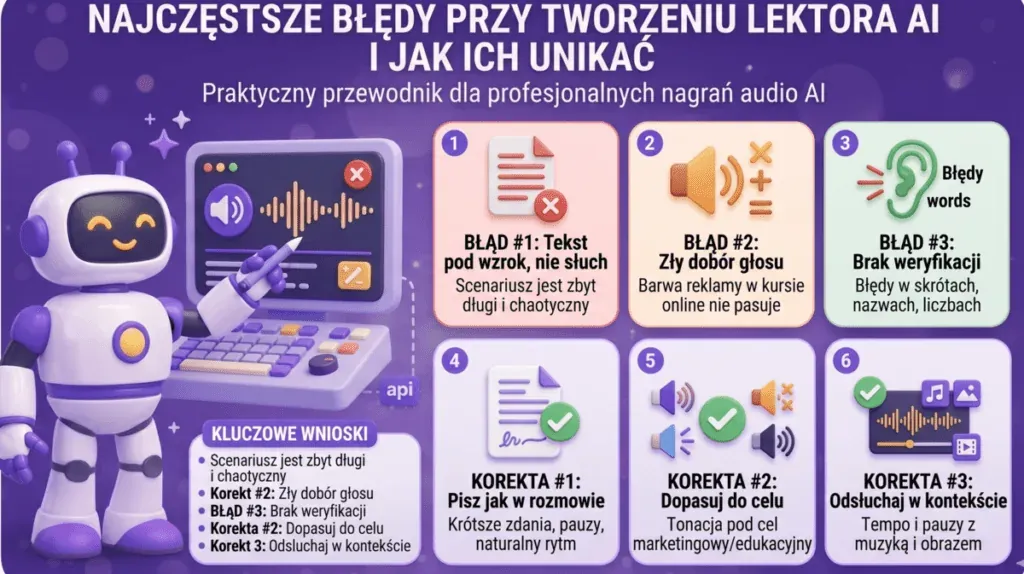
Creating an AI voiceover is instant, yet the first attempt rarely sounds perfect. The most common mistake is treating the tool as a simple text converter, ignoring the rules of audio communication. Even the best text to speech technology will not fix a script that is too long or written purely to be read with the eyes. To get a natural result, the content should be prepared as if it were meant to be spoken in a relaxed conversation. Shorter sentences, logical pauses and a clear rhythm of delivery are the key to making an AI voiceover sound credible and professional.
Choosing the right voice for the purpose of the recording matters just as much. A timbre that is perfect for a dynamic sales advert will not work in a substantive online course, an expert presentation or a long audiobook. Before generating the file, it is worth deciding what emotions the message should build: one tone supports an informational function in B2B materials, while another builds engagement on social media. At the same time, you should avoid excessive expressiveness in the settings offered by the AI voice generator, since it can give the recording an artificial, theatrical character.
The last pitfall is skipping the final check of the recording. AI can misread an abbreviation, a number or a proper name, which affects the brand's image. Before publishing, it is essential to listen to the whole thing, ideally combined with the target music or image. This lets you check whether the pace and pauses work with the rhythm of the material and whether the message doesn't get lost in the background. Only with this approach does a digital voiceover stop being a technological novelty and become an effective tool that supports modern promotion and sales.
The Future of Digital Voiceovers: How AI Is Changing the Audio and Video Industry
The development of voice technologies based on artificial intelligence is clearly accelerating, and modern AI audio solutions are becoming the standard in professional production. Tools that only a few years ago offered a mechanical sound now deliver a level of realism that allows wide use in marketing, education and entertainment. Platforms such as ElevenLabs are consistently rolling out new features that push the boundaries of what speech synthesis can do. This lets companies quickly create professional recordings, test different variants of a message and scale content production without committing huge budgets.
One of the most important directions of development is personalisation and voice cloning, which lets brands build a unique, consistent audio identity. The ability to generate video material, audiobooks or short-form content for platforms such as TikTok using a single, recognisable voice builds a strong bond with the audience. The continuous evolution of AI audio means generated speech increasingly captures subtle emotions, accents and linguistic nuances, which is crucial in campaigns run in international markets.
This progress also brings challenges, especially in the area of privacy protection and data security. The creators of these tools are placing growing emphasis on security systems and access controls to prevent misuse involving other people's voices. At the same time, extensive APIs let developers deeply integrate voice features with mobile apps and business systems, opening the way to full automation of customer communication.
Looking at it strategically, digital voiceovers will play a key role in marketing operations. The ability to roll out new content quickly and produce it at scale means companies can respond to market trends almost in real time. Tools based on AI audio build a complete ecosystem that supports sales and improves the user experience. For businesses, this means one thing: artificial intelligence in the audio space has stopped being just a novelty and has become the foundation of modern, effective communication.
Check Out Also: