














LLMs (Large Language Models) are advanced artificial intelligence models that can understand and generate natural language based on huge sets of text data. They're exactly what powers tools such as ChatGPT, Gemini and Claude, and they're behind most modern text-based AI systems. Whether a model recommends your brand specifically isn't a matter of chance, and you can influence it: that's what AI SEO is about.
Unlike traditional systems, which relied on simple rules, large language models analyse patterns in language and predict the next words in a sentence. This lets them produce coherent answers, translate text, analyse data and hold conversations.
The rise of LLMs has completely changed how we interact with technology. Instead of searching for information, users ask a question and get a ready-made answer. That's exactly why understanding what language models are and how they work is now essential in marketing, SEO and business.

What Is an LLM (Large Language Model)?
An LLM, or large language model, is an artificial intelligence model trained on huge sets of text data, whose job is to process and generate natural language. Its main function is predicting the next pieces of text based on context.
A language model analyses language as a stream of data, learning the relationships between words, sentences and meanings. For an LLM, scale is key: the more data and parameters, the more advanced the model's capabilities.
Large language models, such as GPT (Generative Pre-trained Transformer), differ from earlier AI systems in that they aren't built for a single specific task. They're universal and can be used for many purposes: from generating text, through analysis, to interacting with users.
It's precisely this universality that has made LLMs the foundation of modern artificial intelligence, and the basis for the development of AI Search.
How Do Large Language Models Work?
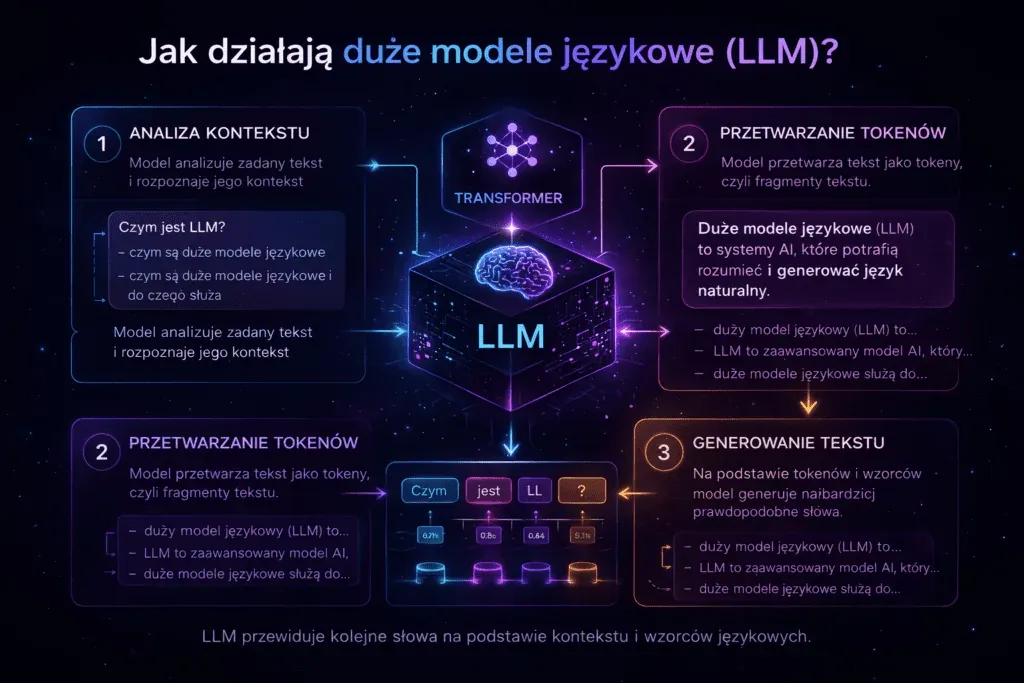
Large language models work by analysing context and predicting the next tokens, the smallest units of text that an answer is built from. LLMs don't “think” like a human and don't understand content the way humans do. Their operation is based on statistics, language patterns and the analysis of a huge number of examples from training data.
In practice, this means the model receives a piece of text, analyses its context, and then calculates which next element has the highest probability of occurring. This process repeats step by step until a whole sentence, paragraph or full answer is produced.
Tokens Instead of “Words”
An LLM doesn't work directly on words in the classic sense. It operates on tokens, fragments of text that can be a whole word, part of a word, a number or a special character. Tokens are the basic unit that the model processes, analyses and predicts.
This lets the model work flexibly across different languages, writing forms and types of text data. At the same time, the number of tokens affects how much context the model can take into account in a single answer.
The Importance of Context
Context is one of the most important elements of how an LLM works. The model doesn't generate an answer in isolation from the question, but based on what came before it in the conversation or in the given piece of text. The better defined the context, the higher the quality of the answer.
That's exactly why the same models can produce very different results with different prompts. Changing a few words in a query changes the context, and with it the model's predictions.
Language Patterns and Prediction
Large language models learn patterns found in text data. They don't simply memorise ready-made answers. They learn relationships: which words appear next to each other, which constructions are typical, which concepts are related, and which forms of expression fit a given context.
It's this mechanism that lets LLMs generate fluent, natural language. The model predicts not just the next word, but the whole structure of the answer: its tone, logic and semantic coherence.
The Role of NLP, or Natural Language Processing
LLMs are part of a field called NLP (Natural Language Processing). NLP covers all the technologies that let computers analyse, interpret and generate human language.
Large language models are the most advanced form of NLP, because they combine language analysis with text generation on a very large scale. This lets them not only recognise the meaning of sentences, but also create new statements matched to the user's intent.
Transformer: The Architecture That Changed AI
Most modern LLMs are built on the transformer architecture. This approach lets the model analyse relationships between tokens across a whole sentence or paragraph, instead of processing text in a purely linear way.
The transformer's most important advantage is its ability to take multiple elements of context into account at once. This lets the model better understand the relationships between words, capture the meaning of whole passages, and generate more coherent answers.
In short: an LLM works by analysing tokens, understanding context and predicting the most probable continuation of the text. This mechanism is exactly what's behind the answers generated by ChatGPT and other modern AI systems.
How Are LLM Models Created?
Large language models are created by training neural networks on huge sets of text data, using machine learning methods. This process involves analysing billions of examples of language, which lets the model learn patterns, relationships and the structure of communication.
Creating an LLM isn't a one-off action, but a multi-stage process that includes gathering data, training the model and further fine-tuning it. Each of these stages affects the quality of the answers the model can generate.
Training Data as the Foundation
Data is the foundation of every language model. LLMs are trained on huge sets of text data, which can include articles, books, websites, documents or conversations.
The larger and more varied the dataset, the better the model handles different topics and language styles. At the same time, data quality is crucial: incorrect or inconsistent information can affect the quality of the answers generated.
The Model Training Process
Training an LLM involves repeatedly analysing data and adjusting the model's parameters. The model receives a piece of text and learns to predict what comes next. Every time it makes a mistake, its parameters are updated.
This process is repeated millions or billions of times. This lets the model gradually improve its predictions and better reflect language patterns.
Machine Learning and Neural Networks
LLMs are built on machine learning and artificial neural networks. A neural network consists of many layers that process data and learn the relationships between it.
For large language models, the number of parameters can run into the billions. It's exactly this scale that lets models recognise complex patterns and generate coherent answers.
The Importance of Scale and Computing Power
One of the key elements in the development of LLMs is scale. Both the volume of data and the amount of computing power have a direct effect on the model's capabilities.
Training large language models requires enormous resources: specialised processors (GPUs), large amounts of memory and time. That's exactly why developing LLMs is mainly possible for tech companies with the right infrastructure.
In short: LLM models are created by training neural networks on huge sets of data, using machine learning and advanced infrastructure. This combination of data, algorithms and computing power forms the foundation of modern AI.
What Are LLMs Used For?
Large language models are used to generate, analyse and process text in a way that resembles human communication. Thanks to their versatility, they can be used in many areas, from simple chatbots to advanced systems that support business, marketing and data analysis.
The biggest advantage of LLMs is that they aren't limited to a single task. The same model can write text, analyse documents, answer questions and support decision-making processes.
Generating Text
One of the most common uses of LLMs is generating text. Models can create articles, product descriptions, social media posts, emails or marketing content.
Thanks to their analysis of language patterns, the generated text is coherent, logical and matched to the context. This is why LLMs are widely used in content marketing and SEO.
Analysing and Processing Text Data
LLMs can analyse large amounts of text and extract key information from it. They can summarise documents, identify the most important conclusions, analyse sentiment or classify content.
This use is especially valuable in business, where fast analysis of text data allows for better decisions.
Chatbots and User Interaction
Language models are the foundation of modern chatbots and conversational systems. They enable natural conversations, answering questions and supporting users in real time.
It's precisely thanks to LLMs that it's possible to build systems such as ChatGPT, which can carry out extensive interactions with users.
Automating Processes
LLMs are used to automate many language-related processes. They can generate responses to customer queries, create reports, analyse documents or support customer service.
Automation using language models saves time and increases team efficiency.
AI Search and New Search Engines
Large language models are changing how we search for information. Instead of a list of results, the user gets a ready-made answer generated by AI.
LLMs are exactly what underpins systems such as ChatGPT, Copilot and Gemini. They analyse the query, select the relevant information and generate an answer matched to the user's intent.
In practice, this means LLMs are becoming a central part of modern information systems. Their use goes far beyond generating text and covers the whole AI ecosystem.
Why Are LLMs So Groundbreaking?
Large language models are groundbreaking because, for the first time, they've made it possible to use language as a scalable, natural interface to technology. Instead of learning tools, the user communicates with the system intuitively, through questions and instructions.
This shift is changing how we use the internet, software and data. LLMs remove the technical barrier and let anyone use advanced features without specialist knowledge.
Scale and Versatility
One of the most important factors behind how groundbreaking LLMs are is their scale. Models are trained on huge sets of data and have billions of parameters, which lets them recognise complex language patterns.
At the same time, they're versatile. A single model can perform many tasks without needing a separate system built for every case. This is radically changing the approach to building software.
A New Way of Interacting With Technology
LLMs introduce a new standard of interaction: communication based on natural language. Users don't need to know the interface or the structure of the system. They just need to be able to ask a question.
This makes technology more accessible and intuitive. Instead of learning how to use tools, the user focuses on the goal and the problem they want to solve.
The Impact on Business, Marketing and SEO
LLMs have a direct impact on how businesses operate. They automate processes, speed up content creation and change how businesses communicate with customers.
In marketing and SEO, this means a shift in the visibility model. Users increasingly get an answer instead of a list of results. This means companies have to adapt their content to the new mechanisms by which AI selects information.
The Foundation of AI Search
Large language models are the foundation of modern AI-based search engines. They're what analyses queries, interprets intent and generates answers.
AI Search doesn't exist without LLMs. These are exactly the models that make it possible to move from searching for links to generating answers. In practice, this marks a new stage in the development of the internet and how we consume information.
LLMs are changing not just technology, but also the way we think about information, knowledge and interaction with digital systems.
Limitations of LLMs: What You Should Know
Large language models have significant limitations, which stem from their statistical nature and the way they're trained on data. While they can generate very convincing answers, they aren't fact-checking systems, and they have no genuine understanding of the world.
Understanding these limitations is essential for using LLMs consciously and safely, especially in the context of business, marketing and decision-making.
AI Hallucinations
One of the most important limitations is the phenomenon of hallucination. A model can generate information that sounds credible but has no basis in reality. This applies to numerical data, facts, sources or events.
Hallucinations aren't a technical bug, but a natural effect of how the model works: it predicts the most probable answer, even when it doesn't have complete data.
No Genuine “Understanding”
LLMs don't understand the meaning of information the way humans do. They operate on language patterns, not on knowledge in a cognitive sense. This means they can generate correct-looking text without actually understanding the topic.
In practice, a model can produce an answer that sounds correct but isn't logically consistent, or that contains hidden errors.
Dependence on Training Data
The quality of an LLM's answers depends directly on the data it was trained on. If the data is incomplete, outdated or contains errors, the model can reproduce them.
Models don't have access to complete, up-to-date knowledge of the world unless they're connected to external data sources.
Data That Isn't Up to Date
LLMs work based on data from a specific point in time. This means that without integration with up-to-date sources, they may not account for the latest information, market changes or events.
This matters especially in fast-moving areas such as technology, finance or law.
Sensitivity to Prompt Quality
The quality of the answer a model generates depends on how the question is asked. An imprecise prompt can lead to incomplete, incorrect or ambiguous answers.
Precisely defining the context and purpose of a query significantly improves the quality of the results and reduces the risk of errors.
LLMs are powerful tools, but they require conscious use and verification of information. Their limitations don't eliminate their value, but they define how they should be used.
Summary
LLMs, or large language models, are the foundation of modern artificial intelligence, enabling the processing and generation of natural language on a scale never seen before. It's precisely thanks to them that it's possible to communicate with technology as a conversation, not just an interaction with an interface.
Language models work by predicting the next tokens based on context, learning patterns from huge sets of data. Their strength comes from their scale, the transformer architecture and their ability to be applied universally across many areas.
LLMs are used in content generation, data analysis, process automation and modern AI-based search engines. At the same time, they have limitations, such as hallucinations or a lack of genuine understanding, which call for a conscious approach to how they're used.
The development of large language models is changing how we use information, technology and the internet. In practice, this marks a shift from searching for data to receiving ready-made answers.
Understanding what LLMs are and how they work is essential today for anyone who works with content, data or technology. This isn't just a trend, but a lasting change in how the digital world functions.
Also Check Out: