












Artificial intelligence (AI) is making an increasingly bold entrance into the everyday lives of billions of people, and one of its most dynamic and ubiquitous manifestations is Meta AI, an intelligent assistant built directly into the Facebook, Instagram, WhatsApp and Messenger ecosystem. It's no longer just a tool for generating text or images, but a genuine intelligence layer that understands the context of our interactions, personalises content in real time, and supports a billion users in communication, creativity and exploring the digital world.
What Is Meta AI and What Is Its Place in Meta's Strategy?
Meta AI is a specialised area of business within the Meta Platforms group, focused on developing advanced artificial intelligence systems that span language models as well as solutions in computer vision, data analysis and recommendation systems. It isn't a single product, but an extensive technology ecosystem that permeates almost every service the company offers, from Facebook and Instagram to WhatsApp and metaverse-related solutions. In practice, Meta AI is the technological foundation that enables content personalisation, process automation and the creation of intelligent conversational interfaces.
In May 2025, Mark Zuckerberg announced that the Meta AI system had passed 1 billion monthly active users across all of the company's apps (Facebook, Instagram, WhatsApp, Messenger, plus the dedicated Meta AI app). This is the fastest growth of an AI platform in history: ChatGPT needed almost two years to reach it, while Meta did it in around 18 months.
How Does Meta AI Work? Technologies, Models and Learning Mechanisms
Meta AI is built on the natively multimodal Llama 4 models, which process text, images, audio and video in a single engine thanks to early modality fusion and a Mixture-of-Experts (MoE) architecture. At the heart of the technology is advanced natural language processing (NLP) combined with reinforcement learning and behavioural analysis, which enables precise recommendations, content generation and natural voice conversations. As a result, Meta AI acts as an integral, scalable intelligence layer, deeply embedded in everyday social apps.
The LLaMA Language Models and Their Importance for AI Development
One of Meta AI's biggest strengths is its open models from the Llama 4 family: Scout and Maverick (released in April 2025), along with the still-evolving and most powerful model, Behemoth (still being refined, as of March 2026).
Llama 4 Scout is a "light but powerful" model: it runs even on a single graphics card, yet still handles reasoning, code writing and tasks that require analysing text, images, audio and video at the same time.
Llama 4 Maverick is a bit bigger and more powerful, delivering even better quality answers on harder tasks while remaining efficient and fast.
Both models can work in two modes, chosen by the user (or selected automatically by the system):
- standard mode (fast): responds instantly, ideal for everyday things such as chat reply suggestions, text corrections, and quick questions like "what's the weather on Saturday" or "give me a gift idea". Everything happens in a second.
- "think longer" mode (Thinking Mode): the model doesn't rush, "thinks" step by step, and gives a much more accurate, better-considered answer. Great for harder matters: maths, code analysis, planning (such as a trip or a budget), and complex questions that require logic.

The Successor to Llama 4: The Avocado Model and 2026 Challenges
Meta is working intensively on its next flagship model, code-named Avocado. A launch was initially planned for March 2026, but according to reports from March 2026 (including The New York Times and Reuters), the launch has been pushed back to at least May 2026, and possibly later. The reason for the delay is the results of internal testing: the model still lags behind market leaders (Gemini 2.5/3.0, Claude 4, GPT-o3/o1-pro) in reasoning, coding and the quality of the text it generates. Despite huge investment, catching up with OpenAI and Google at the absolute top of frontier models remains Meta's biggest challenge in 2026.
Integrating AI with Social Platform Infrastructure
Meta AI's greatest strength, however, isn't just the technology itself, but its deep integration with the global infrastructure of social platforms. Artificial intelligence is the core of the mechanisms responsible for content ranking, feed personalisation, content moderation and ad campaign optimisation. Every click, reaction or amount of time spent on a given post becomes a signal for the algorithm, which analyses user preferences and adjusts subsequent recommendations. Thanks to this, Meta AI creates a digital environment that reacts dynamically to audience behaviour. The integration also extends to messaging apps, where conversational assistants are being rolled out that can generate replies, conversation summaries and suggested actions.
In practice, this means a shift in the model of interaction with the platform: from passively browsing content to a more active, dialogue-based form of communication with technology. Importantly, Meta's scale means that even small algorithm improvements translate into the experience of billions of users. It's precisely in this synergy between advanced artificial intelligence and extensive digital infrastructure that the full potential of Meta AI, as a technology genuinely changing how we use the internet, becomes apparent.
Meta AI in Everyday Use: How Does It Affect Facebook, Instagram and WhatsApp?
Although mostly associated with advanced models and research, Meta's artificial intelligence is most visible in everyday social media use. It's precisely while browsing your feed, chatting or watching reels that algorithms match content to user behaviour in real time.
The system analyses activity, reactions and interests to create a personalised experience. As a result, every user sees a different version of the platform, with content and recommendations tailored to their preferences. This makes using Facebook, Instagram or WhatsApp more intuitive and engaging, and gradually changes the way content is consumed into something more interactive and user-specific.
Smart Suggestions, Recommendations and Content Personalisation
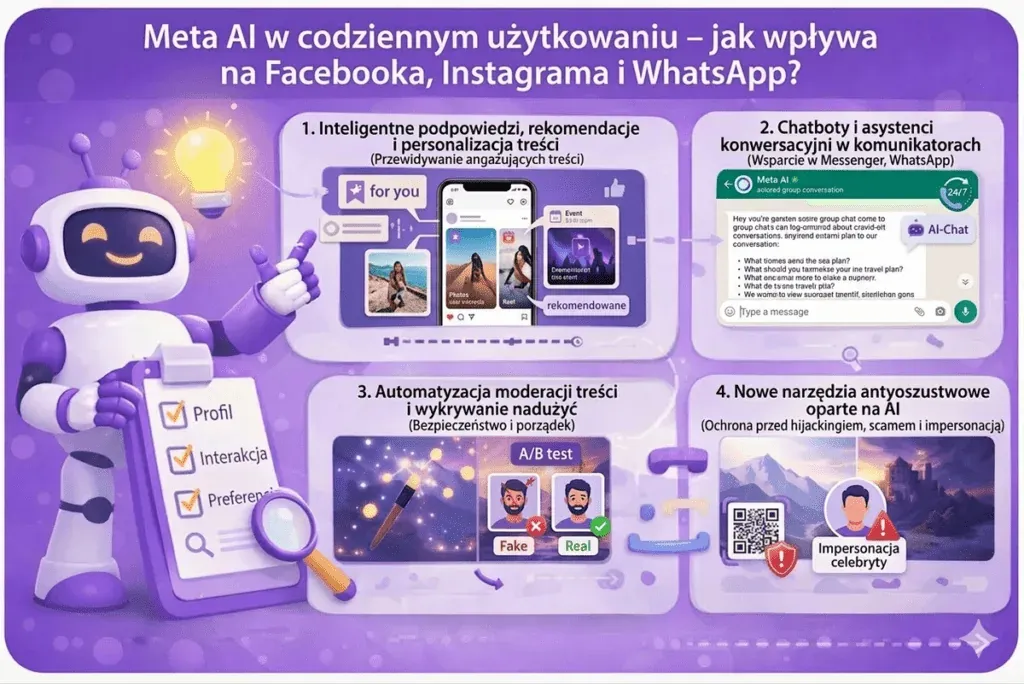
One of the most important elements of how Meta AI works is the content recommendation system, which decides what a user sees in their feed. Algorithms analyse behaviour such as clicks, reactions and viewing time to predict which materials will be most interesting. This lets platforms deliver content tailored to individual preferences, increasing user engagement.
In practice, this means content personalisation is no longer an add-on, but the basis of how social media functions. For businesses, this is a huge opportunity to reach audiences precisely, but also a challenge, because only valuable, well-matched content stands a chance of breaking through the algorithm.
Chatbots and Conversational Assistants in Messaging Apps
In Messenger and WhatsApp, Meta AI is developing smart assistant features that support communication between users and businesses. Chatbots can answer questions, hold conversations and help complete simple tasks, such as checking an offer or placing an order. In practice, this means the assistant can instantly summarise a multi-threaded group conversation, picking out the key decisions from it, or help plan a get-together by searching for a location directly within the chat window. Additionally, thanks to multimodality, a user can send a photo of the contents of their fridge, and Meta AI will respond by generating a list of recipes or suggesting missing ingredients for dinner.
Automated Content Moderation and Abuse Detection
Another important application of Meta AI is moderating content published on the platforms. Algorithms analyse posts, comments and video material to detect spam, hate speech and disinformation.
This increases user safety and makes platforms better organised. From a brand's point of view, it also means greater control over the context in which their content appears, which has a direct impact on the image and effectiveness of marketing activities.
New AI-Based Anti-Scam Tools
In March 2026, Meta rolled out a package of new anti-scam protections on WhatsApp, Facebook and Messenger, using advanced AI systems to proactively detect threats. Key features include:
- warnings about suspicious attempts to link devices on WhatsApp (protection against account hijacking via fake QR codes or links),
- alerts on Facebook for suspicious friend requests (analysis of behavioural patterns and context),
- detection of impersonation of celebrities, brands, public figures and profiles (AI analyses photos, bios, writing style and interaction context),
- blocking or warning against suspicious links and scam messages.
Thanks to these tools, platforms can step in before a user gets caught up in a scam. In 2025, Meta removed more than 159 million scam ads and 10.9 million accounts linked to crime centres, and these new features significantly strengthen proactive protection and build user trust.
Meta AI Features That Genuinely Change the User Experience
The development of modern AI-based systems means that using social platforms is no longer just about passively browsing content. Increasingly, users get active support, both during communication and when creating materials or searching for information. These technologies work in the background, but genuinely affect how convenient and fast it is to use the apps.
In practice, this means intelligent algorithms now take on some of the tasks that used to require time and effort. They make writing easier, support creativity and help you find the content you need faster. It's precisely these features that make the user experience smoother, more intuitive and better matched to expectations.
Real-Time Text and Reply Generation
One of the most noticeable changes is the ability to automatically create content and suggestions while typing. The system analyses the context of a message, so for example, when you're writing to a friend on WhatsApp about planning a barbecue, Meta AI can automatically suggest a shopping list or check the Saturday weather forecast directly in the chat.
This kind of text generation is useful not only in private conversations, but also in business. Brands can respond to customers faster, create product descriptions or prepare marketing content. As a result, communication automation saves time and lets you scale up activities.
Image Creation and Creative Support
Another important area is the development of tools that support creating graphics. Based on a simple description, a user can generate an image that meets their needs. This significantly simplifies the process of creating visual content.
Thanks to this, creative tools become accessible to a wider group of users, not just designers. Businesses can test ideas faster and create materials without major expense. In practice, content creation becomes more flexible and dynamic.
Example of an image generated by Meta AI:

Meta AI in Business and Marketing: New Opportunities for Companies
The development of technologies based on artificial intelligence is significantly changing how marketing activities are run and how businesses are managed. Companies gain access to tools that not only automate processes, but also help them better understand customer needs and react faster to market changes. This is no longer just operational support, it's a genuine competitive advantage.
In practice, intelligent systems enable more precise audience targeting, campaign optimisation and improved customer service quality. This lets companies operate more efficiently, scale their activities and make decisions based on data rather than intuition.
Automating Ad Campaigns and Audience Targeting
One of the key applications of AI in marketing is ad campaign automation. Systems analyse user data and use it to select target groups, optimise budgets and decide which creatives will be most effective.
This makes audience targeting much more precise than in traditional advertising models. Ads reach people who are genuinely interested in the offer, which increases their effectiveness and lowers the cost of acquiring a customer.
Data Analysis and Predicting Consumer Behaviour
Modern systems can analyse huge amounts of data in a very short time, identifying patterns and relationships invisible to humans. This makes it possible to predict users' future behaviour and purchasing decisions.
This makes data analysis the foundation of effective marketing strategies. Companies can plan activities better, anticipate trends and adjust their offer to customer expectations. What's more, behaviour prediction allows them to react in advance, rather than only after the fact.
AI-Powered Customer Service Support
Artificial intelligence is playing an increasingly important role in customer service, automating many communication processes. Chatbots and conversational systems can answer questions, resolve problems and guide users through the purchasing process.
As a result, customer service becomes faster and more accessible, regardless of the time of day. Companies can handle a larger number of enquiries without growing their team, which translates into lower operating costs. At the same time, communication automation improves the user experience, as they receive an immediate response and support.
Meta AI vs the Competition: How Does It Compare with OpenAI and Google?
The artificial intelligence market is developing extremely dynamically, and its main players today are companies such as Meta, OpenAI and Google. Each of them is developing its own technologies, language models and product ecosystems designed to meet the growing needs of users and businesses. However, the differences between them aren't limited to model quality alone, they also extend to their approach to development, technology availability and how it's rolled out.
In practice, the artificial intelligence developed by these companies takes various forms, from closed systems available as part of specific services, to more open solutions that support the developer community. This means the choice of technology has real significance for companies planning AI implementations.
Technological Differences and Development Models
In technological terms, each company is developing its own approach to building AI models. OpenAI focuses on advanced language models used in tools such as ChatGPT, Google develops AI within its own ecosystem (Search, YouTube, Gmail), while Meta integrates its solutions directly with social platforms.
This means language models differ not only in architecture, but also in application. For Meta, the key thing is embedding the technology in users' everyday interactions, while competitors often develop more universal tools available as standalone products. These differences affect how AI is used in practice.
Open Source Strategy vs Closed Solutions
One of the most important distinguishing factors is the approach to technology availability. Meta relies more heavily on open source, making selected models available to the research community and developers. This accelerates the development of the ecosystem and makes it possible to build your own solutions on top of the available technologies.
OpenAI and Google, on the other hand, more often develop closed solutions, available within their own platforms and services. This approach gives greater control over quality and security, but at the same time limits the ability of external parties to freely use the technology. The choice between these models therefore depends on a company's needs and strategy.
Meta AI's Competitive Advantages and Limitations
The biggest advantage of the solutions developed by Meta is their direct integration with platforms used by billions of users. This means the technology ecosystem allows new features to be rolled out at a huge scale and their effectiveness to be tested quickly in real-world conditions.
On the other hand, technological limitations can arise from the need to adapt solutions to the specifics of social platforms and to privacy and regulatory requirements. As a result, the development of some features may be slower or more controlled than with independent AI tools. Even so, the potential arising from Meta's scale and user data means it remains one of the key players in the market.
| Area | Meta | OpenAI | |
|---|---|---|---|
| Main application | AI integration with social media | Universal conversational tools | AI within the search and services ecosystem |
| Language models | Llama 4 (Scout, Maverick, Behemoth in progress) | GPT (e.g. o1, o3, GPT-5 lineage) | Gemini (2.5 / 3.0) |
| Availability | Partly open source | Mostly closed solutions | Closed solutions |
| Integration | Facebook, Instagram, WhatsApp | API, ChatGPT | Gmail, YouTube, Search |
| Limitations | Regulation, privacy | Limited openness | Closed ecosystem |
The Future of Meta AI: Where Is Technology Development Heading?
The development of technologies based on artificial intelligence clearly shows that we're only at the beginning of a huge digital transformation. AI is increasingly permeating users' everyday lives, from communication and entertainment to work, education and purchasing decisions. In this context, the solutions developed by Meta are particularly significant, because they're directly integrated with platforms used by billions of people around the world.
In the coming years, immersive technologies that combine the physical and digital worlds will play a key role. Augmented reality and the development of virtual environments will make interacting with technology even more natural and engaging. Artificial intelligence will stop being just a tool, it will become an active participant in users' everyday experiences.
FAQ: Frequently Asked Questions About Meta AI
How Do I Start Using Meta AI?
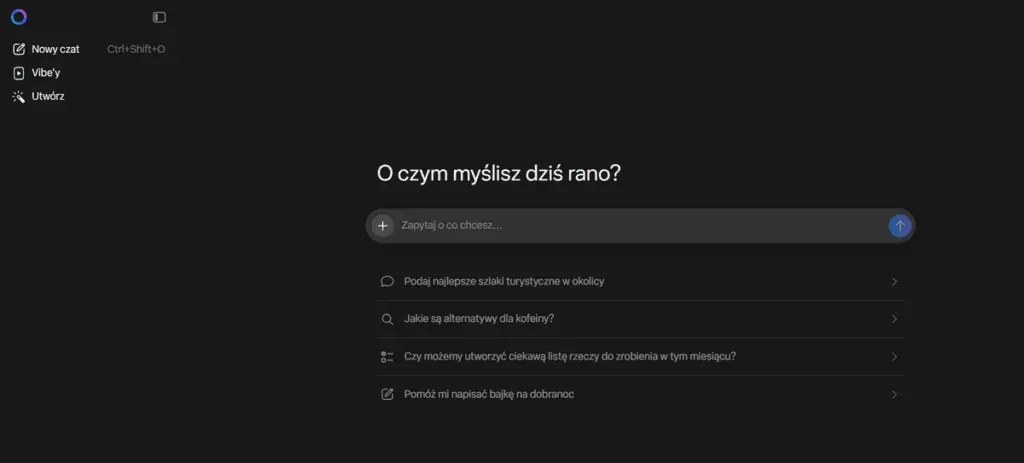
To start using Meta AI, you can go directly to the dedicated meta.ai website or use it within apps such as Messenger, Instagram or WhatsApp, simply click the AI icon in the chat or search bar.
Is Meta AI Free?
Most artificial intelligence features are available to users at no extra cost within Meta's apps. However, paid extensions or premium features for businesses may appear in the future.
How Do I Turn On Meta AI on Facebook or Instagram?
Access to Meta AI features depends on your region and app updates. In most cases, it appears automatically in Messenger, the search bar or as an assistant within the app. If you don't see it, it's worth updating the app and checking feature availability in the settings.
How Does Meta AI Differ from ChatGPT?
Although both solutions use language models, they're used differently. ChatGPT works as a standalone tool for conversations and content generation, while Meta's solutions are integrated directly with social platforms and focus on personalisation and communication.
Does Meta AI Read My Messages?
The system uses data to improve its services, though the company states that it applies safeguards. Even so, data security and privacy remain one of the most important topics for users.
Read Also: