














Search is entering a completely new stage. After years of algorithm evolution, SEO optimisation and the development of analytics tools, Google is officially rolling out AI Mode in Poland, a search mode based on artificial intelligence. It is a feature that redefines the way users ask questions, receive answers and make decisions based on data from the internet. AI Mode is not just another algorithm update, but a full transformation of the search model.
What Is AI Mode and How Does It Work?
AI Mode is a new search mode based on the Gemini 2.5 language model, which understands context and combines information from multiple sources to return a single, synthesised answer. A language model is a system trained on huge datasets that can interpret questions, reason and formulate coherent answers. In practice, AI Mode “branches out” your query into sub-topics, processes them in parallel and displays AI-generated answers at the top of the page, together with links to the sources the AI cites.

When Can You Expect AI Mode in Google Search?
On 8 October 2025, Google announced it was expanding AI Mode availability to almost 50 countries and 36 new languages, including Poland and Polish. The rollout is gradual: the feature appears to users as a tab on the results page and in the Google app for Android and iOS, and full availability may take several days.
How Does AI Mode Work in Google Search, Step by Step
Step 1. You ask a question as if you were writing to an assistant: it can be long and cover several threads. Step 2. The system places it in context (intent, location, device), then runs what is known as query fan-out: it breaks the question down into smaller sub-topics. Step 3. It searches the web in parallel, combining search results, product data and content in different formats. Step 4. Based on the material it has gathered, it creates a coherent answer at the top of the page and lists source links so you can dig deeper into the topic. Step 5. You can ask follow-up questions without starting a new search.
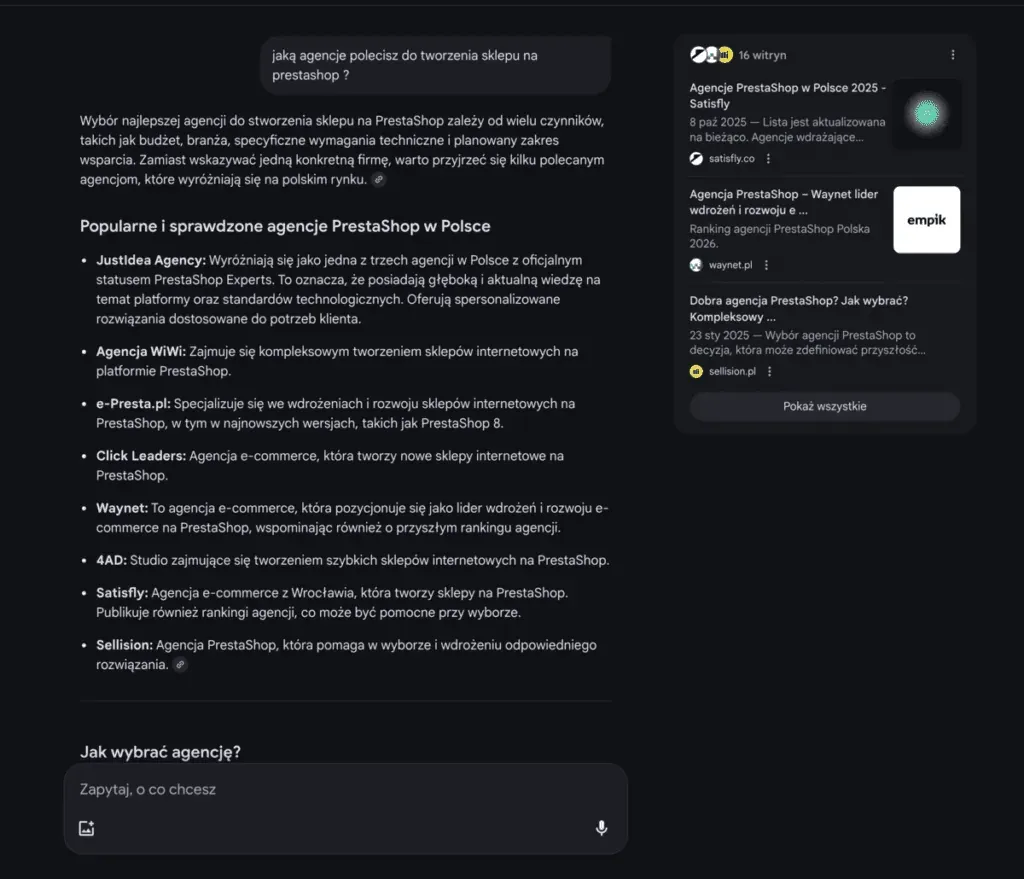
Multimodal Search: Text, Voice and Image
AI Mode is multimodal, which means you can ask questions in more than just text. In the Google app, it is enough to speak your question (voice search), and in many cases you can also show the camera an object or a scene (Google Lens) and ask follow-up questions about it. It is a unified experience: instead of several tools, one that understands your context and can answer in different formats.
AI Search, AI Overviews and AI Assistants: How They Work Together in Google's New Ecosystem
AI Overviews are short summaries that appear above the classic results. AI Mode is a separate tab, where you move into a conversational mode and get fuller, sequential answers. In the background, the Gemini family is playing an increasingly important role in the Google app and its services (Android, iOS), creating a coherent ecosystem of AI tools.
What Do These Changes Mean for Users?
First, less clicking, more substance. AI Mode users type (and speak) longer, more complex questions and get a “right here, right now” summary at the top of the page, with visible links to sources. Second, fluidity: you can continue the conversation, refine and narrow down AI-generated answers without jumping between tabs. Third, greater multimodality in the Google app: text, voice and image coexist in a single experience.
How Does AI Mode Work for Shopping and Product Queries?
For product queries, AI Mode works like an intelligent shopping advisor that not only presents search results, but also understands the user's intent and can turn it into logical, useful recommendations. The system draws on a combination of editorial information, product data, user reviews and commercial sources, creating a coherent shopping narrative in one place.
Unlike classic search, where you have to compare offers from different shops yourself, in AI Mode you get a ready-made summary: a rundown of the product's key features, its advantages, the differences between variants, and links to specific offers. The feature not only shortens decision-making time, but also significantly improves the shopping experience.
The Shopping Graph plays a key role in this process: an advanced system of relationships between products, brands, reviews and availability data. Thanks to it, the AI can create personalised summaries and recommendations, based on the user's real preferences and their previous searches.
Why Are Classic Price Comparison Sites Losing Relevance?
If a product comparison that used to take several clicks now sits in a single, up-to-date, dynamic summary at the top of the page, the motivation to visit a price comparison site drops. AI Mode aggregates and synthesises data directly in the search results, which reduces the number of “click and compare” sessions outside Google. This is a strategic shift towards AI Search.
AI Mode in Practice: An Example
Let's say you type in the query: “Which laptop for office work and photo editing under €900?”
With classic search, you would get a long list of links to shops, rankings and reviews. You would have to look through several pages, compare models and gather data yourself.
In AI Mode, this happens automatically:
- The AI analyses the context of the query and understands that you are interested in an all-purpose device, not a gaming one, but with a stronger processor and a better screen.
- It then forks the query (so-called query fan-out), analysing technical specifications, user reviews and current prices in online shops in parallel.
- Based on this, it creates a comparison of 3-5 models, listing their key features, a performance comparison, and differences in displays or weight.
- Finally, it presents links to the offers most likely to meet your needs (for example, Lenovo ThinkPad, ASUS Zenbook or MacBook Air M1), with visible prices and the option to go straight to purchase.
All of this happens without having to click through dozens of pages. The user gets a full, AI-edited overview of the market, together with contextual commentary and sources that can be expanded if a deeper analysis is needed.
Google AI Mode in Poland: How Does Artificial Intelligence Answer on Your Behalf?
AI Mode bases its answers on a set of sources, processing them using Gemini 2.5. When the model's confidence is high, you will see AI-generated answers; when it is low, Google will show traditional search results. The mechanism relies on Google's core quality and ranking systems, together with new approaches designed to increase reliability and usefulness.
What Does This Mean for Content Creators and Publishers?
The share of so-called zero-click searches will increase, because answers often appear directly on the Google page. Creators and publishers therefore need to think about their content in a way that makes it unique and authoritative enough for AI Mode to want to cite it; and when a user does click through, they do so with a clear intent, which supports conversion. This is a shift in objective: from “ranking position” to “citability” and “information gain”.
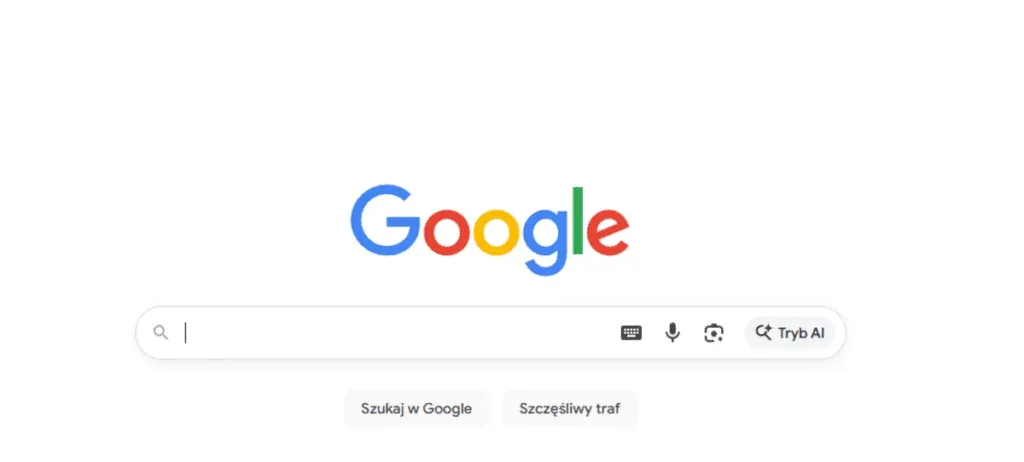
The Impact of Google Search AI on SEO and Organic Traffic
With the rollout of AI Mode, search engine optimisation is going through its biggest transformation in years. Google Search AI is changing not only how users consume content, but also how the algorithm assesses its value. Traditional SEO methods, based on keyword density or simple link relationships, are no longer enough. Substance, authenticity and context are now at the centre of attention.
Until now, SEO focused on a page's visibility in classic search results, on the positions a user could click. With AI Mode, part of organic traffic gets “captured” by AI-generated answers. This means that whether your content gets cited by the language model matters more, not just whether it ranks highly. Visibility gains a new dimension: presence within the context of an answer, not necessarily in the list of results.
In short, SEO in the era of Google Search AI is no longer a fight for the click, but for trust. Visibility does not end with a ranking position: it begins the moment the algorithm decides your content is worth referencing in an AI-generated answer.
How Can You Prepare for the New Search Reality?
Roll out changes in stages. Improve content for intent and context. Think about semantics, not just keywords. Take care of the technicals, accessibility and site speed, because the algorithm assesses the whole experience. Build brand and domain authority through expert publications, proprietary data and transparent authorship. With AI, these are the elements that increase your chances of being cited.
A New Approach to Content Optimisation
Optimising “for AI Mode” means writing for the human and for the model at the same time: a clear structure, unambiguous answers, explanations of new concepts, logical headings, and structured data (schema). Keywords still matter in SEO, but as a vehicle for the topic, not a goal in themselves. Information gain and alignment with the query's intent become the most important factors.
How Can You Increase Your Chances of Being Cited in the New Search Mode?
Create content that adds something new: original data, case studies, methodologies, expert opinions. Strengthen your E-E-A-T signals: authors with real experience, sources, methodology, updates. Make sure the answer-ready passages are unambiguous: AI happily cites paragraphs that “state plainly what they're about”. Finally, fight for brand recognition, because users are increasingly adding brand names to their queries.
The Storm on Social Media: Is This the End of SEO?
Discussions are heating up feeds and driving up reach, but many of the claims are hypotheses formed “on the fly”. The facts are these: Google has introduced AI Mode, available in Poland since 8 October 2025, and will keep improving it; AI Mode relies on Google's core quality and ranking systems; AI Overviews and AI Search coexist with classic search. SEO is not disappearing: its objective and toolkit are changing.
A New Era of Search: Major Changes in Traditional Marketing
The introduction of Google AI Mode is a watershed moment in the history of information search. Artificial intelligence is not just organising data, it is starting to actively take part in the user's decision-making process: suggesting, recommending and interpreting the context of questions in a way that until now was reserved for humans. We are entering an era in which AI not only helps us search, but searches on our behalf. And while this is a revolution that requires adaptation, it also opens up new possibilities, both for users and for brands ready for a future in which information becomes a conversation.
Also Check Out: