














Artificial intelligence in SEO has become a key factor shaping modern website ranking strategies. Have you noticed how fundamentally artificial intelligence is changing the approach to website optimisation and data analysis in the age of advanced AI algorithms? Above all, AI models help with analysing and interpreting content, which allows search engines to better understand user intent, along with search algorithms that are getting increasingly better at interpreting context. As a result, the ranking process becomes faster, more precise and tailored to individual user needs, and AI helps analyse the behaviour of people searching for specific terms. AI tools are better able to interpret what really interests users and how that knowledge can be used to improve SEO results.
Using artificial intelligence in an SEO strategy brings companies a measurable increase in the effectiveness of their optimisation efforts and a significant competitive edge. Thanks to automating many processes, you can save time while maintaining quality. It's worth stressing that AI in SEO gives small and medium-sized businesses a real chance to level the playing field in the fight for search engine visibility. As technology keeps developing, companies that adopt AI in their SEO efforts faster will gain a significant competitive advantage in the market. In this article, we'll analyse how artificial intelligence in website ranking can be applied in practice and how you can make use of its potential.
What Is AI SEO and How Does It Work?
AI SEO is a modern approach to website optimisation that uses advanced artificial intelligence technologies to analyse data and create content. It's a process of adapting websites to AI algorithms, which increasingly determine visibility in internet search engines. While traditional SEO focused solely on Google, today we need to think more broadly, about how to make our content recognised, cited and linked to by artificial intelligence. In practice, this means AI SEO focuses not only on classic Google results, but also on systems based on language models like ChatGPT, Gemini or Perplexity. This shows that optimisation in website ranking needs to be understood much more broadly today.
Definition and Basic Mechanisms of AI in SEO
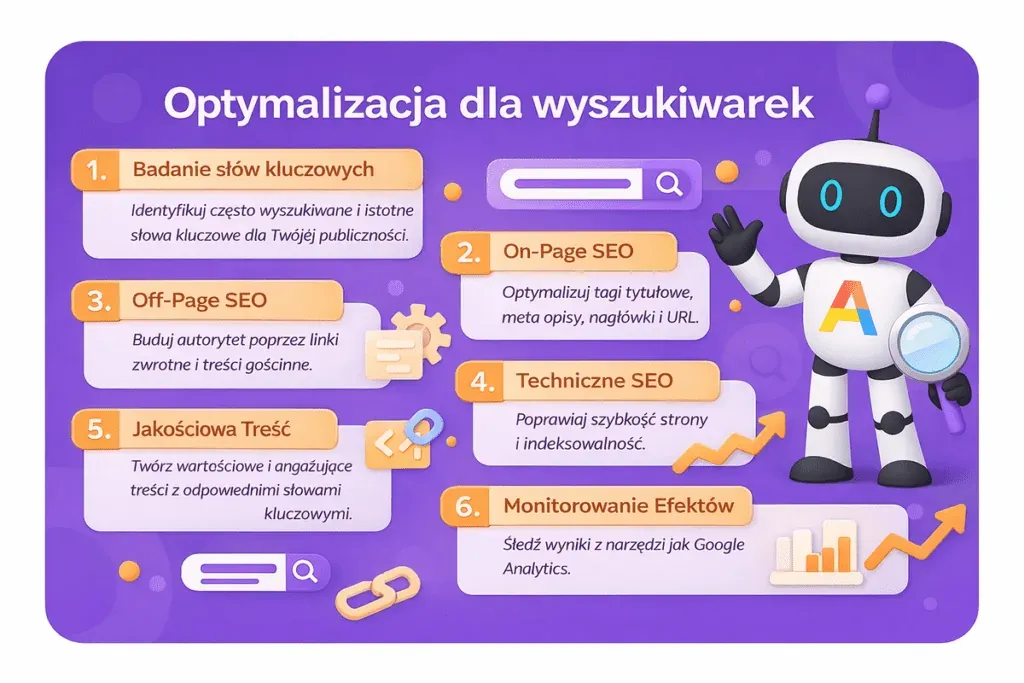
Artificial intelligence in SEO is an innovative approach to optimisation that uses advanced technologies to analyse data and create content. This lets you not only increase a site's visibility in search results, but also better understand user intent and tailor content to their expectations. AI SEO involves optimising content, optimising site structure and implementing structured data, so the site is better understood by artificial intelligence algorithms. The foundation of AI SEO is the E-E-A-T principles, which form the basis of online content credibility. Unlike the traditional approach, where ranking position mattered most, in AI SEO the key measure of success becomes presence in the answers generated by artificial intelligence, which shows that artificial intelligence is changing the rules of the game.
Source: own material
The Role of NLP, Machine Learning and Automation
Natural Language Processing (NLP) is a field of artificial intelligence that lets machines understand and interpret human language. In the context of SEO, NLP helps search engines understand the context and semantics of queries, analyse user intent and assess the emotional tone of text. Algorithms based on NLP, such as BERT or MUM, analyse not just individual phrases, but the whole context, examining the way a user thinks, their intent, and even the emotions hidden between the lines. Using AI and SEO this way lets you create content much better tailored to users' needs.
Machine learning, meanwhile, helps crawl the web to find page suggestions that best match a user's query. SEO automation using artificial intelligence takes the load off routine tasks and lets you focus on building SEO strategy and on strategic activities.
The Benefits of Artificial Intelligence in SEO
Artificial intelligence is significantly transforming SEO automation, opening up new horizons for optimisation. It enables more accurate data analysis, which helps you better understand user intent, a key aspect of effective website ranking. On top of that, AI reduces human error through automatic monitoring of results and identification of potential technical problems. This means many tasks can be carried out faster and more accurately. As a result, artificial intelligence directly affects the effectiveness of your efforts and a site's overall SEO results.
How AI Is Changing the Fundamentals of SEO
The fundamentals of SEO are currently undergoing a deep transformation thanks to artificial intelligence, which is completely changing how we perceive and carry out ranking strategies. Artificial intelligence in SEO is no longer the future, it's the present, and it's shaping new standards of visibility online. Traditional methods based solely on historical data and manual analysis are giving way to advanced algorithms that can process data even ten times faster than conventional tools. This lets specialists save time that would otherwise go into manual research. What's more, a large number of industry experts agree that AI-assisted ranking better reflects users' real intent, which clearly confirms the growing impact of technology on SEO.
Understanding User Intent
AI has revolutionised how search engines understand user queries. Instead of simple keyword matching, algorithms using NLP analyse context, synonyms and semantic relationships between concepts. This lets search engines recognise the real questions hidden behind a typed phrase. For example, they can spot the difference between "buying a gaming laptop" and "best laptop for remote work". According to 2024 Gartner data, a growing share of product queries among Gen Z and millennial representatives start outside classic search engines, including in AI chatbots. On top of that, Similarweb reports a decline in global Google traffic, while AI-integrated tools are seeing growth. That's a clear signal that ranking websites for language models too is becoming a necessity.
Automating Data Analysis
Artificial intelligence in SEO enables the automation of processes that previously required significant manual effort. AI systems can independently detect technical errors such as slow page loading, 404 errors, duplicate content or indexing problems. Thanks to this approach, specialists can spend less time on routine tasks and more on strategic and creative work. Artificial intelligence not only streamlines ranking activities, but also changes how we look at SEO, shifting it from a reactive process to a proactive one, based on predicting trends. AI algorithms analyse search trends and predict which phrases will grow in popularity. This is a great example of why AI in SEO should be treated as a tool supporting key decisions.
AI's Impact on Google's Algorithms
Google keeps developing its algorithms based on artificial intelligence. The introduction of Google AI Overview shows the direction of these changes. Google is moving towards a more contextual way of using search. In this new approach, context matters more, especially for complex and specialist queries. For SEO specialists, this means having to adapt to a reality in which it's not just your position on the results list that matters, but also the chance of being cited by AI, which is becoming crucial. Google is placing growing emphasis on E-E-A-T, and recent updates show that a fight against automatically generated content with no added value has begun in the meantime. This is another reason why AI and SEO need to work together to build visibility.
Using AI in Keyword Analysis
Keyword analysis has always been the foundation of an effective SEO strategy, but traditional methods required hours of tedious work with spreadsheets. Today, artificial intelligence is completely changing this approach, automating processes and delivering deeper insights than was previously possible. AI tools for keyword research simplify time-consuming processes, uncover new opportunities and make it easier to plan content designed to effectively compete in search rankings. Thanks to advanced algorithms, this process runs faster and with greater accuracy than with traditional tools, and specialists can redirect their efforts towards more creative tasks. It's worth taking a closer look at how AI is transforming individual aspects of keyword analysis and how it affects SEO keywords and their effectiveness.
Grouping and Clustering Phrases
AI models trained on huge sets of text data can classify the intent behind queries with high accuracy, which allows for the creation of logical thematic clusters. Instead of manually sorting hundreds of phrases, you can use tools such as Semrush to automatically group keywords by semantic similarity. AI groups phrases that answer similar queries, which lets you plan a content SEO strategy based on actual search intent. This lets you visualise the relationships between phrases using tools such as ClickUp boards and create coherent, comprehensive content covering the whole spectrum of user queries. Modern tools such as Surfer SEO also play a huge role in this process.
Detecting Long-Tail Keywords
One of the most important benefits of artificial intelligence in keyword analysis is its ability to identify long-tail keywords, longer, more specific phrases that often have less competition but a higher conversion rate. Thanks to context-recognition technology, AI can distinguish keywords with high conversion potential from those that generate only traffic with no business value. Tools create lists of thousands of keywords from a single concept, which greatly simplifies the work of SEO specialists and helps generate high-quality SEO content.
Competitor Analysis Using AI
Artificial intelligence also enables comprehensive analysis of competitors' SEO activities. Using AI tools isn't limited to identifying competitors' strengths, it's equally important to search for market gaps, meaning areas where competitors aren't investing enough. AI compares hundreds of articles in terms of structure, length, phrases used and internal linking, which helps identify thematic niches that can provide an edge in search results. Tools such as Surfer and Semrush let you quickly identify competitors' strategies, their most effective keywords and content gaps that you can turn to your advantage. All of this affects how successful AI SEO is and how the role of SEO with AI in market analysis keeps growing.
Generating and Optimising SEO Content
Artificial intelligence is turning the traditional approach to creating SEO content upside down, offering tools that not only speed up this process, but also significantly raise its quality. Thanks to advanced language models, creating valuable articles has become more accessible even to people without specialist knowledge. Meanwhile, SEO experts can use these tools as support, focusing on the strategic aspects of a campaign. AI models analyse huge sets of data, spotting trends and predicting user intent much faster than a human could. In fact, artificial intelligence can instantly analyse thousands of competitor pages, pointing out content gaps and suggesting topics with high potential.
Creating Content With the Help of AI
Language models such as ChatGPT let you quickly create article drafts and product descriptions tailored to keywords. With AI support, it's possible to, among other things, generate article plans and structures that follow SEO principles, as well as create proposed headings and meta descriptions matched to queries in Google. The key to getting high-quality content is the ability to formulate precise instructions, in other words, prompting. In the AI era, it's precisely the quality of prompts that separates a specialist from an amateur, a well-prepared prompt will get you the result you expect, while a poorly formulated one will generate generalities unfit for publication. Remember that AI won't create your whole strategy for you. Algorithms rely on data and patterns, but assessing which results are valuable and how to use them remains the job of SEO specialists. This is crucial for effectively using artificial intelligence in ranking a site's content.
Paraphrasing and Summarising
AI-based paraphrasing tools detect the finest linguistic nuances and correctly reproduce them in modified text. Well-designed paraphrasers don't just replace words with synonyms, they also change sentence structure, creating content that's unique but keeps its original meaning. It's worth using such tools to quickly generate multiple versions of the same text, increasing productivity and avoiding content duplication. On top of that, AI tools can automatically summarise longer texts, creating concise abstracts that keep the key information, which helps build SEO content through continuous optimisation.
Matching Content to User Intent
Before you start creating content, it's worth answering the questions: what is the user asking, what do they need, at what stage of the decision-making process are they, and what kind of answer are they expecting? Artificial intelligence analyses not just the words, but the purpose of the query, which lets you create content matched to specific types of intent: informational, navigational and transactional. Instead of focusing on keywords, it's worth concentrating on answering customers' questions in a natural way.
Using NLP in Optimisation
NLP in SEO helps increase a page's topical relevance score for chosen keywords. Thanks to NLP, we can understand the intent behind users' queries and create content aimed primarily at people, which precisely matches search intent. When using NLP, you should write in a simple and understandable way, answer frequently asked questions and create content in a logical manner. What's more, optimising content for NLP involves the right density of keywords, using bold text and sentences that are thematically related. Most important of all, though, is creating valuable content that's easy for people to read and understand, since that's the content with the best chance of good visibility and better rankings for websites in search engines.
Improving UX and Personalisation Thanks to AI
User experience (UX) is now a key factor influencing a site's position in search results. Artificial intelligence opens up new possibilities for analysing user behaviour and personalising content, which translates into better ranking results. Modern AI tools can process huge amounts of data in real time, identifying patterns invisible to the human eye. In practice, this means you can better match a site to users' real needs and systematically improve conversion rates. This is one of the most important elements of AI in SEO, a practical application of technology in growing a website's visibility.
Analysing User Behaviour
Advanced machine learning algorithms analyse user behaviour on websites, processing data from clicks, scrolling, time spent on a page and interactions with various elements. This makes it possible to understand how users use a site, what attracts them, and what causes frustration. AI detects hidden patterns and trends that may point to changing user needs, allowing UX strategy to be adjusted accordingly.
Personalised Content Recommendations
Personalising the user experience is becoming standard, and according to reports, a significant share of users expect personalised content, and when such interactions don't happen, they become frustrated. AI analyses search history, shopping habits and time spent on individual pages, and tailors content to individual preferences. What's more, most respondents said personalised communication was a key factor that encouraged them to take advantage of an offer, and this is something users increasingly expect during the search process.
Detecting UX Errors and Optimisation
Automating data analysis with AI makes it possible to quickly detect UX problems, such as navigation difficulties or the points where users most often leave a site. Tools use machine-learning-based algorithms to analyse which page elements attract the most attention. As a result, companies see significant benefits, applying personalisation can significantly increase conversions and revenue.
Risks and Limitations of AI in SEO
Despite its many advantages, implementing AI in SEO comes with certain risks, and being aware of them is key to achieving the desired results. Understanding these limitations allows for a more responsible use of artificial intelligence in website ranking strategies and for minimising the risks associated with AI in SEO.
The Black Box Effect
The black box problem in AI is a situation where algorithms make decisions, but we can't explain why they happened that way. The models act like black boxes, giving statistically precise results, but hiding how they arrived at them. This raises questions about the reliability of and trust in these systems. A lack of transparency in AI makes it hard to assess compliance with ethical standards and regulations. On top of that, so-called "comprehension debt" builds up, arising from a lack of understanding of a complex model's decisions, which grows over time and makes it harder to keep the AI system under control.
The Risk of Content Duplication
Using AI to generate content increases the risk of duplicating material that already exists online. Language models are trained on existing texts, which can lead to unintentional plagiarism. Google judges such practices harshly, which negatively affects a site's rankings. To avoid this problem, you need to implement systematic methods for verifying content's originality.
Excessive Trust in Automation
Relying too heavily on AI leads to a loss of personal contact with users and can result in publishing imprecise information. Artificial intelligence can make mistakes in data analysis, which leads to suboptimal SEO decisions. Automatically generated texts tend to be generic in nature, often lacking unique insights and brand voice. That's why it's important not to rely solely on AI, but also to monitor and verify the actions these systems take.
The Importance of AI for the Future of SEO Strategy
Artificial intelligence has undoubtedly revolutionised how SEO is carried out, offering tools and methods that seemed unattainable just a few years ago. Thanks to advanced AI algorithms, it's now possible to analyse user behaviour much more precisely, create better-matched content and automate tedious processes, saving time and resources. This technology also enables a deeper understanding of search intent, which forms the foundation of an effective ranking strategy in 2025. This is exactly why AI in SEO is becoming an increasingly important element of competitiveness.
You do need to remember, though, that despite its many benefits, AI won't replace human experience and creativity. The most effective SEO strategies combine the power of artificial intelligence with human insight and expertise. Instead of treating AI as a total replacement for traditional methods, you should see it as a powerful tool that supports your efforts, helping achieve better SEO results for a site and strengthening its position in the world of SEO.
It's also worth noting that companies that adopt AI-based solutions faster gain a significant competitive advantage. Implementing AI in keyword analysis, content creation or UX optimisation can bring measurable benefits in the form of better search rankings and higher conversion rates. At the same time, you need to stay alert to potential risks, such as the black box effect or the risk of content duplication, challenges that form an important part of AI in SEO.
Finally, it's worth stressing that the future of SEO is inseparably linked to the development of artificial intelligence. Although this technology keeps evolving, it's already giving small and medium-sized businesses a real chance to level the playing field in the fight for search engine visibility. That's why, regardless of company size, it's worth considering the use of AI in SEO, or at least AI in some SEO activities, to stay competitive in a dynamically changing digital market.
Check out also:
- How to Measure Visibility in AI Search Engines and Use It to Increase Organic Traffic
- Google AI Mode in Poland, a New Era of Searching for Information
- Google AI Overview in Poland, How It's Changing SEO and What to Do to Avoid Losing Visibility?
- Gemini AI, a Comprehensive Guide to the Tool and Its Features