














In 2025, the search engine market is more diverse than ever before. Although Google remains the most popular search engine in the world, more and more users are looking for alternatives, whether because of privacy, internet censorship, or the new features offered by search engines built on artificial intelligence. In this article, we take a look at the ranking of the most popular search engines in Poland and compare them with the leaders of the global market, analysing how they work, their competitive advantages, and their place in the global search engine market.
What Is a Search Engine and How Does It Work?
A search engine is a tool that lets users search for content on the web by entering a query into a specially designed interface, most often a search bar. It works through three basic processes: indexing web pages, analysing their content, and displaying an organised list of results. Modern search algorithms, such as Google's, take hundreds of ranking factors into account to deliver the most relevant answers possible.
A Brief History of Search Engines
The history of search engines goes back to the 1990s, when tools such as Lycos, AltaVista and Yahoo began cataloguing the internet. Over time, Google took over as the dominant player, introducing the groundbreaking PageRank system, which assesses the value of a page based on the number and quality of links pointing to it. In the following years, search engines evolved, adopting increasingly advanced technologies, including machine learning, result personalisation, and integration with additional services such as maps or cloud storage.
What Does the Process of Searching for Information Online Involve?
Searching for information online is a process that starts when a user types in a phrase, a keyword. The search engine analyses the query, matches it semantically and lexically to indexed resources, and then displays an organised list of results. What the user sees is the output of a powerful technological backend: crawling bots, databases, ranking systems and a user interface.
The Search Engine Market in 2025
According to the data, Google holds close to 89% of the global search engine market. In some countries, however, including Poland, interest in alternative search engines is growing. Both classic browsers such as Bing and Yahoo!, and modern AI search engines such as Perplexity, You.com or Phind, are entering the game. Their goal is not only to match Google on the quality of search results, but also to offer something more, such as protecting personal data, uncensored search, or a conversational UX. Differences in how a search engine works, such as how queries are processed, how content is indexed, or how results are presented, mean that users now have a real choice and new experiences when searching for information.
1. Google: The Undisputed Giant
Google is currently the most popular search engine in the world, the undisputed leader in scale, quality and reach. Google is the most popular search engine not only because of its number of users, but also because of the complexity of its infrastructure and its ability to process billions of queries a day. Its dominance stems from the sheer number of indexed web pages, its speed, and its powerful technological backend. Thanks to integration with services provided by Google, such as Google Maps, Google Ads, Gmail, Google Analytics and the Google Chrome browser, this search engine has become part of users' daily lives. Google's algorithms, including BERT, MUM and models based on artificial intelligence, keep evolving to better understand user intent. At the same time, controversies over censorship, excessive profiling and the handling of personal data are becoming more frequent, opening up space for alternative search engines to grow.
Google: Why Does It Dominate the Market?
Google's dominance stems from several factors. First of all, the quality of Google's search results is incomparable to the competition thanks to constant improvements to Google's algorithms. Secondly, having Google set as the default browser on Android, along with its integration with Google Chrome, gives it enormous reach. Thirdly, Google's comprehensive ecosystem of services, including Google Business Profile, Google Analytics, Google Maps and Google Ads, creates a full environment supporting online marketing and SEO. All of this adds up to the search engine's huge popularity, making Google not only a technology leader, but also the most frequently chosen search tool, both in Poland and worldwide.
2. Bing: Microsoft's Search Engine With Copilot
Bing, Microsoft's official search engine, has spent years in Google's shadow, but in 2025 it's experiencing a clear revival, mainly thanks to the introduction of AI-based technologies. The most important innovation, one that has radically changed this search engine's position, is Copilot, an integrated chatbot built on OpenAI's GPT-4 model, working in real time and answering user queries in an interactive, conversational and context-aware way.
Bing uses its own web index as well as advanced classification and result personalisation algorithms. It also supports image and video search using pattern recognition algorithms and mechanisms for comparing visual features. For example, a user can upload a photo of a dog, and the search engine will suggest its breed, compare it with a database of photos, and suggest similar content.
Copilot integrated with Bing doesn't just let you write text, summaries or code; it can also analyse data, generate reports, and even handle voice queries in natural language. What's more, Bing works in close symbiosis with Windows 11 and the Microsoft Edge browser, meaning desktop users have direct access to it from the desktop or start menu. It's also worth mentioning the extensive Bing Maps section and integration with Microsoft 365 services.
Although Bing's market share still hovers around 3 to 4%, it's precisely these features, combining search, AI and desktop convenience, that make Bing one of the best search engines in 2025 and a genuine alternative to Google.

3. Yahoo!: Once a Giant, Now Powered by Bing
Yahoo! is an icon in the history of the internet, with roots going back to the 1990s. Before Google's dominance, it was the most popular search engine, running on manually curated directories of websites. Over the years, Yahoo! turned into an extensive portal with news, weather, entertainment and email, and the search engine itself lost significance.
Today, Yahoo! runs on Bing's technology, which means the search results are supplied by Microsoft's engine. Even so, Yahoo! keeps its own look, interface and contextual extras, such as news from Yahoo News, analysis from Yahoo Finance, or forecasts from Yahoo Weather. What sets Yahoo! apart, then, isn't the search algorithm itself, but its ecosystem of services and access to integrated content.
In the US and Japanese markets, Yahoo! still holds a noticeable market share, and in Japan it's even the default search engine on some mobile devices. Despite the lack of innovation in AI or query-context recognition, Yahoo! enjoys a loyal user base attached to the portal's look and the simplicity of its interface. For older users who are less tech-savvy, Yahoo! remains a friendly alternative, free of excessive feature "clutter".
4. Yandex: Russia's Answer to Google
Yandex is the largest search engine in Russia, with a market share there exceeding 50%. Often called the "Russian Google", Yandex is not just a search engine but a comprehensive platform offering services such as Yandex.Mail, Yandex.Maps, Yandex.Taxi, Yandex.Disk and Yandex.Market. Integrating these services into a single, coherent digital ecosystem gives the company a dominant position in CIS countries.
What sets Yandex apart from the competition? Above all, its advanced analysis of the Russian language. Yandex's algorithms handle morphology, declension and sentence context better than Western search engines often can. Yandex also takes a different approach to ranking results, placing more weight on locality, source freshness and topical match than on backlinks alone.
At the same time, it's worth noting that Yandex, as a company operating under Russian oversight, functions within an environment of partial internet censorship. This applies, for example, to blocking phrases related to protests, politics or human rights. Even so, in countries such as Belarus, Kazakhstan and Armenia, Yandex remains the default search engine, competing effectively with Google.
5. Baidu: China's Internet Giant
Baidu is China's version of Google, but built in an entirely different political and technological environment. It was founded in 2000 and has since grown into one of the most technologically advanced search engines in the world. In China it controls over 70% of the market, a dominance made possible by the Chinese government's block on Google.
Baidu's algorithms are excellently adapted to analysing Mandarin, taking into account the meaning of characters, sentence structure and local linguistic conventions. Baidu also offers advanced features such as image search, voice recognition and context-based results powered by artificial intelligence. Notably, Baidu invests heavily in autonomous vehicles (Baidu Apollo) and artificial intelligence, becoming an innovation leader in the Asian region.
On the other hand, Baidu operates under a strict regime of internet censorship: many queries, for example about "freedom of speech", "human rights" or "protests in Hong Kong", are automatically filtered or redirected to controlled sources. Baidu is therefore a technologically advanced search engine, but one operating within a tightly closed information ecosystem.
6. DuckDuckGo: A Private Search Engine Without Tracking
As we mentioned earlier, user privacy and data tracking have become key issues in the global search engine market. In response to the dominance of Google and Bing, which collect vast amounts of data to personalise ads, DuckDuckGo was created, today one of the best-known anti-tracking projects on the internet.
DuckDuckGo runs on APIs from search engines such as Bing as well as its own index, but its key distinguishing feature is that it doesn't profile users. No personal data, search history or location is stored. Search results are identical no matter who's asking, which eliminates the so-called "filter bubble" effect. DuckDuckGo doesn't integrate with Google Ads, doesn't tailor results based on previous queries, and doesn't track user behaviour either in the search bar or outside it.
Technically, DuckDuckGo also offers a "bangs" feature (e.g. !w, !yt, !a), which lets you redirect a query straight to a chosen platform, such as Wikipedia, YouTube or Amazon. The mobile version of the search engine has been integrated with its own DuckDuckGo Browser, which automatically blocks trackers and behavioural retargeting ads. For users looking for an alternative to Google, especially when it comes to privacy, DuckDuckGo is an exceptional solution.
7. Ecosia: The Eco-Friendly Search Engine That Plants Trees
It's not just privacy; environmental awareness is also becoming an important criterion when choosing a search engine. Ecosia, an eco-friendly alternative to Google, redefines how online marketing can be used to achieve environmental goals.
Ecosia's business model is based on a simple premise: ad revenue generated by searches goes towards planting trees. According to transparent reports published every month, 80% of profits go to partner organisations running reforestation efforts in regions such as Madagascar, Peru, Burkina Faso and Indonesia.
On the technical side, Ecosia uses the Bing engine along with its own algorithms for assessing page quality. Its advantages also include a clear, lightweight interface and a low carbon footprint: Ecosia's servers run on 100% renewable energy. The search engine doesn't track user history and offers a "Private mode" option.
It's worth noting that Ecosia doesn't aspire to be a purely technological product. Its message is philosophical and social: searching becomes an act of everyday activism. In 2025, Ecosia may not be the most popular search engine in the world, but it's a model example of an ethical alternative to the giants of the search engine market.
8. Qwant: European Privacy Compliant With GDPR
Qwant is a French search engine, designed in response to growing demand for technology solutions that comply with European privacy regulations, particularly GDPR. It's one of the few solutions built in Europe that has earned real recognition and user trust.
Unlike many popular search engines, Qwant doesn't track user activity, doesn't store search history and doesn't build advertising profiles. Qwant's engine is based on a combination of its own index and Microsoft Bing's technology, which lets it deliver a broad range of results without giving up privacy.
Functionally, Qwant splits results into categories: Web, News, Social, Music, letting users quickly filter information. There's also an educational version, Qwant Junior, aimed at children and schools, equipped with special content filters and algorithms that block harmful results.
From the perspective of online marketing, Qwant doesn't offer an ad system comparable to Google Ads, which reduces its commercial value. For public institutions, non-profit organisations and individual users looking for search engines without censorship and without tracking, though, Qwant is a significant point of reference in the alternative search engine market.
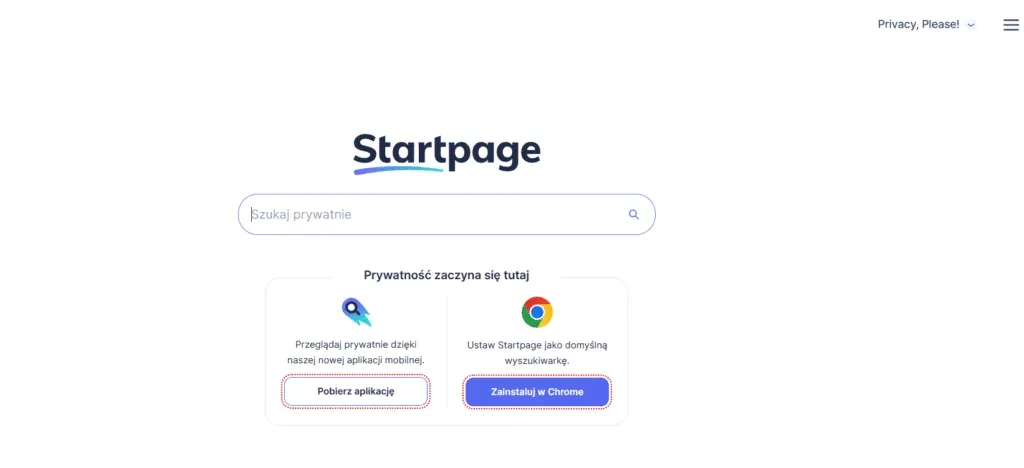
9. Startpage: Google Without Tracking
Unlike DuckDuckGo or Qwant, which partly rely on their own indexes, Startpage works as a secure intermediary between the user and Google's search engine. The key innovation is that queries are anonymised: Startpage "masks" the user's data and only then sends the query to Google, receiving results without them being tied to any identifier.
So users get Google's search results without the risk of profiling, search history tracking, or targeted ads. Startpage also offers an Anonymous View feature: a special button lets you visit a website without passing on any data to it (IP address, cookies, fingerprints). For many people, this is the best search engine when it comes to balancing result quality with privacy protection.
Startpage also has its own mobile browser, available for Android and iOS, as well as extensions for Chrome and Firefox. For users who value Google's functionality without the consequences of tracking, Startpage remains the number one choice in 2025.
10. Brave Search: An Independent Search Engine With AI
The last of the alternatives covered here, Brave Search, was created by the team behind the Brave browser. Unlike Startpage, Qwant or Ecosia, Brave Search doesn't rely on external engines. It was built from scratch with its own index, which handles queries in real time, with full transparency and no censorship.
At the start of 2025, Brave announced full integration with Leo AI, an advanced assistant built on an LLM (large language model). Thanks to this, Brave Search offers AI-generated answers at the top of results, similar to Google SGE, Perplexity AI or Bing Copilot, but without compromising user privacy.
Brave blocks all tracking ads, fingerprinting and advertising cookies. What's more, there's no content-profiling mechanism at all. The search engine is fully aligned with an open data-distribution model and is developing as an open-source alternative to the giants of the search engine market.
Brave Search works perfectly with the Brave browser, but you can also use it independently. Its popularity among users interested in digital sovereignty and AI is growing quickly. Looking at the future of search, Brave Search is one of the most interesting projects of the decade.

Lesser-Known but Worthwhile AI-Related Alternatives
Given the growing dominance of artificial intelligence in the search sector, it's worth paying attention to a new category of tools: AI search engines built on large language models (LLMs). Although their market share is still relatively small, they're growing fast thanks to their ability to understand query context, hold conversations, and generate synthetic, personalised results. Unlike classic search engines, they don't rely solely on keyword matching; their behaviour is closer to decision-support systems and personal assistants.
You.com: A Conversational AI Search Engine
As we mentioned earlier in the context of changes in the global search engine market, You.com is one of the first attempts to build a fully conversational search platform. It was designed by former Salesforce employees and, from the start, had one goal: to take over the function of a classic browser and search engine within a single interface.
In practice, You.com combines an AI chatbot function with the classic structure of search results. Its core is a large language model that answers user questions not just in text but through interactive elements: sources, infographics, images and figures. Thanks to add-ons such as:
- YouWrite: a tool for generating marketing, academic or creative content,
- YouImagine: an image generator built on AI models (e.g. Stable Diffusion),
- and the "Code Complete" feature for creating short code snippets,
You.com becomes a multi-purpose assistant that speeds up creative, academic and analytical work.
A unique feature of this solution is its modular results structure: users can choose whether they want to see classic links, an AI-generated summary, or interactive components (video, information cards, charts). This way, You.com redefines the concept of search results, turning them into material for exploration and interaction.
Phind: An AI Search Engine for Developers
In technical circles, where classic search can be too general, Phind (formerly "Hello Cognition") stands out as one of the best tools for developers. It's a platform combining natural language processing with advanced context-aware coding; the search engine understands complex technical questions and formulates answers in a style resembling Stack Overflow, only much faster and more precise.
Phind indexes open-source project documentation, libraries, APIs, and data from GitHub and Stack Overflow, offering instant answers in the form of:
- code snippets,
- line-by-line explanations,
- usage examples (e.g. "how do I implement OAuth2 login in Next.js?"),
- error suggestions and fixes.
For technical SEO, DevOps, or building AI-based solutions, Phind can drastically cut the time needed to analyse documentation. One of its major advantages is also transparency: every answer includes a reference to the source, repository or official documentation.
Compared with Google, whose algorithm often leads to outdated or low-quality pages, Phind offers a vertical search engine, optimised for the needs of IT specialists.
Perplexity AI: AI Plus Sources and Chat
Perplexity AI is one of the fastest-growing tools in the AI search segment. Its innovation lies in combining chatbot precision with precise source citations, a response to one of the main criticisms of ChatGPT and similar tools: a lack of transparency and the difficulty of verifying content.
Perplexity uses various models (including GPT-4, Claude and Mistral), and its functionality includes:
- an interactive AI chat with the ability to ask follow-up questions,
- a response structure resembling academic footnotes,
- the ability to switch between a classic, academic or creative style,
- exporting results as cited research threads.
For academic work, investigative journalism, and even preparing strategic marketing analyses, Perplexity lets you carry out complex research while keeping full control over your sources. Thanks to its thread structure, users can return to earlier questions, expand conversations and compare answers, something classic search engines have never offered.
Waldo Search: Academic Research and Qualitative Data
Waldo Search is a solution aimed at professionals: researchers, analysts, consultants and students. This specialised AI-integrated search engine was designed for searching:
- academic databases (e.g. PubMed, JSTOR, ArXiv),
- government, NGO and think-tank reports,
- PDF files, internal documents and whitepapers.
Waldo uses extensive semantic and contextual recognition algorithms, letting it pinpoint the most relevant fragments of long documents. The system suggests citations and bibliographies on its own, lets you generate APA/MLA/Chicago references, and offers an "Export to Word / Google Docs" feature.
Compared with other tools, it also stands out for its ability to run multi-source comparative analyses, for example comparing epidemiological data with reports from the World Health Organization and national health agencies. For people working with qualitative data, Waldo becomes an alternative to traditional academic literature search systems, while saving time and improving research precision.
How to Choose Among the Most Popular Search Engines?
2025 has shown that despite Google's continued dominance, the search engine market in Poland and worldwide is becoming increasingly diverse. More and more users, especially those aware of privacy, data ethics and censorship issues, are turning to alternative solutions. The most popular search engines in Poland, such as Google, Bing and DuckDuckGo, are now competing not just on result relevance, but also on innovative AI-based features.
It's worth noting that desktop users in Poland are more open to trying new platforms such as You.com or Perplexity AI, which offer conversational interfaces and transparent sources. On mobile devices, meanwhile, Google's ecosystem dominates, mainly thanks to Android and Chrome's default settings. Even there, though, search apps focused on privacy and sustainability, such as DuckDuckGo or Ecosia, are growing in popularity.
The ranking analysis shows that choosing the best search engine today depends on many factors: from user needs and cultural context, to attitudes towards advertising, personal data and source quality. Whatever your preferences, one thing is certain: the era of a single company's monopoly is ending, and the ranking of the most popular search engines in Poland increasingly includes innovative, specialised and more ethical alternatives.
See also:
- How to remove negative reviews from Google
- How to create a Ghibli-style image and a viral doll in ChatGPT
- Bing Places: how to set up and manage your business profile in Bing Places for Business
- What should an SEO audit include?
- What to consider when choosing an SEO agency
- ChatGPT in SEO: see how to use AI in search engine optimisation