














AI Overviews and AI Mode show that Google is moving further and further away from being just a search engine understood as a list of links. Today, a user doesn't always want to open several pages themselves, compare information and piece an answer together from multiple sources. More and more often they expect a short summary, a pointer in the right direction, or a conversation with the search engine that helps them work through a more complex topic. For businesses, publishers and SEO specialists, this changes the rules of the game: a position in the classic TOP 10 alone may no longer be enough. In this article, we explain how AI Overviews and AI Mode differ, how they affect traffic from Google, and how to prepare content for AI-driven search.
What are AI Overviews and AI Mode?

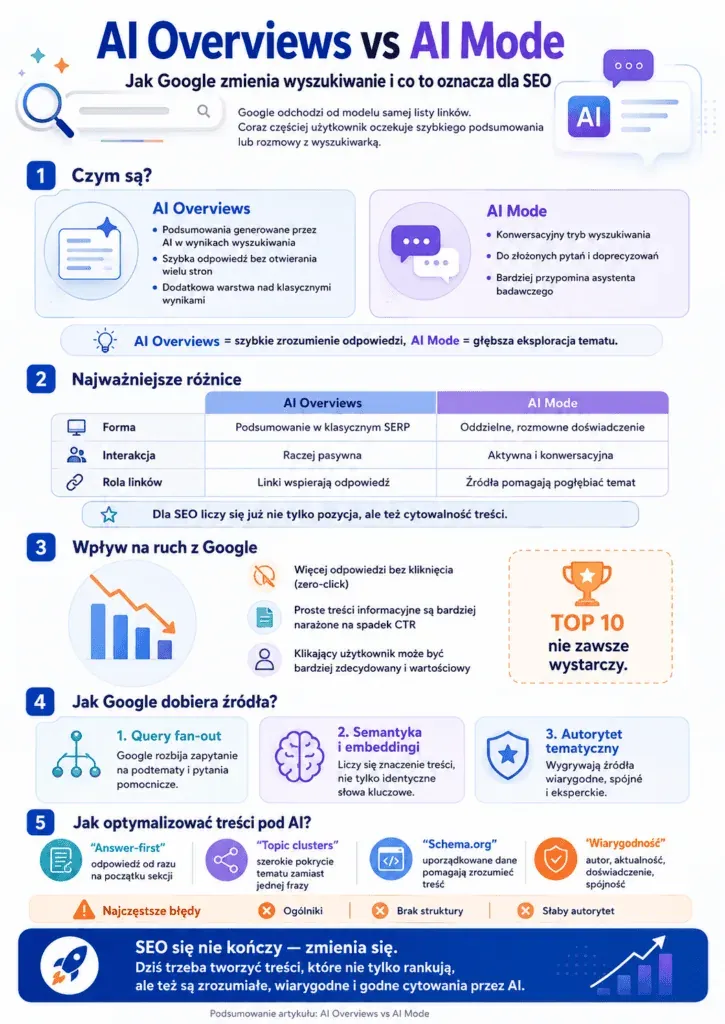
AI Overviews are summaries generated by artificial intelligence that can appear in Google's search results. Their job is to quickly gather the most important information and present the user with an answer without them having to open several pages. AI Overview doesn't replace the whole search engine; it appears as an extra layer on top of, or alongside, the classic results.
AI Mode works differently. It's a more conversational search mode where the user can ask a complex question, refine it, and keep the conversation going with Google. AI Mode is closer to a research assistant than a classic search engine. Instead of one short answer, the user can get a more detailed explanation and then ask follow-up questions.
The simplest way to put it is this: AI Overviews help you understand an answer faster within classic search, while AI Mode lets you explore a topic more deeply through conversation. Both use AI, and both can link back to sources, but they serve slightly different user needs.
This matters for SEO, because content visible in traditional results isn't always the same source Google uses in an AI answer. The search engine no longer looks solely at the page as a whole. What increasingly matters is whether specific pieces of content clearly answer the user's questions, are trustworthy, and are easy for Google's systems to understand.
AI Overviews vs AI Mode: the key differences
AI Overviews and AI Mode are often lumped together, but from a user and SEO perspective, they're two different experiences. Both use generative AI, but they differ in how the answer is presented, the level of interaction, and the role classic search results play.
How the answer is displayed
In AI Overviews, the AI answer appears within Google's classic results. The user still sees the search engine, organic results, sometimes ads, images, product modules or other SERP elements. AI Overview is an extra layer that can grab some of the user's attention even before they click a result.
In AI Mode, the user enters a more separate experience. It's no longer just a summary sitting on top of the results, but a conversation with the search engine. The answer can be broader, more multi-threaded, and built up through further questions. This changes how people use Google: instead of one query and a list of links, you get a string of interactions.
How users interact with AI results
AI Overviews results are more passive. The user types a query and Google may show them a ready-made summary. If the answer is enough, the user might not click any result at all. If they need more detail, they can move on to the sources or the classic results.
AI Mode is more active and conversational. The user can ask longer questions, add context, and develop the topic further. This matters especially for comparison, purchase, educational and problem-solving queries. For example, someone doesn't have to type "best laptop for work"; they can instead ask which laptop suits specific software, a budget and their way of working.
The role of links and sources
In both formats, links still matter, but their role is changing. In classic SEO, the user sees a list of results and picks a page. In AI Overviews and AI Mode, Google may first draw on information from sources, build an answer, and only then show supporting links.
That means the goal is no longer just to rank well. What increasingly matters is whether content is worth citing. A page should clearly answer questions, have a good structure, demonstrate experience, and not hide the most important information behind a marketing preamble.
How do AI Overviews and AI Mode change traffic from Google?
AI Overviews and AI Mode can change traffic from Google in two ways. First, some users get their answer without needing to click through to a page. Second, those who do click may be more decided, because they've already seen a summary of the information and want to dig deeper at the source.
So not every drop in clicks has to mean a drop in traffic value. If a user still visits the site after an AI answer, they probably have a more specific need. They might want to check details, compare an offer, see a full guide, or verify information. On the other hand, if the content only answers a simple question, AI may satisfy the user's intent without sending them on, which can show up as a drop in clicks in Google Search Console.
The content most at risk is very simple, definitional, article-style content with informational intent. An AI Overview box may well appear for this type of content. The user will see a short explanation in the results and have no reason to click.
In traditional SEO, many businesses focused on one question: "are we in the TOP 10?" With AI results, that question still matters, but it's no longer enough.
This changes how you approach visibility. In practice, what counts isn't just the ranking of the whole page, but also the quality of each individual section. Any well-written passage can become a potential answer.

How does Google choose sources for its AI answers?
Google chooses sources for its AI answers based on many signals. It's not just about keywords, but about understanding the topic, semantic matching, the quality of the information, the trustworthiness of the source, and the usefulness of the specific passage. That's why optimising for AI Overviews and AI Mode requires a broader approach than the classic "write a text targeting a keyword".
Query fan-out and query expansion
One important mechanism is query fan-out. Put simply, Google doesn't just analyse the user's single query. The system can break it down into related subtopics, run several supporting queries, and only then build the answer from those pieces.
For SEO, this is a big shift. It's not enough to answer the main keyword. You need to cover the whole context of the topic. If a user asks for a comparison of AI Overviews and AI Mode, Google may look for information on definitions, differences, user intent, sources, the impact on CTR, content structure and optimisation.
Embeddings and semantic content matching
AI-driven search increasingly relies on semantic matching. That means Google doesn't have to look only for identical words. It can understand that "AI mode in Google", "AI Mode", "conversational search" and "AI search assistant" all relate to a similar area.
Embeddings, mathematical representations of the meaning of content, help with this among other things. You don't need to artificially repeat one phrase throughout an article. What matters more is natural coverage of the topic, explaining concepts, using related terms and building context. Well-written content doesn't read like a list of keywords; it reads like a complete answer from an expert.
Topical and link authority
AI needs sources it can trust. That's why topical authority, links, brand recognition, the quality of the authors and consistent publishing in a given area all matter. A site that regularly publishes good material on SEO carries more credibility on search topics than a random site with a single blog post.
Google needs to see that a site genuinely understands the topic, not that it's just trying to use and rank for a keyword.
How do you optimise a site for AI Overviews and AI Mode?
Optimising for AI Overviews and AI Mode doesn't mean abandoning SEO. It's more of an extension of good practices, with greater precision, better structure and stronger topic coverage. Indexing, the technical side of the site, content that helps users and credibility still matter. The difference is that content now needs to be easier for AI systems to understand and use.
Answer-first structure
The most important rule is answer-first: put the answer at the start of the section. If the heading reads "How does AI Overview differ from AI Mode?", the first sentences should answer that question straight away. Only after that should you add context, examples and further detail.
This helps both the reader and the AI. Readers get their answer faster, and the system finds it easier to spot the passage it can use in a summary. Long introductions, generalities and marketing preambles work worse and worse, because they make it harder to extract the meaning from the content.
Topic clusters instead of single keywords
AI search rewards broad topic coverage. So instead of writing a single article targeting one keyword, it's worth building topic clusters. The main page can explain the topic in general terms, while related articles develop specific aspects: structured data, E-E-A-T, query fan-out, content for AI Overviews, AI's impact on CTR, or e-commerce visibility.
A structure like this gives Google more context. It shows that a site doesn't just use trendy terms but genuinely covers the whole area. It also helps users move on to more detailed content.
Schema.org and structured data
Structured data doesn't guarantee visibility in AI Overviews or AI Mode, but it helps Google understand a page better. Depending on the type of content, it's worth considering Article, FAQ, HowTo, Product, Review, Organization or LocalBusiness markup. What matters most, though, is that structured data matches the content and doesn't describe something the user can't actually see on the page.
Schema.org is especially important wherever Google needs to identify the author, the publication date, the type of content, a product, its price, availability, a review, or the organisation behind the material. It's not a magic SEO trick, just a way of organising information.
The most common mistakes in optimising for AI results
The biggest mistake is a lack of specifics. Text full of generalities, with no examples, no clear answers and no structure, is hard for AI to use in its answers. Another problem is weak authority: anonymous content, no named author, no updates, no related material, and no credible external signals.
FAQ: AI Overviews vs AI Mode
Will AI Mode replace classic Google results?
AI Mode may take over part of user queries, especially for complex questions, comparisons and research. That doesn't mean the immediate end of classic results, though. A mixed model is more likely, where the user chooses between a quick answer, a conversation with AI, and a traditional list of results.
Can you appear in AI Overviews without a TOP 10 ranking?
Yes, that's possible, because AI answers can draw on pieces of content that match part of a query well. A high position in classic results still helps, but it's not the only condition. Clear answers, source authority, content structure and topic coverage all matter too.
Can local businesses appear in AI answers?
Yes, local businesses can appear in AI answers if their data is consistent, visible and trustworthy. What matters includes the website, the Google Business Profile, local content, reviews, contact details, and consistency of information across different places. In local SEO, data accuracy is especially important.
How do you check whether a site appears in AI Overviews or AI Mode?
The simplest way to start is by manually checking your most important queries and seeing whether Google shows an AI answer and which sources it cites. It's also worth monitoring data in Google Search Console and in SEO tools that are developing features to track visibility in AI answers. Keep in mind, though, that reporting for these formats is still evolving.
Do AI Overviews and AI Mode need a separate SEO strategy?
They shouldn't be treated as a completely separate world, but they do call for an extension of your classic SEO strategy. The fundamentals stay the same, but there's now a greater emphasis on answer-first structure, topic coverage, structured data, semantics, and building content that can be cited as a trustworthy source.
Summary: AI Mode vs AI Overviews
AI Overviews and AI Mode don't mean the end of SEO, but they do change how you should think about visibility on Google. It's no longer enough to ask only about your ranking for a keyword. You also need to ask whether your content is understandable to AI, whether it answers real user questions, and whether it can be used as a trustworthy source.
In practice, the sites that win will be the ones that combine classic SEO with good information structure. What counts is a clear answer, full context, topical authority, structured data and consistently built content clusters. AI Overviews and AI Mode don't reward hollow text written for the algorithm. They reward content that genuinely helps users understand a topic.
See also: