














In short
- Facebook advertising has no price list: the advertiser sets the budget and bid strategy, and Meta's auction works out the price of an impression. The ad with the highest total value wins, so a better-targeted ad can beat a higher bid.
- Meta calculates the minimum daily budget, and with a cost-target strategy it should be at least five times that cost. For optimisation, Meta recommends 50-100 conversions a week per ad set.
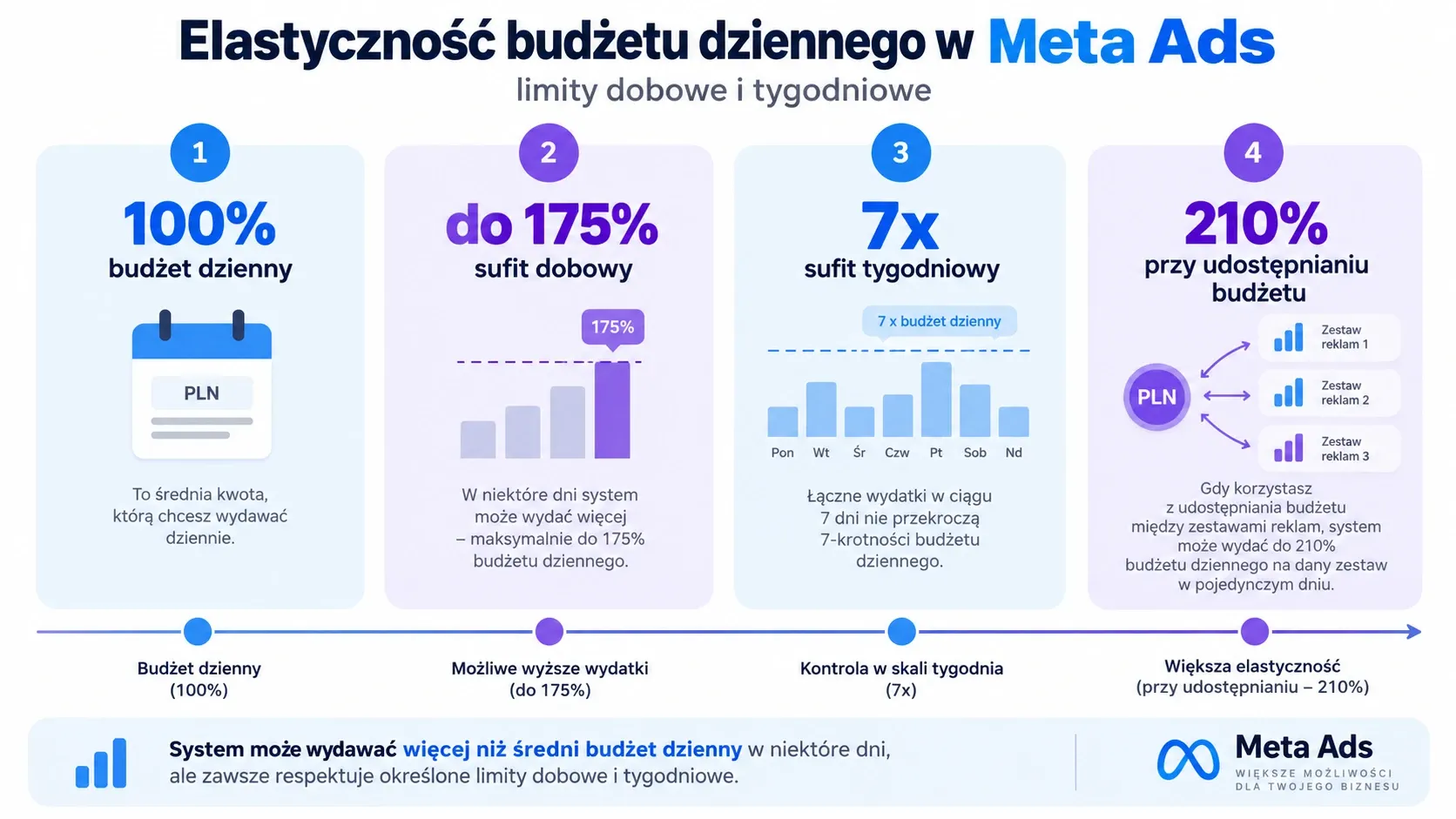
- The daily budget is a weekly average: Meta can spend up to 75% more on a single day. Significant changes, such as to targeting or creatives, or a budget jump from about €22.9 to €229, can send an ad set back to the learning phase, where the cost per result is usually higher.
How much do Facebook ads cost?
Facebook advertising has no price list. You set the amount you spend yourself through the budget and bid strategy, and the price of a single impression is worked out by Meta's auction at the moment an opportunity arises to show an ad to a specific person.
Meta states this explicitly in its documentation: when advertising on Facebook, Instagram, Messenger and the Meta Audience Network, it's the advertiser who decides how much to spend. The platform doesn't sell packages or a subscription. It sells access to an auction, and the result of that auction is the price.
The right question is a different one: how much does one result that actually earns money cost me? That number differs for a shoe shop, a law firm and a language school, even with an identical daily budget.
What do you set in Ads Manager, and what does Meta's auction price?
The line is clear:
| You set | Meta's auction prices |
|---|---|
| Daily or lifetime budget | The price of a single impression (CPM) |
| Campaign objective and optimisation event | The rate per link click |
| Bid strategy and cost target | The cost of a single conversion |
| Audience, placements and creatives | The order of delivery relative to competitors |
The overall level of spend stays with you, but the price of a single result doesn't. To control your budget better, Meta lets you set a campaign spending limit and an account-wide spending limit that covers all active campaigns.
What you pay for in Facebook Ads: impressions (CPM) or clicks (CPC)?
You choose separately the event you pay for. In the “When you get charged” section, you indicate whether you pay for impressions (billing then follows the CPM model, that is, per thousand impressions) or for a link click, which corresponds to the CPC model.
The available options depend on the campaign objective, and you can't always choose any model you like. A new ad account must first spend at least 10 USD, or the equivalent of that amount in the account currency, on impression charges before it can switch to another billing event. This is a safeguard for fresh accounts, not an extra fee.
In reports you'll see both metrics regardless of the billing model you choose. CPM and CPC are only part of the picture, though. Profitability is decided mainly by the cost per conversion: a low CPC with no sales is cheap traffic, not an effective campaign.
How does the Facebook ad auction work, and why do rates differ?
Billions of auctions take place on Meta's platforms every day, and each one concerns a single impression shown to a specific person. The ad with the highest total value wins, and that value is made up of three elements: the advertiser's bid, the estimated action rate and ad quality.
The last two components together determine relevance. This matters, because a better-matched ad can win an auction even against a competitor offering a higher bid. A budget advantage therefore doesn't decide the outcome.
As a result, the quality of the creative and how well the message fits the audience can have a bigger effect on the cost per result than simply raising the bid. A high CTR and no low-quality signals, such as withholding information, sensational language or engagement bait, work in an ad's favour in subsequent auctions.
Meta adds that adjustments applied in the auction won't result in a charge higher than the bid placed. The upper limit of the price per impression is therefore set by your bid.

What affects the cost of Facebook ads in 2026?
Several factors affect the cost of a single result, and many of them lie outside the ad platform itself. The biggest difference comes from:
- Season. In periods of heavier competition, more advertisers with bigger budgets enter the auction, so the price of reach rises too.
- Audience size. A very narrow target group gives the system fewer delivery opportunities, which can push up the cost of reach.
- Position in the funnel. A purchase is a rarer and harder event than a site visit, so it also costs more.
- Creative fatigue. When people see the same material too often, CTR and engagement may fall and the cost per result rise.
- Placements. The same ad can appear on Facebook, Instagram, Messenger and the Audience Network, and the cost per result differs in each of these places.
- Competition for the same people. One person can belong to the target audiences of many advertisers at the same time. The more companies target the same group, the more ads compete for each impression.
- Quality of conversion data. Without a correctly implemented Meta pixel and Conversions API, some conversions never reach the system at all.
The last point can be the costliest, yet it's the one checked least often. Gaps in measurement distort not only the report but also the profitability calculation for the whole campaign.
Facebook advertising budget: how much to set aside at the start?
The most frequently repeated question about Facebook Ads is about the entry amount. The problem is that there's no single answer. In practice you have to separate three levels: the technical minimum imposed by the platform, the budget the algorithm needs to learn, and the amount that makes sense from a business point of view.
Minimum budget for Facebook Ads: what does Meta require?
A technical minimum exists, but it isn't a single fixed amount. Meta calculates the required daily budget based on, among other things, the country, campaign objective, budget type, bid strategy, optimisation event, currency and schedule. If the amount you set is too low, Ads Manager will show an alert.
Meta gives thresholds in dollars, but the rules themselves work in the ad account's currency, so the examples below have been converted into euro.
One rule is stated explicitly and numerically: with a cost-per-result target strategy, the daily budget should be at least five times that cost. If the target is about €4.57 per result, the budget should be at least about €22.9 a day.
Meta also imposes restrictions when you lower a lifetime budget. The new amount can't be lower than spend to date plus 10% of the amount spent in the last 2 days. If a campaign has already spent about €686, of which about €229 in the last two days, the new budget can't fall below about €709.
Learning phase: how many conversions does Meta's algorithm need?
The technical minimum and a sensible minimum are two different things. The optimisation system learns from events, so with a handful of conversions a week it simply has too little data.
Meta recommends at least 50-100 conversions a week per ad set for best performance. This threshold often tells you more about a realistic budget than market averages do.
This is the source of a common mistake on small accounts: splitting a small budget across several ad sets. Each then gets only part of the data and none collects it fast enough. One well-fed ad set usually has a better chance of stable optimisation than several underfunded ones.
The learning phase is a separate matter: the period in which the system works out how best to deliver a new or changed ad set. An ad set usually exits it after about 50 results in a week since the last significant edit. This is the threshold for leaving the learning phase, not the 50-100 conversions mentioned above that are recommended for best performance. For shop ads, Meta requires at least 17 purchases through the website and 5 through Meta.
In the learning phase, results are less stable and CPA is usually higher than later on. The start of a campaign and every significant change are therefore more expensive than a period of stable delivery, which is worth factoring in when planning the budget for the first days.
How to work out a Facebook Ads budget from customer acquisition cost
Instead of starting with “how much do others spend?”, work out the budget backwards. First establish the most you can pay for one sale or lead while the transaction stays profitable.
Then check whether you're counting the result from the first transaction only or from the whole relationship with the customer. For subscription services and shops with repeat purchases, the acceptable acquisition cost is based on LTV (customer lifetime value), not just the value of the first basket.
Finally, set this cost against the platform's requirements and check whether such a daily budget is within the company's means. If not, change the optimisation method or use an intermediate goal, rather than splitting the budget across several ad sets.
Daily budget on Facebook: how much can Meta spend in one day?
A daily budget isn't a hard limit. Meta treats it as an average spend over a week and leaves itself room for heavier delivery on days when the system sees better ad opportunities.
The platform can spend up to 75% more than the daily budget you set, with a weekly limit equal to seven times that amount. At about €22.9 a day, a campaign can therefore spend as much as €40 on a single day, but no more than €160 in a week.
When budget sharing between ad sets is on, part of the funds may be shifted to where the system sees a better chance of a result. In that setup the limits are higher, and changing the budget mid-week affects how the remaining spend is distributed.
It means one thing: a single day doesn't give the full picture of the pace of spend. It's better to judge results over a wider window, because that's how Meta distributes delivery.
The most common mistakes when planning a Facebook Ads budget
A well-calculated budget is easy to spoil once a campaign has started. These four mistakes raise the cost per result even though the amount in the platform doesn't change.
Tweaking a campaign in the learning phase
Every significant edit sends an ad set back to the learning phase. Meta counts among these, among other things, a change of targeting, ad creative, optimisation event and bid strategy, adding a new ad, and pausing an ad set for at least 7 days.
If you make changes every few days, the campaign never leaves the stage where the cost per result is usually higher. Results from this period also don't determine future performance, so judging after the first few days can be misleading.
Frequent and large budget changes
A budget change doesn't always reset learning, because its scale matters. In Meta's example, converted into euro, raising the budget from about €22.9 to €23.1 is unlikely to send the ad set back to the learning phase, but a jump from about €22.9 to €229 may. It's safer to change the budget less often and gradually than to react every day to swings in results.
Be careful, too, about lowering the budget late in the day. The system may already have spent more than the new amount, and the new settings may not take effect in time.
Switching off placements with a higher average cost
The report shows the average cost per result separately for Facebook, Instagram and the Audience Network, so it's tempting to switch off the most expensive one. With Advantage+ placements, however, the system looks for the lowest cost for the whole ad set, not for each placement separately. In the example Meta describes, switching off Instagram produced fewer results at a higher unit cost for the whole campaign.
Leaving an ad set with the “Learning limited” status
If an ad set is unlikely to gather the results needed to exit the learning phase, the Learning limited status appears in the Delivery column. Meta treats it as a signal that the budget isn't being spent effectively. The remedies it gives are merging similar ad sets, widening the audience, raising the budget, or changing the optimisation event to a more frequent one, for example from purchase to add to cart.
Facebook Ads or Google Ads: which to choose with the same budget?
Both systems sell advertising in an auction, but what you buy in them is different. The choice of channel depends less on rates and more on whether demand for your offer already exists.
When to start with Google Ads
Google Ads has the advantage when customers themselves type into the search engine the name of a product, a service or the problem you solve. This is the case with urgent needs, local services and categories that people consciously compare before buying. The ad then answers a ready-made query, and the budget goes to people closer to a decision. For an overview of automation in this channel, see the article What are the AI features in Google Ads?.
When to start with Facebook Ads
Facebook Ads works when demand has yet to be created. This applies to new products, impulse purchases, offers that are best shown in a photo or video, and categories that almost nobody searches for. You then aim the ad at people described by interests and behaviours, instead of waiting for a query.
The channels aren't mutually exclusive. Facebook can build interest in a brand that later shows up in searches, and remarketing in both systems lets you return to people who have already visited your site. With a small budget, though, the rule is the same as for ad sets: first one channel, which will collect enough data, and only then the second.
Costs beyond the media budget: creatives, management and measurement
The amount going directly to Meta is the most visible part of the spend, but not the only one. The full cost of a campaign also includes several items that are easy to overlook at the planning stage.
The first is producing creatives. Ad materials have to be refreshed and tested regularly, and the cost grows with the number of variants, formats and versions prepared for different placements.
The second is campaign management: analysing results, A/B tests, work on audiences and replacing weaker creatives. The third is measurement, which returns here not as a cause of higher rates but as a budget item: implementing the pixel, Conversions API and integration with the sales system.
When planning a Facebook advertising budget, separate these costs from the media budget itself right at the planning stage. Otherwise it's easy to put all the funds into delivery and be left with no room for creatives, measurement and optimisation.
The price of a result is an outcome, not a setting in the platform
You set a budget in the platform in a few seconds. You work out the cost per result over months, and it's what decides whether a campaign adds up.
So instead of asking “how much to spend?”, start with the value of a customer. The rest of the numbers follow from that one.
If you want to check what budget makes sense for your margins and goals, see how we run Facebook Ads campaigns.

FAQ: Facebook advertising
Can you run Facebook ads for a few euros a day?
Technically yes, as long as the amount meets the minimum Meta calculates for a given objective and currency. Only top-of-funnel objectives then make sense: for conversion campaigns, such a budget is simply too small.
What is the difference between a daily budget and a lifetime budget?
You set a daily budget with no end date, and the campaign spends it as it goes until you stop it. A lifetime budget is an amount for a fixed delivery period, which Meta schedules between the chosen dates. For ongoing campaigns a daily budget is more convenient; for short pushes with a hard end date, a lifetime budget.
Does a higher budget lower the cost per click?
No. A higher budget increases the number of impressions and the speed of data collection, but the unit price is decided by the mechanism described above, in the section on the auction. With aggressive scaling, the rate can even rise, because the system reaches for more expensive ad opportunities.
Which bid strategy should I choose to start with?
To start, spend-based strategies are the safest, that is, highest volume or highest value, because they use the whole budget and don't restrict delivery. A cost-per-result target and a ROAS target make sense once the account has built up conversion history and you know your acceptable cost.
Are Facebook ads more expensive than Google Ads?
Comparing rates alone says little, because the two systems operate at different moments of the buying journey. In search you pay to reach someone who is already actively looking for something. On Facebook you more often attract attention first and only then build interest in the offer.
The cost per click may be lower on Facebook, but the road to a sale is usually longer. That's why it's better to compare the two channels by cost per conversion and the quality of the customer acquired than by the cost per click alone.
Do you pay for Facebook ads up front?
Not with automatic billing by card or PayPal. Costs accrue during delivery, and Meta charges later: once the payment threshold is reached and on the monthly billing date. You do have to add a payment method before publishing your first ad, though, and a charge may be taken several times a month, even after delivery has ended.

Have a question about this article? Write to us.