










International SEO is the process of optimising a website so that it's visible in search results in markets outside your home country. These activities aim to reach new audiences in different countries, often with different shopping habits, languages and search preferences.
In practice, international SEO shouldn't be limited to translating an existing site. Individual countries differ in how people search for information, the level of competition, the structure of search results, user expectations, and the profitability of specific sales channels. That's why your strategy should be built on data from the specific country, not just by copying solutions that have worked in Poland.
Why is it worth investing in SEO abroad?
With a well-planned organic visibility strategy, it's possible to increase brand recognition, generate valuable traffic to the site, and build a competitive advantage.
A well-planned investment in international SEO increases your chances of growing visibility, gaining new audiences, and developing sales outside Poland.
An additional benefit is revenue diversification. A company selling in several countries isn't dependent solely on demand in just one of them. Expanding into another country can also open up access to customers with a higher basket value, or to segments where local competition is lower.
SEO in Poland vs. abroad: key differences
Although the principles of SEO in Poland and other countries are based on similar fundamentals, international SEO requires a completely different approach than activities carried out only in Poland. You need to take into account:
- language and cultural differences,
- how search engines work and user preferences,
- a site structure adapted to multiple language versions,
- the need to acquire links from local domains and sites,
- adapting content and offers to the specifics of the target market,
- how prices are presented,
- popular payment methods,
- delivery and returns conditions,
- marketplaces and price comparison sites,
- the difference between targeting a language and targeting a specific country.
What does the SEO expansion process look like, step by step?
SEO for foreign markets should start with an analysis of demand, competition and sales potential. Starting with translating the site or acquiring links without prior analysis can lead to investment in a country where demand is insufficient or the level of competition significantly exceeds the available budget.
A practical sequence of steps might look like this:
- initial list of markets,
- verifying demand and competition,
- assessing search results,
- choosing the target country or language,
- choosing the site structure,
- local keyword research,
- localising content and the offer,
- implementing technical elements,
- developing content and link building,
- monitoring results,
- scaling activities to further markets.
This approach lets you verify in advance whether the chosen country has sufficient business potential and whether the entry costs are proportionate to the possible return.

Analysing the target market and competition
Effective international SEO starts with thoroughly researching the target country in which the company wants to grow sales or acquire customers. Without knowing the specifics of that country, the preferences of its residents, and what competitors are doing, it's hard to plan an effective SEO strategy.
Choosing the right foreign market
Not every country will be equally attractive for a given business. Before deciding to expand, you need to assess the market's potential. The analysis should cover:
- the size of the market and the target group,
- the level of competition in the industry,
- shopping culture and consumer habits,
- the language and the level of English proficiency (if you plan to use it),
- the availability of promotion and sales channels suited to the given country.
It's also worth checking:
- the real search volume for products or services,
- the cost of acquiring links,
- logistics capabilities,
- the costs of returns and customer service,
- the regulations in force in that country,
- the expected margin.
How do you assess the profitability of entering a new market?
Before starting any activity, it's a good idea to prepare a simplified business forecast. It should compare the potential for gaining organic traffic with the expected revenue.
You can analyse:
- the monthly volume of the most important queries,
- the estimated traffic that could be achieved,
- the expected conversion rate,
- the average order or lead value,
- the margin,
- the cost of content,
- the cost of link building,
- technical outlays,
- customer service costs.
This lets you assess whether the investment in international SEO makes business sense. A large country or high demand don't always mean the best direction for expansion: sometimes a smaller country with lower competition turns out to be more advantageous.
Researching competitors in the target market
Competitor analysis lets you identify what organic visibility strategies local players are using, what materials they publish, which keywords dominate, and where their links come from. It's a good idea to pay attention to:
- competitor sites appearing in Google's top 10,
- their site structure and information architecture,
- types of content (blogs, guides, product descriptions),
- use of country-code domains (.de, .fr, .it),
- presence in local directories, maps and forums.
Marketplaces and price comparison sites as competition in the SERPs
Search results aren't always dominated by direct competitors. In e-commerce, a large part of the results can be taken up by marketplaces, price comparison sites and aggregators.
On the German market, these include Amazon, Otto and Zalando, among others. In Czechia, Heureka matters, among others, and you can also analyse Seznam.
In such a situation, your own shop's strategy needs to put more emphasis on:
- extensive categories,
- long-tail queries,
- guides,
- comparisons,
- expert content,
- more precise purchase needs.
Analysing user behaviour
Audience behaviour can differ depending on the country, device and how the site is used. Your analysis shouldn't focus on a single metric, but should assess the entire user journey.
In GA4, the most useful metrics are:
- engagement rate and engaged sessions,
- average engagement time,
- the most frequently visited subpages,
- paths leading to conversion,
- devices used by the audience,
- the points where people give up on a form or the buying process,
- differences in behaviour between users from different countries.
The bounce rate can be treated as a supporting metric, but it shouldn't be analysed in isolation from the other data.
Choosing keywords in an international context
One of the key elements of a well-planned organic strategy abroad is choosing the right keywords. Unlike activities carried out solely in one country, international SEO depends not only on language, but also on cultural context, how people search for information, and regional language habits.
The importance of localising keywords
Without properly adapting your keywords to the language and realities of a given country, even the best website won't reach the right audience. Users from Germany, Spain or France may type in completely different phrases than users from Poland, even though they're looking for the same products or services.
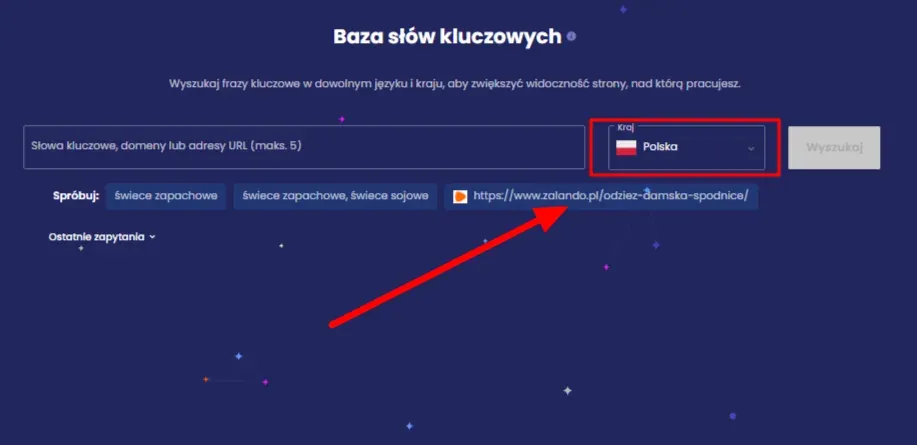
Choosing keywords should be based on data from the specific country, not on a simple translation of Polish keyword research. Polish data can be a starting point for creating a list of topics, but the actual queries need to be verified using tools and the search results for that country.
Tools for keyword analysis in international SEO
To choose queries and keywords for individual countries, it's worth using tools adapted to different languages and regions:
- Google Keyword Planner (location and language settings),
- Ahrefs and Semrush: analysing competitors and queries in different countries,
- Ubersuggest: for exploring long-tail queries and suggestions in foreign languages,
- AnswerThePublic: finding user questions in a given language,
- Google Trends: checking the seasonality and popularity of phrases in regions.
Tool data should be compared with actual search results. A high-volume query can have a different intent than the phrase itself would suggest, or lead to results dominated by a different type of site.
Accounting for language and cultural differences
Translating keywords literally from Polish can lead to mistakes. The same product or service can be called something different not only across languages, but also across different varieties of the same language.
That's why you need to:
- avoid automatic translations without verifying context,
- use the help of native speakers or linguists,
- check the popularity of queries for the specific country, not just globally,
- take slang, regionalisms and synonyms into account.
Matching keywords to user intent also plays an important role. Someone searching for "cheap shoes UK" has a different intent than someone typing "designer footwear UK". When analysing phrases, it's worth matching them to:
- informational intent,
- transactional intent,
- navigational intent,
- local intent.
Targeting by language or by specific country?
If a company offers a digital product available globally, a single English-language version may be enough. In this case, the user's language matters most.
The situation looks different for an online shop selling to the United Kingdom. In that case, the following can matter:
- British English,
- the GBP currency,
- delivery terms,
- returns policy,
- taxes and customs duties,
- promotions prepared for British customers,
- different CTAs and offer elements.
In this situation, it's worth considering a regional version marked, for example, en-GB.
Similarly, German-language content can be aimed generally at German speakers, or separately at Germany, Austria and Switzerland, for example through de-DE, de-AT and de-CH.
Site structure and hreflang tags
A proper structure helps manage language and regional versions and makes it easier for search engines to find them. However, the URL structure alone doesn't eliminate problems with similar content: the right technical signals are also needed.
Domain, subdomain, or language directory?
With international SEO, you need to decide how to organise your site's language versions. Each solution has its own advantages and limitations:
- Country-code domain (ccTLD): e.g. company.de, gives a very clear signal that you're targeting a specific country and can strengthen user trust, but requires developing that domain separately.
- Subdomain: e.g. de.company.com, lets you technically separate the site's versions and manage them independently.
- Language or regional directory: e.g. company.com/de/, lets you develop many versions within a single domain and usually makes scaling easier.
There's no single option that's best for every company. The choice should depend on the number of markets, the budget, the domain's current authority, and plans for further expansion.
Hreflang tags in international websites
What are hreflang tags?
The hreflang attribute helps Google understand which URLs are alternative language or regional versions of the same content. This lets the search engine better match the right URL to the right audience.
Hreflang, however, isn't used for removing duplication, and it isn't a mechanism for preventing cannibalisation in the classic sense of the term.
How do you implement hreflang correctly?
Hreflang tags can be implemented in three ways:
- in the
<head>section of each subpage, - via HTTP headers (for pages without HTML code),
- in the sitemap (sitemap.xml).
Every hreflang entry should contain:
- the URL of the specific language version,
- the language and region code (e.g. en-GB, fr-FR, de-DE),
- a reference to the original version too (a self-referencing tag).
The most important rules for implementing hreflang correctly
- Every URL should also point to itself.
- Versions should point to each other.
- Use full URLs, including https://.
- The language code can appear on its own, e.g. en.
- The country code should appear together with the language, e.g. en-GB.
- For the United Kingdom, the correct code is GB, so the right tag is en-GB, not en-UK.
- For German, you can use, for example, de-DE, de-AT and de-CH.
- Hreflang links should point to working, indexable URLs.
- When URLs change, the hreflang references need to be updated too.
What is x-default?
x-default is used to indicate the version that can be used for users for whom no specific language or regional variant has been prepared.
This role can be played, for example, by a global homepage or a country-selection page.
Example:
<link rel="alternate" hreflang="x-default" href="https://firma.com/" />Avoiding duplicate content
Multilingual and multi-regional sites can contain similar content, especially when the same language serves several countries. This doesn't automatically mean a problem with visibility or indexing. It's important, however, that Google understands the relationships between the individual versions.
That's why it's worth:
- preparing separate materials for each language,
- implementing hreflang correctly,
- monitoring the indexing of language versions in Google Search Console.
For very similar regional versions, it's also worth reviewing your canonical configuration.
Canonical vs. hreflang on an international site
rel="canonical" and hreflang solve two different problems.
Canonical helps the search engine determine the preferred version among identical or very similar URLs. Hreflang, on the other hand, indicates alternative language or regional versions.
So these elements shouldn't be treated interchangeably.
Special attention should be paid to canonical in the case of:
- several regional versions in the same language,
- URLs with parameters,
- filters,
- duplicated subpages,
- migrations,
- several domains containing a similar offer.
If a given language version is meant to be indexed and shown to users, you shouldn't unnecessarily point to a completely different language version as canonical. Such a configuration sends the search engine conflicting signals about the preferred URL.
Automatic redirects and indexing language versions
Every important language or regional variant should have its own stable URL.
The problem arises when the same address displays different content depending on:
- IP address,
- cookies,
- browser language,
- the automatically detected country.
In that case, the search engine crawler may not reach all versions of the content.
A better solution is:
- creating separate URLs,
- providing a language or country switcher,
- using regular HTML links,
- letting users choose the version themselves.
An automatic suggestion can support UX, but it shouldn't completely block access to other versions.
How does Google recognise a site's target market?
Google analyses many signals at once. The most important include:
- the country-code domain,
- the language of the visible content,
- hreflang,
- local contact details,
- currency,
- delivery information,
- links from sites related to the given area,
- site structure,
- the company's presence in that market.
Server location isn't currently the only, or the most important, factor. Because CDNs are so widely used, sites can be served from multiple locations at once.
A CDN can, however, improve the site's performance for users who are far from the main server.
Creating and localising content
Creating content for international SEO is more than just translating existing texts. This is where content localisation comes in: adapting materials not just linguistically, but also culturally and contextually to a given market.
Translation vs. localisation: what's the difference?
Plain translation may not be enough to effectively reach a foreign customer. Localisation involves:
- linguistic adaptation that takes idioms and communication style into account,
- adapting content to local customs, holidays, payment methods or units of measurement,
- transforming graphics, images and CTAs so they're understandable to an audience from a given country,
- creating unique content that has real value for local users.
Localising the offer: currency, payments and delivery
SEO doesn't end the moment a user lands on the site.
Even very good organic traffic may not generate sales if the user:
- sees prices in a foreign currency,
- can't pay with a locally popular method,
- doesn't know the delivery costs,
- can't find information about fulfilment time,
- doesn't understand the returns policy,
- doesn't know whether additional taxes or fees will apply.
That's why localisation should cover the entire user journey, not just the SEO texts.
How do you create effective content for foreign markets?
For content created with search engines and audiences abroad in mind to be effective, you need to approach its preparation strategically. It's a good idea to:
- start with a language audit of your current materials,
- establish buyer personas for individual markets,
- use the services of native speakers or experienced SEO translators,
- naturally use the words and queries used by audiences in a given country.
It's also a good idea to analyse the local top 10 before preparing content. This lets you determine whether, for a given query, Google prefers a guide, a category page, a service page, a comparison, or another format.
Content formats that work well in international SEO
International markets also differ in terms of preferred formats. For example:
- in Germany, expert guides and white papers work well,
- in Spain, dynamic video content and graphics build more engagement,
- in English-speaking countries, blogs, ebooks and podcasts are popular,
- in France, formal language and precise messaging play a big role.
The most important rules for localising SEO content
- maintain a consistent tone of communication and terminology across the whole language version,
- keep a uniform style across materials,
- update content regularly as trends and audience behaviour change,
- metadata and headings should be adapted to the language and search habits in the given country.
SEO specifics in selected countries
SEO in Germany
Germany is an attractive direction for Polish companies due to its scale and geographic proximity, but organic competition is high in many industries.
You need to pay attention to:
- keyword research carried out directly in German,
- natural industry vocabulary,
- language correctness,
- links from German sites,
- company data matched to the requirements of the German market,
- legal information required from the seller,
- marketplace competition.
A .de domain works particularly well when a company is focusing its activities on the German market.
SEO in the United Kingdom
The United Kingdom is a very competitive area for organic activity, because English-language phrases can be served by sites from many countries.
You need to take into account:
- British English,
- en-GB,
- prices in GBP,
- the delivery rules that apply when selling to the United Kingdom,
- potential customs issues,
- links from British sources,
- the intent of users from the UK.
SEO in Czechia
In Czechia, besides Google, you also need to analyse other elements of the local ecosystem, including Seznam and Heureka.
The following matter:
- Czech keyword research,
- Czech price comparison sites,
- Czech industry portals,
- links from Czech sites,
- how prices are presented.
The closeness of Czech and Polish doesn't mean you can safely create content without a native speaker's review.
Link building in foreign markets
Link building remains an important part of building a site's authority and a domain's competitiveness. In international SEO, the quality of sources, their subject matter, and their connection to the country and industry become especially important.
The link profile pointing to a site should be compared with competitors, primarily in terms of the number of referring domains, the pace of acquiring new links, and the types of sites the backlinks come from.
Why are links from a given country so important?
If a site's link profile deviates significantly from competitors' profiles, it can be harder to build a similar level of authority. This doesn't mean, however, that every link has to come from a country-code domain.
Links from valuable sites connected to a given country can:
- strengthen the backlink profile,
- increase brand recognition,
- generate referral traffic,
- make it easier to compete with domains present in search results.
Where can you get links abroad?
Depending on the industry and country, link sources can vary. The most common link-building methods are:
- working with local bloggers and influencers,
- guest articles on regional industry portals,
- registering in business directories and local company databases,
- taking part in industry events that get covered with a link,
- comments and activity on topical forums in the given language.
Tools for effective international link building
For your efforts to produce results, it's a good idea to use tools such as:
- Ahrefs: for analysing competitors' links and identifying link sources,
- Semrush: for tracking the link profile and assessing its quality,
- BuzzStream: for managing outreach campaigns,
- Majestic: for checking domain authority and Trust Flow,
- Hunter.io: for finding contact details for editors and bloggers.
The most common mistakes in international link building
- acquiring links from low-quality, mass-produced directories,
- lack of local context in the linking content,
- links from thematically unrelated sites,
- lack of strategy and random work that doesn't support the domain's visibility,
- copying the link profile from the Polish market,
- focusing solely on the number of links.
The effects of link building show up over time. The best results come from being systematic, consistent, and linking acquired references to valuable content.
Local SEO and technical optimisation
Visibility in local results matters especially when a company has a physical location or serves customers in a specific region. The technical layer, on the other hand, is important for every multilingual or multi-regional site.
Even the best-chosen keywords and valuable content won't produce results if the site loads slowly, is poorly indexed, or isn't adapted to the audience's needs.
A company's visibility in local results
For companies operating in specific markets (e.g. Germany, France or Italy), visibility in Google's local results (the so-called Local Pack) is extremely important.
This includes, among other things:
- registering and optimising your Google Business Profile (formerly Google My Business),
- presence in valuable industry directories from the given country,
- using local contact and company identification details,
- using phrases that include the names of cities or regions,
- gathering reviews on sites popular with the audience.
Technical optimisation: the foundation of good visibility
Among the most important technical aspects of SEO for multilingual and multi-regional sites are:
- correctly implementing hreflang tags (discussed earlier),
- page loading speed, in line with user expectations,
- full responsiveness and accessibility on mobile devices,
- a secure HTTPS connection,
- clean, understandable site code that's friendly to Google's crawlers.
How do you adapt UX to audiences from a given country?
Preferences regarding appearance, payments, navigation or how the offer is presented can differ between countries and audience groups. Rather than basing decisions on general assumptions, it's better to rely on analytics data, UX research and observations of customer behaviour.
Tools that support technical SEO
- Google Search Console: for monitoring indexing, errors and hreflang implementation,
- PageSpeed Insights: speed analysis and optimisation recommendations,
- Screaming Frog: full technical site audits,
- GTmetrix: detailed analysis of page loading and UX.
What determines the budget, time and results of international SEO?
The budget needed for SEO in foreign markets primarily depends on how competitive the industry is, the scope of technical work, the number of language versions being prepared, the cost of content and link building, and the scale of the whole project. That's why the quote needs to be weighed against the potential sales value and the expected return on investment.
The time needed to achieve stable visibility depends, among other things, on the domain's history, content quality, link profile, the site's technical condition, and the strength of the competition. Effectiveness is best judged not just by traffic growth, but also by the number of queries, sales, lead value, and the profitability of the expansion.
Monitoring results and adapting your strategy
International SEO is a long-term process that requires continuous monitoring of results and flexibly adapting activities to changing market conditions. Regular data analysis lets you not only measure SEO effectiveness, but also discover new growth opportunities and eliminate ineffective activities.
Setting KPIs for international SEO
Every SEO campaign should have clearly defined key performance indicators (KPIs). For international activities, you need to take into account:
- organic traffic from individual countries and languages,
- the number of conversions (purchases, inquiries, registrations) from the foreign market,
- the site's visibility in local search engines,
- the rankings of the most important queries,
- the quality and number of links acquired from foreign sources.
Tools for monitoring results
The right analytics tools let you track the effectiveness of SEO campaigns across different countries and languages. The most commonly used are:
- Google Analytics 4: analysing traffic, conversions and entry sources broken down by country,
- Google Search Console: query rankings, CTR and indexing errors in a local context,
- Ahrefs and Semrush: tracking keyword rankings and backlinks from foreign domains,
- Looker Studio: creating combined reports for multiple language versions of the site.
Adapting your SEO strategy: what's worth updating?
Analytics data isn't just numbers, it's primarily a signal to act on. Based on the information gathered, it's a good idea to:
- update content that isn't generating traffic or conversions,
- analyse the reasons why individual pages aren't being indexed,
- adjust the internal linking structure,
- grow the visibility of queries that generate conversions (e.g. by adding supporting content),
- extend processes to new countries or languages.
Checklist before launching a new market
Technical
- Does every version have its own URL?
- Is hreflang correct?
- Are there mutual hreflang references?
- Have the correct language and country codes been used?
- Is x-default needed?
- Does canonical point to the right URL?
- Is there no accidental noindex?
- Does robots.txt block anything important?
- Is sitemap.xml up to date?
- Is HTTPS working correctly?
- Are there no 404 or 5xx errors?
Content
- Has the menu been translated?
- Has the metadata been localised?
- Have the forms been translated?
- Have error messages been localised?
- Do the CTAs sound natural?
- Has the text been proofread?
- Have the keywords been verified using data from the given country?
Offer
- Is the currency correct?
- Are local payment methods available?
- Have delivery time and cost been provided?
- Is the returns policy clear?
- Are prices and taxes clear?
Analytics
- Is GA4 collecting data?
- Is Search Console working?
- Are conversions being measured?
- Have KPIs been set for the given country or language version?
Legal
- Do the documents comply with local regulations?
- Is the privacy policy correct?
- Has the required seller information been provided?
- Do the sales terms comply with local law?
The most common mistakes in international SEO
Although international SEO offers huge growth opportunities, poor implementation can result in a loss of time, money and brand reputation.
1. Lack of content localisation
The most common mistake is automatically translating content without taking cultural context into account. Such content is often confusing, unnatural, and sometimes even off-putting for customers from a given country.
2. Ignoring hreflang tags
Multilingual sites without correctly implemented hreflang tags are at risk of problems matching the right version to the right user.
3. The wrong site structure
The choice between language directories, subdomains and separate domains is often made at random. Yet the wrong decision can make optimisation harder, affect domain authority, and limit the effectiveness of link-building efforts.
4. Lack of market and competitor analysis
Failing to prepare for entering a foreign market can result in investing in a country where competition is too strong or demand too low. A lack of local research is one of the costliest mistakes.
5. Acquiring links from the wrong sources
Links from domains unrelated by language, geography or topic don't just fail to help, they can actively harm a site's rankings. In international SEO, what counts is the quality, locality and context of links.
6. Ignoring local search engines
In some countries, Google isn't the dominant search engine. Examples include Baidu in China and Yandex in Russia. Ignoring these channels means giving up a large part of your potential traffic.
7. Lack of language and UX consistency
Inconsistent messaging, mixing languages on a single page, and the lack of contact details from the given country: all of this lowers the brand's credibility and increases the bounce rate.
Summary and next steps
SEO in foreign markets is a complex but extremely profitable process. It gives you the chance to reach new markets, increase sales, and build global brand recognition. It does, however, require a well-thought-out strategy, flexibility, and adaptation to the specifics of each country, both technically and linguistically and culturally.
Want to grow your business in foreign markets?
Get in touch with JustIdea's team of experts, and we'll help you plan and implement an effective SEO strategy tailored to your chosen countries.
Also check out: