














Local SEO has become an effective part of the marketing strategy for many businesses. It doesn't just help you increase visibility in search results for valuable phrases, it also, and most importantly, helps you reach the right audience, which translates into more traffic and potential sales growth. By tapping into the potential of local SEO, you can reach potential customers who are searching for products or services in a specific location. If your company provides services in selected locations, local SEO is exactly for you. Below, we describe in detail what local SEO is and how to apply it for your company.
Check out: Website ranking services

What Is Local SEO?
Local SEO refers to SEO activities focused on increasing a site's visibility in search results for specific locations. The goal is to increase a company's visibility in Google search results, particularly when a customer is searching for services in a given region. Local search results help users find a company on Google, check its profile, its location, and quickly move on to its website. It's about making sure a company is visible where potential customers are looking for it, in their local surroundings. For many companies, the local market is a key area of business. If you run a restaurant, a hair salon or a beauty studio, local customers are your main source of revenue. That's why it matters so much that they can find your business online quickly and easily. Everything that makes up local SEO aims to increase the visibility of a business among people searching for services in a given city or region.
Local SEO, however, isn't limited to optimising your website. Optimising your Google Business Profile (formerly Google My Business) listing is also an effective activity: it appears in Google Maps and makes it easier for customers to access your address details, opening hours, and customer reviews.
How Do You Implement Effective Local SEO for Your Business?
For your SEO activities to be effective and deliver satisfying results, they need to be implemented correctly. The first stage is very important, because it's worth preparing a detailed SEO strategy that will shape the whole local SEO process. Here are a few steps worth introducing to your local business to make full use of the power of local SEO.
SEO Strategy and Website Optimisation for Local SEO
Local SEO is an inseparable part of a modern marketing strategy, especially for businesses that want to attract customers from a specific region. Applying the right SEO strategy is key to standing out effectively on the local market. It's also worth noting that a strategy prepared in advance will set out the tasks you need to complete to achieve your goals. This kind of document should contain the following elements:
- Technical changes: Good technical optimisation is the foundation that determines the effectiveness of future local SEO work. It's worth regularly implementing technical improvements that make it easier for indexing bots to crawl and index your site.
- Competitor analysis: It's a good idea to carry out a competitor analysis, which gives you information about the activities and solutions that have helped competitors build local rankings on Google.
- Content guidelines: Preparing content for local SEO is different from, say, online stores. Your strategy should include regularly adding content, which is essential for indexing bots.
- A backlink acquisition strategy: Building local rankings also requires acquiring external links. You should focus on getting them from sources such as business directories or local websites. More precisely: the links should come from sites focused on a specific geolocation.
- Keywords: The phrases you want to rank for locally should be the main element driving your SEO strategy.
- Traffic potential estimates: When preparing your action plan, it's worth including estimated traffic from a given keyword and the rankings you're aiming for. Including this in your local SEO strategy will help you set priorities for the work and actions you undertake.
Website Optimisation for Local SEO
In the context of local activities, you can't forget about properly optimising your website. A thorough analysis of your site's content, its loading speed, and its contact details is where you should start working on your site in the context of local SEO. Remember that a user searching for a service or product in a given place also wants to be able to freely browse content and information on your website.
Optimising a site for SEO should cover local keywords, contact details, content tailored to the local market, and elements that make it easier to contact your business. This way, local website SEO can more effectively support your business's online visibility.
Local Keywords in Website SEO
Choosing the right keywords is the first step towards improving your site's visibility. When analysing your main keywords, it's worth adding a city name so you can see the search results for that specific keyword. For example, if you run a restaurant, you want to be visible for phrases related to your industry, particularly the word "restaurant". Analysing this market from an SEO perspective, you'll notice that the main phrase has a high search volume, but that's not the only thing you should pay attention to, since the more important factor is keyword difficulty. The main phrase requires significantly more work before there's a real chance that, once it's added to your site, the site will rank highly for it in search results.
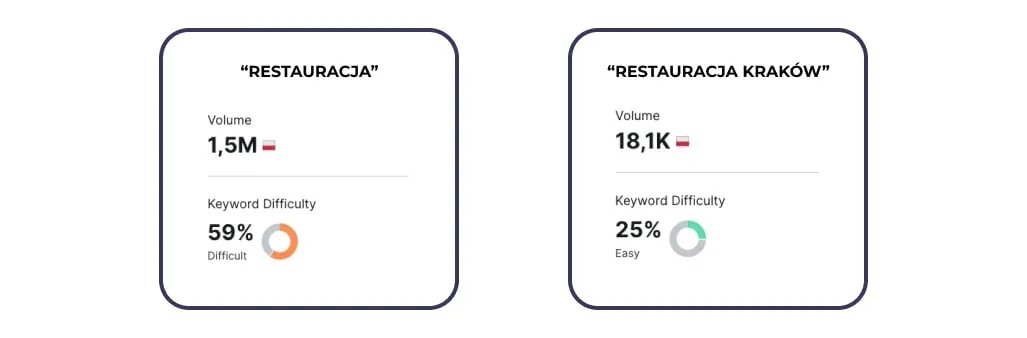
Implementing local SEO can bring you many benefits. Above all, your site's visibility in search results will increase, which will directly translate into more site traffic and potentially more conversions. By carrying out local SEO activities, you direct your efforts straight at the audience that matters most to you: the residents of a given city or region.
However, keep in mind that local SEO isn't just about adding a city name to every phrase. What matters is understanding the needs and expectations of local users, and adapting your website content to them.
The Google My Business Listing and Google Maps in Local SEO
One of the key aspects of effective local SEO is optimising your Google My Business listing. This is where users can find basic information about a company they're interested in, such as its address, phone number, opening hours or reviews from other customers. Your Google Maps listing also lets you showcase the services, products, photos, promotions or events related to your business.
A well-optimised listing can attract potential customers and encourage them to visit your business or online store. Besides the optimisation itself, the key is to update it regularly, keep the information current, and respond to user reviews and comments. Only then can you make full use of this tool's potential and secure visibility in local search results.
Check out our Google Maps ranking offer and win new customers for your business every day!

Internal and External Linking in Local SEO
An important element of a local SEO strategy is building a valuable link profile. Links pointing to your site, especially ones from local sources, can significantly affect its visibility in search results. Local websites, blogs, news portals or organisations can be a great source of such links.
On the other hand, internal linking within your site also plays a key role. By skilfully connecting individual pages, you can not only make it easier for users to navigate your site, but also pass SEO value between pages. An optimal internal linking structure lets you strengthen the pages that matter most to your business and increase their visibility in search results.
Optimisation for Mobile Devices
These days, practically everyone uses the internet via smartphones and tablets. Because of this trend, websites need to be perfectly adapted to the smaller screens of these devices. Mobile optimisation is no longer a nice-to-have, it's a key feature supporting local SEO. Key aspects, such as a responsive design, ensure content is readable and accessible on every device. On top of that, page loading speed becomes even more important in the context of mobility and a user's decisiveness about getting in touch: no one wants to wait for content to load while they're on the move or urgently need a service.
Navigation should be as intuitive as possible, and content adapted for reading on small screens: short paragraphs, clear headings, and a concise message. Modern search engines, such as Google, increasingly reward sites optimised for mobile with higher rankings in search results. In the era of smartphones and tablets, taking care of the quality of your site's mobile version isn't a luxury, it's a necessity.

Customer Reviews and Your Google Listing in Local SEO
In an age of digitisation and widespread internet access, reviews have become one of the most important tools in the consumer decision-making process. When potential customers are considering using a service, they often look for other people's reviews to reassure themselves about their choice. Good reviews can significantly affect a company's reputation and the rankings it achieves through local SEO, attracting new customers and building trust in the brand or business.
On the other hand, negative reviews, if not managed properly, can put off potential customers. It's not just about collecting positive reviews, it's also important to respond to negative ones constructively, showing that the company cares about its customers and is ready to resolve any issues. What's more, search engines such as Google take reviews into account when assessing a site's credibility and authority, which has a direct impact on the effectiveness of local SEO. Today's market requires companies to actively manage their online reputation, and reviews are the tool that lets you build a lasting relationship with customers based on trust and credibility.
The Biggest Challenges of Local SEO
Besides its many benefits, it's also worth paying attention to the challenges associated with local SEO:
- Constantly updating information: Local SEO requires regular monitoring and updating of information, especially in your Google My Business listing.
- Changing search engine algorithms: Just as in classic SEO, you also need to stay on top of the updates and changes Google introduces.
The Most Common Local SEO Mistakes
Like any marketing strategy, local SEO can also be prone to mistakes. Here are a few worth avoiding:
- Outdated information: Incorrect addresses, phone numbers or opening hours can put off potential customers.
- Neglecting reviews: Ignoring negative reviews or failing to respond to comments can affect a company's image.
- Neglecting website content: Local content should be valuable and engaging, not just focused on keywords.
Local SEO: A Summary
Local SEO is an ongoing process that requires attention, commitment, and continuous adjustment. However, correctly executed local SEO activities can significantly increase a business's online visibility and contribute to local sales growth. In the digital age, when a local customer is just one click away from an offer, it's worth investing in effective local SEO.
FAQ: Frequently Asked Questions About Local SEO
How does local SEO work in Google?
Local SEO relies, among other things, on website optimisation, local keywords, linking, and your Google Business Profile listing. Google analyses the user's location and matches results to their query.
What is a Google Business Profile listing?
Google Business Profile, formerly Google My Business, is a business listing displayed in Google Maps and local search results. It contains information about the business, such as its address, phone number, opening hours, or customer reviews.
What phrases should you use in local SEO?
In local SEO, it's worth using local keywords that include a city, district or region name, for example "dentist Kraków" or "Italian restaurant Warsaw".
Does Google Maps affect local SEO?
Yes, Google Maps is a very important element of local SEO. A well-optimised Google Maps listing can increase a business's visibility and generate additional customers.
Does AI affect local SEO?
Yes, Google increasingly uses artificial intelligence to analyse content, customer reviews and local business data. That's why local SEO should take into account the currency of your data, content quality, and the activity of your Google listing.
Local SEO for Your Business
If you run a local business and want to gain more customers, we encourage you to get in touch. We provide local SEO for companies from Kraków and across the whole country: see our SEO services and Google Business Profile management.