![€57,000 a Month Thanks to Marketing Automation [Case Study]](/_astro/1703073333911-e1705577438798-05ef6ac6.CJWpLjRJ.webp)












1. Performance Marketing + Marketing Automation = ?
At one stage of scaling our e-commerce business, we were linearly increasing our ad spend on Google Ads and Facebook Ads: from €11k per month to €80k, with a forecast of reaching €100k within the next 30 days.
At spend levels of €3k+ per day and traffic reaching 10,000 unique users a day, marketing automation activities start to matter enormously.
It's worth remembering that even if you're a healthy e-commerce business with a purchase conversion rate of 2-2.5%, as many as 98% of the users who pass through your site, while tagged with remarketing pixels, will still remain anonymous to you.
The best-known way of catching users at the top of the sales funnel is, of course, abandoned cart mechanisms and classic newsletter sign-ups.
However, I never realised that the choice of tool could have such a dramatic effect on the effectiveness of these activities…
2. MailChimp is DEAD ☠️
A long time ago, when marketing automation was still being born in pain and email activities were based mainly on newsletters, we chose MailChimp as the main tool for our e-commerce stores.
// In fact, at one point we were its first and only partner in Poland!
Over the years, MailChimp evolved into a marketing automation tool. Today I know that it was, and still is, nothing but an unfunny substitute.
One of the main problems with MailChimp is that it is a system oriented purely around its API and has no JavaScript tracking pixels. As a result, MailChimp can only recognise LOGGED-IN users, or those who abandoned their cart at a very late stage of the transaction, that is, at the payment finalisation stage, after they had already created an account.
MailChimp does not store correlations between events within a session or in cookies.
That's a big problem. The result was that only a tiny fraction of the roughly 9,000 unique users who added products to their cart each month (but ultimately didn't complete the transaction) triggered the abandoned cart automation.
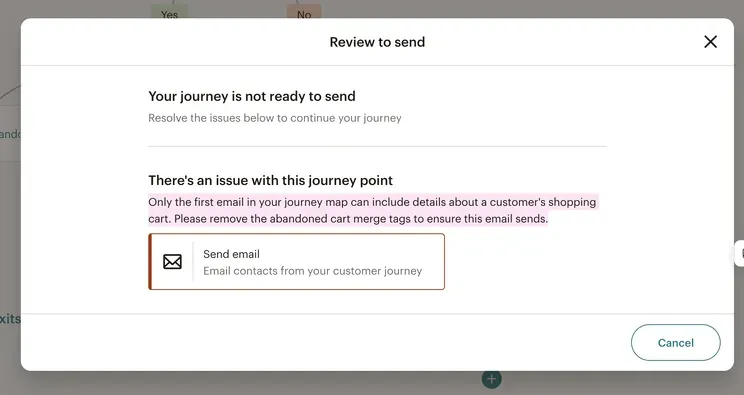
Automation that, in MailChimp, is so crippled that it can only include the products in the cart in its first email. WTF?
On top of that, MailChimp has significant deliverability problems with Polish mailboxes such as Onet, WP, o2 or Interia (major Polish web portals with their own email services). On Gmail, meanwhile, it dumps all emails into the “Promotions” tab.

3. ExpertSender is KING
But at some point we managed to discover marketing automation all over again.
We spent a long time looking for a trusted partner in this area. Our choice fell on ExpertSender, a tool specialising in fashion that serves brands such as CCC, LPP, 4F and Answear. It's a platform whose core is precise user identification plus solid deliverability, not just email sending.
What Does ExpertSender Really Change?
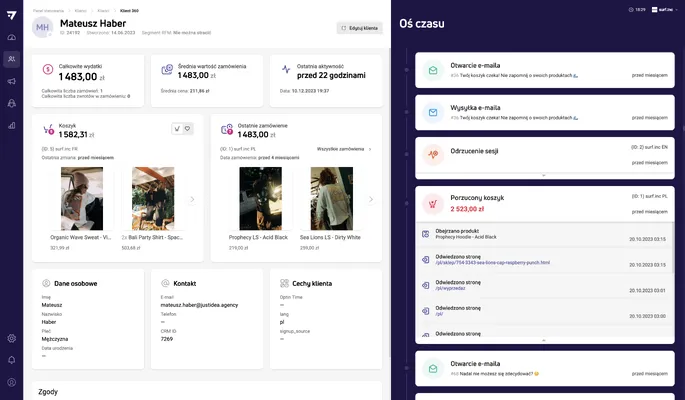
360° User Identification
The key is a mix of API events and pixel tracking, which makes it possible to:
- identify anonymous traffic even before login,
- attribute events to users across sessions,
- retroactively trigger scenarios immediately after a user is recognised,
- deduplicate contacts and build a single, consistent user history.
These are capabilities that most SaaS MA tools lack.
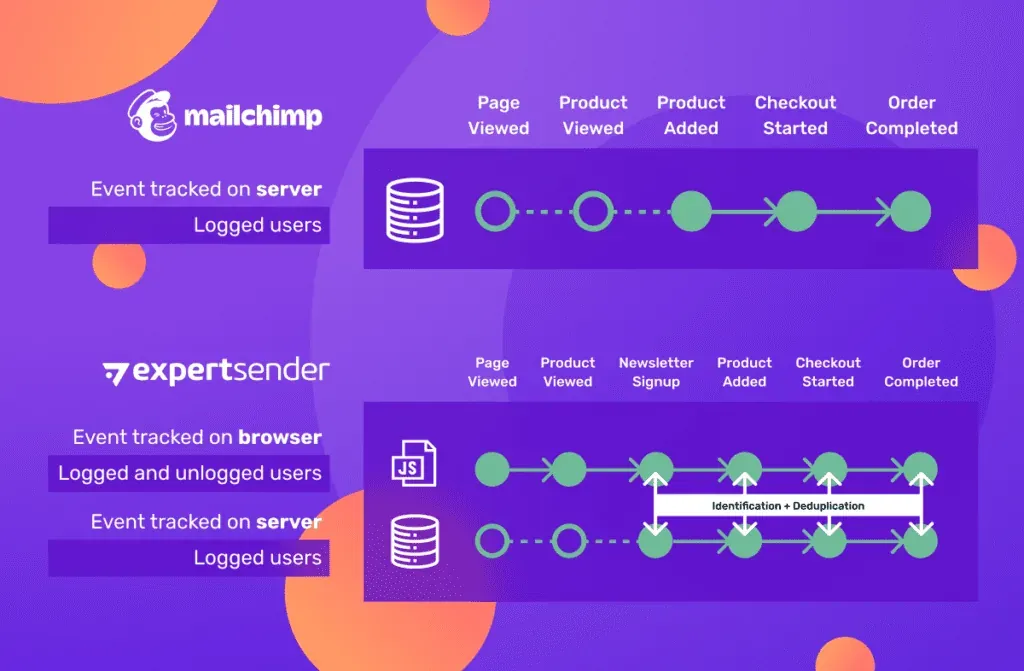
This mechanism allowed us to implement forms encouraging visitors to leave their email address on the product page, in the form of a hidden code.
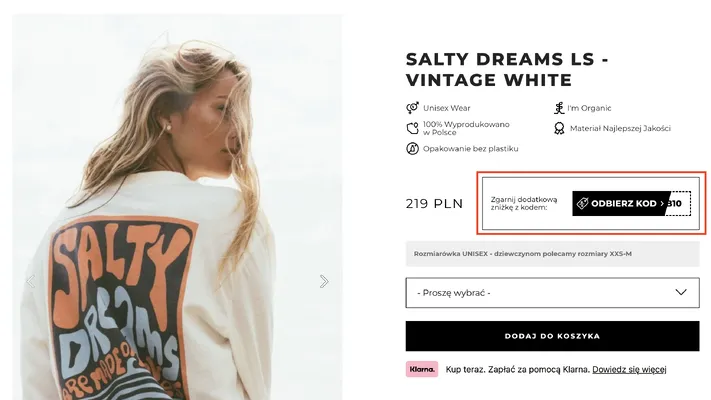
The result was the identification of over 60% of previously unrecognised users abandoning their cart: an additional 5,000 users per month. These were people who might have created their cart even in a previous session, yet were still correctly identified and could have retroactive scenarios triggered for them immediately after identification.
This gave us a growth of 150-200 additional sign-ups to our database per day.
On top of that, thanks to dedicated IPs, ExpertSender gave us better deliverability of emails to the main inbox, both on Gmail and on our domestic mailboxes such as Onet, WP, o2 and Interia!
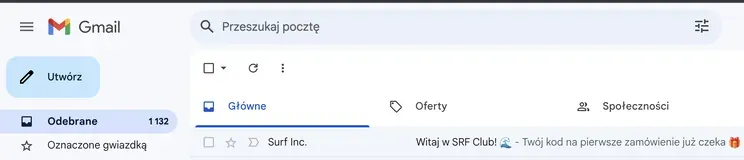
The effects of implementing ExpertSender, whose completion we estimated at only around 30% after 1.5 months, exceeded even our lowest expectations.
Below is a results report for MailChimp vs ExpertSender over a 31-day period. This is historical data from the time of the implementation, which was a turning point and something of a breakthrough for us, showing the immediate impact of the migration on effectiveness.
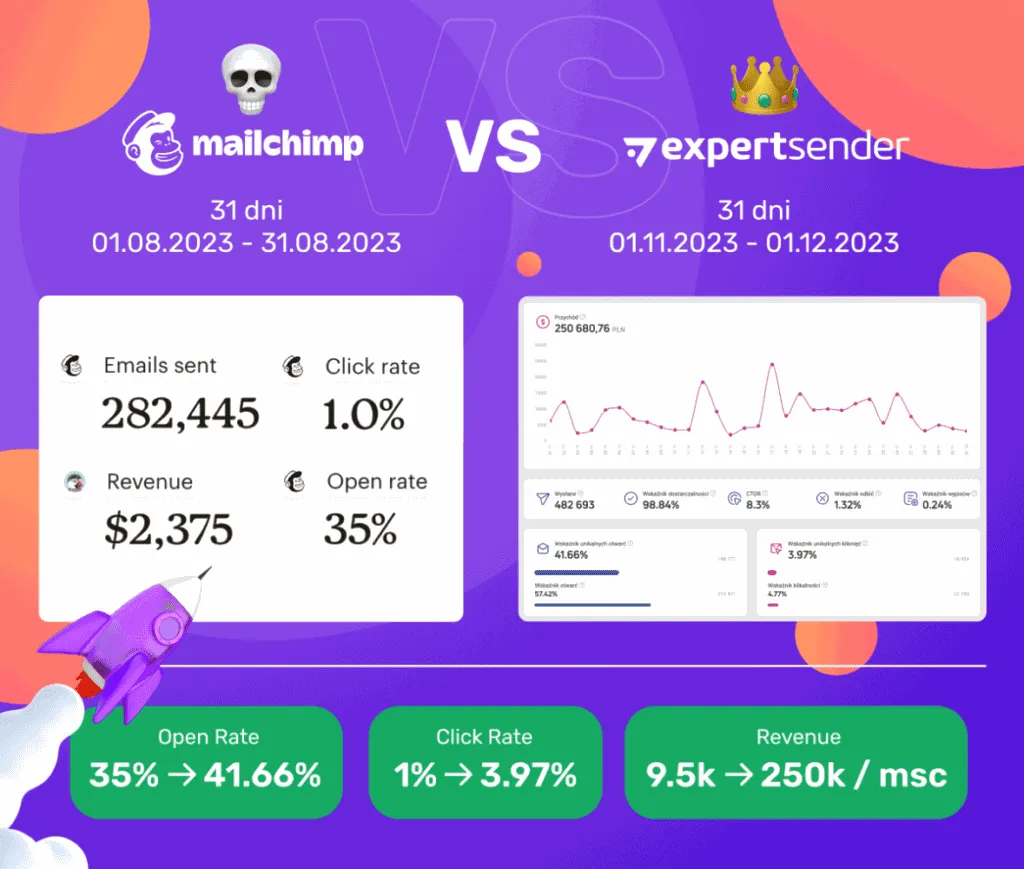
Thanks to the tool migration:
- We increased Open Rate by 19%
- We increased Click Rate by 297%
- We increased Revenue from the MA channel by 2,531%
- We increased the growth rate of our mailing database to +15% per month
Another advantage of ExpertSender is the ability to create dynamic pop-ups depending on the consents a user has already given. Thanks to this:
- we show a different pop-up to an unidentified user,
- a different one to a person who is identified but has not given consent for email marketing,
- and yet another to a person who has already given us consent for email communication but not for SMS communication.
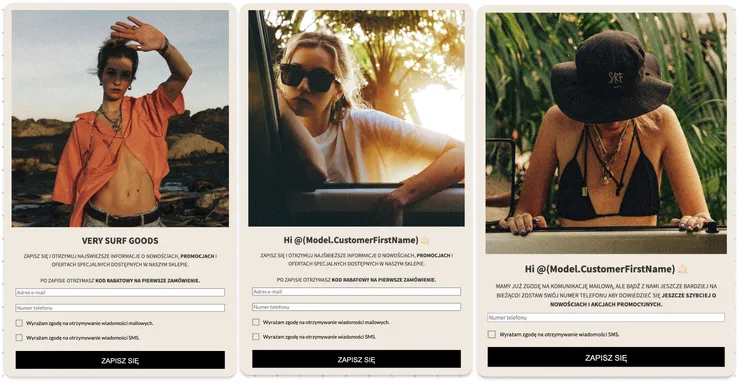
This allows us to actively work towards collecting as many consents as possible for communicating with the customer, both in the email and the SMS channel.
Which we can then use for intelligent automations.
Thanks to these automations, we have generated over €54,000 in additional revenue since the implementation.
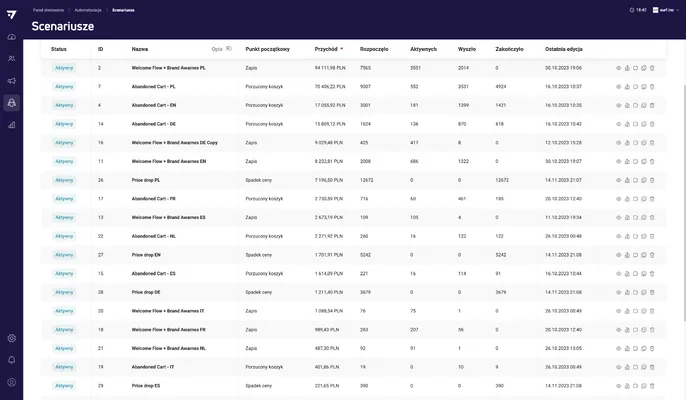
We communicate with clients in 7 languages, which was heavily hampered in MailChimp.
4. The Migration That Put Us on a New Growth Path
To be clear, SaaS-based MA tools like MailChimp can still be a good choice to start with. But once you're grinding through tens of thousands of euros a month in performance marketing spend, a comprehensive MA implementation based on more advanced solutions seems like a necessity today.
When we switched to ExpertSender, we quickly saw how much untapped potential we had in the marketing automation area, even though the processes themselves had already been present at our company. The migration didn't introduce a new operating philosophy, but it finally let us use its real potential.
That was exactly when we organised our communication cycles, launched full automation scenarios and improved the quality of our sends. Improved deliverability, better segmentation and precise user identification translated into a quick, visible business result.
At the same time, we expanded the ecosystem with further components, including SMS automations, push notifications and recommendation frames. In hindsight, it's clear that this was a turning point: simply changing the tool unlocked activities that had previously been technologically constrained.
For us, this was proof that in e-commerce, the choice of MA platform determines not just the quality of communication, but also the possibility of further scaling. And it was precisely this experience that later let us replicate a similar process for our clients, building a dedicated MA department at the agency.
This post was written as part of the Scale Your E-commerce! series, which you can follow via the LinkedIn newsletter: Subscribe! If you see value in this, please subscribe, comment on the post and share it further. This is only the beginning of my journey of sharing knowledge, and every bit of engagement gives me incredible motivation to keep going!
In upcoming posts I'll share:
- How we measure the success of expansion into foreign markets
- How we analyse the performance of bestsellers
- How we estimate stock levels and how we work with our sewing workshop to replenish them
- Why bragging about a high ROAS makes no sense
- Why one-click payment is a winner
- I'll describe the “organic” side effect of performance marketing
- And much, much more!
Also Check Out:

Have a question about this article? Write to us.