










The same implementation, told from the stage, in 14 minutes. Watch on YouTube →
Performance marketing has been the foundation of e-commerce growth for years. But even the largest advertising budgets aren't enough if a brand can't effectively identify and engage users once they land on the site.
Surf.inc, a fast-growing streetwear brand, faced exactly this challenge. Despite spending around €75k a month on advertising and having more than 100,000 unique users a day, only 3% of customers were identified.
The remaining 97% stayed anonymous.
That was the moment we decided to use marketing automation to complement performance activities.
Performance vs marketing automation: two worlds that must complement each other
Paid advertising is great at generating traffic and grabbing attention. But its biggest limitation is that it doesn't give you full control over user data: you reach people on Google and Meta, but in your shop they're still "strangers".
Marketing automation, on the other hand, works more deeply: it captures that traffic, identifies users, personalises communication and closes the sale.
This simple table illustrates it well:
| Performance Marketing | Marketing Automation |
|---|---|
| Generates traffic and initial interest | Builds the relationship, drives repeat purchases |
| Based on an advertising budget (cost per click, cost per reach) | Based on your own customer base: a marginal cost |
| Works as long as you pay for ads | Keeps working even without extra budget, thanks to automation |
| Reaches anonymous audiences | Turns anonymous visitors into real contacts |
| Scaling = higher acquisition cost | Scaling = higher efficiency of the customer base |
Surf.inc combined both approaches and proved that real ROI starts where advertising ends.
How did we do it?
1. Marketing Automation Pixel: our own equivalent of the Facebook Pixel
The traditional Facebook Pixel and Google Analytics tags have a limitation: they mainly work when the user is logged in or has given consent. Surf.inc used a hybrid solution. By implementing a solution based on a mix of API and JavaScript, it became possible to track not only logged-in customers, but also users who weren't logged in, from their very first visit. The data was saved in local storage, and when, for example, someone signed up for the newsletter, it was linked to a specific contact.
The result?
- User identification rose from 3% to 20% (for active, "not bounced" users).
- It became possible to run retrospective scenarios: for example, an abandoned-basket email would trigger even when the user only signed up for the newsletter after adding products to the basket.
2. Creative forms with a hidden code
Inspired by discount-coupon websites, Surf.inc placed a hidden code box on the site, which could only be revealed after signing up.
The result?
- 2,000 new email addresses a month,
- a doubling of abandoned-basket scenarios (from 1,900 to 5,000 a month),
- an increase in basket completions from 15% to 25%.
3. Growing the database with phone numbers
The same box added an option to leave a phone number.
- +900 new SMS contacts a month,
- the option to use cheaper email communication ahead of SMS,
- higher conversion and more effective multi-channel campaigns.
4. Personalising popups and consents
- Popups matched to the customer's stage (e.g. by first name, if they'd already bought).
- Adding an "accept all consents" option increased the number of full consents.
- Result: the database grew by 5,000 emails and 1,500 numbers a month.
Results of the implementation
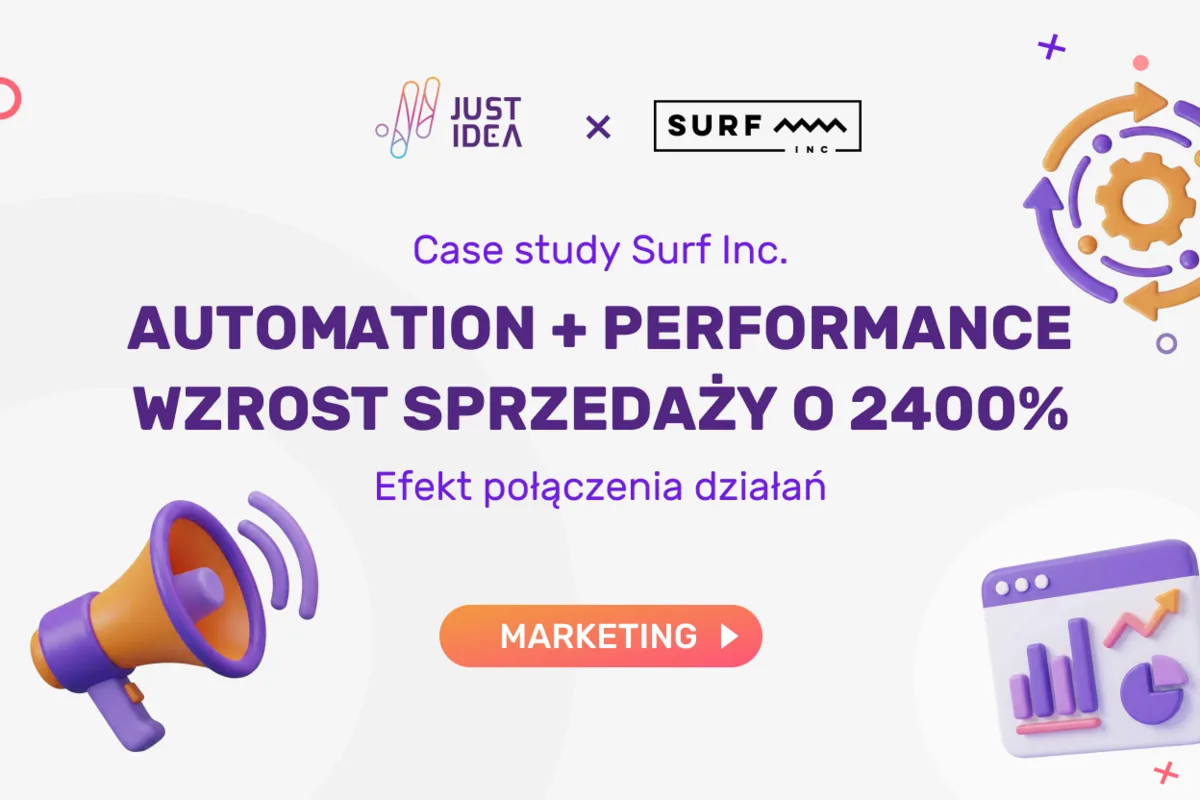
+2,400% sales growth from email & marketing automation activities. User identification: from 3% → to 20%. Basket completions: from 15% → 25%. Email database: +60% in 4 months (as much as it previously took 6 years!)
This shows how strategically combining performance marketing and marketing automation not only increases sales but also stabilises growth in the long term.
Conclusions: why does this work?
- Performance marketing attracts, but it's automation that closes the sale and builds loyalty.
- Thanks to integrating a tool that also tracks anonymous users, Surf.inc stopped "losing" most of its traffic.
- Data from its own database became just as important as data from Meta and Google ads.
This is an example of how, in e-commerce, it isn't enough to invest in advertising campaigns. The full effect only comes when performance marketing and automation are working towards the same goal.
Summary
The Surf.inc case shows that marketing automation doesn't replace performance marketing, but makes it many times more profitable.
It's thanks to this approach that the brand not only grew 3x in 2023, but also achieved a stable revenue source, independent of its current advertising budgets.
Also check out:

Have a question about this article? Write to us.