














What is structured data?
Structured data, in other words schema data or schema markup. This is a marking in the HTML code that tells search engines what kind of element something is and makes it easier for indexing crawlers to recognise and match it in search results. It also helps search engines interpret and display content. It's supported by Google, Yandex, Yahoo and Bing, among other search engines.
Schema.org is a widely supported vocabulary across all search engines. Within Schema.org, there are hundreds of different types of structured data. They tell the search engine how to display the page (or rather, they suggest it). There's no rule that all search engines have to behave the same way.
What exactly is Schema.org?
Schema.org is an initiative backed by major search engines such as Google, Bing, Yahoo and Yandex, which aims to create and promote a shared set of data types for structured website metadata. In practice, it's a vocabulary containing various types of elements that can be used on a website and that search engines can interpret. Sites that use Schema.org can provide search engines with more information, which helps them better understand the site's content.
Why does structured data matter for SEO?
The internet grows bigger and more complex every day. Yet Google still has limited time and resources to carry out its mission of organising the world's information in an easily accessible and useful way. It still struggles to deliver the most relevant and helpful links for every query in its search engine. Structured data matters for SEO because it helps Google carry out that mission more effectively.
As mentioned earlier, structured data helps the search engine better understand your content, which in turn lets it interpret it more accurately. This lets it present more information directly on the search results page in the form of rich snippets. Not only does this make it easier for search bots to interpret your content, it also improves the user experience by giving the results page more information, so users can get an answer to their query faster and more easily.
Schema.org doesn't directly affect a page's ranking in search results, but it has a significant effect on how the page is presented in those results. This can include elements such as rating stars, prices, images and much more. As a result, pages can attract more clicks and increase their visibility in search results, which can ultimately deliver better SEO results.
Why is it worth using rich snippets?
Rich snippets are special elements displayed in Google search results that show users additional information about a website's content. It's worth using rich snippets for several reasons:
- They improve visibility in search results: thanks to the richer snippets shown in results, rich snippets catch users' attention and increase the number of clicks.
- They make it easier to understand a page's content: by presenting additional information such as ratings, prices or reviews, users can understand what the page is about more quickly and easily.
- They improve the quality of traffic to the site: users who click on search results with rich snippets are more likely to interact with the page's content, which can increase time spent on the page and reduce the bounce rate.
- They increase user trust: by displaying additional information about a business, such as its address, opening hours or reviews, users can more easily trust and interact with that business.
Structured data, AI Overview and AI-based search
More and more Google search results aren't a classic list of links, but answers generated by AI: AI Overview or AI Mode. Structured data plays an important role in this context: it helps AI systems unambiguously understand what a piece of content is, who its author is, and what information it contains, instead of guessing based on the text alone.
Well-implemented structured data (especially of the Article, Organization or FAQ type) also supports E-E-A-T signals (experience, expertise, authoritativeness, trustworthiness), which matter increasingly both in classic SEO and in AI-generated results. We write more about building visibility in AI results in our article on ranking in AI Overview.
It's worth remembering that AI using structured data requires the same reliability as classic SEO: the marked-up data must faithfully reflect the page's actual content, or you risk losing the algorithm's trust.
Structured data formats
Schema.org supports many markup formats, but the most popular ones are JSON-LD, Microdata and RDFa. Here's a brief overview of the three best structured data formats in SEO:
- JSON-LD
JSON-LD uses a JavaScript object to insert markup into your page's header. We strongly recommend using this lightweight, simple format, because you can add it to your site without breaking anything. It's also the format preferred by Google.
- Microdata
This used to be the recommended SEO format, but JSON-LD is now more advanced and preferred. With this format, structured data is integrated into your page's main HTML code, so it's somewhat more likely to break the page without a proper implementation. If you know your way around code, you'll probably manage it smoothly.
- RDFa
RDFa uses the HTML5 format to publish linked data within HTML5 documents. This option also works, but it's not our top pick, since Google doesn't prefer it and its alternatives are more advanced.
How to implement rich elements on a website?
To implement rich elements ("rich snippets") on a website, follow the steps below:
- Identify the type of rich element you want to implement on the page. Rich elements can include, among others: rating stars, product descriptions, prices, dates, reviews and much more.
- Make sure your website is optimised for search engines (SEO, "search engine optimization"). Rich elements are usually displayed in search results, so it's important that your page is well optimised for search engines.
- Add structured code to the website. Structured code consists of additional HTML tags that let search engines better understand the page's content. You can use schema.org code to define rich elements on your page.
- Verify that the structured code is correct. To make sure the structured code is correctly implemented, you can use tools such as Google Search Console or the Rich Results Test Tool.
- Wait for the search results to update. After implementing rich elements on your website, you need to wait for the search results to be updated. This time can vary depending on the search engine and the type of rich element.
- Implementing rich elements on a website can help improve your page's visibility in search results and attract more users.
Schema.org:
https://schema.org/docs/schemas.html
Google Rich Results Validator:
https://search.google.com/test/rich-results
Schema Validator:
How to implement Schema on a page?
Implementing Schema.org on a page depends on the technology you use to build the site. The most common way is to add the appropriate Schema tags to the page's HTML. You can do this manually by editing the HTML code, or by using code-generating tools provided by some CMS platforms, such as WordPress.
For example, if you want to add Schema Product, you could add something like this to the page's HTML:
<script type="application/ld+json">
{
  "@context": "https://schema.org/",
  "@type": "Product",
  "name": "Your Product Name",
  "image": [
    "https://example.com/photos/1x1/photo.jpg",
    "https://example.com/photos/4x3/photo.jpg",
    "https://example.com/photos/16x9/photo.jpg"
  ],
  "description": "Your Product Description"
}
</script>
After adding the schema, you should test the page using Google's structured data testing tool to make sure everything is correctly implemented.
Interested in improving your website's SEO?
How to check that structured data is correctly implemented in Google Search Console
Implementing structured data isn't everything: it's worth regularly checking whether Google reads it correctly. The best place to do this is directly in Google Search Console.
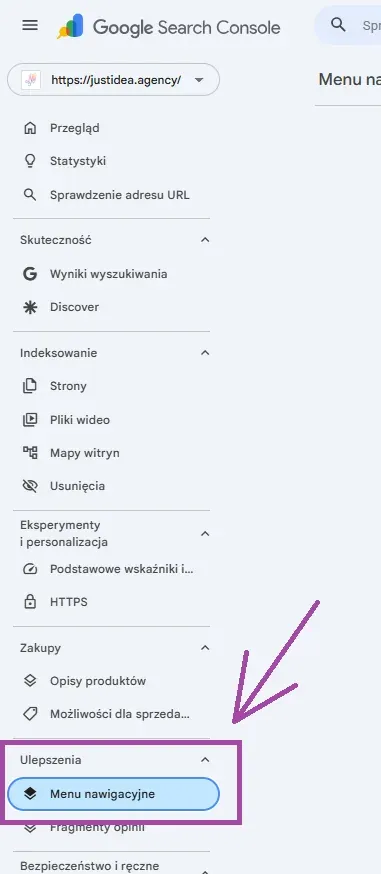
Step 1: In the left-hand menu of Google Search Console, find the "Enhancements" section: there you'll find a list of the structured data types detected on your site (e.g. Breadcrumbs, Review snippets).
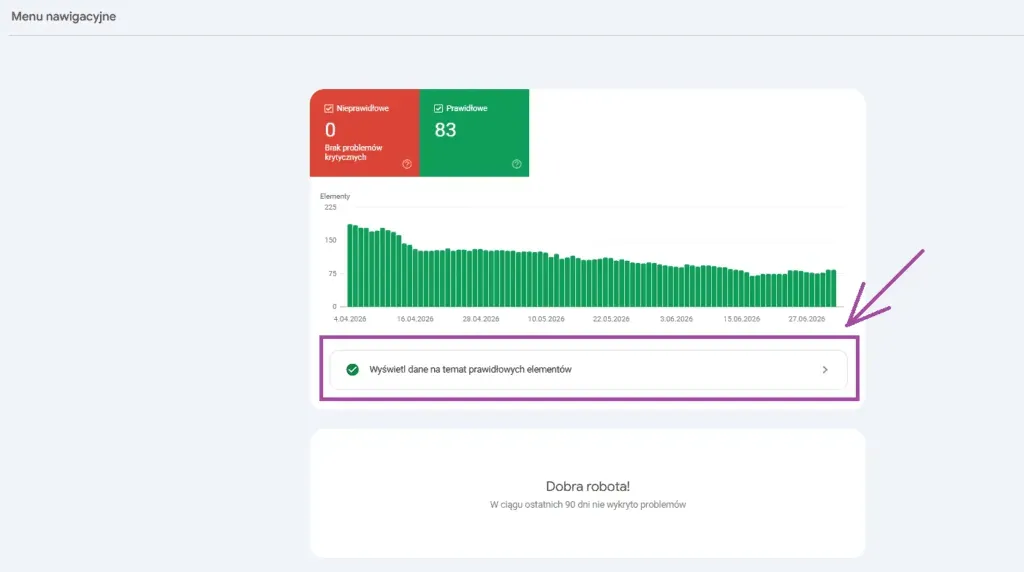
Step 2: Click on the type you're interested in, e.g. "Breadcrumbs", to see a chart with the number of pages with valid and invalid items.
Step 3: Click "View data about valid items" to see the specific list of URLs where structured data was correctly detected.
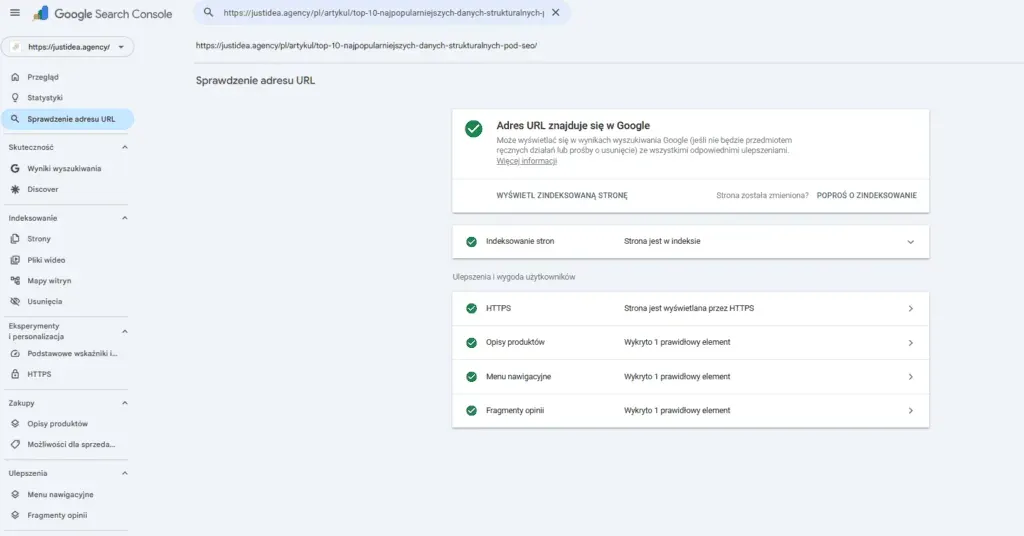
Step 4: For a single page, you can also use the "URL Inspection" tool: paste in a specific address, and in the "Enhancements and user experience" section you'll see which types of structured data Google detected on that page.
Regularly monitoring this report lets you quickly catch errors before they affect your page's eligibility for rich results. Before you start implementing structured data on a larger scale, it's worth understanding one thing: structured data helps SEO, but it affects SEO indirectly rather than through a direct change in ranking; it's about presenting the page better directly in the search results. Because you can use structured data to make your offer stand out, you can genuinely increase your click-through rate (CTR). A ready-made schema markup generator is useful for quickly generating code, and you'll find the full documentation of types at the official Google structured data source.
What types of structured data are there?
Schema.org offers many different types of structured data that can be applied to different kinds of content. Some of them include:
Organization Schema, which can be used to describe companies or organisations.
Schema Product, which can be used to describe specific products.
Schema Review, which can be used to describe reviews of products or services.
Schema Events, which can be used to describe events.
You can find the full list of available schemas on the Schema.org website.
What are the most popular types of structured data for SEO?
Breadcrumbs
Breadcrumbs are used for internal linking near the top of the page, between products, categories and pages, to keep things organised and make navigation easier for users. By marking up breadcrumbs on your page, Google can better interpret your menu structure and match the target page to search results more accurately.
Breadcrumbs are a sequence of links that show where the user currently is on the page within the context of the whole site's structure.
More information: https://developers.google.com/search/docs/appearance/structured-data/breadcrumb
Article
In a blog post, you can mark up many elements to help it be interpreted well. Headings, paragraphs, images, the author and other elements that are all marked up together are interpreted better, which can help the post rank higher in search results than competing content.
Article Schema is a subtype of CreativeWork and is used to describe articles such as blog posts, news articles, scientific articles, and so on. It can contain information such as title, author, publication date, illustrations, a short description, and so on.
More information: https://developers.google.com/search/docs/appearance/structured-data/article
Product
Marking up products is one of the more important things to do, because it lets you interpret each element better, such as currency, price, image, name, description, reviews, and so on. Thanks to this markup, search results can show an image next to the title, currency together with the price below the description, and several other elements that make your search results stand out, giving users a reason to click on your page in particular.
More information: https://developers.google.com/search/docs/appearance/structured-data/product
Review
Reviews are a great way to highlight social proof for your page and let users know that the services or products on it are high quality. By marking up reviews correctly, you can get graphic star ratings as well as an average rating in search results, which draws significant attention.
To display star ratings in search results and aggregate reviews from various places online, we recommend the JustReview tool.
More information: https://developers.google.com/search/docs/appearance/structured-data/review-snippet
FAQ
Marking up questions and answers with the FAQPage type used to produce expandable question tiles in search results. In 2023 Google limited them to government and health websites, and since 7 May 2026 it no longer shows them at all and has removed the documentation for this feature. FAQPage is still a valid schema.org type and keeps the questions on the page well structured, but it will no longer earn a rich result in Google.
More information: https://schema.org/FAQPage
Recipe
The culinary industry is a type of site where structured data simply can't be missing. It lets you display a photo of the dish, which significantly catches users' attention, and even display excerpts of the recipe, which encourages clicks on that result. It can contain information such as the dish's name, prep time, cook time, ingredients, instructions, nutritional values, ratings and reviews, and so on.
More information: https://developers.google.com/search/docs/appearance/structured-data/recipe
CreativeWork
This type of Schema is used to describe creative works, such as books, films, paintings, games, music, articles, and so on. It can be used to add detailed information about creative works, such as title, author, release date, reviews and much more.
More information: https://developers.google.com/search/docs/appearance/structured-data/paywalled-content
Events
Schema Events is used to describe events such as concerts, meetings, seminars, workshops, sports events, and so on. It can be used to add detailed information about the event, such as its name, venue, date and time, organiser, and so on.
More information: https://developers.google.com/search/docs/appearance/structured-data/event
FactCheck
Fact-checking markup is used to label information that has been verified for accuracy. It's often used by fact-checking sites to provide detailed information about what was checked, who did it, and what the results were.
More information: https://developers.google.com/search/docs/appearance/structured-data/factcheck
HowTo
Schema HowTo is used to describe step-by-step instructions. It can be used to convey information about how to do something, such as recipes, repair instructions, guides, and so on. Since September 2023 Google has not shown HowTo rich results on desktop or mobile, so this markup describes the content but does not change how the result looks.
More information: https://schema.org/HowTo
LocalBusiness
Schema LocalBusiness is used to describe a local business. It can be used to convey information such as the company name, address, opening hours, reviews, and so on.
More information: https://developers.google.com/search/docs/appearance/structured-data/local-business
Jobs
Schema Jobs is used to describe job postings. It can contain information such as job title, description, location, type of employment, salary, organisation, and so on.
More information: https://developers.google.com/search/docs/appearance/structured-data/job-posting
Organization
Schema Organization is used to describe an organisation, such as a company, school, government body, NGO, and so on. It can contain information such as name, address, logo, contact details, social media, and so on.
More information: https://schema.org/Organization
Corporation
This type of Schema is a subtype of Organization used to describe a corporation. It can be used to add detailed information about the corporation, such as name, address, CEO, founder, and so on.
More information: https://www.semrush.com/blog/schema-markup-for-company-corporations/
Speakable
Schema Speakable is used to mark up sections of a page that can be processed well by voice assistants such as Google Assistant, Siri, or Alexa. It's particularly useful for pages with news content.
More information: https://developers.google.com/search/docs/appearance/structured-data/speakable
Film
Marking up videos on a page lets them be displayed in search results as thumbnails, which make such videos stand out significantly and encourage users to click.
This schema lets you add detailed information about a video, such as title, director, cast, release date, duration, reviews, and so on. If you publish how-to or product videos, it's worth implementing this markup alongside the other types of structured data on your page.
Our marketing agency combines the expertise of every department to deliver you the highest-quality websites. Interactive agency JustIdea is at your service!
Structured data for online stores
In e-commerce, structured data matters especially: Schema Product lets you display a product's price, availability and rating in search results, which directly affects CTR and the decision to click. Combined with Review Schema and Breadcrumbs, an online store gets a more attractive presentation on Google than competitors without such markup.
If you run an online store and are wondering how to comprehensively implement structured data and the rest of your SEO optimisation, check out our online store services, or start with an SEO audit that will show you what's missing.
FAQ: frequently asked questions
Does structured data affect Google rankings?
Not directly: Schema.org isn't a ranking factor in itself, but it affects how a page is presented in results (rich snippets), which increases CTR and can indirectly improve visibility.
What is AI search?
It's search based on generative artificial intelligence (e.g. Google AI Overview), where the user gets a ready-made answer built from multiple sources instead of a classic list of links.
How do you check that structured data has been implemented correctly?
The best way is through the "Enhancements" report in Google Search Console, or the "URL Inspection" tool for a single page: they show whether the data is valid or contains errors.
Which structured data format is best?
JSON-LD: it's the format recommended and preferred by Google, the easiest to implement without risking damage to the page's code.
Check out these too: