








That's why in 2026 you have to monitor visibility in two places at once: in search results and in answers generated by AI. In this roundup you'll find 7 tools that make that possible. For each one we've added prices checked in October 2026, the list of supported platforms and how it copes with the Polish market.
What is AI visibility and what does a monitoring tool measure
AI visibility is a measure of how often and in what context your brand appears in the answers of chatbots and AI search engines. This covers ChatGPT, Gemini, Perplexity, Copilot, and also Google AI Overviews and Google AI Mode, the AI modules built into Google results. Optimising for these answers is called GEO, or ranking in AI.
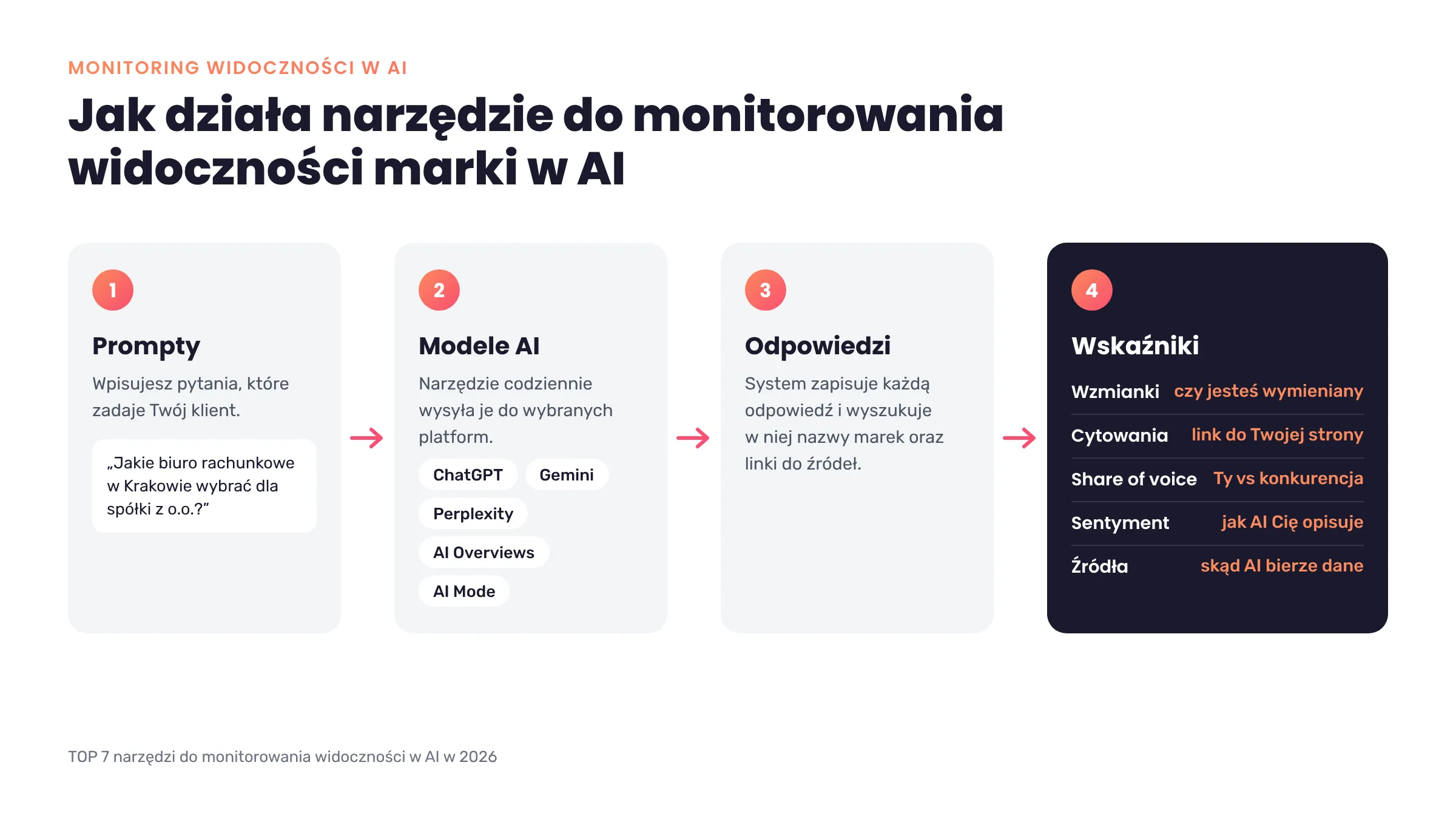
A tool for tracking LLMs works simply. You enter a list of queries your customer asks, and the system regularly sends them to chosen models and records the answers. From this data come the metrics:
- mentions: whether the AI model named your brand at all,
- citations: whether it gave a link to your website as a source,
- share of voice: what percentage of all recommendations in your category goes to you and what percentage to competitors,
- list position: whether you're named first or fifth,
- sentiment: whether the answer describes you positively, neutrally or critically,
- sources: which sites the model draws information about your industry from.
The last metric is the most practical. If you know that Perplexity and Google AI rely on three portals and one ranking in your industry, you also know where it's worth being present.
How AI monitoring differs from classic SEO
In SEO a phrase has one position that you can check at any moment. In AI search engines there is no such fixed position. The same user asking the same question twice may get different answers. This is affected by conversation history, location and model version. That's why AI tracker tools don't show “position 3”, but the percentage of answers in which the brand appeared, calculated from many repetitions.
The unit of measurement is different too. Instead of keywords, you track prompts, that is full questions in natural language, for example “which invoicing software to choose for a one-person company”.
How AI monitoring changed in 2025 and 2026
In 2025 most tools tracked mainly ChatGPT and AI Overviews. In 2026 Google AI Mode, Gemini and Copilot have become standard too, and the large SEO suites have added their own AI modules. The market is changing quickly on pricing as well, because vendors change limits and plans even during the year. Before you buy a subscription, check the current price list with the vendor.
How we chose the best tools for monitoring visibility
There are already dozens of AI visibility platforms on the market, so only those that meet a few conditions made it into the roundup. The first is coverage: the tool must cover at least ChatGPT and one of Google's AI modules. The second is the ability to set the Polish market or any location, because answers for a user in Warsaw differ from those for a user in New York.
We also looked at pricing transparency and the real cost of getting started, not just the headline price. Depth of data counted: sources, sentiment and comparison with competitors, not just counting mentions.
Prices come from vendors' price lists and documentation and are current as of 16 October 2026. We give them net, in the vendor's currency. Where a vendor doesn't publish prices, we used independent roundups and say so in the description.
Comparison of AI visibility monitoring tools
| Tool | AI platforms | Price from (per month, net) | Starting limit | Polish market | Best for |
|---|---|---|---|---|---|
| Semrush AI Visibility Toolkit | ChatGPT, Google AI Mode | $99 | 25 prompts | yes, Poland in reports | Semrush users |
| Ahrefs Brand Radar | AI Overviews, AI Mode, ChatGPT, Perplexity, Gemini, Copilot | $199 + Ahrefs plan | database of 479 million prompts + check packs | location chosen for each check | Ahrefs users, competitor analysis |
| Peec AI | 3 models of your choice (incl. ChatGPT, AI Overviews, AI Mode, Gemini, Copilot) | about €89 | 50 prompts | any country and language at no extra charge | agencies, brands in several countries |
| Otterly.AI | AI Overviews, ChatGPT, Perplexity, Copilot (+ AI Mode, Gemini, Claude for an extra fee) | $29 | 15 prompts | not stated in the price list | small businesses, a first test |
| Brand24 AI Visibility | 9 platforms, including ChatGPT, Claude, Gemini, Perplexity, AI Overviews | $199 (annual billing) + AI add-on | depends on the plan | not stated in the price list | brands already doing social listening |
| SE Ranking | AI Overviews, AI Mode, ChatGPT | $52 (annual billing, add-on) | about 200 prompts | not stated in the price list | Google-focused companies |
| Profound | up to 9 platforms on the Enterprise plan | custom quote | 50 prompts in the 7-day trial | one language and region in the trial | large brands and agencies |
As of 16 October 2026. Prices for Peec AI, SE Ranking and Profound come from third-party roundups, the rest from vendors' price lists.
Top 7 tools for monitoring brand visibility in AI
1. Semrush AI Visibility Toolkit: AI monitoring for Semrush users
If your team works in Semrush, this add-on is the simplest way to get started. Semrush AI costs $99 a month and includes 25 tracked prompts, 1 project and 1 domain. A further 50 prompts cost $60 a month. There is no trial period.
The strongest feature is Prompt Research. It is the equivalent of keyword research: it shows what users ask AI in your category, with estimated volume, difficulty and intent. On top of that come the AI Visibility Score, share of voice and sentiment analysis, and an audit of your site for AI bots. Poland is supported in visibility reports, competitor analysis and Prompt Research.
Limitation: prompt tracking covers only ChatGPT and Google AI Mode. Perplexity, Gemini and Claude are outside the scope. You'll find the details in the Semrush documentation.
2. Ahrefs Brand Radar: the largest prompt database for competitor analysis
Brand Radar is the AI module in Ahrefs, and it works in two modes. In the first you browse a database of over 479 million prompts and check how AI models talk about any brand, including competitors, with no prior setup. In the second you track your own queries.
The add-on costs from $199 a month, and on top of that you need an Ahrefs plan (Lite is $129). Your own prompts are billed in checks: one check is one prompt on one platform in one location. The Basic pack at $50 gives 2,500 checks a month, which is enough for about 80 prompts a day in one model. Brand Radar covers AI Overviews, AI Mode, ChatGPT, Perplexity, Gemini and Copilot, among others (Ahrefs pricing).
The downside? The cost climbs quickly when you want to track many models every day.
3. Peec AI: a tool for tracking visibility in several countries
Peec AI has a separate price list for agencies and by default lets you track clients' brands in one account. Every plan has an unlimited number of users, and prompts are checked daily. The Starter plan includes 50 prompts and 3 models, Pro 150 prompts, and Advanced 350 prompts and export to Looker Studio. According to the Toolradar roundup, Starter costs about €89 a month, and with annual payment you get a 15% discount.
Important information for a Polish brand: according to the vendor, you can track any supported country and language at no extra charge. On the standard plans you choose models from among ChatGPT, AI Overviews, AI Mode, Gemini and Copilot, among others. Claude, Perplexity or Grok are available only on the Enterprise plan or as add-ons (Peec AI pricing).
4. Otterly.AI: the cheapest monitoring tool to start with
Otterly is a good choice when you first want to check whether AI visibility is relevant to your industry at all. The Lite plan costs $29 a month and includes 15 prompts. Standard is $189 and 100 prompts, and Premium $489 and 400 prompts. Every plan includes Google AI Overviews, ChatGPT, Perplexity and Copilot. You can add Gemini and AI Mode on the Lite plan for $9 a month each, and Claude for $29 (Otterly.AI pricing).
The tool has a GEO audit, alerts and Semrush integration. The limitation shows at larger scale: model add-ons get more expensive along with the plan, so the full set of platforms on Premium already costs over $1,000 a month.
5. Brand24 AI Visibility: brand visibility in AI alongside social listening
Brand24 is a company with Polish roots, known for monitoring the internet and social media. The AI Visibility module tracks as many as 9 platforms: ChatGPT, Claude, Gemini, Perplexity, Google AI Overviews, AI Mode, DeepSeek, Grok and Copilot. It shows a Brand Score, share of voice split by chatbot and a list of the sites AI cites in your category (module description).
There is one advantage, but a big one: in a single panel you see what people say about you online and what AI models say. The downside is the price. Plans start at $199 a month with annual payment, and the AI module is a paid add-on with no price in the price list. On the plus side, there's a 14-day trial with no card (Brand24 pricing).
6. SE Ranking: monitoring Google AI Overviews in a rank tracker
SE Ranking suits companies for which Google is the main battleground. AI Results Tracker is an add-on to the rank tracker, so you see organic positions and presence in AI Overviews in one view. According to the Analyze AI review, the add-on starts at $52 a month with annual payment (about 200 prompts). A separate product, SE Visible, costs from $189.
Reach beyond Google is narrow. ChatGPT is tracked to a limited extent, and Perplexity and Gemini are only announced.
7. Profound: an LLM monitoring tool for large brands
Profound is an enterprise-class platform. On the Enterprise plan it covers up to 9 platforms, including ChatGPT, Perplexity, Gemini, Claude, Copilot, DeepSeek and both of Google's AI modules. It offers full history, an API, SSO and data on how models break a user's question down into many searches.
In September 2026 Profound withdrew its Starter and Growth plans for brands. Today a brand can use a 7-day trial (50 prompts, one language and region) or negotiate a custom quote. Agencies have a plan from $99 plus $399 per client (GEO Toolbox roundup). For a small company it's simply too big a tool.
How to choose an AI visibility monitoring tool
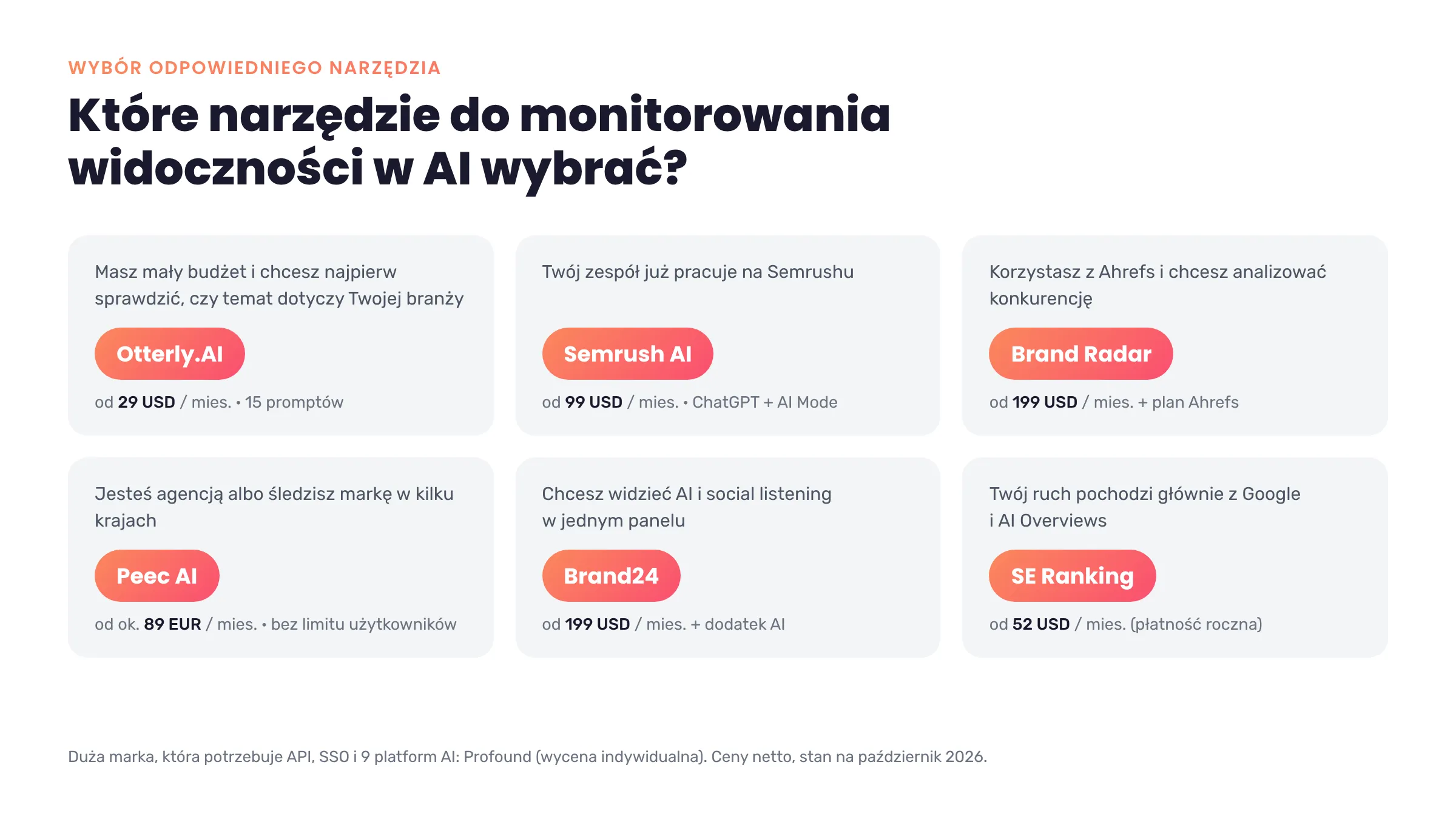
Start with the question of where your customers search. An online shop that lives on Google traffic should first watch AI Overviews and AI Mode. A B2B company whose customers compare suppliers in a conversation with a chatbot needs ChatGPT, Perplexity and Gemini above all.
The second criterion is the tools you already have. If you pay for Semrush or Ahrefs, their AI add-on will give you data without a new panel and without learning a new interface. If you don't use any SEO suite, a standalone tool such as Otterly.AI or Peec AI will be cheaper.
The third criterion is scale. For a small company, 20-30 prompts in two or three models is enough to start. An agency serving a dozen or so clients needs separate projects, unlimited users and export to reports, so Peec AI will work better. A large brand with a compliance department will need the SSO and API that Profound provides.
Manual visibility monitoring: the €0 version
Before you buy a subscription, you can run a test yourself. Prepare 20-30 questions your customer asks, and once a month enter them into ChatGPT, Gemini and Perplexity in a mode without conversation history. Record each answer in a spreadsheet: whether the brand appeared, in which position and which source the model gave.
You calculate share of voice with a simple formula: the number of mentions of your brand divided by the number of all brand mentions in those answers, times 100%. If 90 names appeared in 30 answers and yours 18 times, your share is 20%.
This method has one flaw: it's labour-intensive and relies on single answers. When the test shows the topic matters for your industry, move to a tool that repeats the measurement every day.
How to prepare queries for monitoring your brand's visibility
Even the best tool will show a wrong picture if you enter the wrong prompts. The most common mistake is tracking questions with the brand name, like “what do you know about company X”. Such a query tells you how AI describes you, but not whether it recommends you to someone who doesn't know you.
A good set combines four types of queries:
- Category: “best accounting firm for a limited liability company”
- Problem: “how to reduce accounting costs in a small company”
- Comparison: “company X or company Y, which to choose”
- Location: “accounting firm in Kraków with online service”
Write prompts the way your customer talks, not the way a phrase looks in Google. Queries to chatbots are longer and often contain context: budget, company size, city.
A Polish brand has one more challenge: name inflection, because Polish changes the endings of names depending on the sentence. The model may write “w Kowalskim”, “u Kowalskiego” or “Kowalski & Syn”, and in each case it means the same company. Check whether the tool you pick lets you add variants of the brand name. If not, some mentions simply won't be counted, and your visibility in the models will come out lower than it really is.
FAQ: the most common questions about AI visibility monitoring
Are there free tools for monitoring visibility in AI?
The tools in this roundup are paid, but you can test some of them for free. Brand24 gives 14 days with no card needed, Profound offers a 7-day trial, and Peec AI a trial period. If you don't want to pay yet, start with the manual monitoring described above.
How often should you check AI visibility?
Tools collect data daily or weekly, but you don't have to analyse it that often. AI answers change from day to day, so a single drop means little. Assess trends once a month, and set alerts for large changes in visibility, for example when a competitor is suddenly recommended instead of you.
Does a high position in Google mean brand visibility in ChatGPT?
No. Good visibility in Google results helps, because AI Overviews draws on Google's index. ChatGPT and Perplexity, however, build their answers from their own sources, which often include rankings, forums and industry portals. A brand on the first page of Google may not appear in a chatbot at all.
How does AI monitoring differ from Google Search Console data?
Search Console shows impressions and clicks from Google search. It won't tell you, though, whether ChatGPT or Perplexity named your brand or what they wrote about it. An AI visibility tool analyses the content of the answers, so it's worth using both data sources in parallel.
How many prompts should you track at the start?
For one brand in one market, 20-30 prompts are enough. It's better to have 25 well-chosen questions covering all four types than 200 variants of the same phrase.
Where to start monitoring your brand's AI visibility this month
You don't have to buy the most expensive tool right away. Write down 30 questions your customer asks and run a manual test in three models. If your brand appears rarely and competitors regularly, you have a ready argument for including AI visibility in your strategy.
Whichever tool you choose, the most valuable thing will be the list of sources cited by AI. These are industry rankings, comparison sites, forums and expert portals where your brand should be present for models to start recommending it. Review them every month and plan content and PR activities around them.