












The internet is increasingly no longer a space handled only by people and classic indexing bots. Autonomous assistants, meaning advanced AI agents, are entering the game en masse, capable of independently searching for information, comparing offers, using forms and carrying out complex tasks on behalf of the user.
In response to this revolutionary shift, a new feature debuted on 7 May 2026: agentic browsing in PageSpeed Insights, referred to in the Polish version as "Przeglądanie agentowe" (Agentic Browsing). Its main job is to check whether a site can be correctly handled by autonomous artificial-intelligence systems and whether it is fully adapted to work with AI agents.
The new audit shows that modern site optimisation no longer stops at loading speed, responsiveness and search visibility alone. Semantic HTML code, the accessibility of interactive elements, and the ability to clearly recognise the actions that can be performed on a page are all becoming increasingly important.
What Is Agentic Browsing and Why Is It Changing How We Use the Internet?
For many years, the internet was designed with two main audiences in mind: users and search engine bots such as Googlebot. Today, this model is starting to change in favour of autonomous systems that use language models to carry out tasks on a person's behalf. It's with these systems in mind that Google is developing a new audit category, agentic browsing, which appeared in Google PageSpeed Insights.
Its aim is to check whether a website is prepared not only to display content to people, but also to be correctly interpreted and handled by artificial intelligence. This is a significant shift, because AI is no longer limited to answering simple questions. It's increasingly able to analyse sites on its own, compare offers, fill in forms, or plan the next steps without needing constant user involvement. This means site owners should start designing their websites not only with classic SEO in mind, but also with the new generation of intelligent assistants.
Who Are AI Agents and How Are They Becoming the Web's New Users?
AI agents are advanced systems that, unlike traditional chatbots, aren't limited to generating text answers. They can independently pursue specific goals by planning actions, using external tools, browsing websites, and making decisions based on the data they've gathered.
In practice, this means that instead of a person, such an assistant can independently find the best insurance offer, compare the technical specifications of devices, book a hotel, or put together a shopping cart.
For website owners, this means the arrival of a completely new type of visitor. It isn't guided by the site's aesthetics and appearance, but by its code structure, technical accessibility, and how easy specific interactions are to carry out. That's exactly why Google, in its new audits, places such heavy emphasis on elements that make it easier for machines to navigate a site, such as semantic HTML code, correctly described buttons, and a logical heading hierarchy. You can check part of that accessibility, namely what a crawler sees on the page without JavaScript and whether robots.txt lets it in, with our free AI visibility checker.
How Do Autonomous Shopping Assistants Work in Practice?
Imagine a situation where a user asks their AI assistant to find the best coffee machine within a set budget. Instead of displaying a list of links to browse on their own, the agent visits selected online shops itself, analyses product descriptions, directly compares technical specifications, checks reviews and availability, and then presents a ready-made recommendation or prepares an order for the user to finalise.
For such a scenario to be possible, the site must be fully readable by the machine. A correct code structure, clearly described interactive elements, and a stable interface all become essential. The new Agentic Browsing audit was created precisely to check whether a site can handle these kinds of autonomous tasks.
From Traditional SEO to AEO: How Are Customer Search Intents Changing?
The development of AI agents is fundamentally changing how people find information online. Until recently, the main goal of SEO was to achieve a high position in search results and encourage the user to click on a link. Today, users increasingly don't want to browse pages themselves, they expect a ready-made answer or the immediate completion of a task.
In this new model, AEO (Answer Engine Optimization) is becoming hugely important: optimising content for systems that generate direct answers. This isn't the end of classic SEO, though, but its natural evolution. Modern websites need to be well visible in traditional search results, easy for language models to understand, and fully prepared for technical cooperation with AI agents that carry out specific actions on behalf of the user, all at the same time.
Companies that adapt their sites to these requirements the fastest will gain a significant competitive advantage in an era where artificial intelligence increasingly makes purchasing decisions.
How Does Agentic Browsing Differ from Googlebot Indexing?
The classic Googlebot focuses primarily on indexing content: understanding a site's subject matter so it can appear for the right queries in search results. It doesn't simulate the behaviour of a regular user, doesn't click buttons, and doesn't go through transactional processes.
Agentic Browsing works completely differently. It's based on active interaction with the site. An AI agent visits a page with a specific task to complete: it might click a button, fill in a form, filter products, compare offers, or check whether the whole process can be completed. That's why code quality, the technical accessibility of elements, and interface stability matter so much.
Classic SEO answered the question "does the search engine understand the page's content?", while Agentic Browsing asks a new, far more demanding question: "can artificial intelligence actually use this page effectively?"
Agentic Browsing in Google PageSpeed Insights: What Does the New Feature Mean?
Until now, Google PageSpeed Insights focused on performance, accessibility, compliance with best practices, and aspects related to standard SEO. The new audit extends this analysis with another dimension, checking a site's readiness for direct cooperation with autonomous assistants.
This means that, alongside speed and correct page rendering, how clear the interface is to language models is now becoming essential. Google stresses that this feature is currently experimental and will be developed further as AI assistants become more widespread. Even now, though, it's worth treating it as a sign of the direction modern technical optimisation is heading in.
How to Check the AI Test Result and Interpret the New Recommendations
The result of the new analysis can be found directly in Google PageSpeed Insights, alongside the classic sections assessing performance or SEO. Unlike the traditional performance score, which is presented on a scale from 0 to 100 points, Agentic Browsing displays its result as a fraction, for example 2/3 or 1/2.
The number on the left indicates how many audits were passed, while the number on the right shows how many tests were run for the given page. It's worth remembering that the denominator isn't fixed, it depends on the type of site and which audits Lighthouse considers applicable. Google also notes that the category is experimental, so both the number of tests and how they're scored may change in future versions of the tool.
To find out which elements need improving, you just need to expand the report's details. The tool clearly points out specific failed audits, suggests what changes to make, and explains why particular code errors can block AI assistants. These recommendations link directly to the standard best practices and SEO categories, most often concerning the readability of the HTML code, correctly associated form labels, and the site's visual stability.

Why Does This Topic Matter for Website Owners and SEO Specialists?
Although Google doesn't yet treat the Agentic Browsing score as a direct ranking factor, preparing a site for these guidelines genuinely strengthens technical SEO. For online business owners, this is a clear signal that classic search engine optimisation needs to be extended with technical flexibility in the code.
Investing in correct semantic code and modern accessibility standards is no longer just a matter of niche technical audits. It's becoming a real foundation for building brand visibility in an environment where artificial intelligence increasingly makes purchasing decisions and searches for offers on behalf of the end customer.
The Technical Backbone of the Agentic Web: How Do Machines Interpret a Website?
One of the biggest differences between traditional internet browsing and Agentic Browsing is how artificial intelligence "sees" a page. A human pays attention mainly to the graphic design, colours and how intuitive the interface is. AI agents work completely differently: they ignore aesthetics and focus on the document structure, the relationships between elements, and the actions that can be performed on them. As a result, well-written, semantic code becomes just as important as attractive design.
Accessibility Tree, Semantic HTML and Structured Data: How Does AI Interpret a Page?
Although modern AI models can already analyse screenshots, the page's source code remains their primary and most reliable source of information.
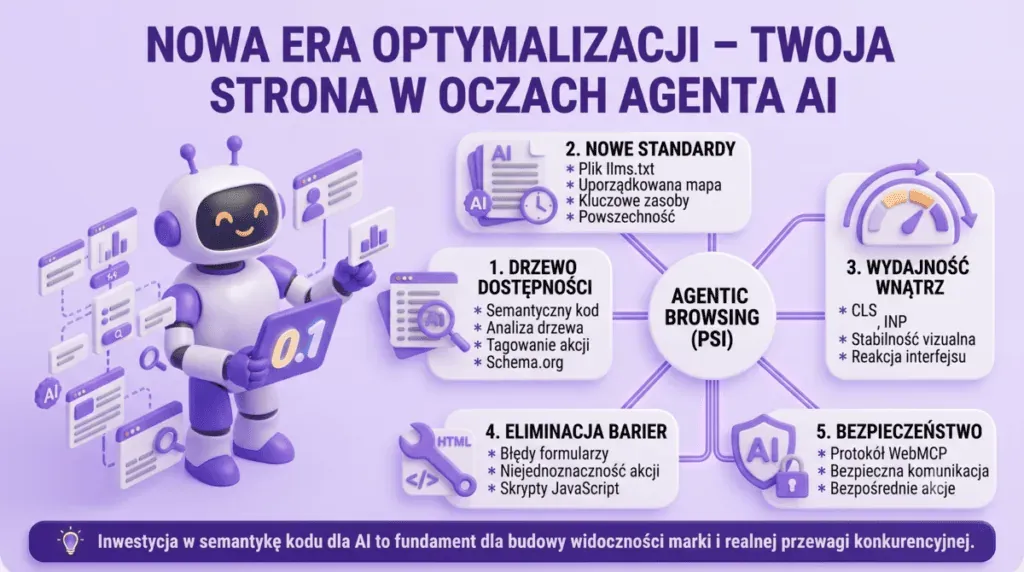
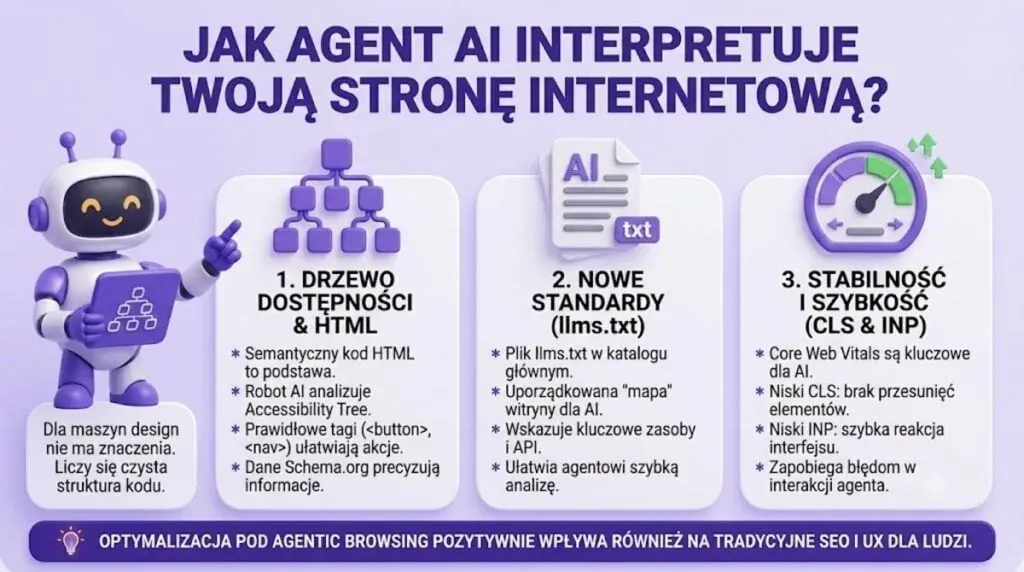
The Accessibility Tree plays a key role here: a structure the browser builds from the HTML code. It's exactly this tree that AI agents read to work out which elements are headings, buttons, links or form fields, and what actions can be performed on them.
The more semantic the HTML code is (correct use of the <header>, <nav>, <button>, <main>, aria-* tags and so on), the more easily and reliably AI can navigate the page. Structured data from Schema.org provides additional support, letting you precisely mark up products, prices, reviews, contact details or opening hours. This means the agent doesn't have to "guess": it simply knows.
A New Standard: What Is the llms.txt File for Language Models?
In response to the needs of AI agents, the llms.txt standard was created for language models. The file, placed in the domain's root directory, contains concise, organised information about the site: the main sections, key subpages, a description of the offer, the API structure, or links to documentation. Thanks to this, an AI agent doesn't need to search the whole site, it immediately gets a "map" prepared by the owner.
Although the standard isn't mandatory yet, it's becoming an increasingly important part of the modern ecosystem of AI-friendly websites.
WebMCP: Why Does Google Mention This Standard?
Alongside the llms.txt file, WebMCP (Web Model Context Protocol) is also gaining importance. This is an evolving communication standard between web applications and AI agents, designed to let sites expose clearly described functions to machines in the form of structured tools. This means language models may in future be able to search for offers, fill in forms, make bookings, or add products to a cart more efficiently, instead of relying solely on visually analysing the interface and guessing what individual page elements are for.
Although this technology is still at an early, experimental stage of development, it clearly points to one of the possible directions the web could evolve in. Over time, sites may not only present content to users, but also expose selected functions to external agents acting on their behalf. In future, such systems could support users while they search, compare offers, and complete part of a transaction process, all within the rules and safeguards set by the application's owner.
INP and CLS Metrics: Why Do Page Stability and Speed Matter for AI Agents?
Preparing a site for AI agents doesn't excuse us from caring about performance. Quite the opposite: Core Web Vitals metrics, especially INP (Interaction to Next Paint) and CLS (Cumulative Layout Shift), are taking on new significance. If page elements shift during loading, buttons respond with a delay, and forms behave unpredictably, the problem doesn't only affect people. An autonomous agent might click a button that has "shifted", or lose context while filling in a form. A stable, fast interface is now one of the most important success factors for both human users and artificial intelligence.
How to Prepare Your Site for Agentic Browsing and the Coming Age of AI
Although agentic browsing in PageSpeed Insights is still an experimental feature, it's already worth preparing your site for the growing role of autonomous AI agents. Unlike classic indexing bots, agents don't just read content, they actively try to carry out tasks: adding products to a cart, filling in forms, or comparing offers. For a site to be friendly to them, it needs to be fully readable at the code level.
Key Changes to Your HTML Code
The foundation is a semantic, predictable document structure. Headings should form a logical hierarchy, buttons must trigger real actions, links must lead to valid addresses, and forms must have precisely associated labels.
It's worth avoiding excessive reliance on complex JavaScript and custom components without the proper ARIA attributes. The more organised and standards-compliant a site is, the more easily AI agents will understand it and be able to carry out specific tasks on it.
How to Improve Your Agentic Browsing Results in PageSpeed Insights
Google hasn't yet published a full list of the factors affecting the score, but the recommendations in the panel clearly show the direction optimisation should take. The best approach is to run the audit regularly after every major code change and respond quickly to any errors it flags.
Particular attention should be paid to the technical accessibility of forms, correct descriptions for buttons and interactive elements, a logical heading structure, and visual interface stability (CLS). It's also good practice to limit aggressive pop-ups and overlays that could block an agent from working.
Agentic Web Actions Worth Implementing Today
The best way to enter the Agentic Web era is to consistently implement proven technical practices. It's worth starting by organising the HTML heading hierarchy and implementing correct form labels and descriptive button names. The next step should be analysing and optimising the INP and CLS metrics, which are responsible for interface stability and smoothness. After that, it's worth implementing Schema.org structured data and adapting the site to WCAG accessibility guidelines.
A very valuable addition will be adding an llms.txt file to the domain's root directory and actively following the development of the WebMCP standard. Regularly testing your site in PageSpeed Insights, Lighthouse and Chrome DevTools will let you quickly eliminate errors before AI agents become a significant source of traffic to your site.
Agentic Browsing and the Future of SEO: Is This a New Web Standard?
Although the agentic browsing audit in Google PageSpeed Insights is still experimental, the direction the web is heading in is clear. Increasingly, the first visitor to your site won't be a human, but an autonomous AI assistant comparing offers or preparing a transaction. This isn't the end of traditional SEO, but its natural evolution. Semantic HTML, accessibility and a clear information architecture, which bring together classic search engine optimisation with the requirements of artificial intelligence, are all gaining importance.
The good news is that optimising for AI bots overlaps with proven SEO and UX practices. Correct headings, a stable interface, fast loading and clear forms have been building good websites for years. What's new is that these same standards will now make life easier for intelligent agents too. Keeping track of these changes and gradually implementing Google's recommendations will let you stay ahead of the competition and prepare your site for the next stage in the internet's development.
FAQ: Frequently Asked Questions About Agentic Browsing
What Exactly Is Agentic Browsing?
Agentic Browsing is a new way of interacting with the internet, in which pages are browsed, interpreted and handled not by people, but by autonomous artificial-intelligence systems. These systems, called AI agents, don't just read content, they can actively click buttons, fill in forms, compare offers, and make bookings on behalf of the user.
Does the Agentic Browsing Result in PageSpeed Insights Directly Affect SEO?
Google hasn't identified the Agentic Browsing score as a direct ranking factor. Many of the actions recommended in the audit, though, such as improving HTML semantics, accessibility and layout stability, overlap with good technical SEO and UX practices.
How Does Agentic Browsing Differ from Traditional Googlebot Indexing?
The classic Googlebot visits your site solely to fetch its content and index it in the search engine's database. It doesn't interact with the page's elements. An AI agent, on the other hand, simulates the behaviour of a real customer, meaning it actively tries to use the site's features, for example by filtering products or going through the steps in a shopping cart.
What New Technical Standards Are Worth Implementing Now?
A key element is taking care of semantic HTML code and a correctly built Accessibility Tree. It's also worth implementing an llms.txt file in the domain's root directory, which acts as a roadmap for language models, and following the development of the WebMCP standard, which makes secure background communication with AI agents easier.
Won't Adapting Your Site for AI Bots Ruin the UX for Real People?
Definitely not. All the technical requirements set by agentic browsing, such as interface stability (a low CLS score), a fast response time to clicks (INP), or clear button descriptions, are also the foundation of great UX and the WCAG guidelines for traditional users. By taking care of artificial intelligence, you automatically create a better, faster site for people too.
See Also: