











ChatGPT ads have stopped being just an announcement. Since 24 August 2026, ChatGPT Ads has covered 31 European markets, Poland among them. For advertisers, this means a channel where the starting point isn't a typed phrase but a conversation held right before a purchase decision. What exactly changes in practice, and where should you start preparing?
What is ChatGPT Ads?
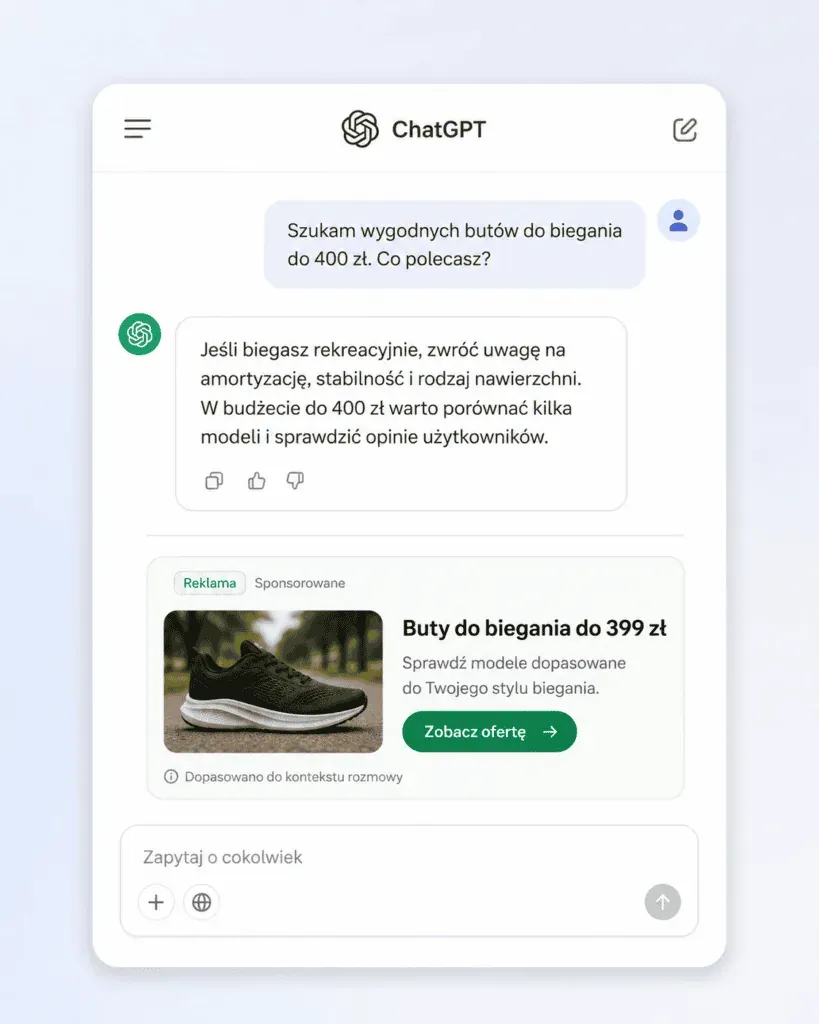
ChatGPT Ads is OpenAI's advertising system, which displays paid ads underneath answers. The ads are labelled as sponsored, kept separate from the content of the answer, and selected based on the topic of the ongoing conversation rather than a list of keywords set by the advertiser.
The purchasing mechanism itself resembles other performance marketing platforms. The advertiser sets a budget, goal and bid, prepares the creative, and directs traffic to a chosen page. The difference starts with the question of who sees that ad and at what moment.
In a search engine, the signal is a single query. In ChatGPT, a user rarely stops at one phrase: they describe a situation, ask follow-up questions, and narrow down their choice over several messages. That whole exchange becomes the material the system uses to decide whether to serve an ad.
OpenAI's basic premise here is unambiguous. Ads don't affect the content of the generated answer, and conversations remain inaccessible to advertisers, who receive only aggregated statistics.
Since when has ChatGPT Ads been running in Poland?
OpenAI announced the expansion on 18 August 2026, and ad serving started on Monday, 24 August. It covered 31 European markets, including Poland, Germany, France, Spain, Italy and the Nordic countries. This is the largest geographic expansion since the pilot launched in the United States in February 2026.
Who will see ads in ChatGPT?
Ad serving covers only the Free and Go plans. Plus, Pro, Business, Enterprise and Edu accounts remain ad-free. OpenAI also doesn't target ads to accounts recognised as belonging to people under 18.
Europe has one more restriction that's easy to forget when planning. Ad personalisation isn't available at launch in the European Economic Area or in Switzerland. Creative selection is therefore based on the context of the current conversation and basic data such as general location and device type. This is closer to contextual targeting than to the profiling known from social media.
What does advertiser access look like?
Ads are already visible to Polish users, but campaigns can't yet be launched independently. At this stage, access runs through the OpenAI Ads Solutions team and agency and technology partners, who handle campaign setup and management. A self-service Ads Manager is expected to arrive later.
What does an ad in ChatGPT look like?
The format is concise and embedded underneath the model's answer. A single ad unit contains:
- the advertiser's name and logo: identifying the brand even before a click,
- a headline: a short message answering the need expressed in the conversation,
- a description: one or two sentences expanding on the offer,
- an image: a visual element that sets the ad apart from the answer text,
- a landing page address: the destination the user reaches after clicking.
This set will be familiar from text and product ads. What's new is the setting: the message appears in the middle of a conversation, next to content the user is actually reading, rather than on a results list.
Targeting based on conversation, not on phrases
This is one of the biggest differences compared with search campaigns. The system takes into account the context and intent of the current conversation, the ad content, the landing page content, and hints provided by the advertiser. The reference point is therefore purchase intent, not a specific phrase typed by the user.
Context Hints: hints instead of keywords
Context Hints are descriptions of situations, topics and needs in which an ad should be considered. They can hold short terms similar to purchase phrases, as well as entire scenarios: a person comparing several solutions, a user with a specific budget, someone looking for a product with a particular feature.
What matters is what Context Hints are not. They don't work like keywords in exact match, and they don't guarantee an ad will be served when the given wording is repeated exactly. They point to an area of intent in which the ad makes sense.
The practical conclusion from the first configurations is simple: the consistency of a single ad group matters more than its breadth. Throwing in loosely related topics just to increase reach makes it harder to evaluate results later.
An auction where relevance counts
The bid alone doesn't decide which ad gets shown. The system also takes into account how well the message fits the context of the conversation. That's why three elements should be consistent with one another: the context hints, the ad content and the landing page.
If each of them says something different, relevance drops. When the hints refer to a narrow category, the ad talks generally about the brand, and the user lands on the store's homepage, the system gets inconsistent signals and finds it harder to match the ad well.
| Campaign element | Google Ads (search network) | ChatGPT Ads |
|---|---|---|
| Signal that triggers an ad | Query typed into the search engine | Topic and context of the whole conversation |
| Targeting setup | Keywords and match types | Context Hints, i.e. descriptions of needs and situations |
| Placement | Sponsored link in search results | Card displayed underneath the model's answer |
| Data in a product campaign | Name, brand, model and product code | Product use case and the problem it solves |
| Moment of contact | The user usually knows what they're looking for | The user is at the stage of discovering or comparing options |
Campaign formats and billing models
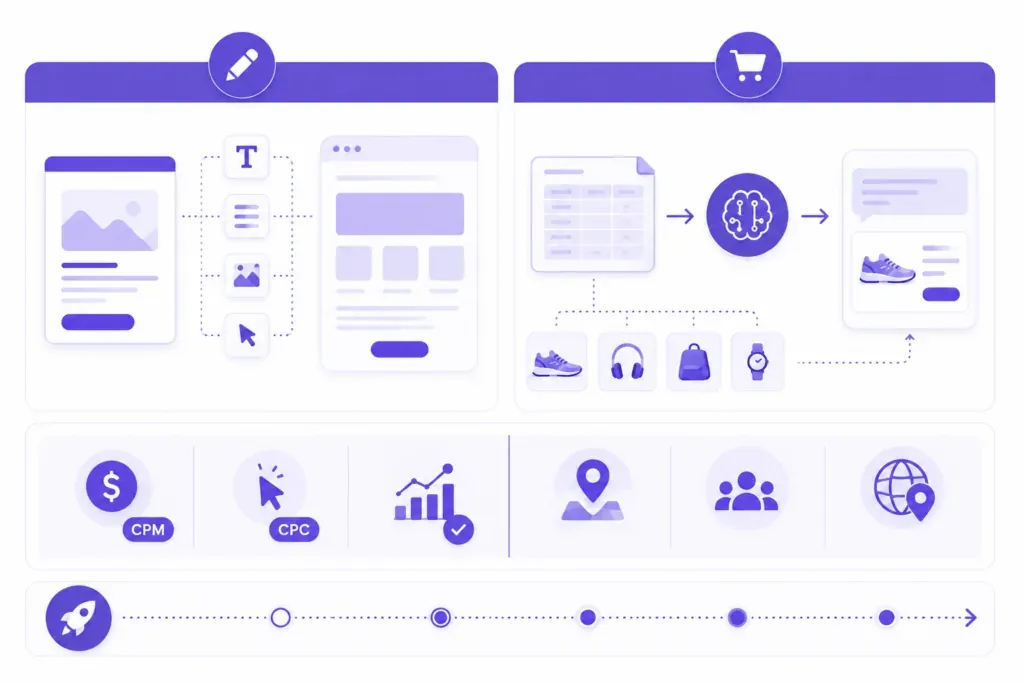
The advertiser can choose between two approaches. Standard campaigns are based on creative prepared in-house: the headline, description, image and landing page remain under the brand's full control. These work well for promoting services, categories and the highlights of an offer.
The second path is campaigns based on a product catalogue. Here, the system uses the submitted product feed and selects the items matching the conversation itself, pulling ad titles and descriptions directly from the product data. For e-commerce, this means feed quality stops being a purely technical issue and becomes part of the creative.
On the billing side, CPM and CPC models are available, and the platform also allows optimisation for measured conversions. Geotargeting and custom audiences are also included. In terms of functionality, ChatGPT Ads is therefore getting closer to the standard known from mature advertising platforms, although the product itself is still being rolled out in stages.
Measuring conversions in ChatGPT Ads
Clicks alone don't tell you whether the channel is profitable. OpenAI provides two ways of sending events, which can be used separately or in parallel.
The first is the OpenAI Pixel: a script running in the browser that records actions taken after clicking the ad, such as a purchase, a form submission, or a sign-up. It can be implemented directly on the site or through Google Tag Manager, which will be a more convenient solution for most teams.
The second is the Conversions API, meaning events are sent directly server-to-server. OpenAI points to this method as more reliable and recommends it wherever implementation is possible. Integrations with external measurement tools are also available.
Order matters. It's worth configuring the right events before launching the campaign; otherwise, after the first week you'll mainly know how much the traffic cost, not what it produced. When comparing results with other systems, you also need to account for differences in attribution, conversion windows and event deduplication.
How to prepare for ChatGPT Ads
The period before the self-service panel launches is a good time for work you can't skip anyway. Below are a few scenarios from different business models.
A kitchenware shop
The conversation usually starts with a problem, not a product name: little counter space, cooking for two people, or noise in an open-plan space. Fill your feed with information that answers these needs: dimensions, noise level, or intended use. The manufacturer's code alone adds little value here.
A software vendor for car repair shops
A user might ask about billing labour hours or integration with a fiscal cash register. Map your customers' most common operational problems and assign separate landing pages to each. A single offer page for all queries dilutes the relevance signal.
A language school for businesses
The decision matures over weeks and goes through several stages: recognising the need, comparing class formats, or settling on a budget. Describe these stages separately in your Context Hints, instead of limiting yourself to a general slogan about courses. You can't always shorten the decision path, but you can address each of its stages with a different message.
What to prepare regardless of your business model
Prepare your analytics and check that your landing pages actually answer the needs that come up in conversation. With a small budget, start with one well-defined category. Expanding scope later will be easier than tidying up a campaign that tried to cover everything from the start.
Conversation becomes a new advertising surface
ChatGPT Ads isn't just another version of search advertising, so copying a Google Ads account structure one-to-one won't get you far. The starting point for building a campaign changes: instead of a single query, what matters is the situation in which the user describes a problem and compares the available options.
For the Polish market, the current stage has one big advantage. Ads are already visible, but the race for self-service access hasn't started yet, so you can prepare your data, content and landing pages without the pressure of a budget already being spent.
Most of the work happens outside the ad panel anyway. A feed describing product use cases, a well-matched landing page and correctly measured conversions are useful in every channel. In ChatGPT Ads, though, their absence can be visible from the very first day of serving.

Interested in this topic? Check out these too:
- What are the AI features in Google Ads?
- Performance Max: a complete guide for 2026
- What are the Meta Ads ad types? Formats for 2026
FAQ section: ChatGPT Ads
How does ChatGPT Ads differ from organic visibility in ChatGPT?
Organic visibility is a brand's presence within the model's own answer, described as Generative Engine Optimization. ChatGPT Ads is a paid unit that appears underneath the answer and is labelled as sponsored. Both areas rely on the same foundations, clear product descriptions and well-organised page content, but they're measured in completely different ways.
Do ads affect ChatGPT's answers?
According to OpenAI, no. Ads remain separate from the model's answer and don't change its content, and advertisers don't get access to users' conversations. They only receive aggregated data, such as the number of impressions and clicks.
Is a Google Merchant Center feed enough for a product campaign?
It can serve as a starting point, though it will rarely be the final version. Titles prepared for search engines usually describe the brand, model and specification, while in a conversation what matters most is the product's use case. Before launch, review your titles, descriptions, categories and attributes in Google Merchant Center with this in mind.
What budget should you set to start a campaign?
OpenAI doesn't publish a minimum entry threshold for the Polish market, and bids are set at the ad group level. Rather than hunting for benchmarks, it's more sensible to gather your own data on a narrow slice of your offer and only then scale the budget.
Will ChatGPT Ads replace Google Ads?
At this stage, these channels serve different moments of the conversion funnel. Search engines best serve queries from people who already know what they're looking for, while ChatGPT comes in earlier, at the stage of discovery and comparing options. This is closer to complementing the mix than to replacing one channel with another.

Have a question about this article? Write to us.