














Prices set them clearly apart: a million input tokens costs from $0.10 in Haiku (for requests up to 100K tokens) to $10 in Fable. The model you pick decides how much you pay for a single task and how long you wait for the result.
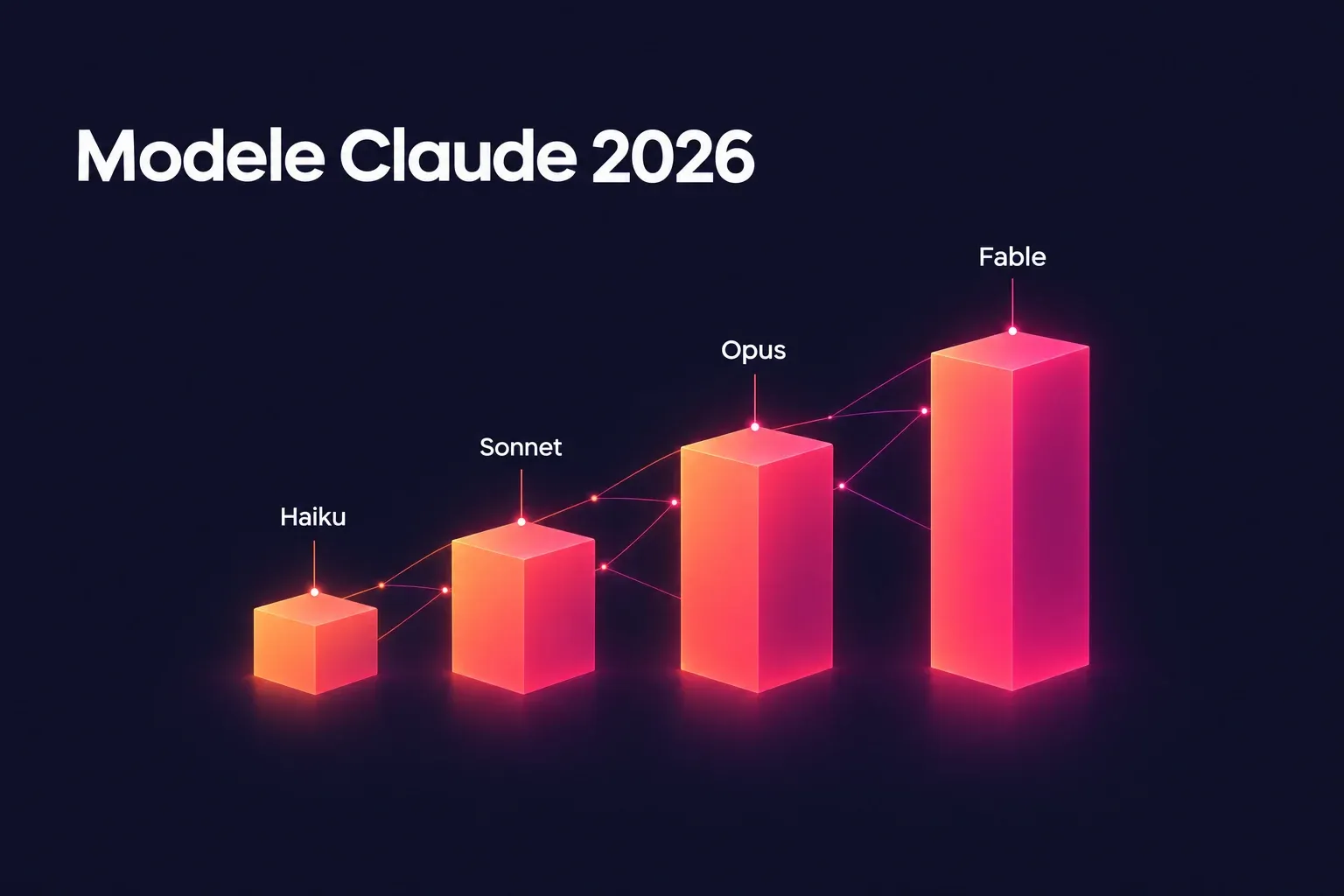
Haiku, Sonnet, Opus and Fable: how Anthropic divides the Claude models
Claude is a family of large language models (LLMs) from Anthropic. Until the end of 2025 it had three lines, and a fourth was added in June 2026. Haiku is the smallest and fastest model, built for simple tasks at large scale, such as classifying tickets or giving short chat answers. Sonnet sits in the middle and handles most everyday work. Opus is the model for complex analysis and coding, and Fable stands above it, designed for the hardest, multi-hour tasks.
Alongside Fable there is also Mythos. It is the same model as Fable, but with less restrictive safeguards in cybersecurity and biology. Only verified organizations from the US in trusted access programs can use it, so you won't meet it in everyday business work (Anthropic announcement).
The number after the name marks the generation and its update. The 5 series arrived in June 2026, and 5.1 and 5.5 are its later updates, not new models built from scratch.
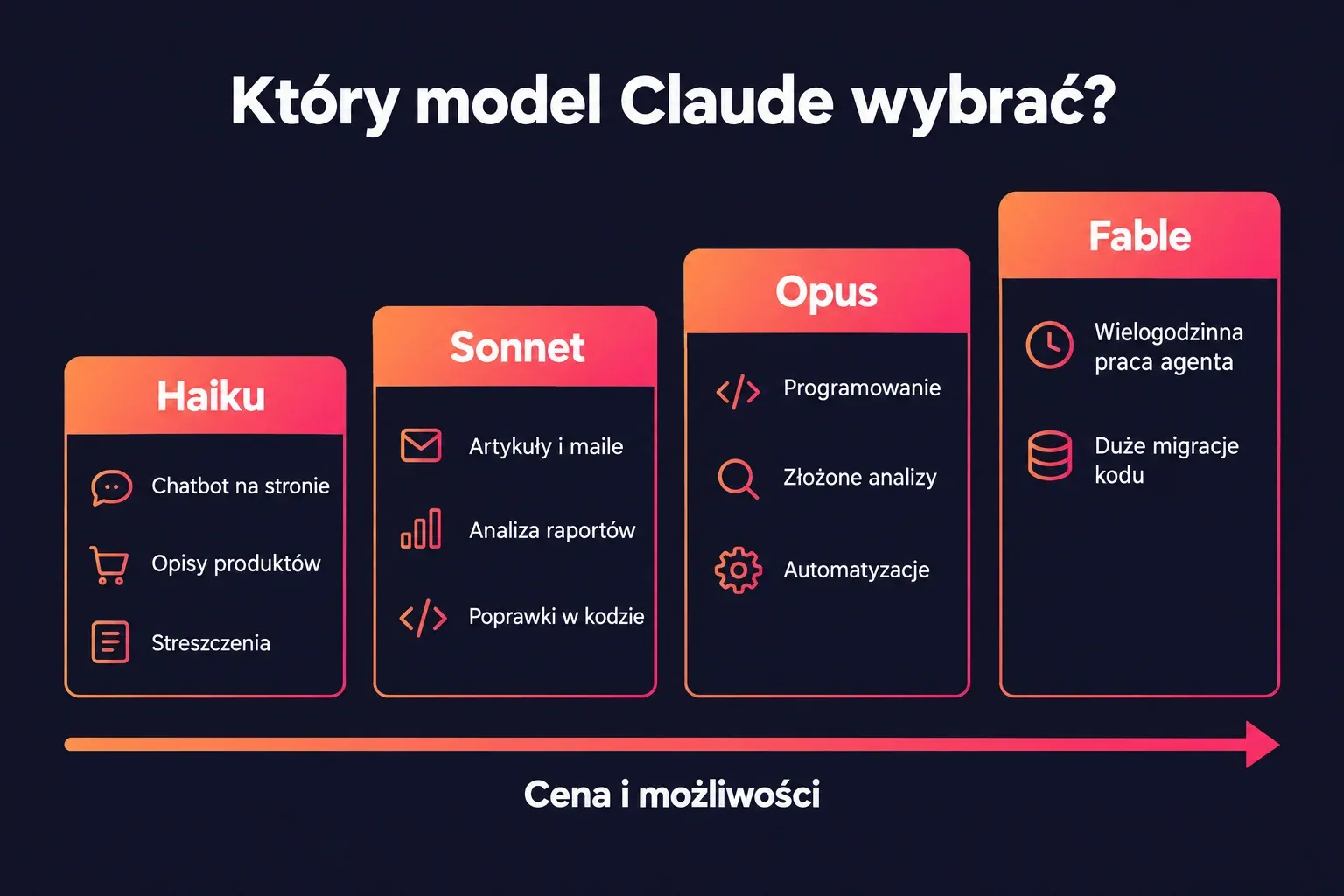
How Claude models changed in 2026
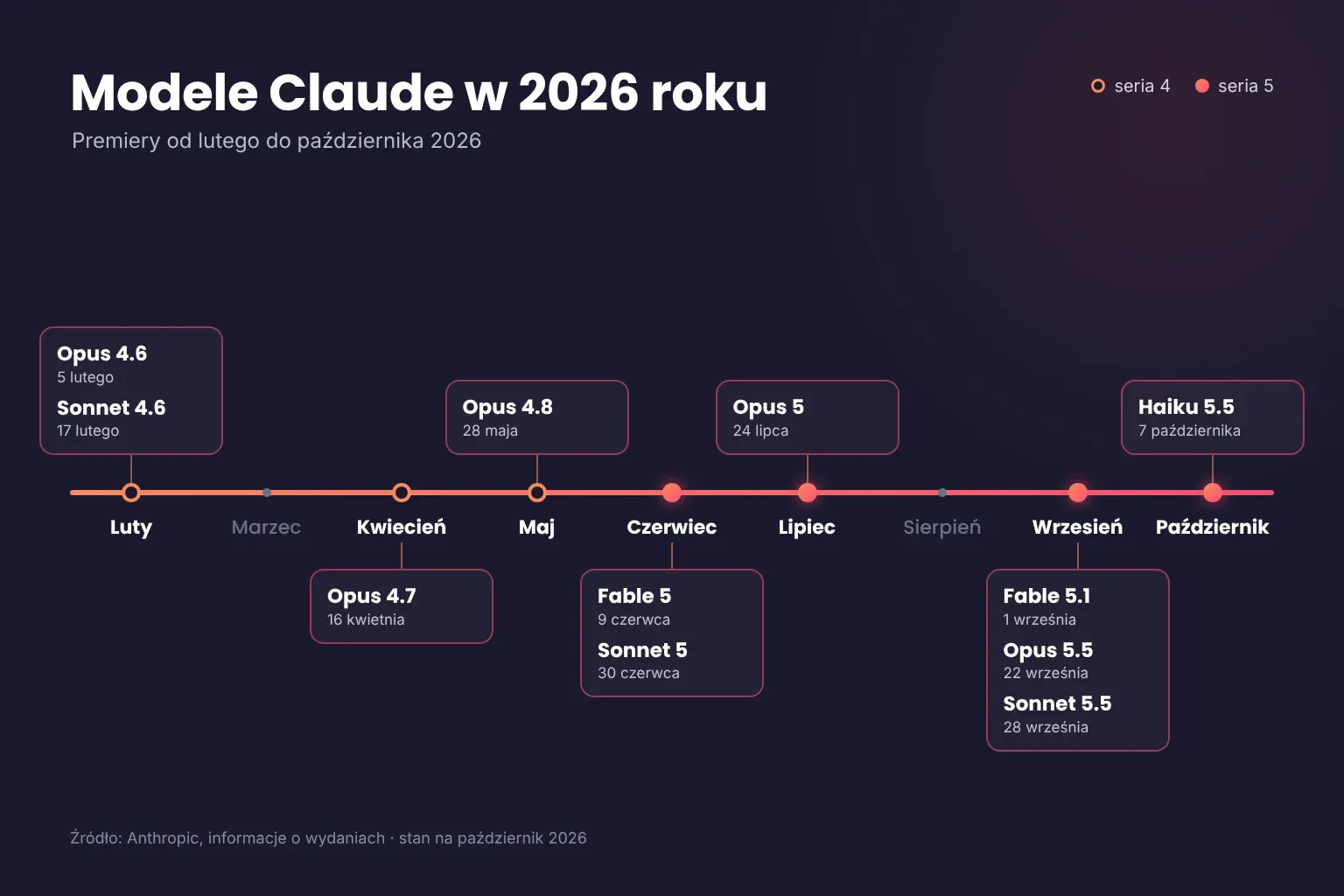
February to May: the last models of the 4 series
The year began with Opus 4.6 (February 5) and Sonnet 4.6 (February 17). Opus 4.7 appeared in April, and on May 28 came Opus 4.8, which had a context window of one million tokens by default. The way models think changed in this period too: a model no longer needs a manually set token limit for reasoning and decides for itself how long to think (adaptive thinking). You control it only with the effort parameter, which sets the level of effort (release notes).
June and July: the 5 series and the new Fable line
In early June (June 9), Anthropic showed Fable 5, the first publicly available Mythos-class model with additional safeguards. Sonnet 5 followed at the end of June (June 30), and Opus 5 on July 24. The 5 series brought a new tokenizer that produces about 30% more tokens from the same text (release notes). When you compare prices with older models, you need to consider not only the rate but also the number of tokens.
September and October: the 5.5 family
Fable 5.1 (September 1) kept the price of Fable 5, but thanks to cheaper reads from the cache it cut the cost of typical work by about 25%. Three weeks later, on September 22, Opus 5.5 debuted. It is cheaper than Opus 5 and, according to Anthropic, matches Fable 5.1 on most tasks. Sonnet 5.5 joined at the end of September (September 28), and Haiku 5.5 on October 7. For requests up to 100K tokens, Haiku 5.5 costs 90% less than Haiku 4.5.
What Claude models have in common in 2026
Technically, the four current models are very similar. Each has a context window of one million tokens, which is how much text the model sees at once: the whole conversation, attached files and its own answer. Each can also write up to 128 thousand tokens in a single response, and its knowledge of the world ends in June 2026 (Anthropic models overview). The model learns about later events only from a search engine or from files you give it.
All of them accept text and images, such as screenshots, charts or photos of documents, and can use tools: a search engine, files or other programs connected through MCP connectors.
You work with all the models the same way: in the Claude app, through the API, and on AWS, Google Cloud and Microsoft Azure. A prompt written for Sonnet will therefore work in Haiku or Opus, and only the quality and response time will change. Whatever the model, it is worth checking numbers and dates at the source, because AI hallucinations happen in every one of them.
How Claude models differ: price, speed and capabilities
The biggest difference is the price per token, which is a piece of text the model reads or writes. A token is roughly a fragment of a word. The data is as of October 2026, with API prices from the Anthropic pricing page and default effort from the models overview:
| Model | Release | Price per 1M tokens (input / output) | Speed | Default effort | Best for |
|---|---|---|---|---|---|
| Claude Fable 5.1 | Sep 1, 2026 | $10 / $50 | slowest | high | the hardest agentic tasks |
| Claude Opus 5.5 | Sep 22, 2026 | $4 / $20 | moderate | medium | coding, complex analysis |
| Claude Sonnet 5.5 | Sep 28, 2026 | $2 / $10 | fast | high | everyday work, content, code fixes |
| Claude Haiku 5.5 | Oct 7, 2026 | $0.10 / $0.50 (up to 100K tokens), $0.50 / $2.50 (above) | fastest | medium | chatbots, classification, summaries |
Opus 5.5 or Fable 5.1: is it worth paying more
Fable 5.1 is 2.5 times more expensive than Opus 5.5 and slower, and according to Anthropic, Opus 5.5 matches it on most tasks. On Terminal-Bench 4.0, Opus 5.5 scored 66.4% and Fable 5.1 scored 55.8%. Opus rewrote a large program from C to Rust at a 51% lower cost than Fable (Anthropic data). That is why Anthropic recommends starting with Opus 5.5 and turning to Fable only when Opus at a higher effort level can't cope.
Sonnet 5.5 or Opus 5.5: when the cheaper one is enough
Sonnet costs half of what Opus does, and in many tests it loses little to it. On OSWorld 2.1, which tests computer use, it scores 80.1% against Opus's 81.8% (Anthropic comparison). Opus wins on open-ended tasks where it has to make decisions on its own over a longer time. Sonnet works better for a clearly described task: a bug fix, a presentation, a spreadsheet or a blog post.
Haiku 5.5: for high-volume tasks
For requests up to 100 thousand tokens, Haiku 5.5 is 20 times cheaper than Sonnet. It is Anthropic's fastest model at standard speed. It handles summaries, classification, customer chat support and work as a helper agent next to Opus or Sonnet. Anthropic does not recommend it for complex coding (Haiku 5.5 announcement).
Which Claude model to choose for which task
For high-volume tasks, use the smallest model. For everyday work, use Sonnet. Keep Opus and Fable for tasks where a mistake costs the most. The data is as of October 2026:
| Task | Model | Why |
|---|---|---|
| Customer support chatbot, FAQ on a website | Haiku 5.5 | fast and very cheap across thousands of conversations |
| Product descriptions, translations, data tagging | Haiku 5.5 | simple, repetitive tasks |
| Blog articles, posts, marketing emails | Sonnet 5.5 | good style, half the price of Opus |
| Analysis of campaign results and reports | Sonnet 5.5 or Opus 5.5 | Opus when many data sources are involved at once |
| Coding and automation | Opus 5.5 | the default model according to Anthropic |
| Multi-hour agent work, large code migrations | Fable 5.1 | when Opus is not enough |
In marketing, Sonnet is enough for most tasks. The content you publish goes through editing anyway, so the difference between Sonnet and Opus is rarely worth the extra cost. It is different with analysis of data from many sources, for example from Google Ads campaigns, GA4 and a CRM at once. Here it is worth trying Opus, which handles tasks with no single obvious answer better. If you connect Claude with other tools, for example through the API and automation in n8n, check Haiku first. At thousands of calls a day, the difference in the bill is large.
For developers: before you switch to a more expensive model, try raising the effort. Opus 5.5 has a medium level by default, and according to Anthropic, even at that level it does better on Terminal-Bench 4.0 than Opus 5 set to maximum. You can also cut costs with the cache, because reading stored content costs a fraction of the normal price, and with batch mode (Batch API), which gives a 50% discount on tasks that don't need an answer right away. When time matters, Opus 5.5 has a Fast mode: up to 2.5 times faster, but priced at $8 / $40 per million tokens (pricing).
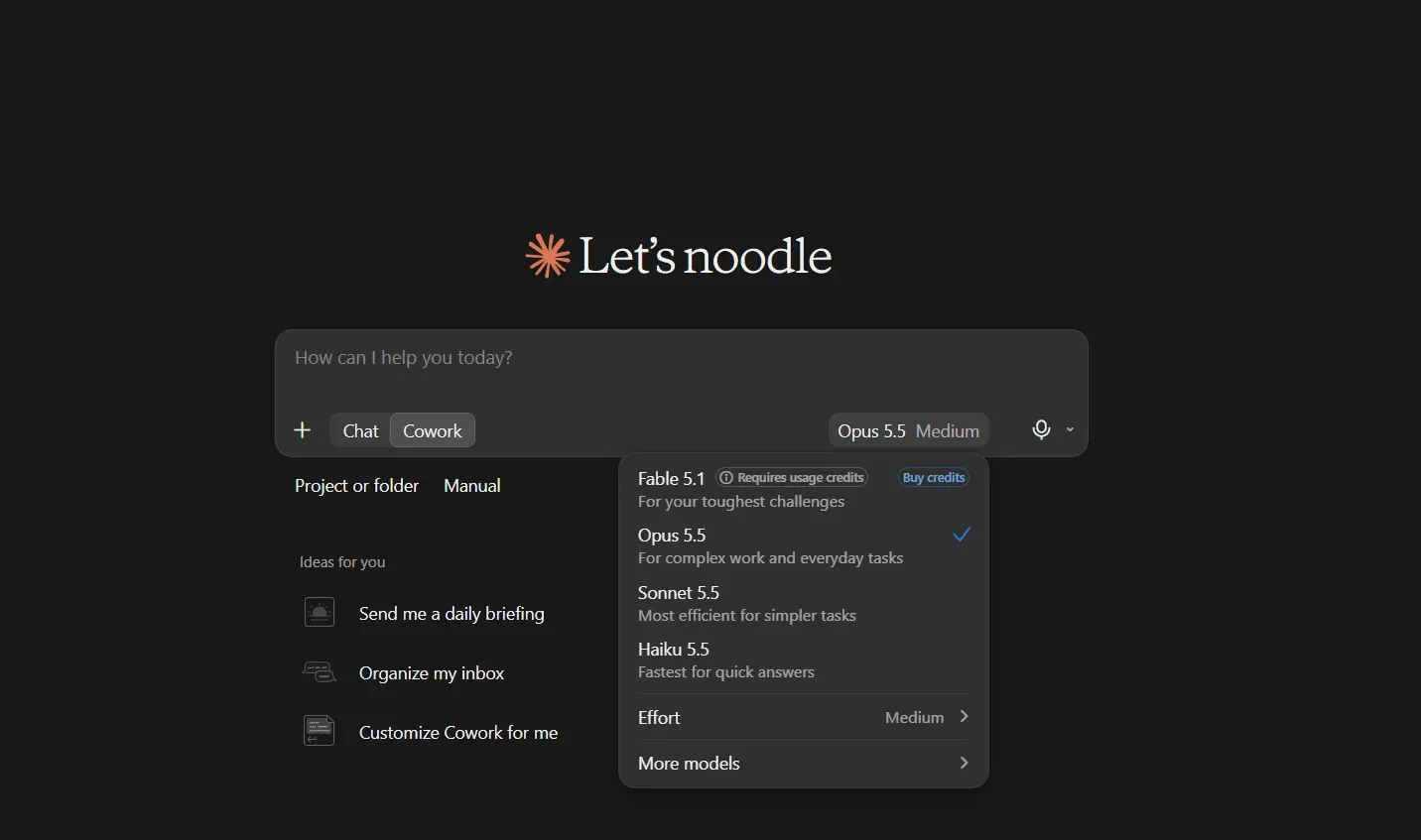
Claude models in subscriptions and the API
In the Claude app you don't pay for tokens but for a plan, and the plan decides which models you see. The Pro plan ($20 per month, or $17 with annual billing) gives you access to Opus, Sonnet and Haiku, while Fable is available for extra credits. Max plans start at $100 per month and let you spend half of the weekly limit on Fable. Prices exclude tax, according to the Claude pricing page.
In the API you pay for every token at the rates in the table above. It is the better choice when Claude is to work inside your tools, for example answering customers on your site or generating product descriptions. For a team working on its own files, a subscription and Claude Cowork will work better, and for work done at a fixed time, scheduled tasks in Claude. If you want to compare Claude with ChatGPT and Gemini, see the ranking of the best language models in 2026.
What happened to older Claude models
Anthropic usually retires older models a few months after their successors launch. Claude 3.7 Sonnet stopped working on February 19, 2026, Opus 4 and Sonnet 4 on June 15, and Opus 4.1 on August 5. Sonnet 4.5 will be shut down on November 30, 2026. Haiku 4.5 and Opus 4.5 still work, but the availability guarantee for Haiku 4.5 ended on October 15, and for Opus 4.5 it ends on November 24, 2026. You can find the current schedule on the model deprecations page.
For developers: if your code contains the identifier claude-sonnet-4-5-20250929, change it to claude-sonnet-5-5 before November 30. Requests to retired models end in an error. After moving to the 5 series, recalculate costs on a sample of your own requests.
Frequently asked questions about Claude models
What is the latest Claude model?
The latest is Haiku 5.5, from October 7, 2026. The most powerful publicly available model is Fable 5.1, and Anthropic recommends Opus 5.5 as the default.
How is Claude Fable different from Mythos?
It is the same model with different safeguards. Fable is available to everyone, but it hands some cybersecurity and biology tasks over to Opus models (Fable 5.1 announcement). Mythos goes only to verified organizations from the US, for example teams working on defense against cyberattacks.
Which Claude models are in the free plan?
Sonnet and Haiku, with a usage limit. Opus and Fable require a paid plan (Claude pricing page).
Which Claude model is best for coding?
Anthropic recommends Opus 5.5. Sonnet 5.5 is enough for simple fixes, and Fable 5.1 is worth turning on for multi-hour tasks that Opus can't handle.
Do Claude models understand Polish?
Yes, all current models write and understand Polish. For texts you plan to publish, give them a style example and check the punctuation.
Start with Sonnet and pay more where you see the difference
In 2026, Claude models differ most in price, not in technical capabilities. According to Anthropic, Opus 5.5 matches Fable 5.1 on most tasks for 40% of its price, Sonnet 5.5 comes close to Opus for half the rate, and Haiku 5.5 costs ten times less than Haiku 4.5 for requests up to 100K tokens. Before you choose a more expensive model, run the same task on a cheaper one and compare the results.
Claude models also increasingly answer your customers' questions about products and services. If you want them to recommend your company, see how AI model optimization works, or contact us.