














Below you'll find the 10 elements every product page needs, plus a checklist you can use to review them in your store.
What Is a Product Page and Why Does It Decide Online Sales?
A product page is a page of an online store dedicated to a single item. It gathers everything a shopper needs to make a buying decision: name, photos, description, specifications, price, availability, and an "Add to cart" button.
In a physical store, a customer can pick up the product and ask a salesperson. In e-commerce, the product page takes over that role, so it is usually what decides whether the customer buys. From an SEO perspective, it is also most often the page that answers queries with clear purchase intent, such as "women's waterproof hiking boots size 39". The category page competes for general phrases, while the product page captures the long tail of queries typed by customers who are ready to buy.
The Top 10 Elements a Product Page Must Include
The order is not random. The first three elements mostly decide whether a shopper clicks your page in the results. The rest decide whether they stay on it and buy.
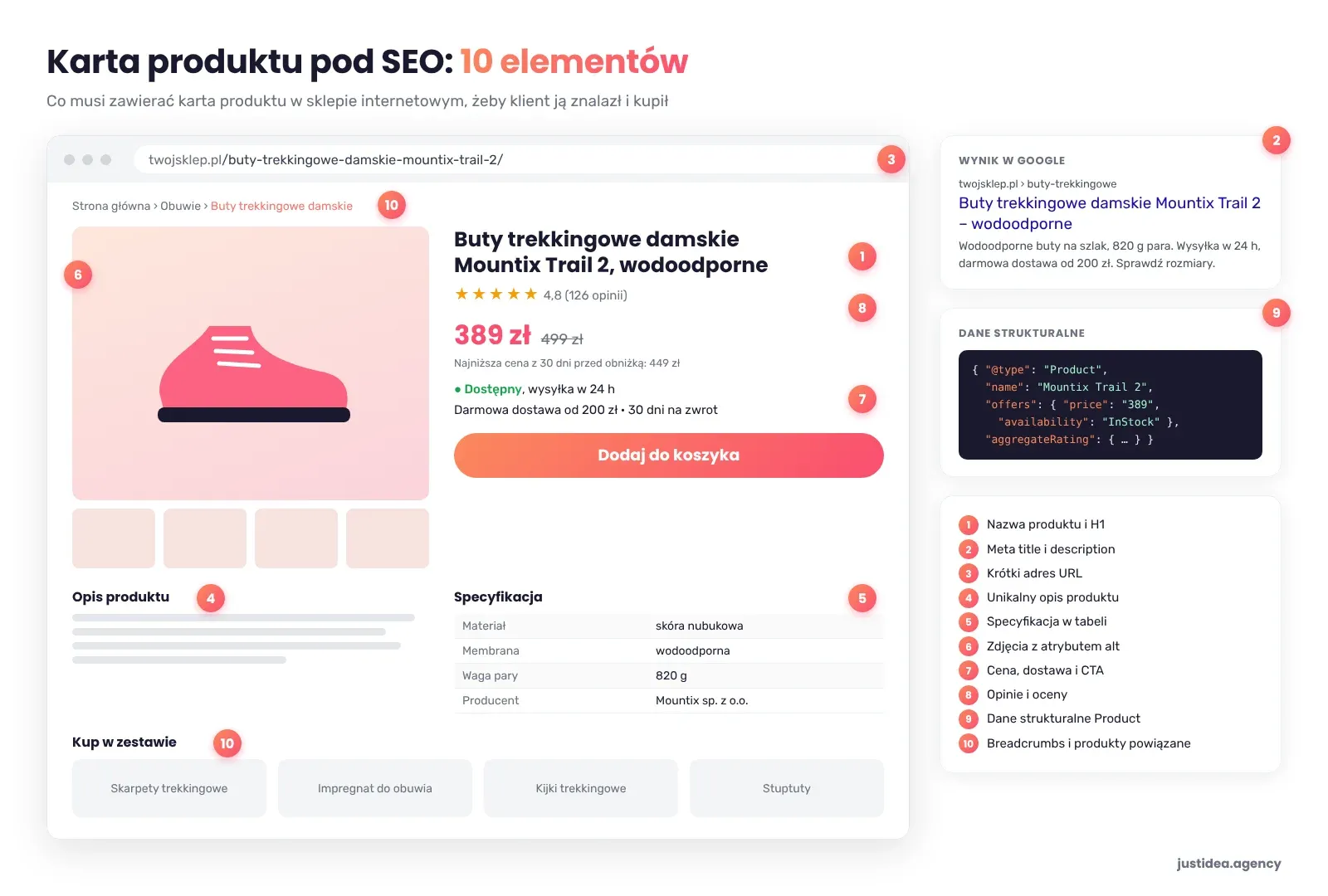
1. Product Name and H1 Heading
The product name serves as the H1 heading on the page and most often goes into the page title as well. A good name combines the product type, brand, model, and a feature that sets it apart from others, for example "Mountix Trail 2 Women's Hiking Boots, Waterproof". The shopper knows right away what they are looking at, and Google gets a phrase that people actually type into the search engine.
Avoid names with a warehouse code ("MTX-TR2-W-39") and marketing names that don't say what the product is. You'll find more examples in our recommendations on product naming.
2. Meta Title and Meta Description
The page title (meta title) is the first text a shopper sees in Google results. Fit in the product name and one piece of information that encourages a click, for example free delivery or shipping within 24 hours. We described the detailed rules in the article on how to write a title in 2026.
The meta description doesn't directly affect rankings, but it decides click-through rate. Google builds the result snippet mainly from the page content and shows your description only when it describes the page better. In a store with thousands of products, a template works best: product name, the main benefit, price or delivery, and a short call to action.
3. A Short, Readable URL
The product URL should contain the product name in lowercase, without diacritics or unnecessary parameters, for example /buty-trekkingowe-damskie-mountix-trail-2/. The shopper understands such a URL before clicking, and you can analyze it more easily in reports.
Once a URL is published, don't change it without a 301 redirect. Without one, you lose the page's history, and links from other sites lead to a 404 error.
4. A Unique Product Description Written in Terms of Benefits
Stores often spend the least time on the product description and copy the manufacturer's text, so the same description appears on dozens of sites. Google then picks one version to display, and the other stores have nothing to stand out with. We described this mechanism in the article on cannibalization and duplicate content.
A good description starts with what matters to the customer. Instead of "upper with a Gore-Tex membrane", write "your feet stay dry in the rain and on wet grass, because a Gore-Tex membrane protects the upper". That is benefit-driven copy: product features turned into an effect the customer will feel. Add how the product is used and who it is for, and work keywords in where they sound natural.
Match the length of the description to the product. A USB cable doesn't need a thousand words, but an electric bike or an espresso machine needs answers to a dozen or so questions a customer would ask in a store. If you have a large catalog, start with the products that already get traffic and sales, and fill in the rest in stages.
5. Technical Specifications in a Table
Put detailed product information, such as dimensions, weight, material, compatibility, or EAN code, in a table below the description. A table lets the shopper quickly compare two models and reduces questions to store support. For search engines, it is clearly structured data that is easier to match with specific queries, for example "30 l backpack with ventilated back panel".
In the specifications, also include the data required by law. Since December 13, 2024, the GPSR regulation (the EU General Product Safety Regulation) has applied. For online sales, it requires you to provide, among other things, the manufacturer's name and contact details and, for manufacturers outside the EU, the details of the person responsible for the product (source: KPMG). If you run your store on PrestaShop, our GPSR module can help.
6. High-Quality Photos and Video With a Filled-In Alt Attribute
An online shopper can't touch the product, so photos have to make up for it. Show the product from different angles, in close-ups of details, and in use, and for clothing, also on people with different body types. A short video works for products whose operation is hard to describe in words, for example foldable furniture or home appliances.
For SEO, what the customer doesn't see counts. Google calls alt the most important attribute describing an image and recommends file names that describe the content instead of "IMG_0023.jpg". Save photos in WebP or AVIF format and use compression, because heavy images slow the page down on a phone. You can read more about image visibility in the article on ranking images in Google.
7. Price, Availability, and Delivery Next to the "Add to Cart" Button
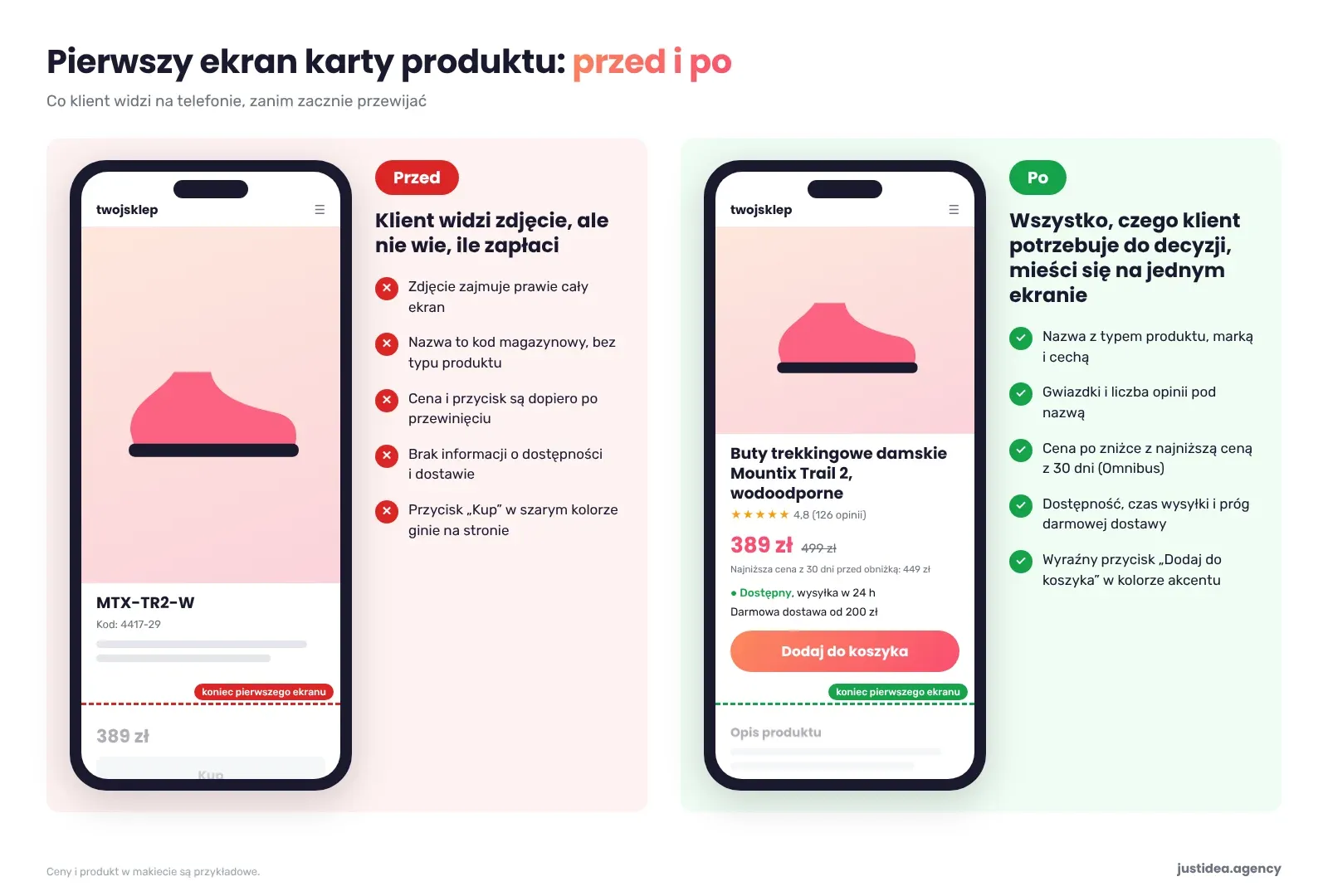
The product price, availability information, delivery cost and time, and the "Add to cart" button should be visible without scrolling. A shopper who has to look for the shipping cost often finds out about it only in the cart and abandons the purchase. That's an abandoned cart that one sentence next to the price could have prevented. If you can offer free delivery above a certain amount, say so next to the price.
Next to the price, also show why it's worth buying from you. It might be same-day shipping, free returns within 30 days, or a conversation with an advisor before purchase. Such a differentiator, or USP, often decides the choice of store when the same product costs about the same in several places.
When you offer a discount, remember the Omnibus directive (an EU consumer protection rule). Next to the reduced price, you must show the lowest price from the 30 days before the reduction, and the obligation also applies to online sales (UOKiK, the Polish consumer protection authority). Make the CTA (call to action) button stand out with a color that doesn't appear in other elements of the page, and name the action directly. "Add to cart" tells the customer what will happen after the click, and "See more" doesn't.
8. Customer Reviews and Ratings
Reviews and ratings show that others bought this product and are happy with it. This is social proof, which often decides the purchase, especially in a store that is new to the customer. At the same time, reviews are user-generated content: every new review adds to the page the words customers use to describe the product, and questions the description's author didn't anticipate.
Since January 1, 2023, a store that publishes reviews must say whether and how it checks that they come from people who bought the product (UOKiK). Collect reviews automatically, for example by email a few days after delivery, and don't delete negative ones. A factual reply to criticism builds more trust than five-star ratings alone.
9. Product Structured Data
Structured data describes the product in a language the search engine understands: name, price, currency, availability, ratings, and, for sales offers, also shipping costs and return policies. Thanks to it, Google can show the price and stars next to the result. For pages where the product can be bought, Google recommends the merchant listings format, and for products in several colors or sizes, the ProductGroup type.
AI models use the same data too, as we write in the article on schema.org and visibility in AI models. You'll find a list of types worth starting with in the roundup of the 10 most popular structured data types for SEO. After implementation, check the code in the Rich Results Test tool and make sure the price in the data matches the price on the page.
10. Internal Linking and Related Products
A product page can't be a dead end. Breadcrumbs show the shopper and Google's robots where the product sits in the category tree. The "Buy as a bundle" and "Customers also viewed" sections lead to more products, and a link to a blog guide helps those who don't yet know what to choose.
Choose related products so that they complement the purchase rather than compete with it: a sleeping bag and a sleeping pad for a tent, not three other tents. Well-chosen cross-selling raises the average order value, and every link strengthens other product pages in Google's eyes. We described the rules for distributing links in the article on internal linking.
Variants, Out-of-Stock Products, and Speed: Technical Pitfalls of Product Pages
Even a perfect product page will lose visibility if the store generates several copies of it. This most often happens with variants. If a T-shirt in five colors has five URLs with the same description, specify one canonical URL and mark the variants in structured data. Leave a separate page only for a variant that people search for on its own, for example "iPhone 17 Pro 1 TB".
A temporarily unavailable product shouldn't disappear from the store. Keep the page, mark the product as out of stock, give the expected delivery date, and show alternatives. When a product is permanently discontinued, redirect the URL (301) to its successor or to the category, and if there is no sensible replacement, return a 410 code.
The last pitfall is speed. A product page loads a gallery, reviews, recommendations, and marketing scripts, so it's easy to exceed the Core Web Vitals thresholds Google uses to assess user experience. On phones, LCP most often fails. It is the load time of the largest element on the page, usually the main product photo. Only 62% of pages get a good result (Web Almanac 2025). The second metric worth checking on pages with many scripts is INP, the response time to a click. The shopper doesn't wait for the gallery to finish loading and goes back to the results. Our guide on page loading speed suggests what to fix first.
How Do You Check Whether Your Product Page Works?
Pick the 10 products with the most traffic in Google Search Console and go through each of them with this list:
- the product name in the H1 includes the product type, brand, and model,
- the meta title is up to 60 characters, and the meta description includes a benefit and a CTA,
- the URL is short and contains no parameters,
- the description is unique, doesn't come from the manufacturer, and answers customer questions,
- the specifications are in a table and include the manufacturer data required by GPSR,
- every photo has a descriptive alt and is compressed,
- the price, availability, delivery cost, and "Add to cart" button are visible without scrolling on a phone,
- with a discount, the lowest price from the last 30 days is shown,
- reviews include information on how they are verified,
- structured data passes the Rich Results Test without errors,
- the page has breadcrumbs and links to related products.
If a page fails three or more points, start with it. Make changes in batches and compare clicks and conversion rate after 4-6 weeks, so you know what actually helped. You'll find more ways to improve sales in the article on how to increase conversion in an online store.
FAQ
Can I generate product descriptions with AI?
Yes, Google evaluates the quality of content, not how it was produced (Google guidelines). Give the model real data about the product and check every description before publishing, because AI can add specifications the product doesn't have.
Can I use the same description in my store and on Allegro?
Better not to. The same text in two places is duplicate content, and Google will show only one version, not necessarily the one from your store. Keep the full description in your store, and on the marketplace (Allegro is Poland's largest) use a shorter version written from scratch.
Does an FAQ section on a product page help SEO?
Yes, if it answers real customer questions, for example about sizing, warranty, or compatibility. Short answers are easy to cite in AI results, and the shopper doesn't have to write to support. We described how to prepare such a section in the article on the role of FAQ in SEO and AI.
How do I do SEO for an online store when the product pages are already done?
Product pages are the foundation, but a store's visibility is also affected by categories, technical SEO, and links from other sites. If you want to hand this over to specialists, check out our SEO for online stores.
Your Product Page Is Your Best Salesperson: Start With Three Changes
You don't have to rebuild your whole store to see results. Start with unique descriptions, delivery visible next to the price, and structured data on your most popular products.
If you don't know which pages to start with, order an online store SEO audit. We'll check your store's product pages and show which changes will bring the most traffic and sales.